Best Cybersecurity Schools in South Carolina
Compare 16 accredited Cybersecurity programs in South Carolina at 15 colleges, with net price after aid, graduation rates, earnings and debt from IPEDS and the U.S. College Scorecard.

For a bachelor's degree in cybersecurity, the South Carolina options run from campus programs to online study through an SC-based school. Degree structure matters as much as reputation. Most schools title the degree Bachelor of Science (B.S.) in Cybersecurity, a four-year program at Winthrop University and Bob Jones University, among others.
Not every option carries that title. Citadel Military College of South Carolina offers cybersecurity as a concentration within computer science, and Voorhees University combines the two fields in one degree.
Employers hiring entry-level security analysts tend to weigh networking skills and certifications such as CompTIA Security+ alongside the name on the diploma.
Key Points
- Winthrop, Anderson, and Bob Jones award a dedicated B.S. in Cybersecurity.
- The Citadel teaches cybersecurity as a concentration within computer science.
- Rankings weigh 2024 net price after aid against graduate earnings.
Ranking 10 South Carolina Schools Offering a Bachelor's Degree in Cybersecurity
Ten South Carolina colleges and universities offer an enrollable bachelor's degree with a real cybersecurity core, and they differ sharply in structure. Some award a dedicated Bachelor of Science in Cybersecurity; others fold the security coursework into a computer science or information science major with a named track. The list below follows our overall ranking and mixes campus, hybrid and fully online routes.
University of South Carolina
#1Columbia, SC · ~$23,000/yr (est.)
Best for: Future security analysts wanting industry-designed coursework
South Carolina's flagship public university in Columbia and the largest cybersecurity option on this list by enrollment and resources. Cybersecurity sits inside the Information Science major as one of five specialization tracks, so students graduate with a broad information science degree plus a security focus. The track leans on a virtual cyber range, industry mentorship, and coursework mapped to NIST risk frameworks and Department of Defense certification requirements.
- Cyber Security is one of five specialization tracks in the Information Science major
- Hosted by the College of Information and Communications in Columbia
- Students practice in a virtual cyber range with industry mentorship
- Track built with industry experts and aligned to NIST risk frameworks
- Coursework meets DoD Cybersecurity Maturity Model Certification requirements
- Includes Cloud Computing, Purple Teaming and Threat and Incident Response
- Prepares students for security analyst, penetration tester and security engineer roles
Southern Wesleyan University
#2Central, SC · $15,000/yr (est. net price)
Best for: Working adults seeking fully online computer science
A private Christian university in Central, within commuting distance of Clemson, that has moved much of its computing study online. Its computer science major carries a cybersecurity concentration and can be completed fully online through the Rize Education consortium, with Southern Wesleyan awarding the credit. That makes it one of the few South Carolina based routes to security coursework that does not require relocating.
- Cybersecurity is one of three concentration options in the computer science major
- Fully online option delivered through the Rize Education consortium
- Credit is awarded by Southern Wesleyan University
- Concentration covers network security, cryptography, and attack defense and recovery
- Core coursework in programming, systems and software development
- Consortium courses are reviewed and approved by Southern Wesleyan faculty
Anderson University
#3Anderson, SC · ~$24,000/yr (est.)
Best for: Hands-on learners preferring a dedicated cybersecurity major
A private university in Anderson with one of the state's few dedicated cybersecurity majors, plus a second option that pairs the technical core with criminal justice. Students move through a 123-credit, eight-semester plan that includes forensics, ethical hacking, cloud security and a certification preparation course. The Center for Cybersecurity anchors the hands-on lab work.
- 123-credit-hour degree with a 37-credit cybersecurity major core
- Includes network security, digital forensics, ethical hacking and cloud security
- 15 credit hours of cognates plus business or computing electives
- Eight-semester sequence with fall and spring start dates
- Built around hands-on exercises and risk management coursework
- A dedicated certification preparation course is part of the major
- Pairs cybersecurity coursework with criminal law and investigations
- 123 total credit hours over eight semesters on the main campus
- Covers digital forensics, ethical hacking, cryptography and risk management
- Prepares students for cyber crime investigator and digital forensics roles
- Program sits within the university's Center for Cybersecurity
- Rolling admission with fall and spring entry points
Coker University
#4Hartsville, SC · $20,000/yr (est. net price)
A small private university in Hartsville that frames cybersecurity as a business problem rather than a purely technical one. The curriculum covers policy, risk, network configuration and ethical hacking, with some courses delivered online through a Rize Education partnership. Small classes and faculty mentoring are the selling points here.
- Business-oriented cybersecurity degree blending technical and management skills
- Covers risk identification, security policy, network configuration and ethical hacking
- Select courses delivered online through a Rize Education partnership
- Small classes with dedicated faculty mentors
- Designed to pair with computer science or business administration study
Benedict College
#5Columbia, SC · ~$18,000/yr (est.)
A historically Black college in Columbia that approaches cybersecurity through criminal justice and social science. Its Bachelor of Arts in Cybersecurity blends technical coursework with legal and investigative training, which suits students aiming at forensics and threat intelligence work. The program sits in the Criminal Justice Administration and Social Sciences Department.
- Interdisciplinary degree combining computer science, criminal justice and security policy
- Housed in the Criminal Justice Administration and Social Sciences Department
- Coursework in network technology, risk analysis, cryptography and cyber crime
- Trains students in digital investigation skills and legal reasoning
- Prepares graduates for computer forensics investigator and cyber threat intelligence roles
Citadel Military College of South Carolina
#6Charleston, SC · $13,000 – $39,000/yr (est.)
A state military college in Charleston where the cybersecurity concentration runs inside the computer science major, alongside the Corps of Cadets leadership and ROTC requirements. Students take networks, computer security and advanced cybersecurity, then finish with a senior research project. The college is also a convening site for statewide cyber-sector planning among schools, districts and employers.
- Cybersecurity concentration inside the computer science major
- 124 credit hours plus leadership, ROTC and physical education requirements
- Coursework in computer networks, computer security and advanced cybersecurity
- Senior research project caps the concentration
- ROTC requirements apply to South Carolina Corps of Cadets members only
- Prepares students for security analyst, penetration tester and incident responder roles
- An academic map lays out the eight-semester course sequence
Bob Jones University
#7Greenville, SC · ~$17,000/yr (est.)
A private Christian university in Greenville with a campus-based cybersecurity major. The program emphasizes programming in Python and Java, penetration testing, applied cryptography and hands-on competition work such as capture-the-flag. Internships and lab assistantships give students work experience before graduation.
- Campus-based program covering Python and Java programming
- Includes penetration testing, applied cryptography and computer security
- Internship and lab assistantship opportunities
- Students compete in capture-the-flag and intercollegiate programming contests
- Coursework also covers digital forensics and network management
- Faculty bring industry experience to the classroom
Winthrop University
#8Rock Hill, SC · $15,000/yr (est. net price)
A public university in Rock Hill with a standalone Bachelor of Science in Cybersecurity built on a computer science foundation. Seven dedicated security courses cover forensics, cloud computing, enterprise security and ethical hacking, taught in classes of 12 to 30 students. Computing clubs, hack-a-thons and regional programming contests add practice outside class.
- Seven-course cybersecurity core on top of a computer science foundation
- Core covers cyber forensics, cloud computing, enterprise security and ethical hacking
- Classes of 12 to 30 students with award-winning teaching faculty
- Prerequisite sequence includes Programming 1 and 2, architecture, databases and networks
- Students join ACM and STARS computing clubs and local hack-a-thons
- Three required math courses plus the university general education program
Claflin University
#9Orangeburg, SC · ~$18,000/yr (est.)
A historically Black university in Orangeburg that lists cybersecurity as a Bachelor of Science in the School of Natural Sciences and Mathematics. The university publishes the degree among its 44 undergraduate programs, with requirements and course descriptions set in the 2026-2027 undergraduate catalog. Students pair the security coursework with a science and mathematics grounding.
- Listed as a Bachelor of Science program in the School of Natural Sciences and Mathematics
- One of 44 undergraduate programs the university reports for 2026-2027
- The 2026-2027 undergraduate catalog is the official source for requirements
- Program requirements, outcomes and course descriptions are set by that catalog
Voorhees University
#10Denmark, SC · $10,000 – $15,000/yr (est.)
A small historically Black university in Denmark offering a combined computer science and cyber security degree. The 121-credit program pairs programming, mathematics and physics with core computing and security courses, and faculty bring expertise in artificial intelligence and cybersecurity. It is built for students heading into industry, government or graduate study.
- 121 credit hours combining computer science fundamentals and cybersecurity
- Strong mathematics component alongside physics and programming
- Faculty expertise in artificial intelligence and cybersecurity
- Prepares students for graduate study or for industry and government roles
- Career paths include security analyst, network administrator and systems engineer
Cost & outcomes by school
Federal data for the highest-earning Cybersecurity programs, independent of the ranking above. Earnings are this field's bachelor's graduates four years after completing where the Scorecard reports them, else the school's undergraduate median.
| School | Net price / yr | Grad rate | Earnings | Debt | Grads/yr | Format |
|---|---|---|---|---|---|---|
| Citadel Military College of South Carolina SC | $20,723 | 75% | $72,085 | $21,096 | — | Campus |
| University of South Carolina SC | $22,811 | 79% | $62,177 | $21,500 | 16 | Campus |
| Newberry College SC | $21,656 | 45% | $48,040 | $26,805 | — | Hybrid |
| Southern Wesleyan University SC | $15,464 | 52% | $47,756 | $26,000 | 3 | Online |
| Winthrop University SC | $15,343 | 57% | $47,185 | $26,975 | — | Campus |
| Charleston Southern University SC | $21,666 | 47% | $45,898 | $26,471 | 4 | Campus |
| Bob Jones University SC | $16,641 | 65% | $44,354 | $16,585 | — | Campus |
| Anderson University SC | $23,544 | 66% | $42,101 | $26,700 | — | Campus |
| Columbia College SC | $18,408 | 37% | $41,338 | $22,750 | — | Online or campus |
| Claflin University SC | $17,800 | 52% | $40,304 | $29,000 | — | Campus |
| Coker University SC | $20,286 | 40% | $40,117 | $26,000 | 1 | Campus |
| South Carolina State University SC | $18,097 | 37% | $38,262 | $31,000 | — | Campus |
Sources: U.S. Department of Education. Net price, graduation rate, earnings and debt: College Scorecard (earnings and debt for this field's bachelor's graduates where reported, else school-wide); graduates: IPEDS. A dash means no figure is reported.
Cost, debt & payoff
Median earnings of this field's bachelor's graduates (4 yrs after completing, else the school's undergraduate median) vs. their median federal loan debt · U.S. College Scorecard
Across these programs the median graduate earns about $42,101 and finishes with roughly $26,700 in debt — a ratio that clears a common rule of thumb (keep debt below first-year salary). Net price and debt vary widely school to school, so check the per-school figures in the table above before you shortlist.
Most Affordable Ranking 10 South Carolina Schools Offering a Bachelor's Degree in Cybersecurity
These are the lowest-cost options among the schools ranked here, ordered by average annual net price, which is what families typically pay after grants and scholarships, based on 2024 IPEDS and College Scorecard data from the U.S. Department of Education. Published tuition can mislead: Southern Wesleyan University lists the highest sticker price in this group but lands near the middle once aid is applied. Compare net price first, then check the format against your schedule.
| School | City | Average Net Price (per year) | Published Tuition and Fees (in-state) | Program Format |
|---|---|---|---|---|
| Voorhees University | Denmark | $13,335 | $12,630 | On campus |
| Winthrop University | Rock Hill | $15,343 | $14,678 | On campus |
| Southern Wesleyan University | Central | $15,464 | $29,800 | Online |
| Bob Jones University | Greenville | $16,641 | $24,470 | On campus |
| Claflin University | Orangeburg | $17,800 | $18,282 | On campus |
What Put These Programs in Order
The ranking weighs what a student pays against what the data shows after graduation, and it counts bachelor's programs only. Four inputs drive it, and each one is easy to check yourself.
- Net price after aid: The average cost once grants and scholarships are subtracted, which tells you more than published tuition.
- Program completions: How many students finish the degree each year. Steady completions point to an established program, while low counts often mean a newer one.
- Delivery format: Whether the degree is offered on campus, online, or both.
- Published outcomes: Earnings and similar results, used only where a school reports them. Nothing is estimated to fill a gap.
Scope: Bachelor's Degrees Only
Only bachelor's programs at South Carolina-based schools are ranked. Certificates, associate degrees and graduate study are not mixed in, so every comparison is between four-year undergraduate paths. Some schools offer a dedicated cybersecurity major, while others, such as Citadel Military College of South Carolina, place it as a concentration inside computer science.
Read the Averages Carefully
Graduation rate and net price are institution-wide averages. They describe a school's whole undergraduate body, not the cybersecurity majors alone. A school with a strong overall graduation rate may still have a small or brand-new cybersecurity cohort, and the reverse can also be true.
Use these figures to narrow your options, then ask each department about cohort size, course sequence and what its recent graduates are doing.
Dedicated B.S. vs. Track, Newer vs. Established: How to Choose
A stand-alone cybersecurity degree and a cybersecurity track inside computer science can lead to the same jobs, but they ask different things of you.
Stand-Alone Degree or Track
A stand-alone B.S. in Cybersecurity builds the whole curriculum around defense, forensics, and risk. Anderson University, Coker University, Bob Jones University, Winthrop University, and Claflin University fall in this camp, and Benedict College offers a stand-alone cybersecurity degree blended with criminal justice.
A track or concentration sits inside a broader computer science or information science major. The University of South Carolina offers cybersecurity as a specialization track within information science. Citadel Military College of South Carolina and Southern Wesleyan University attach a cybersecurity concentration to a computer science degree, and Voorhees University pairs computer science with cyber security. A track gives you a wider programming foundation and easier pivots to software roles. A stand-alone degree usually goes deeper on security topics.
Newer vs. Established Programs
Some cybersecurity bachelor's programs in South Carolina are recent additions. Launch dates and enrollment status for those programs could not be confirmed, so ask each admissions office directly. Newer programs often mean smaller cohorts, a still-forming course catalog, and few graduates to point to. Established programs can show you where alumni actually work.
What CAE-CD Designation Means
The National Security Agency runs the Centers of Academic Excellence program, with designations in Cyber Defense (CAE-CD) and Cyber Operations (CAE-CO).1 A designation lasts five academic years, and schools must reapply to keep it.2 NSA's overview counts three current CAE institutions in South Carolina but does not name them in the material we reviewed.2 We therefore could not confirm designation for any school discussed here. Verify on NSA's official institution list before you rely on it.
Three Checks Before You Commit
- CAE status: Look up the school on NSA's list and confirm the designation is current, not lapsed.
- Certification prep: Anderson lists a certification preparation course in its curriculum. Ask other schools which industry exams their courses map to.
- Internships and employer ties: Bob Jones lists internship opportunities, and USC lists industry mentorship. Coker and Southern Wesleyan use courses developed with Rize Education. Ask for named employers, not general promises.
Online, Hybrid, and On-Campus Cybersecurity Bachelor's Options at SC Schools
Online delivery has become a normal part of cybersecurity education, but in South Carolina the campus still dominates. Sort the schools by the format each one lists, and the imbalance is immediately clear.
Campus-Based Programs
The University of South Carolina, Anderson University, Coker University, Benedict College, Citadel Military College of South Carolina, Bob Jones University, Winthrop University, Claflin University, and Voorhees University are all listed as campus programs. Some of these pages describe the structure (Anderson and Citadel publish eight-semester sequences, for example), but none states whether evening, part-time, or hybrid sections exist. Ask each admissions office directly.
Online Option at an SC-Based School
Southern Wesleyan University is the school here with an online listing. Its program is a Computer Science (BS) with a cybersecurity concentration, offered fully online through the Rize Education consortium. Credit is awarded by Southern Wesleyan, though some courses are taught by partner institution faculty. We could not confirm residency requirements, start terms, or part-time and degree-completion routes, so verify those before applying.
The University of South Carolina system also runs a separate online completion route, a B.S. in Applied Computer Science with a cybersecurity concentration. It requires 120 credits and is aimed at students who already hold 45 or more college credits. Transfer guidance mentions 45 to 60 credits from a regionally accredited school and a preferred 2.0 GPA, with new terms starting six times a year. Treat these details as a starting point and confirm them with the program. Its page does not formally state whether part-time enrollment is allowed. That route is separate from the Columbia campus program listed above, which is campus-based.
Who Each Format Fits
- Working adults: An online program such as Southern Wesleyan's offers the most scheduling control, once you confirm pacing and term dates.
- Technical college transfers: A completion route built around 45+ transferred credits can save time, so ask how your associate coursework will apply.
- Military-connected students: Online study suits those who relocate often. Citadel is a campus experience, and its ROTC requirements apply only to cadet members.
- Traditional first-year students: The campus programs offer labs, clubs, and in-person internships and contests.
Getting in: GPA, Test Policy, and Transfer Credit at SC Schools
When you compare these programs, two questions matter most: do I need an SAT or ACT score, and will my associate-degree credits count? The answer depends on the school, and the policy can change from one admissions cycle to the next. Knowing what to ask, and which page answers it, is most of the work.
What Each School's Admissions Page Should Tell You
For the University of South Carolina, Southern Wesleyan University, Anderson University, Coker University, Benedict College, Citadel Military College of South Carolina, Bob Jones University, Winthrop University, Claflin University, and Voorhees University, check three items on the undergraduate admissions page before you apply:
- Minimum or typical GPA: Some schools publish a floor, others publish the average GPA of admitted students, and some publish neither.
- Test policy: Look for the words test-optional, test-required, or test-flexible, and check whether the policy differs for scholarships or for specific majors.
- Transfer credit policy: Look for a credit cap, a minimum grade for transferred courses, and any stated pathway from an associate degree.1
Where a school's page does not state a figure or policy, treat it as unpublished. Do not assume it is waived. Email the admissions office and ask for the answer in writing.
Transfer Credit and Associate-Degree Pathways
Students who start at a two-year college often have the most to gain from reading transfer rules closely. A formal articulation agreement, meaning a written pathway between a specific associate program and a specific bachelor's program, is stronger than a general promise that credits will be reviewed.2 Treat a pathway as real only if the school's own page describes it. Otherwise, assume credits will be evaluated course by course.
Three questions to ask any admissions office:
- Which of my completed courses count toward the cybersecurity major, and which count only as general electives?
- Is there a minimum GPA or grade requirement for transfer admission?
- Will I enter with junior standing, or will some lower-level requirements remain?
Takeaways
- Verify the test policy directly with each school. It is the item most likely to change from year to year.
- A published GPA floor is a minimum for admission, not a guarantee. Competitive programs and scholarships often expect more.
- Transfer students should request a credit evaluation before committing, since a cybersecurity major usually builds on prerequisite math and computing courses.
- Gather this information early, because deadlines for admission, aid, and scholarships often fall well before classes begin.
Related Articles
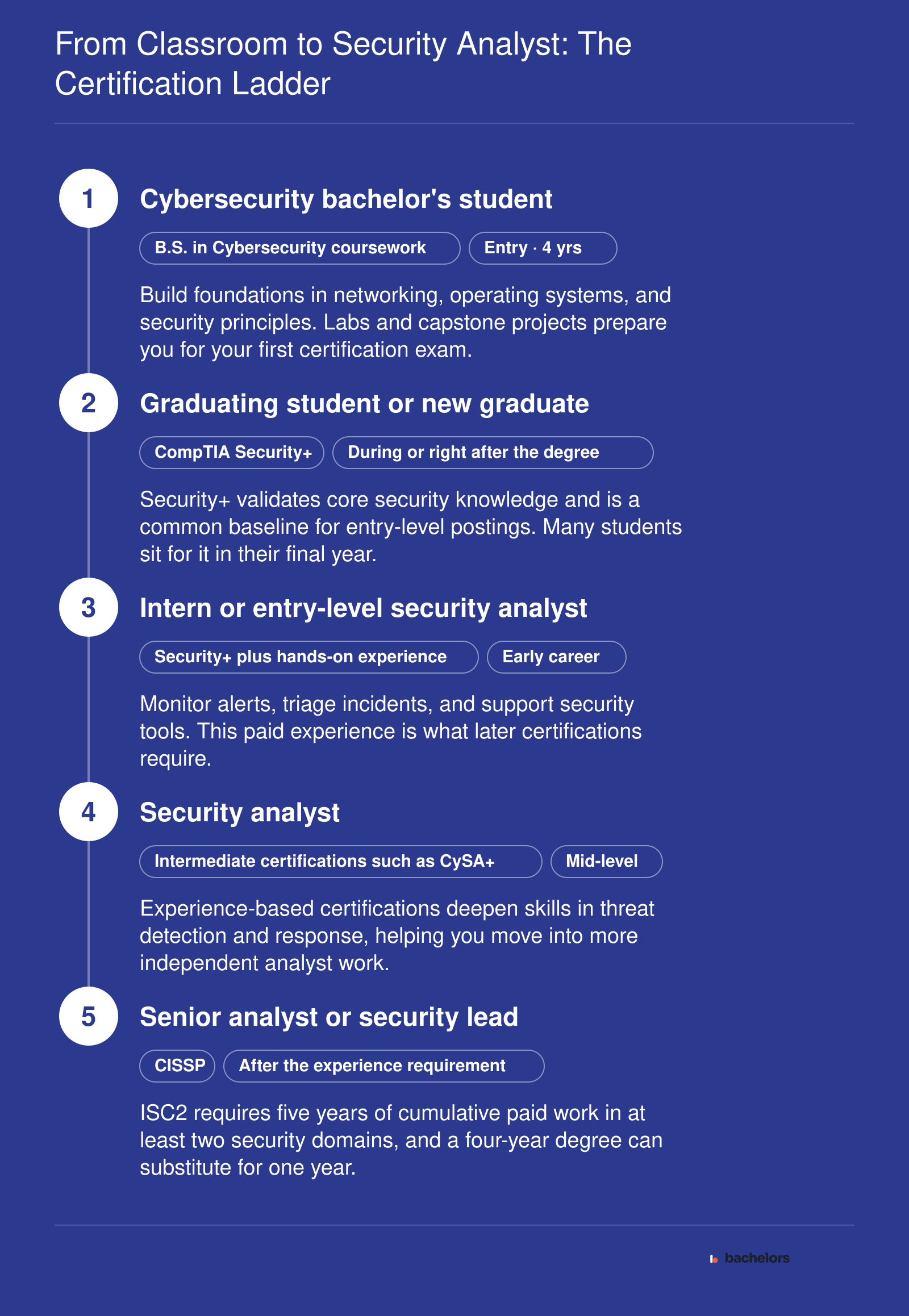
From Classroom to Security Analyst: The Certification Ladder
A bachelor's degree in cybersecurity opens the door, but certifications mark each step up. Most graduates follow a similar ladder, pairing coursework with an entry-level credential and then adding experience-based certifications as their careers grow.
Common Questions About Cybersecurity Bachelor's Programs in South Carolina
These answers draw on the program, cost, and career findings covered above. Check each school's program page for current details before you apply.
What is the best cybersecurity school in South Carolina?
Which South Carolina schools offer a bachelor's degree in cybersecurity?
How much does a cybersecurity degree cost in South Carolina?
Can you earn a cybersecurity bachelor's degree online from a South Carolina school?
How much do cybersecurity graduates earn in South Carolina?
Does South Carolina require a license to work in cybersecurity?
Should you earn Security+ before you graduate?
Can technical college credits count toward a cybersecurity bachelor's in SC?
Compare Cybersecurity programs on the data that matters
Explore more Computers & IT majors or browse every field of study.
All Computers & IT programs Browse every field of study