Best Communications Degree Programs in South Dakota
Compare 3 accredited Communications programs in South Dakota, with net price after aid, graduation rates, earnings and debt from IPEDS and the U.S. College Scorecard.

South Dakota State University charges out-of-state students about $3,510 more per year in tuition and fees than residents, a gap that shapes where a bachelor's degree in communications makes financial sense.
The degree is usually a Bachelor of Arts (B.A.) in Communications, built on writing, media law, and rhetoric rather than a single trade. Augustana University, South Dakota State University, and the University of South Dakota each run Communication Studies programs, and each prices and structures the degree differently. Employers hiring in Sioux Falls and Brookings tend to read portfolios before transcripts.
Key Points
- South Dakota State University offers Communication Studies as a B.A. or B.S.
- Augustana charges a flat $40,160; public schools add about $3,510 for nonresidents.
- Communications is not a state-licensed profession in South Dakota.
Best Bachelor's Degree in Communications Programs in South Dakota, Ranked
This list covers only the South Dakota schools whose bachelor's programs in communications carry ranked program records in our data, so it is a short, focused list rather than a full catalog of every four-year college in the state. All three programs are campus based, and each entry gives the school-wide graduation rate, net price after aid, and program-level earnings and debt where those are reported.
Augustana University
#1Sioux Falls, SD · $20,000 – $25,000/yr (est.)
Best for: Internship-focused PR and media students
Augustana University is a private liberal arts institution in Sioux Falls, and its communication studies major sits in the Department of Communication & Media Studies within the College of Arts & Sciences. The curriculum starts with interpersonal communication and persuasion, then uses electives to tailor the degree, and it works well as a second major alongside business, economics, English, government or journalism. Students intern with organizations such as Make-A-Wish Foundation, Downtown Sioux Falls, Lawrence & Schiller and KELO News, with study-away options in Norway, London and Ireland. School-wide, about 73% of students graduate and net price after aid is $23,894.
- Internships at Make-A-Wish Foundation and KELO News
- Study away in Norway for public relations and strategic communication
- Additional study-away options in London and Ireland
- Can be combined as a second major with business or English
- Curriculum covers interpersonal communication and persuasion
- Student organizations include PRSSA
- Graduates work as PR directors and media producers
South Dakota State University
#2Brookings, SD · $15,000 – $20,000/yr (est.)
Best for: Students planning a communication education pathway
South Dakota State University is the state's largest public research university, based in Brookings, and it offers communication studies as either a Bachelor of Arts or a Bachelor of Science. The 120-credit degree carries 41 credits in the major plus a capstone, 33 upper-division credits and a declared minor outside the major. Electives include health communication, business and professional communication, interviewing, internship and independent study, and all classes meet at the Brookings Main Campus. The school-wide graduation rate is about 62% and net price after aid is $19,841; program graduates reported median earnings of $39,173 one year after completion and $55,345 four years out, with median debt of $25,500.
- 120 total credit hours, 41 in the major
- Capstone required for graduation
- Declared minor outside the major required
- 33 upper-division credits required
- 12 credits of CMST electives
- Electives include health and business communication
- Minimum grade of C in all major courses
- Internship and independent study credits available
University of South Dakota
#3Vermillion, SD · ~$20,000/yr (est.)
Best for: Students seeking faculty research collaboration
The University of South Dakota in Vermillion runs communication studies through a dedicated Department of Communication Studies in the College of Arts & Sciences. Coursework examines how people share meaning through verbal and nonverbal messages, with subfields such as health communication and persuasion, and the department stresses faculty mentorship, undergraduate research collaboration and the Lambda Pi Eta honor society. Graduates move into government, education, sales, marketing, media and nonprofit roles. About 60% of students graduate school-wide and net price after aid is $19,858; program graduates reported median earnings of $35,792 one year after completion and $52,100 four years out, with median debt of about $26,000.
- Internship opportunities available
- Faculty-student research collaboration
- One-on-one mentorship and alumni connections
- Lambda Pi Eta honorary fraternity
- Coursework spans health communication and persuasion
- Career paths in government, education, sales and media
Cost & outcomes by school
Federal data for the highest-earning Communications programs, independent of the ranking above. Earnings are this field's bachelor's graduates four years after completing where the Scorecard reports them, else the school's undergraduate median.
| School | Net price / yr | Grad rate | Earnings | Debt | Grads/yr | Format |
|---|---|---|---|---|---|---|
| Augustana University SD | $23,894 | 73% | $59,217 | $25,000 | 5 | Campus |
| South Dakota State University SD | $19,841 | 62% | $55,345 | $25,500 | 22 | Campus |
| University of South Dakota SD | $19,858 | 60% | $52,100 | $23,625 | 31 | Campus |
Sources: U.S. Department of Education. Net price, graduation rate, earnings and debt: College Scorecard (earnings and debt for this field's bachelor's graduates where reported, else school-wide); graduates: IPEDS. A dash means no figure is reported.
Cost, debt & payoff
Median earnings of this field's bachelor's graduates (4 yrs after completing, else the school's undergraduate median) vs. their median federal loan debt · U.S. College Scorecard
Across these programs the median graduate earns about $55,345 and finishes with roughly $25,000 in debt — a ratio that clears a common rule of thumb (keep debt below first-year salary). Net price and debt vary widely school to school, so check the per-school figures in the table above before you shortlist.
How We Ranked South Dakota Communications Programs
Two communications programs can look identical on a brochure page and still deliver very different outcomes. This ranking leans on what graduates actually paid and earned, not on marketing copy. Every figure comes from federal College Scorecard data, compiled independently here at bachelorsprograms.com.
- Net price: The average yearly cost students actually pay after grant and scholarship aid, not the published sticker tuition.
- Earnings and debt: Median earnings of graduates a few years out, plus typical federal loan debt at completion. Program-level figures are used where the Scorecard reports them.
- Completions: How many students complete the program in a given year, a measure of program size rather than of how many students stick with it.
What the Numbers Cannot Tell You
Net price and graduation rate are institution-wide averages, not program-specific. They describe the school a communications major attends, not the major itself. Read them as context, then weigh what no dataset captures: faculty access, internship pipelines around Sioux Falls and Brookings, and whether the format fits your schedule.
Communications Bachelor's Options: B.A. vs. B.S. and Specializations
Is a B.A. or a B.S. in communications the better choice? For most students, the answer depends on the coursework you want. Employers rarely weigh the letters themselves. A Bachelor of Arts tends to lean toward the liberal arts, with more writing, humanities and often a language component. A Bachelor of Science usually adds research methods, statistics and applied or social-science work. If you enjoy data and audience research, the B.S. is a natural fit. If you want breadth in writing, theory and culture, choose the B.A.
How South Dakota Programs Award Each Credential
At SDSU and USD, you can pick either credential within the same major.
- South Dakota State University: Communication Studies, Journalism and Public Relations each lead to a B.A. or B.S. Communication Studies and Journalism require 120 credits. Journalism students choose Broadcast Journalism or News-Editorial Journalism and must complete an internship.
- University of South Dakota: Communication Studies and Media & Journalism both award a B.A. or B.S. USD frames the B.A. as humanistic and the B.S. as social-scientific and research-based. Media & Journalism students pick Journalism or Strategic Communication, the track built for advertising and public relations careers, with coursework in brand building and event planning.
- Augustana University: Augustana offers Communication Studies in Sioux Falls. Its credential title and active emphasis areas could not be verified for 2026, so confirm both in the university's current catalog before you apply.
Distinctly South Dakota Pathways
Agriculture shapes the state's economy, and SDSU answers with a B.S. in Agricultural Education, Communication and Leadership that includes a Communication Specialization. It is a separate major, not a track inside Communication Studies, and it suits students who want to tell the stories of farming, ranching and agribusiness.
If you plan to teach, SDSU and USD each offer a route into the classroom. SDSU's Communication Studies major includes a Communication Education Specialization, and USD offers Communication Studies with Secondary Education Certification. Teaching licensure details appear in the accreditation and licensure section of this page.
Accreditation and Teaching Licensure for South Dakota Communications Programs
Communications is not a state-licensed profession in South Dakota, so accreditation matters most if you plan to work in journalism or transfer credits between schools. ACEJMC accreditation is program-specific: it covers a named journalism or mass communications unit and its submitted degrees, reviewed every six years, so a Communication Studies major may fall outside that review. Graduates who want to teach communication in public secondary schools need a license from the South Dakota Department of Education, and because its 2026 endorsement requirements were not confirmed for this page, check with the department and the school's teacher education office before you choose a major.
| School | Institutional Accreditation (HLC) | Programmatic Accreditation (ACEJMC/Other) | Teaching Licensure Pathway |
|---|---|---|---|
| Augustana University | Not verified | Not accredited by ACEJMC | Not verified; licensure is issued by the South Dakota Department of Education |
| South Dakota State University | Not verified | ACEJMC: School of Communication and Journalism (Journalism, Advertising, Public Relations; reaccredited 2025) | Not verified; licensure is issued by the South Dakota Department of Education |
| University of South Dakota | Not verified | ACEJMC: Department of Media & Journalism (Media & Journalism; reaccredited 2022) | Not verified; licensure is issued by the South Dakota Department of Education |
Online and Hybrid Communications Bachelor's Options at South Dakota Schools
An online communications bachelor's degree means you finish most or all of your coursework remotely; a hybrid program blends online classes with periodic on-campus sessions. At the South Dakota schools on this page, the published format for each Communication Studies program is campus-based, and no fully online bachelor's completion route is currently described in their program pages.
What Each School Publishes
- Augustana University (Sioux Falls): Communication Studies, listed as a campus program.
- South Dakota State University (Brookings): Communication Studies B.A./B.S., a Brookings Main Campus program at 120 credits; the Journalism B.A./B.S. is also listed as campus-based in Brookings.
- University of South Dakota (Vermillion): Communication Studies, listed as a campus program.
SDSU's School of Communication and Journalism does run an online program, but it is a graduate mass communication offering, not an undergraduate completion degree. If you need to study entirely at a distance, ask each admissions office whether a completion track exists and how transfer credit would apply before you commit.
What Campus Attendance Buys You
Format matters less than access. Augustana places interns at sites such as KELO News and the Make-A-Wish Foundation and hosts a PRSSA chapter. SDSU builds internship and independent study credits into the major, and USD advertises internship opportunities plus a chapter of the Lambda Pi Eta honor society. Student media, faculty references and local newsroom contacts are simply easier to reach in person.
Tuition Differences
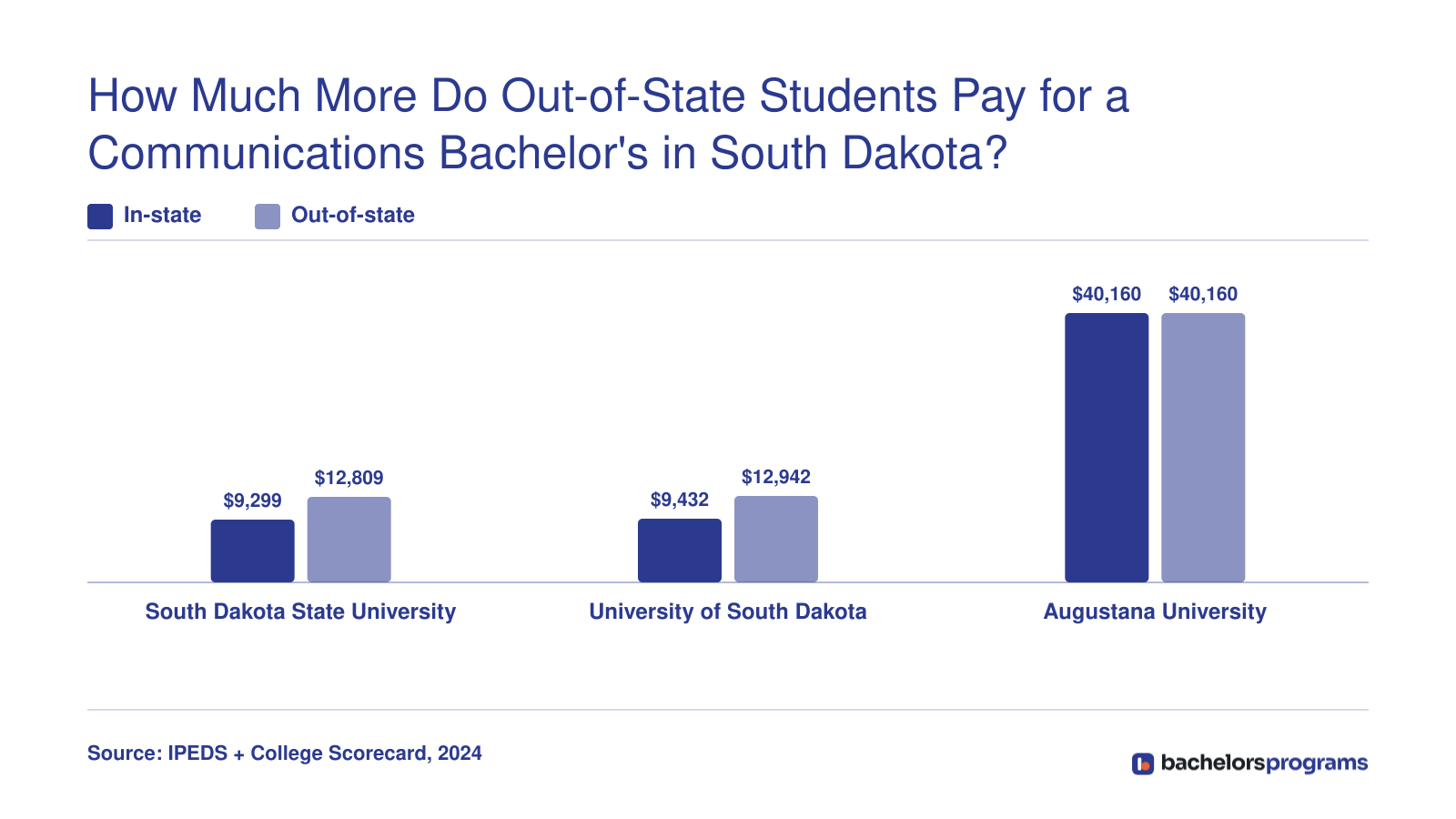
In-state tuition runs $9,299 at SDSU and $9,432 at USD, against out-of-state rates of $12,809 and $12,942. Augustana charges $40,160 regardless of residency. Online rates are typically set separately from campus rates, so confirm the exact figure with the school.
Related Articles
Cost of a Communications Bachelor's Degree in South Dakota
Published tuition and the amount a student actually pays can be thousands of dollars apart in South Dakota, and that gap often decides which communications program is affordable.
Sticker Price, Then Net Price
Published tuition and fees run $9,299 a year in state and $12,809 out of state at South Dakota State University, and $9,432 and $12,942 at the University of South Dakota. Augustana University, a private institution, lists $40,160 for every student. The Board of Regents approved a 2.4% tuition adjustment for 2026-27 at South Dakota State and the University of South Dakota, so confirm the current rate before you budget.
After grant aid and institutional discounts, the average net price for full-time undergraduates is $19,841 at South Dakota State, $19,858 at the University of South Dakota and $23,894 at Augustana. These are institution-wide averages, not a quote for a communications major.
State Aid That Lowers the Bill
The South Dakota Opportunity Scholarship provides a maximum of $6,500 spread across four years to qualifying students at eligible in-state institutions.1 Confirm current GPA, coursework and deadline rules with the state and the financial aid office.
Build Dakota covers tuition, fees, books and required expenses in full, but it is tied to high-need workforce programs at the state's four technical colleges, not to a university communications major.1 Recipients commit to living and working in South Dakota in their field for three years; 618 students received the award in the 2026-27 cohort.2
Regional exchanges such as the Western Undergraduate Exchange or the Midwest Student Exchange can cut out-of-state tuition elsewhere, but South Dakota's participation and 2026 terms are unconfirmed, so ask admissions directly.1
What the Net Prices Suggest
South Dakota State and the University of South Dakota land within $17 of each other on average net price, so the public options are effectively even. Augustana's net price is about $4,000 higher, even though its sticker price is more than four times larger; aid closes most of that gap. For a typical student, the public universities carry the lower final cost, while Augustana's smaller classes and private setting come at a modest premium after aid.
How Much More Do Out-of-State Students Pay for a Communications Bachelor's in South Dakota?
At South Dakota State University and the University of South Dakota, out-of-state students pay about $3,510 more per year in tuition and fees than residents. Augustana University, a private school, charges $40,160 regardless of where you live. Because the public-school gap is modest, out-of-state students should weigh how much a regional exchange discount would actually save before building a school choice around one.
What You Can Do With a Communications Bachelor's Degree in South Dakota
A communications degree keeps your options wide, but that breadth means no single job title is waiting at graduation. Most graduates build a path from a handful of realistic directions.
Common Career Paths
- Public relations: agency and in-house roles. Augustana University lists PR directors among its graduate careers and has a PRSSA student chapter.
- Journalism and broadcast: newsroom and media production jobs. Augustana's internship sites include KELO News.
- Advertising and marketing: sales, content and campaign roles. The University of South Dakota points to marketing and media careers.
- Corporate and nonprofit communications: internal communications, fundraising and outreach. Augustana's internship list includes the Make-A-Wish Foundation.
- Ag communication or teaching: agricultural communication suits a farm-and-ranch state, and teaching is the one route that needs a license.
Earnings and Debt
At the University of South Dakota, communication studies graduates had median earnings of $35,792 one year after completion and $52,100 four years out, with median debt of $23,625. At South Dakota State University, the figures were $39,173 after one year and $55,345 after four, with median debt of $25,500. These cohorts are small, so treat them as rough guides. Augustana's program-level earnings are not reported.
Licensure and Outcomes
Communications has no state licensure requirement. The exception is teaching, where you would complete an education pathway and earn a South Dakota teaching license.
Outcomes vary widely. Pay depends on the industry, the city and the work you can show. Internships and a portfolio of writing, video or campaign samples often matter more to employers than the degree title, so start building both early.
South Dakota Wages for Communications Occupations
Communications occupations turn information into messages for an audience; public relations and news reporting are the two covered here. The U.S. Bureau of Labor Statistics (BLS) tracks pay for both in South Dakota, using its May 2023 state wage estimates, the most recent state-level release in our data1.
Median Pay in Two Core Roles
- Public relations specialists: $63,040 per year, with 240 people employed statewide.
- News analysts, reporters, and journalists: $41,190 per year, with 230 people employed statewide.1
The gap between these two roles is $21,850 a year. Public relations pays noticeably more, and the two occupations employ nearly the same number of people. That makes PR a sensible target for students who want a communications career with a stronger median wage. Reporting often attracts people for the craft and the community role more than the paycheck.
How to Read These Numbers
A median is the midpoint: half of workers earn more and half earn less. Entry-level pay will usually sit below it, and experienced staff in Sioux Falls or Rapid City may land above it. The headcounts are small, so a handful of openings can shift the local market.
BLS publishes national medians for these same occupations. Set them beside the South Dakota figures above to see how local pay compares with the national picture, then weigh that against a lower cost of living if you plan to stay in the state.
BLS also reports state estimates for advertising and marketing roles, but those figures are not shown here. Check the BLS state tables directly for those occupations before you set salary expectations. Graduates of the communication studies programs at Augustana University, South Dakota State University, and the University of South Dakota can use the same tables to compare roles.
Frequently Asked Questions About Communications Degrees in South Dakota
These answers cover the questions prospective students ask most about choosing a program, the degree type, licensing and tuition at South Dakota public universities.
What is the best communications degree in South Dakota?
Is a B.A. or B.S. in communication studies better?
Do I need a license to work in communications in South Dakota?
Can out-of-state students get reduced tuition at South Dakota public universities?
Compare Communications programs on the data that matters
Explore more Communications & Media majors or browse every field of study.
All Communications & Media programs Browse every field of study