Best Secondary Education Degree Programs
Compare 1,100+ accredited Secondary Education programs at 820+ colleges, with net price after aid, graduation rates, earnings and debt from IPEDS and the U.S. College Scorecard.

A bachelor's degree in secondary education, most often a Bachelor of Science (B.S.), does not by itself make you a teacher. The state grants the license, and it requires an approved program with supervised student teaching, typically a full semester in a real classroom. A program that skips or outsources that placement can leave you with a diploma and no path to a license.
The trade-off is concrete. Net prices among the schools here run from roughly $9,300 to $21,600 after aid, yet the cheaper route only pays off if it leads to licensure in the state where you want to teach.
Licenses are issued state by state, so a strong program in Virginia does not guarantee you can teach in Texas without extra steps.
Key Points
- Average net prices at the ranked schools run about $9,300 to $21,600.
- Your state, not the degree itself, grants your teaching license.
- Online or not, student teaching is usually an unpaid, full-time, in-person semester.
Best Schools for a Bachelor's Degree in Secondary Education
The ten schools below pair a bachelor's degree in secondary education with the kind of clinical preparation that hiring districts look for, at average net prices that run from roughly $9,300 to about $21,600 after aid. What separates them is a mix of affordability, institution-wide completion rates, and program-level outcomes such as licensure pathways, field placement hours, and earnings where the data reports them. Every figure is an average, so your own cost will depend on aid, residency, and the subject you plan to teach.
University of Virginia
#1Charlottesville, VA · $22,000/yr (est. net price)
Best for: Future teachers seeking Virginia licensure
The University of Virginia runs its secondary education preparation on the Charlottesville campus, where students enter the School of Education and Human Development by transfer from Arts and Sciences or from another institution rather than straight from high school. Candidates choose an endorsement in English, mathematics, social studies, or science, and the program closes with a 12-credit full-time internship. The school has a graduation rate of 96%. The average net price after aid comes to about $21,565, and what any one student pays will vary with residency and aid.
- 120 credits over four years, or about two academic years after admission
- Endorsement options in English, mathematics, social studies, or science
- Science endorsement spans biology, chemistry, Earth science, and physics
- Admission by transfer from UVA Arts and Sciences or another institution
- Internal deadlines February 1 and June 1; March 1 for external transfers
- 12-credit full-time internship plus field placement and methods courses
- Leads to initial Virginia licensure for grades 6-12
- Guaranteed admission to select UVA master's programs within five years
University of Georgia
#2Athens, GA · ~$14,000/yr (est.)
Best for: Aspiring English and science teachers
The University of Georgia's Mary Frances Early College of Education prepares secondary English, mathematics, and science teachers on its Athens campus. Undergraduates pair deep content coursework in their subject with education methods and a student-teaching experience, and a Double Dawgs pathway lets them continue into a master's with mentorship during the first year of teaching. The school has a graduation rate of 90%, and the average net price after aid is about $13,936. Secondary education graduates reported median earnings of $46,162 one year after completing and $52,240 four years out.
- Housed in the Department of Language and Literacy Education
- Coursework in literature, composition, and language
- Includes a student-teaching experience in secondary schools
- Double Dawgs pathway pairs the BSEd with an MEd in English Education
- Dual AB/BSEd in English and English Education with the English department
- Minors in TESOL and in children's and young adult literature
- College-wide and program-specific scholarships available
- Certification to teach secondary-school mathematics
- Small class sizes with award-winning faculty
- Extensive field experience in local schools
- Double Dawgs bachelor's to master's pathway
- Mathematics Education Student Association (MESA) for students
- Financial aid and college-wide scholarships available
- Four science concentrations to choose from, including biology
- Certification to teach grades 6-12
- Dual BS/BSEd in Biology and Science Education
- BS in Biology to MAT pathway for content majors
- College-wide scholarships and funding for teacher candidates
William & Mary
#3Williamsburg, VA · $15,000 – $20,000/yr (est.)
Best for: Second-major students pairing content and teaching
William & Mary offers secondary education as a second major on its Williamsburg campus, taken alongside a primary arts and sciences major in English, mathematics, science, or social studies. The 33-credit sequence leads to Virginia licensure for grades 6 to 12, includes at least 60 hours in local schools during the fall, and ends with a 15-week full-time student teaching placement in the spring. Admission requires a 2.0 GPA and 39 earned credits. The school has a graduation rate of 89%, and the average net price after aid is about $19,096.
- Second major taken alongside a primary arts and sciences major
- 33 credit hours leading to Virginia licensure for grades 6-12
- At least 60 hours in local schools during the fall term
- 15-week full-time student teaching placement in spring
- Apply after 39 earned credit hours with a 2.0 GPA minimum
- Praxis subject-area assessment required before graduation
- Noyce scholarships up to $26,000 a year for math and science teachers
- Small cohorts with faculty mentorship and regional school partnerships
Florida International University
#4Miami, FL · ~$9,000/yr (est.)
Florida International University's Miami campus offers English Education as a bachelor's pathway that combines the BA in English with content-specific pedagogy for future secondary English Language Arts teachers. Graduates are eligible for a Florida Professional Educator Certificate with an ESOL endorsement, and the endorsement adds no time or expense to the four-year degree. The school has a graduation rate of 74%, and the average net price after aid is about $9,288, among the lowest in this group. Secondary education graduates reported median earnings of $44,522 one year after completing and $53,854 four years out.
- Combines a BA in English with content-specific pedagogy
- Prepares students to teach secondary English Language Arts
- Eligibility for a Florida Professional Educator Certificate
- ESOL endorsement included at no added time or expense
- Four-year program taught on the Miami campus
University of Michigan
#5Ann Arbor, MI · $18,000 – $61,000/yr (est.)
The University of Michigan's Marsal Family School of Education awards a bachelor's degree with secondary teacher certification from the State of Michigan, taught in Ann Arbor. Students choose one endorsement area and complete at least 120 credits, including a student teaching term of 14 to 15 weeks at grades 7 to 12, with placements guaranteed every semester. The school has a graduation rate of 93%, and the average net price after aid is about $13,138. Secondary education graduates reported median earnings of $45,522 one year after completing and $54,558 four years out.
- At least 120 credits: 36 general studies, 16-18 core, 16-17 teaching
- Student teaching term of 14-15 weeks at grades 7-12
- Choose one endorsement such as English, math, science, or social studies
- World languages, music, psychology, and Arabic endorsements also offered
- Field placements guaranteed every semester, one in Ann Arbor schools
- Michigan teacher certification awarded alongside the bachelor's degree
- First-year applicants apply through the Common Application; transfers enter as juniors
Purdue University
#6West Lafayette, IN · ~$15,000/yr (est.)
Purdue University's West Lafayette campus runs English Education, a 120-credit degree that prepares teachers for grades 5 to 12. Five content-specific methods courses sit alongside literature, writing, and language coursework, and every semester includes field experience before a full student teaching semester worth 14 credits. The program meets state and national licensure standards and is accredited by the Council for the Accreditation of Educator Preparation. The school has a graduation rate of 83%, and the average net price after aid is about $14,600.
- 120 credits preparing teachers for grades 5-12
- Five content-specific methods courses on teaching English
- Field experience in local secondary schools every semester
- Full semester of student teaching worth 14 credits
- Learner specialty pathway: ABA, English learners, high ability, or special education
- Accredited by CAEP and the Indiana State Board of Education
- Multiethnic literature and language and writing selectives
Grove City College
#7Grove City, PA · ~$22,000/yr (est.)
Grove City College is a private Christian liberal arts college in western Pennsylvania that awards a Bachelor of Science in Secondary Level Education through its education department. Undergraduates log more than 200 hours of classroom experience beginning in freshman year and finish with a semester of student teaching supervised personally by full-time faculty. Faith is integrated into every course alongside instructional methods, and a humanities core runs beside the education sequence. The school has a graduation rate of 83%, and tuition is listed at about $21,700 a year, the same for in-state and out-of-state students.
- More than 200 hours of classroom experience
- Field placements begin in freshman year at partner schools
- Semester of student teaching completed in senior year
- Full-time faculty supervise student teaching personally
- Faith integrated into coursework alongside instructional methods
- Certification officer on staff guides the state certification process
- Education Career Services assigns each student a personal representative
- Kappa Delta Pi honor society chapter and Secondary Education Society
North Carolina State University at Raleigh
#8Raleigh, NC · $9,000 – $33,000/yr (est.)
North Carolina State University's College of Education offers science education as an undergraduate major on its Raleigh campus, with concentrations in biology, chemistry, and physics taught through the STEM Education department. All bachelor's licensure programs are approved by the North Carolina State Board of Education, the college is accredited by CAEP, and more than 45 scholarships a year are awarded at $1,200 to $5,000 each. Students can join a living-learning community and honor society chapters. The school has a graduation rate of 85%, and the average net price after aid is about $17,303. Secondary education graduates reported median earnings of $44,979 one year after completing and $48,824 four years out.
- Biology concentration within the Science Education BS
- Approved by the North Carolina State Board of Education
- College accredited by the Council for the Accreditation of Educator Preparation
- 45+ scholarships awarded each year, ranging $1,200 to $5,000
- SAY Village living-learning community housed in Syme Hall
- Chemistry concentration within the Science Education BS
- Housed in the STEM Education department
- Omicron Rho chapter of Kappa Delta Pi
- Advising for freshmen and transfers via the Student Success and Advising Center
- Study abroad opportunities through the college
- Physics concentration within the Science Education BS
- Five concentration options across the science education major
- Scholarships based on merit or need
- Epsilon Pi Tau honor society chapter
University of South Florida
#9Tampa, FL · ~$10,000/yr (est.)
The University of South Florida's College of Education offers secondary education on its Tampa campus with four subject concentrations: English, mathematics, science, and social science education. Applications run on cycles for fall, spring, and summer starts, and some programs fill before the deadline closes, so applying early matters. Candidates file an arrest and conviction disclosure and follow fingerprinting instructions before entering. The school has a graduation rate of 77%, and the average net price after aid is about $9,812. Secondary education graduates reported median earnings of $50,442 one year after completing and $51,650 four years out.
- Four concentrations: English, mathematics, science, and social science education
- Fall applications accepted March 15 to August 1
- Spring applications October 15 to December 1; summer March 17 to May 1
- Some programs fill before the admission cycle closes
- Arrest and conviction disclosure and fingerprinting required
- Tampa campus with fall, spring, and summer start terms
Vanderbilt University
#10Nashville, TN · ~$16,000/yr (est.)
Vanderbilt University's Peabody College teaches elementary and secondary education through its Department of Teaching and Learning in Nashville, with particular strength in mathematics and science education, literacy, and classroom management. The secondary track prepares students to teach English, mathematics, natural sciences, or social sciences at grades 7 to 12 and leads to teacher licensure. The school has a graduation rate of 94%, and the average net price after aid is about $15,846, a figure that reflects substantial aid against a high published price. Secondary education graduates reported median earnings of $55,188 four years after completing.
- Secondary track prepares teachers for grades 7-12
- Teach English, mathematics, natural sciences, or social sciences
- Leads to teacher licensure
- Housed in the Department of Teaching and Learning at Peabody College
- Strength in math and science education and classroom management
- Two specializations: Elementary Education or Secondary Education
Cost & outcomes by school
Federal data for the highest-earning Secondary Education programs, independent of the ranking above. Earnings are this field's bachelor's graduates four years after completing where the Scorecard reports them, else the school's undergraduate median.
| School | Net price / yr | Grad rate | Earnings | Debt | Grads/yr | Format |
|---|---|---|---|---|---|---|
| Villanova University PA | $43,756 | 92% | $100,423 | $25,874 | 4 | Campus |
| Northwestern University IL | $29,167 | 95% | $89,363 | $15,000 | 2 | Campus |
| Providence College RI | $48,523 | 86% | $87,054 | $27,000 | — | Campus |
| University of Virginia VA | $21,565 | 96% | $86,863 | $17,500 | 24 | Campus |
| Washington University in St Louis MO | $21,786 | 94% | $86,182 | $17,500 | 3 | Campus |
| University of California-San Diego CA | $12,470 | 86% | $84,943 | $15,500 | — | Campus |
| Missouri University of Science and Technology MO | $16,298 | 64% | $82,957 | $23,250 | 8 | Campus |
| Pepperdine University CA | $58,098 | 83% | $82,939 | $23,510 | — | Campus |
| Virginia Polytechnic Institute and State University VA | $24,953 | 86% | $81,698 | $21,500 | 44 | Campus |
| Gonzaga University WA | $35,119 | 86% | $78,892 | $24,454 | — | Campus |
| Saint Mary's College of California CA | $30,378 | 70% | $78,812 | $23,691 | — | Campus |
| Saint Johns University MN | $25,672 | 75% | $76,786 | $27,000 | — | Campus |
Sources: U.S. Department of Education. Net price, graduation rate, earnings and debt: College Scorecard (earnings and debt for this field's bachelor's graduates where reported, else school-wide); graduates: IPEDS. A dash means no figure is reported.
Cost, debt & payoff
Median earnings of this field's bachelor's graduates (4 yrs after completing, else the school's undergraduate median) vs. their median federal loan debt · U.S. College Scorecard
Across these programs the median graduate earns about $48,647 and finishes with roughly $23,989 in debt — a ratio that clears a common rule of thumb (keep debt below first-year salary). Net price and debt vary widely school to school, so check the per-school figures in the table above before you shortlist.
How We Ranked These Secondary Education Programs
A school can look strong on paper and still be a poor fit for a future teacher. That is why the data behind this list matters as much as the names on it.
What Went Into the Rankings
Each program was reviewed using the same federal and institutional inputs:
- Program-level outcomes: College Scorecard earnings and median federal debt for graduates of the specific secondary education program.
- Completions: how many students finish the program, a rough signal of size and stability.
- School-wide persistence: institution-wide graduation and retention rates.
- Net price: the average cost after grants and scholarships.
Each factor pulls the ranking in an obvious direction. Lower net price and lower debt help a program. Stronger earnings and higher completion help too. We did not assign fixed percentage weights.
Why Program-Level Data Comes First
A university's overall earnings figure blends engineering, nursing, and business graduates with future teachers. That mix can make a campus look far more rewarding, or far less, than its education program really is. Teacher pay follows district salary schedules, so the outcomes of education graduates are the ones worth comparing.
Limits Worth Knowing
- Graduation and retention rates cover the whole school, not only education majors.
- Published net prices are school-wide averages. Your own aid package will differ.
- Some programs have no published earnings at all. Those programs are judged on the remaining factors.
The rankings include online, hybrid, and campus formats side by side. Format is not scored separately, so weigh it yourself against your schedule, location, and how you want to complete your student teaching.
Secondary Education Degree Programs With Teacher Certification
Will a bachelor's degree in secondary education come with a teaching license, or do you apply for one separately? The degree itself does not grant the license. The state does, and it grants it after you complete a state-approved educator preparation program that formally recommends you for an initial certificate.
Licensure Track vs. Studies Track
Colleges often offer two nearly identically named degrees. One is built around certification: coursework, clinical hours, and a recommendation for licensure at the end. The other, often called secondary education studies or educational studies, skips the clinical sequence and the recommendation. That second degree can be a reasonable path toward museum education, policy work, or graduate study, but it will not make you license-eligible in most states without extra coursework and a supervised placement.
What States Ask of New Secondary Teachers
Most states ask for the same basics: a bachelor's degree, an approved program with supervised clinical practice, an exam in your content area, and a background check.1 Praxis Subject Assessments are widely used but not universal. California and New York, among others, administer their own certification tests instead. Rules also shift: Nebraska eliminated most licensure exams in June 2025, Iowa generally requires no exam except a reading content exam for certain endorsements, and Colorado accepts an endorsement-area degree, a content assessment, or 24 semester hours for grades 7-12.1 Treat any generic checklist as a starting point: requirements shift by state, grade band, endorsement, and route.
Crossing State Lines
NASDTEC's Interstate Agreement is not automatic reciprocity, and it does not bind receiving states, which can still add tests, coursework, experience minimums, and fitness reviews.2 The newer Interstate Teacher Mobility Compact, by contrast, is a genuine compact, and its 2026 membership runs from Alabama and Colorado through Virginia and Washington.3 Even there, eligibility assumes a bachelor's degree, a completed state-approved program with no outstanding requirements, a qualifying license level, and a background check in the new state. Moving can still mean extra exams or coursework.
Verifying a Program Before You Pay
- Accreditation: CAEP or AAQEP recognition signals national quality, but it sits alongside state approval rather than replacing it.1
- State approval: confirm the provider, grade band, and specific endorsement in your state education department's official lookup.
- Out-of-state disclosures: online students should ask what the program's licensure disclosures say about the state where they intend to teach.
One rule covers all of it: confirm the program is approved in the state where you plan to teach before you enroll. Approval earned in one state does not travel on its own.
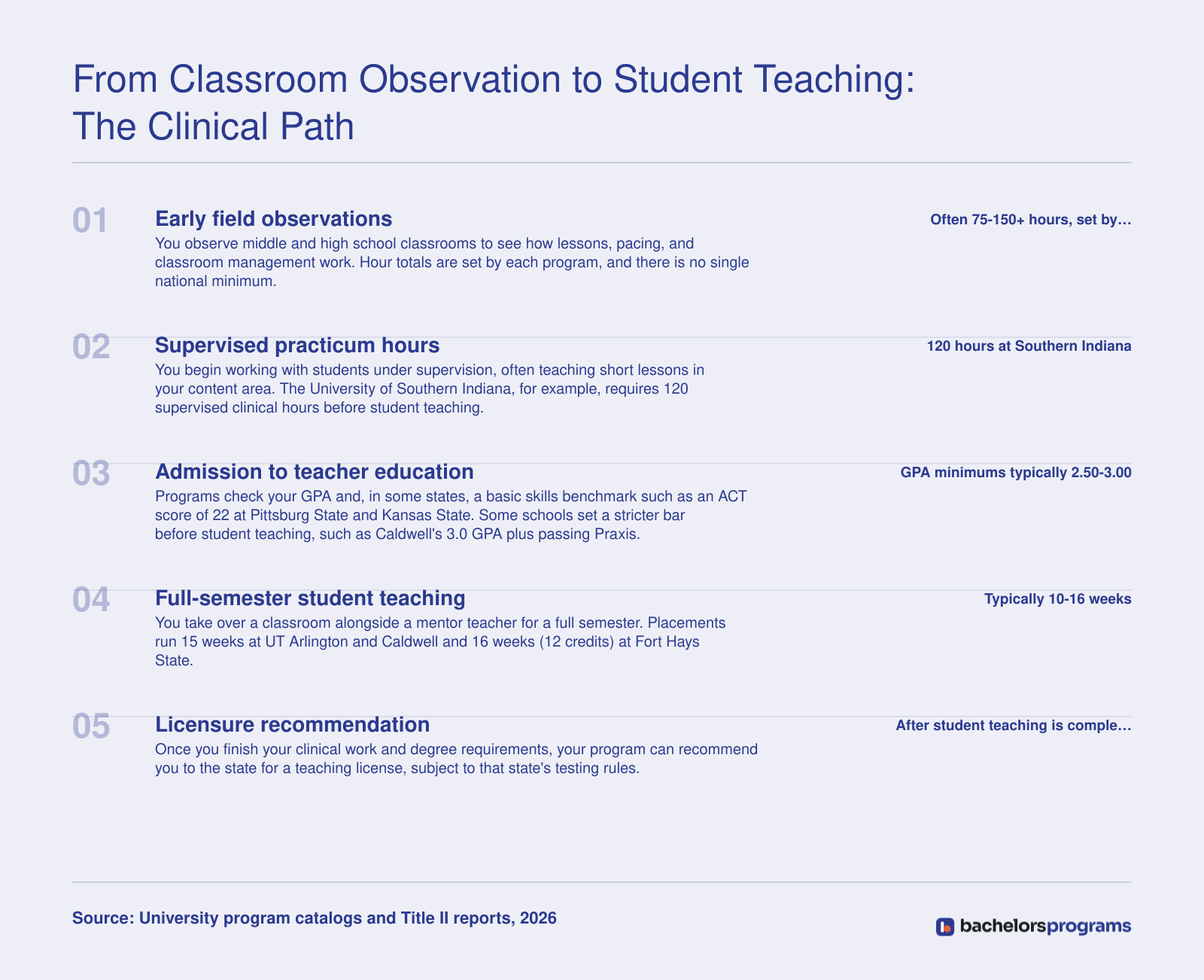
From Classroom Observation to Student Teaching: The Clinical Path
Every B.S. in Secondary Education moves you from watching classrooms to running one, in a set order with checkpoints along the way. Student teaching is usually unpaid and full-time, lasting a full semester, so plan your finances and any job schedule around it well before you reach that stage.
Related Articles
Online vs. Campus Secondary Education Programs: What Changes and What Doesn't
Format changes how you take classes, not how you earn a teaching credential. Student teaching happens in person in a real school whether you study online, in a hybrid program, or on campus. Before you compare formats, check how each program handles placements and whether it can recommend you for licensure in your state.
| Factor | Online | Hybrid | On Campus |
|---|---|---|---|
| Coursework delivery | Lectures, assignments, exams, and student interaction all happen online | Online instruction blended with in-person field experiences | Classes held in person at the university |
| Live vs. flexible scheduling | Asynchronous courses let you work on your own time against deadlines. Synchronous courses meet live at set times, so check which type a program uses. | Usually mixes online sessions with scheduled in-person meetings | Fixed class meeting times set by the campus schedule |
| Student teaching | Completed in person at a school near you | Completed in person, under a certified cooperating teacher and a university supervisor | Completed in person, typically the final semester after all other required coursework |
| How placements are arranged | The university helps build school partnerships in your area, but you start the official placement request with the school or district | Field experiences are school based and often tied to partner districts | Usually arranged through the university's existing local school relationships |
| State authorization and licensure | Authorization rules apply to online courses and out-of-state field placements. Approval to offer a program does not guarantee you can complete placements or be recommended for licensure in another state. | Typically built around the home state's licensure requirements. Some programs require part of student teaching in-state, such as 6 weeks in a Pennsylvania public or charter school at one program. | Designed around the home state's initial licensure, such as grades 6 to 12 licensure in Virginia at one program |
| Placement location limits | Some programs limit placements to the United States, Canada, Guam, Puerto Rico, or the U.S. Virgin Islands | Generally limited to the partner district area | Generally limited to the surrounding region |
| Best fit | Self-directed students who live far from campus and can secure a local placement | Working adults, or students living near a partner school district | Students who want in-person support and a built-in placement network |
Questions to Ask Yourself
Can you cover a full semester of unpaid, full-time student teaching without your current job income?
Will your existing credits transfer as general education or toward your subject-area requirements?
Is the cheaper online program approved to recommend you for licensure in your state?
Would a part-time pace save money now but delay your first teaching paycheck?
Earnings and Debt for Secondary Education Graduates, Program by Program
These figures come from the U.S. Department of Education's College Scorecard and track actual graduates of each specific bachelor's program at one, four and five years after finishing, unlike occupation-wide teacher salaries that blend in every teacher at every experience level. Each CUNY program below pairs median federal debt between $9,558 and $13,920 with median earnings above $36,000 one year after finishing, and Hunter College's adolescent education graduates reached a median of $72,805 five years after finishing. When median debt stays well below a single year of early earnings and the estimated 10-year payment runs $101 to $148 a month, that is a strong sign the degree delivers value.
| School | Program | Median Earnings (1 Year After Finishing) | Median Earnings (4 Years After Finishing) | Median Earnings (5 Years After Finishing) | Employed 1 Year After Finishing | Median Federal Debt | Est. Monthly Payment (10-Year Plan) |
|---|---|---|---|---|---|---|---|
| CUNY Hunter College (New York, NY) | Secondary Education: Adolescent Education | $36,410 | $73,857 | $72,805 | 97% | $13,920 | $148 |
| CUNY City College (New York, NY) | Secondary Education: Social Studies Teacher, Grades 7-12 | $39,169 | $55,895 | $64,326 | 95% | $9,558 | $101 |
| CUNY Brooklyn College (Brooklyn, NY) | Secondary Education | $37,223 | $58,828 | $61,345 | 95% | $10,315 | $109 |
What High School Teachers Earn Nationally
This national median covers high school teachers at every experience level. It is not the starting salary for new graduates.
Secondary Education programs by state
Secondary Education Degree FAQs
These answers cover the questions prospective teachers ask most often. Licensing rules are set by each state, so confirm details with the state education department where you plan to teach.
What is the best degree for a secondary education teacher?
Is a secondary education degree worth it, as people often ask on Reddit?
Can I teach in a different state from where I earned my degree?
Can you get a secondary education degree online?
Compare Secondary Education programs on the data that matters
Explore more Education & Teaching majors or browse every field of study.
All Education & Teaching programs Browse every field of study