Best Communications Degree Programs in Wisconsin
Compare 42 accredited Communications programs in Wisconsin at 22 colleges, with net price after aid, graduation rates, earnings and debt from IPEDS and the U.S. College Scorecard.

From UW-Madison's Communication Arts major to Marquette's Corporate Communication program, a bachelor's degree in communications in Wisconsin goes by many names. The most common credential is the Bachelor of Arts (B.A.) in Communications. Sticker prices differ sharply between public and private campuses, though net price after aid often narrows the gap.
The programs here suit students who want to study in Wisconsin, on campus or online through a Wisconsin-based school. Rankings draw on internal program data: net price, graduation rate, format and specializations.
Program titles vary more than curricula, so compare course lists, not labels.
Key Points
- Carroll University's $38,890 tuition drops to a $15,193 average net price.
- UW-Madison's Communication Arts major is a 30-credit liberal arts program.
- At several UW campuses, net price exceeds tuition by including living costs.
Best Bachelor's Degree in Communications Schools in Wisconsin
Wisconsin's strongest communications options range from a flagship research university with a 30-credit liberal arts major to small private campuses where students build portfolios from their first semester. The ten schools below all award a bachelor's degree in communications or a closely named equivalent, and each entry notes the concentrations, credit requirements, and hands-on media opportunities that separate it from the rest.
University of Wisconsin-Madison
#1Madison, WI · ~$17,000/yr (est.)
Best for: Liberal arts students seeking research depth
Wisconsin's flagship public university offers the Bachelor of Arts in Communication Arts through its College of Letters and Science, with named options in Communication Science and Rhetorical Studies and Radio-Television-Film. The major is 30 credits and does not require a separate application to declare, so students can add it early and build internships or study abroad around it. It is the most selective option in this ranking and the strongest choice for students who want research experience alongside their coursework.
- 30 credits in the major across 10 courses
- Tracks: Communication Science and Rhetorical Studies; Radio-Television-Film
- No separate application required to declare the major
- Internships at communication-related businesses and study abroad worldwide
- Honors program option and hands-on research in communication science
- 120 total credits required for the degree
University of Wisconsin-La Crosse
#2La Crosse, WI · $15,000 – $20,000/yr (est.)
Best for: Students drawn to advocacy and public debate
UW-La Crosse pairs a 39-credit Communication Studies major with emphases in Public Communication and Advocacy, Interpersonal Communication, and Media Studies. The Bachelor of Science track is unusually structured for a communication degree, with required theory and research methods courses and a senior project, and the college requires a minor or second major. Students get a sequenced path rather than a build-your-own major.
- 39-credit major with a required senior project capstone
- Core includes Theories of Communication and Research Methods
- 120 total credits, 40 of them at the 300 or 400 level
- 2.00 cumulative GPA and a minor or second major required
- 30 credits must be in residence at UW-La Crosse
- Interpersonal emphasis covers verbal, nonverbal and cultural messages
- Media Studies emphasis includes Media and Society and Digital Media Production
- Nine elective credits spread across organizational, interpersonal and media areas
- A college diversity course is required within the degree
Marquette University
#3Milwaukee, WI · ~$31,000/yr (est.)
Best for: Milwaukee students wanting agency internships
Marquette University runs one of the larger communication faculties in Wisconsin, with separate Bachelor of Arts majors in Communication Studies and Corporate Communication inside its College of Communication. Internship listings connect students with Southeast Wisconsin employers such as VISIT Milwaukee and the AIDS Resource Center of Wisconsin, so media relations and nonprofit development experience can start before graduation. Both majors require a minor or second major and 120 credit hours.
- 120 credit hours with a minor or second major required
- Coursework in family, gender, persuasion and health communication
- Internships strongly recommended to sharpen a career focus
- Skills courses include public speaking, professional interviewing and conflict management
- 39 credits in the major within a 120-credit degree
- Core includes Corporate Writing, Media Writing and Communication Consulting
- Ethics and Corporate Social Responsibility course required
- Communication Statistics and Analysis plus Introduction to Economics
- Corporate Communication Internship available
- At least 45 credits, including the final 30, must be taken at Marquette
University of Wisconsin-Eau Claire
#4Eau Claire, WI · ~$17,000/yr (est.)
UW-Eau Claire offers Communication in a Communication Studies emphasis, awarded as either a Bachelor of Arts or a Bachelor of Science, with a required minor and a research seminar capstone. Internships are often paid or taken for credit and have placed students at Visit Eau Claire, Big Brothers Big Sisters, and the Eau Claire Leader-Telegram. Campus media, including The Spectator and Blugold Radio, give students bylines and on-air work before they graduate.
- Offered as a Bachelor of Arts or a Bachelor of Science
- Communication Research Seminar capstone required
- Minor required alongside the major
- Internships often paid or taken for credit
- Student media include The Spectator and Blugold Radio
- Coursework spans interpersonal, organizational, small group and mass media
Maranatha Baptist University
#5Watertown, WI · ~$26,000/yr (est.)
Maranatha Baptist University is a small Christian campus in Watertown that teaches communication arts through a biblical worldview. Five hands-on specializations, including digital media, photography, and technical theatre, let students build portfolios in web design, imaging, and production. Students choose a senior capstone or an internship, and alumni have worked at National Geographic and Sight & Sound Theatre.
- Tracks: Dramatic Productions, Speech, Technical Theatre, Digital Media, Photography
- Senior capstone project or internship option
- Coursework in website design, digital imaging, journalism and persuasion
- Biblical worldview integrated throughout the curriculum
- Non-majors can join campus productions and media projects
- Alumni employed at National Geographic and Sight & Sound Theatre
Carroll University
#6Waukesha, WI · $15,000 – $20,000/yr (est.)
Carroll University, in Waukesha, offers Communication as a Bachelor of Arts or Bachelor of Science with tracks in Media, Public Relations, and Relational Communication. Internships have placed students with ABC News and the Milwaukee Bucks, and study abroad in England, Hong Kong, or Belgium satisfies the university's cross-cultural immersion requirement. Double majors with business, psychology, or theatre arts are common, which makes the degree easy to pair with a second field.
- Tracks: Media, Public Relations, Relational Communication
- Offered as a Bachelor of Arts or a Bachelor of Science
- Internships have included ABC News and the Milwaukee Bucks
- Study abroad in England, Hong Kong or Belgium meets the immersion requirement
- Common double majors include business, psychology and theatre arts
- Podcasting and digital media training available
University of Wisconsin-Whitewater
#7Whitewater, WI · $10,000 – $15,000/yr (est.)
UW-Whitewater's Communication Department offers concentrations in Corporate and Health Communication, Electronic Media, and Public Relations, backed by campus TV, radio, and newspaper operations that students can join early. Heide Hall entered an approximately $90 million renovation after an April 2026 groundbreaking, which should reshape the department's production and classroom space. Faculty bring industry experience, and certificates in audio and communication competence are open to any student on campus.
- Three concentration options across six areas of study
- Campus media: UWW-TV, WSUW radio and Royal Purple News
- Certificates in Audio and Communication Competence open to any student
- Faculty bring industry experience to the classroom
- Available in on-campus and online formats
- Project-based consulting and public health campaign work
- Internships and undergraduate research encouraged
- Can be paired with a minor or second major
- Hands-on production experience from the first year
- Video and audio production plus media ethics coursework
- Senior capstone project required
- Training on industry-standard production software
- Students run campaigns for real clients
- Digital strategy and professional writing emphasis
- PRSSA student organization and campus media participation
- Internship and travel study options
University of Wisconsin-River Falls
#8River Falls, WI · $10,000 – $15,000/yr (est.)
UW-River Falls keeps its Communication Studies major tight: a 12-credit core, a senior capstone, and electives organized around five program goals such as collaboration and ethical communication. Students add a 3-4 credit internship or independent study, then fill out a 36-credit major. It is a practical, small-campus option in western Wisconsin with a clear four-year path.
- 36-credit major built on a 12-credit core
- Core includes Interpersonal Communication, Small Group Communication, Senior Capstone
- 3-4 credits of internship or independent study
- Electives organized around five program goals, including ethical communication
- Courses include Intercultural, Organizational and Gender Communication
Saint Norbert College
#9De Pere, WI · $26,000/yr (est. net price)
St. Norbert College, in De Pere, offers Communication as a Bachelor of Arts major and as a minor, built around analysis, writing, and professional speaking. Recent graduates work as account managers, brand coordinators, client relations managers, and staff writers, and others have moved into graduate study at institutions including Northwestern and American University. Student media includes SNC Radio and the student-run St. Norbert Times.
- Offered as a major and a minor
- Builds analysis, writing and professional speaking skills
- Coursework in interpersonal communication and organizational messaging
- Student media: SNC Radio and the St. Norbert Times
- Alumni work as account managers, brand coordinators and staff writers
University of Wisconsin-Milwaukee
#10Milwaukee, WI · $10,000 – $22,000/yr (est.)
UW-Milwaukee awards the Bachelor of Arts in Communication with 36 major credits and four elective areas, including interpersonal communication, rhetoric and public communication, intercultural communication, and technology and communication. The degree can be completed entirely online or in a mix of online and in-person classes, which makes it the most flexible public option on this list. A required research experience ends in a final paper and an oral presentation.
- 36 credits in communication, 18 of them at the 300 level or above
- 15 upper-level credits must be taken in residence at UWM
- Four elective areas, including rhetoric and public communication
- Required research experience with a final paper and oral presentation
- 2.0 GPA required in communication courses and major credits
- Can be completed entirely online or in a mix of formats
Cost & outcomes by school
Federal data for the highest-earning Communications programs, independent of the ranking above. Earnings are this field's bachelor's graduates four years after completing where the Scorecard reports them, else the school's undergraduate median.
| School | Net price / yr | Grad rate | Earnings | Debt | Grads/yr | Format |
|---|---|---|---|---|---|---|
| University of Wisconsin-Oshkosh WI | $14,305 | 46% | $64,103 | $26,000 | 31 | Campus |
| University of Wisconsin-Madison WI | $17,354 | 90% | $61,270 | $20,500 | 279 | Campus |
| Marquette University WI | $31,487 | 83% | $60,482 | $20,000 | 17 | Campus |
| University of Wisconsin-Eau Claire WI | $16,550 | 64% | $58,043 | $22,250 | 30 | Campus |
| Carroll University WI | $15,193 | 71% | $58,009 | $27,000 | 12 | Campus |
| Mount Mary University WI | $20,144 | 43% | $56,763 | $25,288 | 5 | Campus |
| University of Wisconsin-La Crosse WI | $16,210 | 71% | $56,470 | $21,906 | 84 | Campus |
| Concordia University-Wisconsin WI | $36,201 | 68% | $56,075 | $25,750 | 8 | Campus |
| Lakeland University WI | $24,212 | 43% | $55,961 | $25,000 | 5 | Online |
| University of Wisconsin-Milwaukee WI | $15,014 | 49% | $55,697 | $23,000 | 144 | Hybrid |
| Carthage College WI | $26,565 | 64% | $55,654 | $25,125 | 14 | Campus |
| University of Wisconsin-Whitewater WI | $14,158 | 59% | $55,152 | $23,600 | 95 | Campus |
Sources: U.S. Department of Education. Net price, graduation rate, earnings and debt: College Scorecard (earnings and debt for this field's bachelor's graduates where reported, else school-wide); graduates: IPEDS. A dash means no figure is reported.
Cost, debt & payoff
Median earnings of this field's bachelor's graduates (4 yrs after completing, else the school's undergraduate median) vs. their median federal loan debt · U.S. College Scorecard
Across these programs the median graduate earns about $55,829 and finishes with roughly $23,600 in debt — a ratio that clears a common rule of thumb (keep debt below first-year salary). Net price and debt vary widely school to school, so check the per-school figures in the table above before you shortlist.
Most Affordable Communications Bachelor's Programs in Wisconsin
Net price is the institution-wide average a student pays after grants and scholarships (2024 IPEDS and College Scorecard data), so treat it as a benchmark, not an exact quote for your own aid package. Every lowest-cost option below is a public University of Wisconsin campus, with average net prices from $11,772 to $14,158. No private college appears among them, a sign that the public tuition advantage holds even after aid.
| School | City | Public or Private | Average Net Price (After Aid) | In-State Tuition and Fees | Program Format |
|---|---|---|---|---|---|
| University of Wisconsin-Parkside | Kenosha | Public | $11,772 | $8,270 | Campus |
| University of Wisconsin-Superior | Superior | Public | $12,220 | $8,812 | Campus |
| University of Wisconsin-Green Bay | Green Bay | Public | $13,369 | $8,700 | Campus and online |
| University of Wisconsin-River Falls | River Falls | Public | $14,054 | $9,008 | Campus |
| University of Wisconsin-Whitewater | Whitewater | Public | $14,158 | $8,616 | Campus |
Online and Hybrid Bachelor's in Communications Options at Wisconsin Schools
The tradeoff is flexibility versus access: an online communications degree lets you keep a job and stay where you live, while campus programs are usually where the studios, student newsrooms and local internship pipelines sit. Wisconsin schools offer both, and the delivery label on a program page is worth confirming before you apply.
Fully online options
Yes, you can earn a bachelor's degree in communications entirely online from a Wisconsin school. UW-Milwaukee lists its BA in Communication as an online degree: 120 credits total, at least 36 of them in communication courses, with elective themes in interpersonal communication, rhetoric and public communication, organizational communication, and technology and communication.1 The program also notes that online and in-person sections are taught by the same faculty. Ask an advisor early whether any internship or research requirement can be arranged near home.
UW-Green Bay offers its communication degree fully online3 with generalist, health communication and public relations emphases, and UW-Oshkosh describes its Communication Studies program as 100% online. The Universities of Wisconsin online catalog sends communication students to these campus programs rather than to one system-wide collaborative degree, so treat any "UW Online" search result as a pointer back to the campus that awards the degree.
Hybrid and campus-based options
UW-Superior lists Communication as available both on campus and online2, but its published materials do not spell out which courses, labs, practica or orientations must be completed in person. Confirm that with an advisor before you commit.
Among the private schools, delivery is largely campus-based. Marquette, Carroll and Saint Norbert list their communication degrees as on-campus programs, as do UW-Madison, UW-La Crosse, UW-Eau Claire, UW-River Falls and Maranatha. Those are strong fits if you want the newsroom, the speaking opportunities and the local internship network in exchange for a fixed weekly schedule.
What to verify before you enroll
- Experiential requirements: ask whether an internship, practicum or capstone can be arranged in your own area.
- Upper-level residency: most programs require a set number of advanced credits taken through the institution itself.
- Course rotation: online sections often run once a year, so map your sequence before the first semester.
- Transfer credit: confirm how previously earned credits apply before you submit an application.
Admissions for Wisconsin Communications Bachelor's Programs: GPA, Test Policy, and Transfer Credit
Admission to a communications bachelor's program comes down to three things: the grades a school expects, whether it asks for ACT or SAT scores, and how it treats credits you earned elsewhere. Policies differ widely across Wisconsin; the rules below are what each school publishes.
How Selective Are the Schools?
University of Wisconsin-Madison is the most selective, admitting about 45 percent of applicants. Carroll University (about 67 percent) and Maranatha Baptist University (about 72 percent) sit in the middle. University of Wisconsin-La Crosse admits about 76 percent. Marquette University, UW-River Falls, and UW-Eau Claire each admit roughly 81 to 82 percent. UW-Whitewater and Saint Norbert College admit about 86 percent, and UW-Milwaukee is the most open at about 91 percent.
GPA, Test Policy, and Transfer Rules
- UW-Madison: No minimum GPA or credit count is published for the Communication Arts major.1 Students must keep at least a 2.000 GPA in major courses once enrolled.1 ACT/SAT is optional through spring 2028, and applicants who skip scores are not disadvantaged.2 Madison's guidance is to show strong grades, mostly As, in challenging courses.
- UW-Madison transfers: Test scores are not considered.2 Official college transcripts are required, and credit is evaluated only after you are admitted and confirm you will enroll.3 Continuing-education, graduate-level, remedial, technical, vocational, and doctrinal courses do not transfer.3 Major credit needs a COM ARTS course numbered 200 or higher, or an approved COMM ARTS elective.3
- Marquette: No minimum or typical admitted GPA is published. A 2.000 is required for the degree and for major coursework.4 First-year applicants may apply test-optional.5 Transfer applicants need not submit scores, and credits are reviewed during admission.6 Those with fewer than 30 college credits must send a final high school transcript.6
- UW-La Crosse and UW-Milwaukee: Both list a 2.0 GPA minimum within the major. We have no confirmed admission GPA or test policy for either.
- Other schools: We have no confirmed GPA, test, or transfer details for UW-Eau Claire, Maranatha, Carroll, UW-Whitewater, UW-River Falls, or Saint Norbert. Check each admissions page directly instead of assuming a policy.
Tips for Transfer Students
- Ask for a credit evaluation early. Madison will not finalize one until after you confirm enrollment, so plan your course load around that timing.3
- Keep your residency requirement in mind. Marquette requires at least 45 credits completed on its campus, and up to 15 of them can come from approved study abroad.4 UW-La Crosse requires 30 credits in residence.
- Do not count on a particular course transferring. The published materials for Madison and Marquette give no credit cap, minimum grade, or guaranteed equivalency in advance, so get answers in writing from an advisor.
Related Articles
Cost of a Communications Bachelor's Degree in Wisconsin
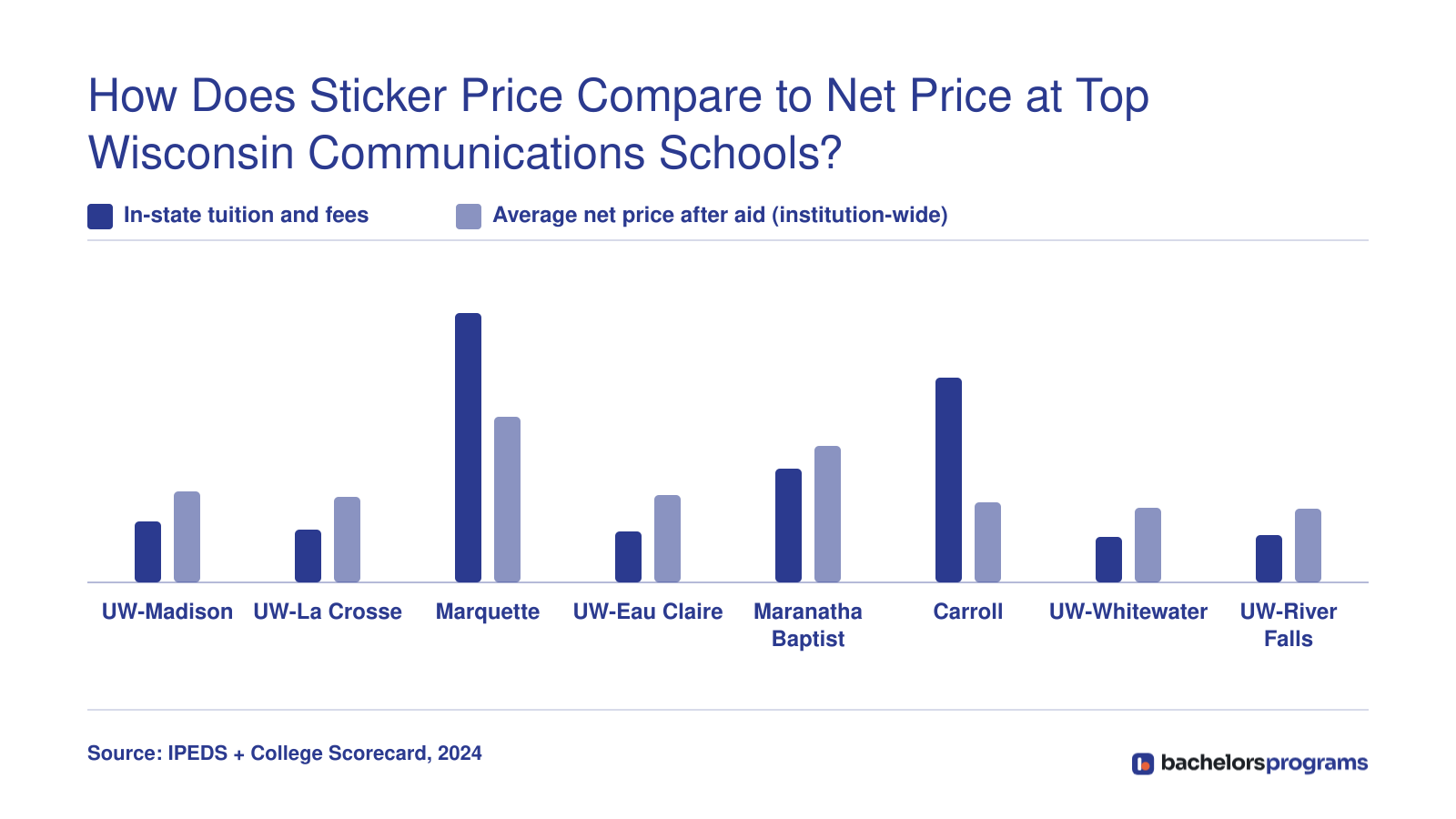
Judge a public school against a private one by what you actually pay, not by the sticker price on its website. Among the ranked schools with the lowest costs, in-state tuition and fees run about $8,616 at UW-Whitewater, $9,008 at UW-River Falls, $10,070 at UW-La Crosse, and $10,398 at UW-Milwaukee. Carroll University lists $38,890. Average net price after aid tells a different story: about $14,054 at River Falls, $14,158 at Whitewater, $15,014 at Milwaukee, $16,210 at La Crosse, and $15,193 at Carroll.
Wisconsin Grant
The Wisconsin Grant is the main need-based state award. You must be a Wisconsin resident (dependent students use a parent's residency), hold a diploma or GED, attend a nonprofit Wisconsin college at least less-than-half-time, and have no delinquent court-ordered child support. Awards last up to 10 full-time semesters.3
For 2026-27, the UW-sector award runs from $1,000 to $3,700, and the private nonprofit maximum is $4,850 for students with a Student Aid Index of $8,000 or lower.1 Part-time enrollment prorates the award: 75 percent at three-quarter time, 50 percent at half time, and 25 percent below half time.1 Some second-tier awards depend on available funds. There is no separate application. Filing the FAFSA is how you apply.
Wisconsin Tuition Promise and Other Aid
The Wisconsin Tuition Promise covers tuition and fees left after other grants at the Universities of Wisconsin campuses other than UW-Madison, which runs its own Bucky's program. UW-Milwaukee also has a separate program. To qualify, your family income must be under $62,000, you must be eligible for the Wisconsin Grant, and you must be a Wisconsin resident for tuition.2 It covers up to eight consecutive fall and spring semesters toward a first bachelor's degree.2 The published details describe students who enrolled in 2023 and 2025, so confirm with your school which entering class is currently covered.
The Academic Excellence Scholarship adds $2,250 toward tuition, split equally between the state's Higher Educational Aids Board and the school.3
Why Private Can Cost Less
A private college's listed price is rarely what students pay. Institutional grants and the Wisconsin Grant, which reaches $4,850 at private nonprofit schools, can bring Carroll's $38,890 down to an average net price near $15,193. Ask each school for a net price estimate before you rule it out, and compare your own aid offers side by side.
How Does Sticker Price Compare to Net Price at Top Wisconsin Communications Schools?
Published tuition rarely matches what families pay. At Carroll University, in-state tuition of $38,890 drops to an average net price of $15,193, below UW-Madison's $17,354. At the University of Wisconsin campuses, net price often runs above tuition because it counts housing, books and fees after grants. Net price is an institution-wide average for all aided undergraduates, not a figure specific to the communications major.
Common Questions About Communications Degrees in Wisconsin
These answers cover the questions prospective students ask most often about a bachelor's degree in communications in Wisconsin. They draw on program details from the University of Wisconsin schools featured on this page.
Can you get a bachelor's degree in communications online from a Wisconsin school?
Is a communications degree worth it?
What is the difference between communications and communication sciences and disorders?
Do you need a license to work in communications in Wisconsin?
Compare Communications programs on the data that matters
Explore more Communications & Media majors or browse every field of study.
All Communications & Media programs Browse every field of study