Best Speech Pathology Schools in Kansas
Compare 4 accredited Speech Pathology programs in Kansas, with net price after aid, graduation rates, earnings and debt from IPEDS and the U.S. College Scorecard.
Which Kansas universities award a bachelor's degree in speech pathology? Kansas State University, the University of Kansas, Wichita State University and Fort Hays State University all do, most often as a Bachelor of Science (B.S.) under a major that schools label Speech Pathology, Speech-Language Pathology or Communication Sciences and Disorders (CSD).
Licensure as a speech-language pathologist in Kansas requires a master's degree, so the undergraduate major is the pre-professional step rather than the finish line. That reality shapes the arithmetic: published in-state tuition runs from $5,923 at Fort Hays State to $12,102 at KU, and whatever debt you carry out of the bachelor's is debt you carry into graduate coursework.
Key Points
- Fort Hays State charges $5,923 in-state, about half of KU's $12,102.
- Kansas State graduates report $61,621 median earnings five years after completion.
- Kansas SLP licensure requires a master's; the bachelor's is the first step.
Best Bachelor's Degree in Speech Pathology Schools in Kansas
These four Kansas universities award a bachelor's degree in speech pathology or its close cousin, communication sciences and disorders, and each one is built as a pre-professional step toward graduate study. The order reflects how each program balances a full clinical foundation, hands-on observation hours, and the cost a Kansas student actually pays after aid. Every card below uses the school's own name for the major.
Kansas State University
#1Manhattan, KS · $11,000 – $29,000/yr (est.)
Best for: Students wanting on-campus clinical observation hours
Kansas State University in Manhattan runs one of the state's largest communication sciences and disorders programs, with about 40 bachelor's degrees awarded in a recent year. Undergraduates get real clinical exposure early, completing observations at the university's own Speech and Hearing Center plus schools and medical facilities in the region, and many instructors are practicing clinicians. A dedicated student organization and undergraduate research openings round out the experience, and the department puts scholarship money in front of incoming majors.
- Introduces the basic sciences of speech, language and hearing
- Coursework in phonetics, hearing science and anatomy of the speech mechanism
- Clinical observations at the K-State Speech and Hearing Center
- Offers language assessment and intervention coursework
- Many faculty are practicing clinicians
- Departmental and university scholarships available
- Dedicated student organization for professional development
- Prepares students for graduate study in speech-language pathology or audiology
University of Kansas
#2Lawrence, KS · $12,000 – $30,000/yr (est.)
Best for: Students weighing research and honors tracks
The University of Kansas in Lawrence offers both a Bachelor of Arts and a Bachelor of General Studies in Speech-Language-Hearing, giving students two routes into the same clinical coursework. The 120-credit major includes a capstone research methods course and a required statistics and math foundation, and majors can pursue departmental honors with a 3.5 major GPA. Roughly 57 bachelor's degrees were awarded in a recent year, the largest undergraduate output among the four schools here.
- Alternate degree track within the same speech-language-hearing major
- Same clinical observation and laboratory coursework as the BA route
- 120 total credit hours including a capstone course
- Capstone is Research Methods in Speech-Language-Hearing
- Requires prerequisite work in mathematics and statistics
- At least a 2.0 KU GPA in junior and senior major courses
- 15 hours of KU resident credit and 12 hours at 300 level or above
- Departmental honors needs a 3.5 major GPA and 6 to 8 research hours
- Includes clinical observation and laboratory projects
- Offered as both a BA and a Bachelor of General Studies
Wichita State University
#3Wichita, KS · ~$13,000/yr (est.)
Best for: Out-of-state students seeking tuition discounts
Wichita State University's Bachelor of Arts in Communication Sciences and Disorders is a 45-credit major that combines speech-language pathology and audiology in one curriculum, and there is no separate departmental application once you are admitted to the university and meet College of Health Professions entrance requirements. Students can add a departmental honors track, and cooperative education credits apply toward the degree. Out-of-state students have several ways to cut costs, including the Midwest Student Exchange Program and Wichita State's resident-rate programs for nearby states.
- 45 credit hours in the major
- Combines speech-language pathology and audiology coursework
- No departmental application beyond university admission
- Departmental honors track open with a 3.500 CSD GPA
- Honors requires 12 credit hours and a mentored scholarly project
- Cooperative education credits up to 8 hours apply to the degree
- Midwest Student Exchange and Shocker Select tuition discounts
- Resident tuition rates available for eligible nearby states
Fort Hays State University
#4Hays, KS · ~$13,000/yr (est.)
The 120-credit degree includes a clinical practicum and electives in autism, sign language and aging, and a 3+2 accelerated pathway lets strong students move toward graduate work sooner. With the lowest in-state tuition of the four and home-state pricing, it is the value option on this list.
- 120 total credit hours
- Includes a clinical practicum experience
- 3+2 accelerated pathway toward graduate study
- Electives in autism, sign language and aging
- Core curriculum in speech and hearing science
- Prepares students for graduate study or audiology doctorate
- Suggested course sequence provided for progress planning
Cost & outcomes by school
Federal data for the highest-earning Speech Pathology programs, independent of the ranking above. Earnings are this field's bachelor's graduates four years after completing where the Scorecard reports them, else the school's undergraduate median.
| School | Net price / yr | Grad rate | Earnings | Debt | Grads/yr | Format |
|---|---|---|---|---|---|---|
| Kansas State University KS | $19,406 | 71% | $61,621 | $17,000 | 25 | Campus |
| University of Kansas KS | $18,059 | 69% | $59,436 | $22,250 | 56 | Campus |
| Wichita State University KS | $13,194 | 51% | $55,638 | $19,500 | 21 | Campus |
| Fort Hays State University KS | $12,569 | 48% | $50,246 | $21,500 | 34 | Campus |
Sources: U.S. Department of Education. Net price, graduation rate, earnings and debt: College Scorecard (earnings and debt for this field's bachelor's graduates where reported, else school-wide); graduates: IPEDS. A dash means no figure is reported.
Cost, debt & payoff
Median earnings of this field's bachelor's graduates (4 yrs after completing, else the school's undergraduate median) vs. their median federal loan debt · U.S. College Scorecard
Across these programs the median graduate earns about $57,537 and finishes with roughly $20,500 in debt — a ratio that clears a common rule of thumb (keep debt below first-year salary). Net price and debt vary widely school to school, so check the per-school figures in the table above before you shortlist.
Compare Kansas Speech Pathology Bachelor's Programs Side by Side
Fort Hays State University charges the lowest in-state tuition and fees at $5,923, about half of the University of Kansas's $12,102, while Kansas State University graduates report the highest median earnings five years after completion at $61,621. Completions show how large each program is: KU's major is the biggest with 57 completions, and Fort Hays State's is the smallest with 25. Tuition, net price and graduation rate are institution-wide figures from federal IPEDS and College Scorecard data, while completions, earnings and debt describe the speech pathology program itself.
| School | Location | Program | Program Completions | In-State Tuition and Fees (Institution-Wide) | Average Net Price (Institution-Wide) | Graduation Rate (Institution-Wide) | Program Median Earnings, One Year After Completion | Program Median Earnings, Five Years After Completion | Program Median Debt at Completion |
|---|---|---|---|---|---|---|---|---|---|
| University of Kansas | Lawrence, KS | Speech-Language-Hearing | 57 | $12,102 | $18,059 | 68.8% | $30,227 | $59,436 | $22,250 |
| Kansas State University | Manhattan, KS | Communication Sciences and Disorders | 40 | $11,221 | $19,406 | 71.1% | N/A | $61,621 | $17,000 |
| Wichita State University | Wichita, KS | Communication Sciences and Disorders | 31 | $9,684 | $13,194 | 51.0% | $21,429 | $55,638 | $19,500 |
| Fort Hays State University | Hays, KS | Bachelor of Science in Communication Sciences and Disorders | 25 | $5,923 | $12,569 | 47.7% | N/A | $50,246 | $21,500 |
Online and Hybrid Speech Pathology Bachelor's Options at Kansas Schools
Which Kansas schools teach remotely
Fort Hays State University is the one school here that delivers its bachelor's degree in speech pathology in both formats. Its Bachelor of Science in Communication Sciences and Disorders, 120 credit hours, runs on campus in Hays and online.
The other three are campus-based. Kansas State University's B.S. in Communication Sciences and Disorders is taught in Manhattan. The University of Kansas Speech-Language-Hearing major is a Lawrence campus program, and Wichita State University's Communication Sciences and Disorders degree is taught in Wichita. None of the three publishes an online version of the undergraduate major, so plan on relocating or commuting if one of them is your target.
How labs and observation hours work
Ask about labs and observation hours before you enroll in any online track. Fort Hays State builds an individualized lab around observing speech, language and hearing activity at both off-campus and on-campus facilities, and its coursework includes required labs plus supervised clinical services with preschoolers, school-age children and adults. The school has not published whether distance students complete every hour remotely or whether any of it must happen in Hays, so email the department and get the answer in writing for your own location.
On the campus side, Kansas State students observe a range of disorders and age groups at the K-State Speech and Hearing Center, with additional opportunities at area schools and medical facilities. Direct supervised clinical work there is available by faculty invitation rather than automatically. KU lists clinical observation and lab projects as part of its major.
Picking the format that fits you
- Working adults and career changers: The Fort Hays State online track is the only route here that lets you keep a full-time job while finishing the degree.
- Rural Kansas residents: If a two-hour drive to Manhattan, Lawrence or Wichita is not realistic, the online option solves the geography problem, with observation hours arranged locally.
- Transfer students with an associate degree: Compare how each school applies your general education credits before committing; the campus programs all accept transfer work, and the difference usually shows up in how many major courses you still owe.
- Students who want daily clinic access: A campus program puts you in an on-site center several times a week, which is hard to replicate at a distance.
Admissions for Kansas Speech Pathology Bachelor's Programs: GPA, Test Policy and Transfer Credit
The table summarizes each school's published GPA, testing and transfer rules for its speech pathology or Communication Sciences and Disorders (CSD) bachelor's degree. Kansas State University adds a separate departmental step: you need a 3.0 overall GPA after 57 credit hours to enroll as a CSD major. Fort Hays State University says program requirements override its university minimum where they are higher. For Wichita State University, check its admissions office directly, because its rules are not covered in the sources used here.
| School | Minimum GPA | Test Policy | Transfer Credit Rules |
|---|---|---|---|
| University of Kansas (Speech-Language-Hearing) | 3.25 high school GPA for freshman admission; 2.5+ GPA for transfer assured admission | Test-optional for general admission and institutional scholarships; KU admits on GPA, not SAT or ACT scores | Assured admission for transfer students with 24+ transferable credit hours and a 2.5+ GPA from a regionally accredited institution |
| Kansas State University (Communication Sciences and Disorders, B.S.) | 3.0 overall GPA after 57 credit hours, including K-State and KSIS-credited transfer coursework, to enroll as a CSD major | Transfer applicants with fewer than 24 transfer hours must submit ACT scores with the final high school transcript; no general test-optional policy published | Most credits from regionally accredited community colleges and universities transfer; up to half of the required hours may come from a two-year college; articulation agreements with 19 Kansas community colleges; Kansas A.A. or A.S. graduates are guaranteed junior standing, though not every credit may count toward the degree |
| Fort Hays State University (Communication Sciences and Disorders, B.S.) | 2.0 GPA on FHSU courses and 2.0 GPA on all coursework; higher program requirements apply where set | No general test policy published; the CSD catalog uses Math ACT 19+, Math SAT 510+ or an alternative measure for MATH 250 placement | 120 hours of recognized college credit required, including at least 30 hours earned at FHSU and at least 45 upper-division hours |
Questions to Ask Yourself
Do you plan to stay in Kansas for the master's degree that licensure requires?
Does the school's transfer-credit policy protect credits from a Kansas community college?
Will you need a hybrid or online format, and how are observation hours handled?
Cost of a Speech Pathology Bachelor's Degree in Kansas
Kansas keeps published tuition low compared with most of the country. The gap between the sticker price and what families actually pay is wider still, since average net price after grant aid runs above tuition at every school ranked here. Net price is a whole-institution average, not a figure for the speech pathology major. Use it to compare schools, not to predict your own bill.
Sticker Price and Net Price
- Fort Hays State University: in-state tuition $5,923, average net price $12,569
- Wichita State University: in-state tuition $9,684, average net price $13,194
- Kansas State University: in-state tuition $11,221, average net price $19,406
- University of Kansas: in-state tuition $12,102, average net price $18,059
The order flips in two places. Kansas State charges less tuition than KU but posts a higher average net price, which usually means KU awards more grant aid per student. Fort Hays State is the cheapest on both measures.
Kansas Aid Programs That Change the Math
Two state programs are worth knowing by name. The Kansas Comprehensive Grant is need-based, reserved for Kansas residents enrolled at Kansas colleges, and requires the FAFSA. The state sets a priority deadline, so filing early matters more than filing perfectly. The Kansas State Scholarship is merit-based, aimed at Kansas high school graduates with strong academic records who stay in state, and generally turns on a qualifying ACT score or National Merit standing. Award amounts and deadlines shift from year to year, so confirm both with the Kansas Board of Regents student aid office before you count on the money.
What Graduates Actually Borrow
For bachelor's graduates who took loans, median debt is $17,000 at Kansas State, $19,500 at Wichita State, $21,500 at Fort Hays State and $22,250 at KU. Pell share, the portion of undergraduates receiving federal need-based grants, sits near 47 percent at Kansas State and KU and between 61 and 63 percent at Wichita State and Fort Hays State, a sign that the Wichita and Hays campuses enroll more lower-income students.
Three Moves That Lower the Bill
- Start at a Kansas community college: complete general education and introductory communication sciences courses, then confirm in writing with your target department which credits transfer into the major.
- File the FAFSA the week the window opens: the Kansas Comprehensive Grant and most institutional need aid are awarded until funds run out, not until the final deadline.
- Ask the department, not just the financial aid office: Kansas State's communication sciences and disorders department advertises its own scholarships, and the other programs hold similar funds that rarely appear on a general application.
Related Articles
Kansas Speech-Language Pathology Licensure: Where the Bachelor's Fits
A Kansas speech-language pathology license is the state's legal permission to practice, issued by the Kansas Department of Health and Environment (KDHE) through the department secretary.2 The license itself requires a master's degree.1 An undergraduate degree in communication sciences and disorders is the pre-professional step that prepares you for that next stage; it does not qualify you for a full license on its own.
The Licensure Sequence in Order
- Bachelor's degree: Complete an undergraduate program in speech pathology, speech-language-hearing or communication sciences and disorders. Kansas State University, the University of Kansas, Wichita State University and Fort Hays State University all offer this foundation.
- Master's degree and clinical practicum: Kansas requires at least a master's in the field plus a supervised clinical practicum totaling at least 375 hours, including at least 250 graduate-level hours in the area of licensure.1
- Supervised postgraduate experience: After the degree and practicum, applicants complete supervised professional experience before full licensure.
- State application: Applications, supporting documentation and fees go to KDHE.2 The same office handles renewals, temporary licenses and licensure by endorsement for clinicians moving in from other states.
KDHE's regulations (K.A.R. 28-61) spell out additional requirements, so check them before you plan your timeline.1
What the Bachelor's Typically Covers
Undergraduate programs usually build the science and language base that graduate clinical training assumes. Expect coursework along the lines of speech and hearing science, phonetics, language development, and an introduction to communication disorders. Many programs also include observation of clinical work. Exact course lists and observation requirements vary by school, so confirm them on each department's page.
Plan for the bachelor's to be the first stage of a longer path, not the final credential. Students who complete the master's and fellowship stages become eligible for a Kansas license. Those who stop at the bachelor's can pursue other roles in the field.
Check the Official Source Before You Apply
Fees, forms and rules change, including through legislation such as the 2026 session laws that assign licensing duties to the KDHE secretary. Use the licensing page on the KDHE website for current fees, application forms and any updates before you submit anything. Choosing a graduate program is a decision to make from your own research once you reach that stage.
What Speech-Language Pathologists Earn in Kansas
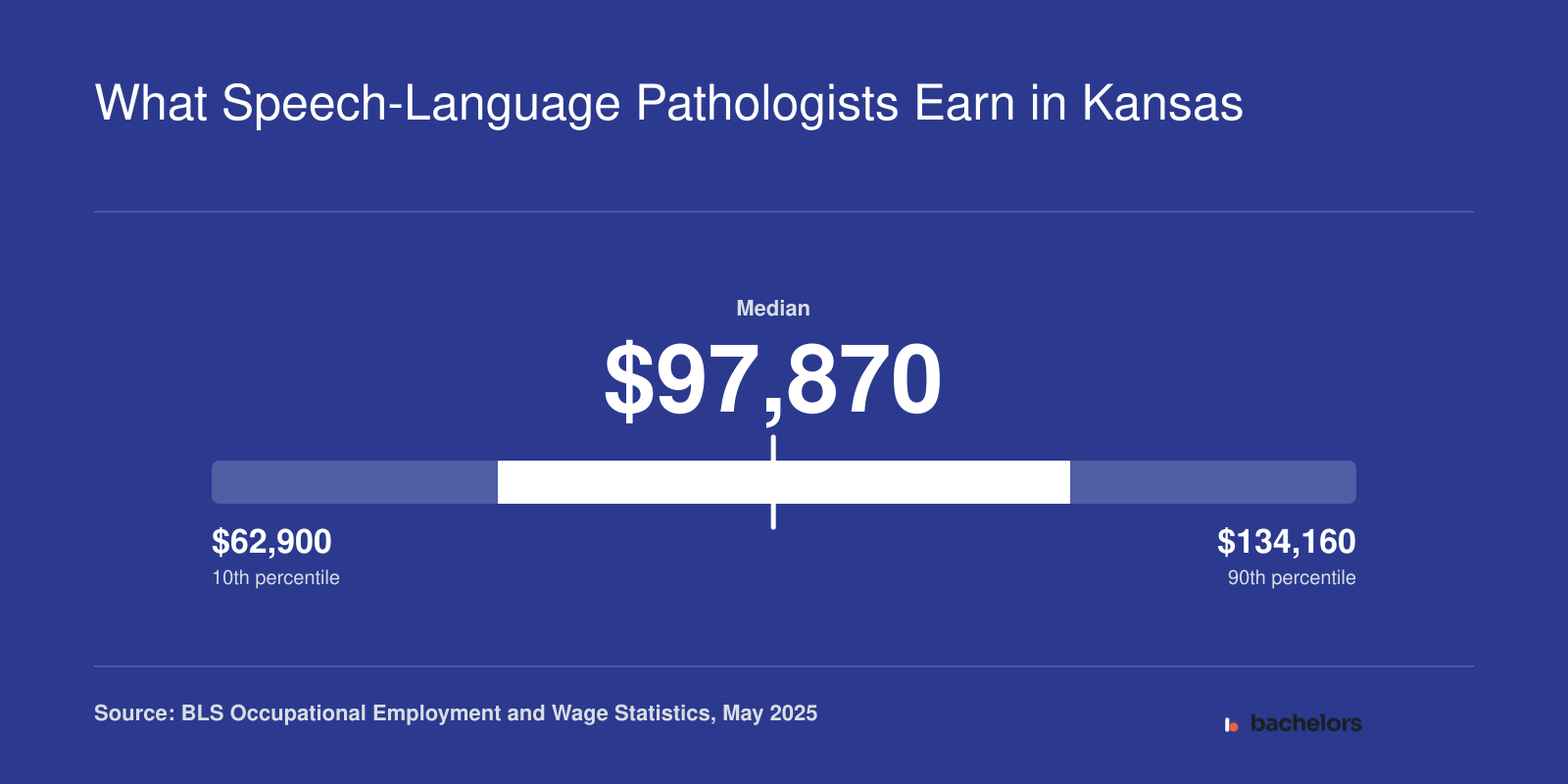
Licensed speech-language pathologists in the U.S. earned a median of $97,870 in May 2025, according to the Bureau of Labor Statistics, with the lowest 10% earning under $62,900 and the top 10% earning above $134,160. The most recent Kansas-specific figure in our research is older: a May 2020 mean of $75,880 across about 1,500 Kansas SLPs, so treat it as a rough benchmark, not a current rate. These wages reflect the licensed profession, which requires a master's degree, and are separate from what graduates typically earn right after finishing a bachelor's degree in speech pathology.
What You Can Do With a Bachelor's Degree in Speech Pathology
A bachelor's degree in speech pathology leads to several jobs, but none of them makes you an independent speech-language pathologist (SLP).
Realistic Paths After Graduation
The bachelor's is a pre-professional degree. Graduates typically move in one of these directions:
- Graduate study: The most common route. Programs at Kansas State University, Fort Hays State University and the University of Kansas describe the degree as a foundation for graduate work in speech-language pathology or audiology.
- Speech-language pathology assistant roles: Assistants work under the supervision of a licensed SLP. Requirements vary by state and employer, so check Kansas rules before counting on this route.
- Early intervention and paraprofessional work: Some graduates support children and families in schools or community programs, often in aide-level positions.
- Related health and education fields: The coursework in speech, language and hearing science also transfers to other helping professions.
What Graduates Earned
Federal Scorecard data tracks earnings by program and by time since completion. One year after completion, University of Kansas graduates in this field had median earnings of $30,227 and Wichita State University graduates $21,429. Wichita State's employment share at that one-year mark was about 84 percent. These cohorts are small, and early earnings often reflect students who are also in graduate school.
Four years after completion, the medians are higher:
- Kansas State University: $61,621
- University of Kansas: $59,436
- Wichita State University: $55,638
- Fort Hays State University: $50,246
These are program-level medians for bachelor's completers. They do not represent what a licensed SLP earns, and they include graduates who went on to graduate school and entered the workforce later.
Why the Bachelor's Alone Is Not Enough
Licensure as a speech-language pathologist in Kansas requires a master's degree. The bachelor's does not qualify you to practice independently or to carry your own caseload. Treat it as the step that builds your clinical-science foundation and keeps graduate options open.
Each school's clinical observation hours and practicum opportunities matter if you want to work in the field soon after graduation. Fort Hays State, for example, lists clinical practicum experience and a 3+2 accelerated option, and K-State lists observations at its Speech and Hearing Center. Those details affect how prepared you are for either a job or graduate study.
How We Ranked Kansas Speech Pathology Schools
A ranking works best with one number per school, but a bachelor's program rarely fits neatly into one. Here is what went into this list and where its limits are.
What We Looked At
We considered only Kansas bachelor's programs in speech pathology and its related majors, whether taught on campus or online through a Kansas-based school. The data behind the list covers tuition, net price after aid, graduation rates and the number of degrees awarded in the field.
Where the Numbers Fall Short
Two figures deserve a caution. The graduation rate and the average net price describe the whole university, not the students in Communication Sciences and Disorders, Speech-Language-Hearing or any other single major. A program can do better or worse than its school's overall number.
Program-level figures appear only where a school or federal source publishes them. Where one is not available, we left it out rather than estimate it.
Where Other Details Come From
Admissions requirements, online and hybrid availability, and Kansas licensure information come from school web pages and state agency pages, not from the federal datasets. We checked those pages in November 2026. Policies and deadlines change, so confirm them with each admissions office before you apply.
This ranking is a starting point for comparison. It cannot tell you which program fits your schedule, budget or goals. Use it to narrow your options, then verify the details directly with the schools.
Compare Speech Pathology programs on the data that matters
Explore more Communications & Media majors or browse every field of study.
All Communications & Media programs Browse every field of study