Best Cloud Computing Degree Programs
Compare 70+ accredited Cloud Computing programs, with net price after aid, graduation rates, earnings and debt from IPEDS and the U.S. College Scorecard.

Cloud computing degrees sit at the low end of the tuition spectrum, and that is the strongest argument for the credential. A bachelor's degree in cloud computing, usually the Bachelor of Science (B.S.) in Cloud Computing, can be completed entirely online at an in-state rate near $3,400 a year, though out-of-state tuition at a flagship campus can exceed $59,000. Median debt among graduates ranges from roughly $9,400 to $27,250.
Programs come in online, campus, and hybrid formats, and many fold AWS and Azure certification prep into the coursework. Employers increasingly ask for the certification alongside the degree, so which exam the curriculum actually prepares you to sit for matters as much as the major itself.
Key Points
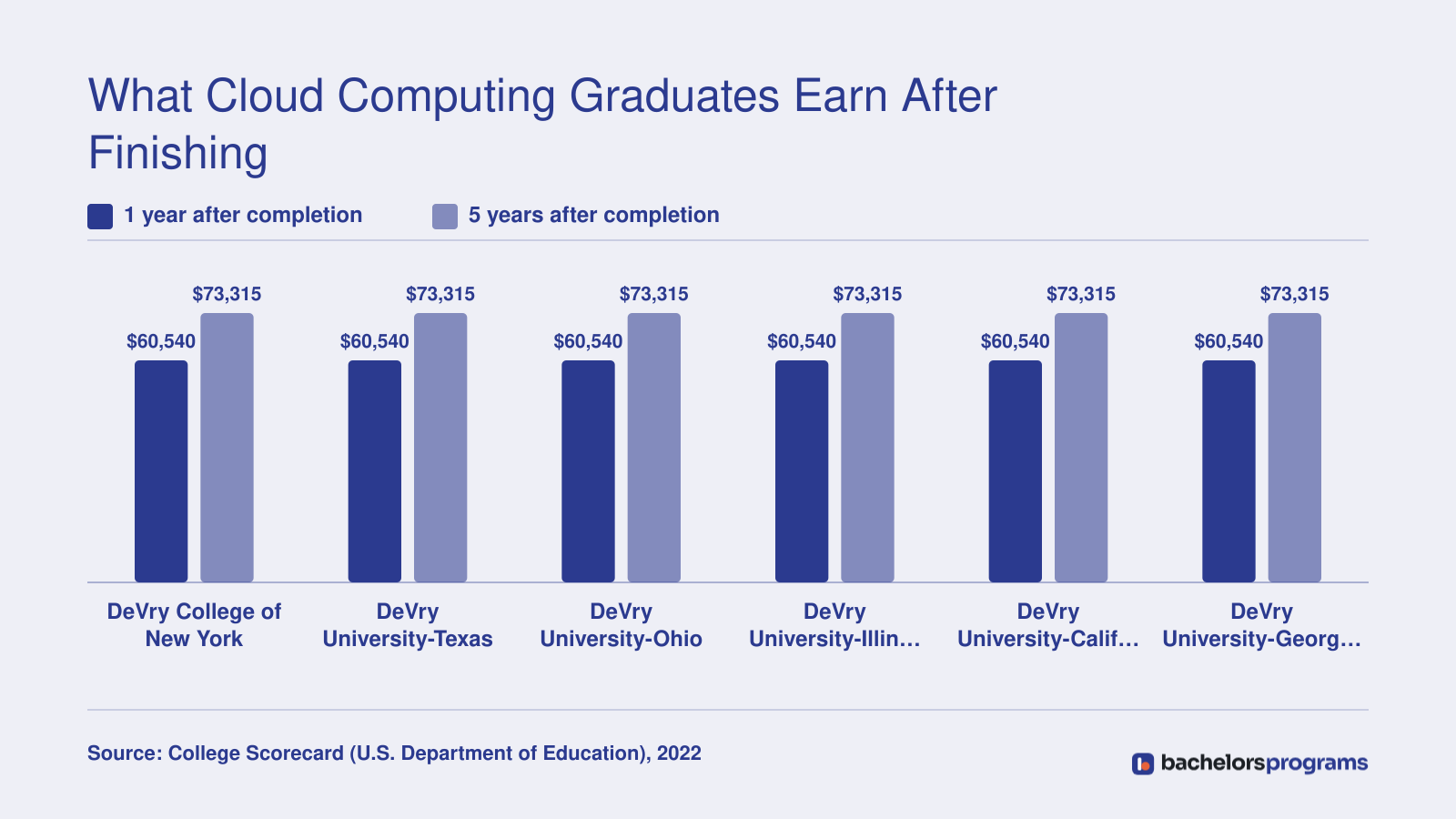
- Median graduate earnings rise from $60,540 to $73,315 within five years.
- Compare net price after grants, not sticker tuition, when weighing costs.
- IT or cybersecurity degrees with cloud tracks suit most undecided students.
Top 10 Schools for a Bachelor's Degree in Cloud Computing
Ten bachelor's degree in cloud computing programs made this list, ranging from a fully online concentration at a flagship public university to a standalone cloud major at an HBCU. Each entry below notes how the program is delivered, what the cloud coursework covers, and which students tend to fit it best.
University of Virginia
#1Charlottesville, VA · $22,000/yr (est. net price)
Best for: Working adults finishing a bachelor's degree online
UVA's School of Continuing and Professional Studies runs the university's online bachelor's completion route, and the Cloud Solutions and Operations concentration sits inside the Bachelor of Interdisciplinary Studies. Students take two courses per term year-round and can finish in three to four years, closing with a two-semester capstone. Admission is competitive and transfer credit is reviewed at entry. About 96 percent of students finish within six years institution-wide.
- 18-credit Cloud Solutions and Operations concentration
- Five required cloud courses plus one elective
- Fully online, two courses per term year-round
- Finish in 3 to 4 years, seven-year maximum
- Two-semester capstone project
- Prepares for AWS Cloud Practitioner and associate-level exams
- 120 total credits, at least 60 taken at UVA
- Choose from 12 concentration options
George Mason University
#2Fairfax, VA · $15,000 – $20,000/yr (est.)
Best for: Associate degree holders transferring into cloud
George Mason pairs its business school and its engineering and computing college on the cloud concentration, and the Applied Science degree is built for transfer students who already hold an associate degree. The Fairfax campus sits inside Northern Virginia's technology corridor, which gives students close access to federal contractors and data center employers. About 68 percent of students finish within six years institution-wide.
- Requires an Associate of Applied Science in a related field
- Cloud Technology or Cloud System Management track
- Co-taught by the Costello College of Business and Engineering
- 120 credits minimum, including 45 upper-level credits
- Most students complete 63 to 66 credits at Mason
- Capstone and BAS 300 Building Professional Competencies required
- Transfer students need a 2.50 GPA to switch into the BAS
- Option to declare two concentrations with 12 unique credits each
Western Governors University
#3Salt Lake City, UT · ~$13,000/yr (est.)
Best for: Certification-focused learners who set their own pace
WGU is the competency-based, fully online option on this list, charging a flat rate per six-month term rather than per credit. Students move through courses as fast as they can demonstrate mastery, and the IT programs bundle industry certifications with exam vouchers covered by tuition. About 46 percent of students finish within six years institution-wide.
- Four tracks: General, AWS, Azure or Cisco
- 34 courses, charged per six-month term
- $3,925 per term plus a $200 e-books and resources fee
- New terms start the first of every month
- Six included certificates: CompTIA A+, Network+, Security+, Cloud+, Linux, ITIL
- Certification exam vouchers covered by tuition
- No ACT or SAT; five readiness options accepted
- Asynchronous courses, typically three or four units
University of Central Missouri
#4Warrensburg, MO · ~$14,000/yr (est.)
Central Missouri's applied science route is built specifically for community college graduates, with a 30-credit core and asynchronous online delivery that fits around a full-time job. University staff also help students tap employer tuition reimbursement, an unusual service for an online completion degree. About 54 percent of students finish within six years institution-wide.
- Requires an Associate of Applied Science in a technical field
- 30-semester-hour core plus cloud electives
- Fully online and asynchronous
- 120 total credit hours
- Employer tuition reimbursement support available
- Graduate with a professional portfolio
- Coursework covers web application security and frameworks
Louisiana State University and Agricultural & Mechanical College
#5Baton Rouge, LA · $15,000 – $20,000/yr (est.)
LSU's cloud concentration lives inside a traditional computer science and engineering degree, so students get the full math and systems foundation alongside four cloud-specific courses. Study is campus-based in Baton Rouge, and approved electives reach into AI and blockchain. About 69 percent of students finish within six years institution-wide.
- Concentration within the B.S. in Computer Science and Engineering
- Four 3-credit cloud courses plus two approved electives
- Cloud Fundamentals, Computer Networks, Mobile Security, Virtualization
- Core includes data structures, operating systems and databases
- Math through calculus II, differential equations and linear algebra
- Electives include AI and blockchain
- Campus-based program in Baton Rouge
- One of five concentrations, alongside cybersecurity and data science
Westcliff University
#6Irvine, CA · ~$35,000/yr (est.)
Westcliff is a private university in Irvine that runs its computer science degree both on campus and online, with a required internship folded into the cloud concentration. Classes are small, and admission is open to students with a 2.0 GPA or 24 college-level credits. About 62 percent of students finish within six years institution-wide.
- 120 credits over four years
- 45 credits of core IT courses and 15 in the concentration
- Six-credit internship and three-credit capstone required
- Concentration covers AWS, Azure, virtualization and cloud security
- Admission with a 2.0 GPA or 24 college credits
- Transfer up to 30 Integrative Studies credits
- On-campus and off-campus internships available
Northwest Vista College
#7San Antonio, TX · under $5,000/yr (est.)
Northwest Vista is part of the Alamo Colleges district, and its cloud degree is a Bachelor of Applied Technology built on accelerated eight-week courses with five entry points a year. The program leans on an AWS partnership so students can earn vendor credentials alongside the degree, and it accepts military benefits. About 32 percent of students finish within six years institution-wide.
- Five start dates: August, October, January, March and June
- Upper-division business courses run eight weeks
- AWS credentials in Cloud Architecting, Cloud Operations and ML Foundations
- Hybrid or fully online delivery
- VA-approved, with San Antonio Ready to Work support
- Billed at a special tuition rate per credit hour
Purdue University Global
#8West Lafayette, IN · $5,000 – $10,000/yr (est.)
Purdue University Global is the online arm of the Purdue system, and its cloud degree is built for working adults: fully online, multiple start dates, and a three-week trial that lets new undergraduates try coursework without financial obligation. Credit is available for prior certifications and military training, and every cloud course uses virtual IT labs. About 50 percent of students finish within six years institution-wide.
- 180 quarter credits across 34 courses
- $371 per credit, about $66,780 total
- 100% online with multiple start dates
- Three-week trial at no cost before enrolling
- Credit for prior certifications
- Prepares for AWS, CompTIA, Microsoft and Cisco certifications
- Virtual IT labs in the cloud coursework
- Higher Learning Commission accredited
Excelsior University
#9Albany, NY
Excelsior is a private online institution in Albany built around generous transfer credit, accepting up to 104 credits toward the 120-credit computer science degree. Courses start every eight weeks and run asynchronously, which suits students returning to finish a degree they began elsewhere. The institution is accredited by MSCHE.
- 15-credit Networking and Cloud Computing concentration
- Transfer up to 104 of the 120 required credits
- Courses start every 8 weeks, asynchronous online
- Concentration covers networking, cloud architecture and virtualization
- Also offers AI, software development and data science tracks
- Python, C++ and Java coursework included
Morgan State University
#10Baltimore, MD · $10,000 – $15,000/yr (est.)
Morgan State offers a rare standalone Bachelor of Science in Cloud Computing rather than a concentration tucked inside another major, with cloud courses running from an introduction through a senior project. The Baltimore university is an HBCU with deep ties to the region's technology and engineering employers. About 41 percent of students finish within six years institution-wide.
- 120 credits: 44 general education, 14 supporting, 62 in the major
- Standalone B.S. in Cloud Computing, not a concentration
- Senior project in cloud computing required
- Senior departmental comprehensive exam to graduate
- 2.0 overall and major GPA, no grade below C in the major
- Four math courses through linear algebra
- Junior and senior major courses taken at Morgan
Cost & outcomes by school
Federal data for the highest-earning Cloud Computing programs, independent of the ranking above. Earnings are this field's bachelor's graduates four years after completing where the Scorecard reports them, else the school's undergraduate median.
| School | Net price / yr | Grad rate | Earnings | Debt | Grads/yr | Format |
|---|---|---|---|---|---|---|
| University of Notre Dame IN | $26,780 | 95% | $99,980 | $19,000 | — | Campus |
| University of Virginia VA | $21,565 | 96% | $86,863 | $17,500 | — | Online |
| Syracuse University NY | $38,793 | 84% | $79,164 | $26,000 | — | Campus |
| Excelsior University NY | — | — | $78,493 | $13,769 | 2 | Online |
| George Mason University VA | $17,915 | 68% | $76,343 | $19,500 | — | Online or campus |
| DeVry University-New Jersey NJ | $26,565 | 71% | $73,884 | $41,421 | — | Online or campus |
| DeVry College of New York NY | $12,855 | 31% | $73,884 | $41,421 | — | Online or campus |
| DeVry University-Texas TX | — | 33% | $73,884 | $41,421 | 1 | Online or campus |
| DeVry University-Florida FL | $29,477 | 33% | $73,884 | $41,421 | — | Online or campus |
| DeVry University-Ohio OH | $25,001 | 39% | $73,884 | $41,421 | — | Online or campus |
| DeVry University-Illinois IL | $30,770 | 37% | $73,884 | $41,421 | 26 | Online or campus |
| Thomas Edison State University NJ | — | — | $69,331 | $12,500 | — | Online |
Sources: U.S. Department of Education. Net price, graduation rate, earnings and debt: College Scorecard (earnings and debt for this field's bachelor's graduates where reported, else school-wide); graduates: IPEDS. A dash means no figure is reported.
Cost, debt & payoff
Median earnings of this field's bachelor's graduates (4 yrs after completing, else the school's undergraduate median) vs. their median federal loan debt · U.S. College Scorecard
Across these programs the median graduate earns about $49,890 and finishes with roughly $25,654 in debt — a ratio that clears a common rule of thumb (keep debt below first-year salary). Net price and debt vary widely school to school, so check the per-school figures in the table above before you shortlist.
How We Ranked Cloud Computing Degree Programs
Ranking cloud computing degree programs means comparing what students at each school actually earn, borrow, pay, and finish, not how well known the school is. We pulled the figures from the U.S. Department of Education College Scorecard and IPEDS. The institution-level figures reflect the 2024 Scorecard snapshot, and program-level earnings and debt come from the 2022 outcomes release.
What We Looked At
- Earnings after completion: Median pay for graduates of the specific program, where it is published.
- Debt and payments: Median federal debt for completers and the monthly payment that debt implies.
- Net price: The average cost after grants and scholarships, not the sticker tuition.
- Completion and retention: How many students at the institution finish, and how many return after year one.
- Format: Whether the degree is offered online, on campus, or both.
How the Factors Were Weighed
We did not assign fixed percentage weights. Program-level outcomes and affordability counted most, because they show what a degree is worth against what it costs. Completion and retention came next, as a signal of whether students are supported through to graduation. Format availability mattered least and mostly separated close calls, since the right format depends on your life, not on quality.
Why Outcomes Beat Reputation
Cloud computing is a young field, and many strong programs are newer or built for online learners. A famous name tells you little about a degree launched a few years ago. Published outcomes let a community college bachelor's or an online-first university compete on what its graduates achieve.
Limits to Keep in Mind
The Scorecard reports medians, which hide the spread between your best and worst outcomes. Some newer programs have yet to report earnings, so the remaining factors decide their place. Every net price here is an average across students, not a personal quote, so run each school's net price calculator for your own estimate.
Cloud Computing Degree Cost, Debt, and Return on Investment
Public schools usually cost less out of pocket than private ones, but the gap is narrower than sticker prices suggest. Compare what students pay once grants are applied.
What Students Actually Pay
Among the public schools here, average net price runs from about $4,500 at Northwest Vista College to roughly $21,600 at the University of Virginia. George Mason, Georgia, Arizona and LSU land in between, at about $14,000 to $19,000. Private options show a wider spread: Western Governors University sits near $12,500, while Notre Dame is closer to $26,800. A realistic planning range for most of these programs is $12,000 to $22,000 a year, and your own aid offer can move that number a lot.
Debt Against Earnings
The debt and earnings figures below are school-wide medians, so they describe each institution's graduates broadly, not cloud computing majors alone. Still, they show how heavy the borrowing is relative to pay about ten years after enrollment.
- Excelsior University: Median debt of $13,769 against earnings of $78,493, because its online format keeps borrowing low while pay stays strong.
- Notre Dame: Median debt of $19,000 against earnings of $99,980, the highest pay on the list for debt that is only modestly higher.
- University of Virginia: Median debt of $17,500 against earnings of $86,863, a strong return from a public school.
By contrast, Arizona and LSU pair debt of about $20,000 with earnings near $60,000, a thinner cushion.
Is a Cloud Computing Degree Worth It?
Yes, when your total borrowing stays well below what you expect to earn in your first year on the job. Every school above clears that bar on a school-wide basis, with debt between roughly 18% and 33% of later earnings. Be cautious if your loan estimate points to a monthly payment that takes a large slice of your take-home pay. Lower-cost online and transfer-friendly routes, Excelsior University, Thomas Edison State University and Western Governors University, make that outcome easier to avoid.
Lowest-Cost Cloud Computing Bachelor's Options
These programs carry the lowest average net price after aid in IPEDS and College Scorecard data (2024) from the U.S. Department of Education. That figure reflects what students typically pay after grants and scholarships, not sticker tuition. Pell Grant recipients make up the majority of students at each school, including about 91% at Northwest Vista College and 86% at Purdue University Global, so students who qualify for need-based aid are the most likely to see costs near these figures. Texas residents gain the most from Northwest Vista's in-state pricing. Working adults who need a fully online schedule fit well at Purdue Global. Kentucky students who want a cloud track inside a cybersecurity degree should look at Murray State, which also posts the highest institution-wide graduation rate of these options.
| School | Program | State | Format | Average Net Price After Aid | Graduation Rate (Institution-Wide) | Share of Pell Grant Recipients |
|---|---|---|---|---|---|---|
| Northwest Vista College | Bachelor of Applied Technology in Cloud Computing | TX | Online or on campus | $4,525 | 32% | 91% |
| Purdue University Global | Bachelor of Science in Cloud Computing and Solutions | IN | Online | $7,770 | 50% | 86% |
| Murray State University | Cybersecurity and Network Management (Cloud and System Administration track) | KY | Online or on campus | $9,096 | 61% | 60% |
Related Articles
What Cloud Computing Graduates Earn After Finishing
Median earnings for cloud computing graduates start at $60,540 one year after finishing and reach $73,315 five years out, based on College Scorecard program-level data for the 2022 Scorecard year. That is a gain of about 21% in the first years on the job. Every DeVry campus shown reports the same figures because each one offers the same Information Technology and Networking program with a cloud specialization.
Cloud Computing Degree Salary and Job Outlook
A cloud computing salary is really two different numbers, and mixing them up is the fastest way to misjudge whether the degree pays off. One number is what graduates of a bachelor's degree in cloud computing earn in the first few years after finishing. The other is what experienced cloud professionals earn nationally, and the Bureau of Labor Statistics tracks that second figure by occupation.
What Recent Graduates Earn
Among the schools ranked here that report federal earnings data, DeVry's cloud computing graduates show median earnings near $73,300 five years after completing the program, and Keiser University's cloud engineering graduates come in around $57,000 four years out. Those numbers describe people early in their careers, many still in support or administrative roles, not architects with a decade of experience behind them.
What the Occupations Pay Nationwide
BLS puts the median annual wage for computer network architects, the category that includes cloud architects, at $134,050, with projected growth of 8% from 2025 to 2035.1 Information security analysts, a common destination for cloud graduates, earn a median $129,180, with 21% projected growth over the same window.2 Network and computer systems administrators, the most typical first job, earn a median $99,130.3 BLS expects that last category to contract 4% by 2035 as automation absorbs routine server and network upkeep, which pushes new entrants toward cloud engineering and security rather than pure administration.3 National medians also blend expensive tech hubs with smaller markets, so local pay can land well above or below these figures.
The Career Ladder
The path generally runs cloud support or systems administration first, cloud engineer next, then cloud architect or cloud security specialist, with software development as an adjacent branch. Every rung adds responsibility and pay, so a gap between a new graduate's earnings and a national median for experienced workers is normal and expected. The BLS wages above are for 2025, and its projections run from 2025 to 2035.
Cloud Architect Pay at a Glance
Cloud architects are counted under the federal category for computer network architects, which makes the Bureau of Labor Statistics wage for that occupation the clearest benchmark for the role.
Standalone Cloud Computing Degrees vs IT and Cybersecurity Degrees With Cloud Tracks
The best degree for cloud computing is the one that gives you hands-on platform practice and certification readiness, and for most students that means an IT or cybersecurity degree with a cloud concentration, unless you are already certain about cloud. Employers weigh demonstrated skills heavily: nearly 42% of about 850,000 U.S. technology job postings from January 2025 through March 2026 required experience with a major cloud platform, and certifications appear in roughly 70% of cloud job descriptions. A standalone B.S. suits students certain about cloud, while a broader degree keeps more doors open.
| Factor | Standalone B.S. in Cloud Computing | IT or Cybersecurity Degree With a Cloud Track |
|---|---|---|
| Curriculum depth in cloud | Most of the major is cloud architecture, deployment, and platform work | Cloud is a concentration or a few electives alongside networking, security, and systems courses |
| Career flexibility if cloud demand shifts | Narrower title, though the skills carry into infrastructure roles | Broader base for IT, security, and infrastructure roles. Cloud security ranked among the top technical skills sought by cybersecurity hiring managers in 2025 |
| Employer recognition | Most cloud job descriptions list a bachelor's in computer science or a related field as preferred or required. No separate rate is published for standalone cloud degrees | Fits the computer science or related field wording employers commonly use, and the usual starting point for cloud engineering roles |
| How many schools offer it | Fewer schools offer a dedicated cloud major | More schools offer IT and cybersecurity degrees, many with cloud options |
| Built-in certification prep | Often aligned to AWS, Azure, or Google Cloud credentials. AWS appears in 30% of technology postings and Azure in 24% | Varies by school. Cloud security certification prep may sit alongside security credentials. 89% of surveyed cybersecurity hiring managers would consider candidates with only an entry-level certification |
| Best-fit student | Certain about a cloud career and wants focused platform training | Wants cloud skills while keeping IT or security paths open, or plans to shift roles later |
Cloud Computing programs by state
Compare Cloud Computing programs on the data that matters
Explore more Computers & IT majors or browse every field of study.
All Computers & IT programs Browse every field of study