Best Geosciences Degree Programs
Compare 340+ accredited Geosciences programs at 300+ colleges, with net price after aid, graduation rates, earnings and debt from IPEDS and the U.S. College Scorecard.

A bachelor's degree in geosciences is a four-year undergraduate program in how the Earth works: rocks, water, tectonics, climate, and the data tools used to measure them. Graduates work on groundwater supply, earthquake and landslide hazards, the mineral demands of the energy transition, and climate records. Only undergraduate programs are covered.
The tension is that the major is small and the details matter. Most programs require a summer field camp, and about 30 states license geologists, so the exact courses on your transcript can decide whether you qualify for the Professional Geologist credential. Two programs with similar names can lead to very different career options.
Key Points
- UC Berkeley geosciences graduates post $74,453 median earnings five years out.
- About 30 states plus Puerto Rico license or register geologists.
- State licensing boards judge your coursework, not your diploma's label.
Best Geosciences Schools Ranked: Top 10 Bachelor's Programs
This ranking covers bachelor's-level geosciences, geology and earth science programs in every format: campus, online and hybrid. Each entry summarizes what the school does distinctively for undergraduates, paired with the cost, admission and outcome figures printed on its card.
Princeton University
#1Princeton, NJ · ~$6,000/yr (est.)
Best for: Aspiring climate science researchers
Princeton's geosciences major runs through a curriculum introduced in Fall 2025 that applies chemistry, physics, biology and statistics to Earth and environmental problems. Students declare after three prerequisites, complete two core geosciences courses plus five upper-level electives, and finish with a year-long senior thesis and a spring junior project. The department's climate work sits close to NOAA's Geophysical Fluid Dynamics Laboratory, putting undergraduates near federal climate research.
- Three prerequisites required before declaring
- Core sequence includes GEO 362 and GEO 390
- Five upper-level geoscience electives
- Year-long senior thesis plus spring junior project
- C- or better required for departmental credit
- New curriculum introduced in Fall 2025
- Electives span climate science, geophysics, paleontology
- Study abroad possible in junior fall
Stanford University
#2Stanford, CA · $10,000 – $15,000/yr (est.)
Best for: Earth science majors eyeing graduate school
Stanford awards a Bachelor of Science in Earth and Planetary Sciences through the Doerr School of Sustainability, with an honors track and a coterm option alongside the standard major. The curriculum builds a broad base in Earth science fundamentals plus the quantitative, analytical and communication skills research careers demand. Graduates move into geological and environmental consulting, land use planning, law, teaching or graduate study.
- BS, minor, honors track and coterm option offered
- Housed in the Doerr School of Sustainability
- Builds quantitative, analytical and communication skills
- Prepares students for graduate study in geosciences
- Paths into consulting, land use planning, law, teaching
University of California-Berkeley
#3Berkeley, CA · ~$13,000/yr (est.)
Best for: Students seeking specialization flexibility
Berkeley's earth and planetary science major lets students choose among six specializations, from geology and geophysics to atmospheric science and marine science. Training blends coursework, labs, primary field research and computer modeling, with oral presentations and written reports built into the work. The EPS Honors Program supports a senior thesis, and the Ramsden Fellowship can fund field camps and conferences.
- Six specializations, including Geology and Geophysics
- Foundation course EPS 50 plus chemistry, math and physics
- Upper division core includes EPS 102 and EPS 150
- Senior thesis available through EPS Honors Program
- Ramsden Fellowship funds field camps and conferences
- Training spans labs, field research and computer modeling
- First-year students enter undeclared, then declare
University of California-San Diego
#4La Jolla, CA · $10,000 – $15,000/yr (est.)
Geosciences at UC San Diego is delivered through Scripps Institution of Oceanography, so majors study the ocean, solid Earth and climate inside a major marine research setting. All students take a shared core in field methods, geochemistry, geophysics, computing and mineralogy, then build depth in geology, geological oceanography, environmental geology or geophysics. Classes stay small and field trips are part of the curriculum.
- Delivered through Scripps Institution of Oceanography
- Shared core: SIO 50, SIO 65 and SIO 75
- Upper division covers field methods, geochemistry and geophysics
- Computing and data analysis course (SIO 113) required
- Four concentrations, including geology and geophysics
- Seven upper division electives, four in one concentration
- C- or better required, courses taken for a letter grade
- Scripps Undergraduate Honors Program available
California Institute of Technology
#5Pasadena, CA · ~$16,000/yr (est.)
Caltech's geological and planetary sciences major layers a GPS core and electives on top of the institute's demanding mathematics, physics, chemistry and biology requirements. Students can add a specialization track in geology, geobiology, geochemistry, geophysics or planetary science, and fieldwork is part of the geology path. Summer research involvement is encouraged, and the division also runs an environmental science and engineering major.
- Major and minor both offered in GPS
- Tracks in geology, geobiology, geochemistry, geophysics, planetary science
- Layered on Caltech's core in math, physics, chemistry, biology
- Summer research involvement encouraged
- Geology track includes fieldwork
- Separate Environmental Science and Engineering major available
University of Michigan
#6Ann Arbor, MI · $18,000 – $61,000/yr (est.)
Michigan's earth and environmental sciences major awards either a BA or a BS, with the BS requiring at least 60 credits in science and math. Students take core courses spanning geophysics, geobiology, earth materials, climate and environmental geochemistry, then complete a field-based course at Camp Davis in Wyoming. Reported outcomes for the program include median earnings of $45,974 one year after finishing and $60,949 four years after finishing, with median federal debt of $17,875.
- BA or BS awarded; BS needs 60 science and math credits
- 30 credits beyond prerequisites, 38 with a sub-plan
- Four core courses from geophysics, geobiology, climate and more
- Field-based course at Camp Davis, Wyoming
- Sub-plans include geology, geochemistry, geophysics, oceanography
- Honors admission requires a 3.4 GPA and a thesis
- Secondary teaching certificate in earth science available
University of Washington-Seattle Campus
#7Seattle, WA · ~$14,000/yr (est.)
The University of Washington offers a BS in Earth and Space Sciences with a geoscience option built on a 35-credit science core and 34 credits of upper-division earth science work. Advisers guide students toward the geologist licensing examination, the department posts job and internship openings, and scholarships are awarded each spring. Reported outcomes for the program include median earnings of $29,724 one year after finishing and $66,845 four years after finishing, with median federal debt of $19,000.
- Geoscience option requires 94 to 99 credits
- 35-credit science core plus supporting science
- Two 300-level ESS core courses required
- 34 credits of upper division ESS coursework
- Minimum 2.00 GPA in ESS-prefixed courses
- Advisers guide students toward the geologist licensing exam
- Departmental scholarships offered each spring
- Honors options and job postings available
Georgia Institute of Technology
#8Atlanta, GA · ~$12,000/yr (est.)
Georgia Tech's BS in Solid Earth and Planetary Sciences requires 122 credit hours and centers on geophysics, structural geology and planetary physics. Technical electives reach into seismology, geodynamics, earthquake physics and land remote sensing, and a seven-credit capstone pairs Earth system modeling with a geophysical field methods lab. A BS/MS option lets qualified students count up to six credits toward a master's.
- 122 credit hours required for the BS
- Core includes EAS 3610 geophysics and EAS 4200 structural geology
- EAS 4370 Physics of Planets required
- 12 credit hours of technical electives in seismology and geodynamics
- Seven-credit capstone with geophysical field methods lab
- BS/MS option counts up to 6 credits toward the master's
- International Plan available to undergraduates
University of North Carolina at Chapel Hill
#9Chapel Hill, NC · ~$12,000/yr (est.)
UNC-Chapel Hill's BS in Earth and Marine Sciences offers a geoscience concentration built around geology, hydrology, tectonics and surface processes, structured so graduates can pursue professional licensure in geology. Students complete a capstone through undergraduate research, a summer geology field course or an honors thesis, and some do that work at the Institute of Marine Sciences in Morehead City. Study abroad options include the Galapagos, Florida and Belize.
- Two concentrations: Geoscience and Marine Biology and Ecology
- Geoscience track aligns with geology licensure coursework
- Starts with EMES 200, 201 and 203
- Four fundamentals courses, at least one with a lab
- Capstone: research, summer field course or honors thesis
- Chemistry, two calculus courses and physics required
- 2.000 GPA and 45 UNC-Chapel Hill credit hours required
- Honors admission needs 3.3 GPA; highest honors 3.60
Rice University
#10Houston, TX · ~$13,000/yr (est.)
Rice's BS in Earth, Environmental and Planetary Sciences requires at least 120 credit hours, with a geoscience specialization drawing on geophysics, petrology, geochemistry and surface processes. Independent research and an honors thesis are encouraged rather than required, and geology field camp is an elective option. The department also runs specializations in environmental earth science and planetary science.
- At least 120 credit hours required
- Major takes 71 to 74 credit hours
- Three specializations, including geoscience and planetary science
- Geoscience area: 7 courses, 21 to 23 credits
- Covers petrology, geochemistry, geophysics and surface processes
- Minimum 2.00 GPA in the major
- Honors thesis available but not required
- Geology field camp is an elective
Cost & outcomes by school
Federal data for the highest-earning Geosciences programs, independent of the ranking above. Earnings are this field's bachelor's graduates four years after completing where the Scorecard reports them, else the school's undergraduate median.
| School | Net price / yr | Grad rate | Earnings | Debt | Grads/yr | Format |
|---|---|---|---|---|---|---|
| California Institute of Technology CA | $16,075 | 94% | $128,566 | — | 3 | Campus |
| Stanford University CA | $13,807 | 92% | $124,080 | $12,000 | 43 | Campus |
| Princeton University NJ | $6,128 | 98% | $110,066 | $10,320 | 8 | Campus |
| Cornell University NY | $28,690 | 95% | $104,043 | $14,000 | 10 | Campus |
| Boston College MA | $41,704 | 91% | $103,937 | $19,000 | 2 | Campus |
| Georgia Institute of Technology GA | $12,116 | 94% | $102,772 | $21,672 | 15 | Campus |
| Yale University CT | $23,777 | 96% | $100,533 | $12,975 | 12 | Campus |
| Duke University NC | $29,612 | 97% | $97,800 | $13,000 | 12 | Campus |
| Dartmouth College NH | $29,519 | 96% | $97,434 | $17,500 | 19 | Campus |
| Washington and Lee University VA | $23,781 | 94% | $94,810 | $19,500 | 7 | Campus |
| Brown University RI | $25,184 | 96% | $93,487 | $11,428 | 10 | Campus |
| University of Southern California CA | $32,740 | 92% | $92,498 | $18,000 | 14 | Campus |
Sources: U.S. Department of Education. Net price, graduation rate, earnings and debt: College Scorecard (earnings and debt for this field's bachelor's graduates where reported, else school-wide); graduates: IPEDS. A dash means no figure is reported.
Cost, debt & payoff
Median earnings of this field's bachelor's graduates (4 yrs after completing, else the school's undergraduate median) vs. their median federal loan debt · U.S. College Scorecard
Across these programs the median graduate earns about $59,252 and finishes with roughly $21,500 in debt — a ratio that clears a common rule of thumb (keep debt below first-year salary). Net price and debt vary widely school to school, so check the per-school figures in the table above before you shortlist.
How We Ranked Bachelor's Degree Programs in Geosciences
A ranking for bachelor's students should reward what undergraduates actually experience, not the prestige of a graduate research lab. We began with College Scorecard earnings and debt figures for bachelor's programs in geology and related earth science fields. We then added institution-level net price, graduation rate, retention rate and admission rate for each school.
Why research prestige took a back seat
Graduate reputation and research funding show how productive a department's faculty are. They say little about how well a first-year student is taught. For a bachelor's student, field access, class size, and whether classmates finish and pay off their debt matter far more. Field access and class size are not captured in federal data, so confirm them directly with each department before you apply.
What the numbers can't tell you
Treat the figures as a starting point, not a verdict. The graduation rate and net price cover the whole institution rather than the geosciences program, so geology majors at a given school may fare differently. Program earnings are medians, which hide how much graduates' pay varies. Small programs often have unpublished earnings because too few graduates are counted, and a school with a blank there is not necessarily weaker.
Use the rankings to build a shortlist, then compare field courses, faculty access and internship pipelines on the schools that make your cut.
What a Bachelor's Degree in Geosciences Covers: Geology vs. Geophysics vs. Earth Science
The label on a geosciences diploma matters less than the transcript behind it, because state licensing boards read coursework line by line.
Four Labels, Four Emphases
- Geology: Rocks, minerals, structure, and field mapping, usually with a field camp.
- Geophysics: Physics and math-heavy imaging of the subsurface, such as seismic and gravity methods. Strong calculus and physics sequences matter most when you compare geophysics programs.
- Earth science: A broad survey of geology, oceans, weather, and astronomy, often built for future teachers.
- Environmental geoscience: Groundwater, soil, and contamination, with a focus on how water moves through earth materials.
BA vs. BS
A bachelor's degree in geosciences typically takes four years of full-time study. The BA leaves room for electives, a second major, or teaching certification. The BS usually requires calculus, chemistry, and physics sequences, and it is the safer path toward licensure and technical jobs.
Coursework and Licensure
ASBOG sets no single nationwide rule for the Fundamentals of Geology exam.1 State boards control eligibility, and the exam targets graduating seniors and recent graduates of an accredited geology program.2 Some states also accept a related geoscience degree.1
The 30-hour threshold recurs. Texas and Florida each ask for 30 semester hours (45 quarter hours) of geoscience coursework.3 Delaware also wants 30 credits, 24 of them at the third-year level or higher.4 Washington requires 24 semester hours of upper-division geology.6 Professional Geologist licensure then adds work experience, commonly 3 to 5 years, though Washington specifies 5.1 Totals, approved subjects, and experience rules differ by state, so treat these as examples rather than a national standard, and check your own state board before choosing electives.
Accreditation
ABET accredits some geological engineering programs individually. A university can hold ABET accreditation for geological engineering while its separate geology BS carries none. Most geology BS degrees are not ABET-accredited, and that is normal. For most students, regional accreditation of the institution is what counts. Florida, for example, ties eligibility to coursework at schools whose curriculum meets the criteria of a USDE-recognized accrediting agency.5
Cost, Net Price and Debt Compared
The programs below are sorted by average net price after aid, the cost basis reported by IPEDS and the College Scorecard (2024), with published in-state and out-of-state tuition and fees shown side by side so you can see the residency premium at public universities. The University of Florida is the clearest affordability pick at $4,815 a year. Princeton's $6,128 average net price undercuts every public option except Florida because its aid is generous enough to offset a $62,688 sticker price. Remember that net price is an average across aided students, not a quote, so run each school's net price calculator before comparing offers.
| School | Sector | Avg. Net Price After Aid | In-State Tuition & Fees | Out-of-State Tuition & Fees | Median Debt (All Graduates) | Median Federal Debt (Geosciences Program) | Est. 10-Year Monthly Payment |
|---|---|---|---|---|---|---|---|
| University of Florida | Public | $4,815 | $3,876 | $16,579 | $15,000 | $19,737 | $209 |
| Princeton University | Private nonprofit | $6,128 | $62,688 | $62,688 | $10,320 | N/A | N/A |
| Florida State University | Public | $11,297 | $5,656 | $18,786 | $18,000 | N/A | N/A |
| University of North Carolina at Chapel Hill | Public | $11,655 | $8,994 | $41,203 | $14,000 | N/A | N/A |
| Georgia Institute of Technology | Public | $12,116 | $12,058 | $34,484 | $21,672 | N/A | N/A |
| University of California-San Diego | Public | $12,470 | $16,758 | $50,958 | $15,500 | N/A | N/A |
| University of Michigan | Public | $13,138 | $17,736 | $60,946 | $19,500 | $17,875 | $190 |
| Rice University | Private nonprofit | $13,370 | $64,144 | $64,144 | $11,000 | N/A | N/A |
| University of California-Berkeley | Public | $13,481 | $16,347 | $50,547 | $13,000 | N/A | N/A |
| Stanford University | Private nonprofit | $13,807 | $65,910 | $65,910 | $12,000 | N/A | N/A |
Related Articles
Geosciences Salary and Job Outcomes by School
Geosciences graduates tend to see their biggest pay gains several years after finishing, not in the first paycheck. Program-level federal data shows that pattern clearly across the schools ranked here.
Earnings Leaders
- UC Berkeley: $74,453 median earnings five years after completion, the highest five-year figure here.
- Texas A&M: $72,906 five years out, up from $44,585 one year out.
- University of Illinois Urbana-Champaign: $68,201 four years after completion.
- University of Michigan: $45,974 one year out, the strongest early-career figure in this group.
Job Placement One Year Out
Employment one year after graduation runs high. UT Austin reported every graduate in its tracked cohort employed, followed by the University of Washington (93.6%), UC Davis (93.5%) and Michigan (92.5%). Michigan also leads on financial footing, with 95.8% of graduates earning above 150% of the federal poverty line, ahead of Berkeley (94.4%) and Texas A&M (93.9%).
Earnings Against Debt
- UT Austin: $16,993 median debt against $83,481 four years out.
- Texas A&M: $18,686 median debt against $72,906 five years out.
- UC Davis: $16,000 median debt against $66,050 five years out.
At all three, median debt sits at roughly a quarter of annual earnings or less a few years after graduation.
What BLS Data Shows
The Bureau of Labor Statistics Occupational Outlook Handbook reports these national medians as of May 2025:
- Geoscientists: $101,920, with 5% projected growth from 2025 to 2035, faster than average. A bachelor's degree is the typical entry credential.1
- Hydrologists: $96,600, with 1% projected growth. A bachelor's in geology, hydrology or a related field is typical, though some employers prefer a master's.2
- Geological and hydrologic technicians: $57,150, with 2% projected growth. An associate's degree is typical, but some jobs require a bachelor's.3
A bachelor's degree in geosciences qualifies you for technician work and many entry-level geoscientist roles. Berkeley lists GIS analyst and hydrogeologist among its graduates' career paths. If hydrology is your target, factor in that some employers favor graduate study.
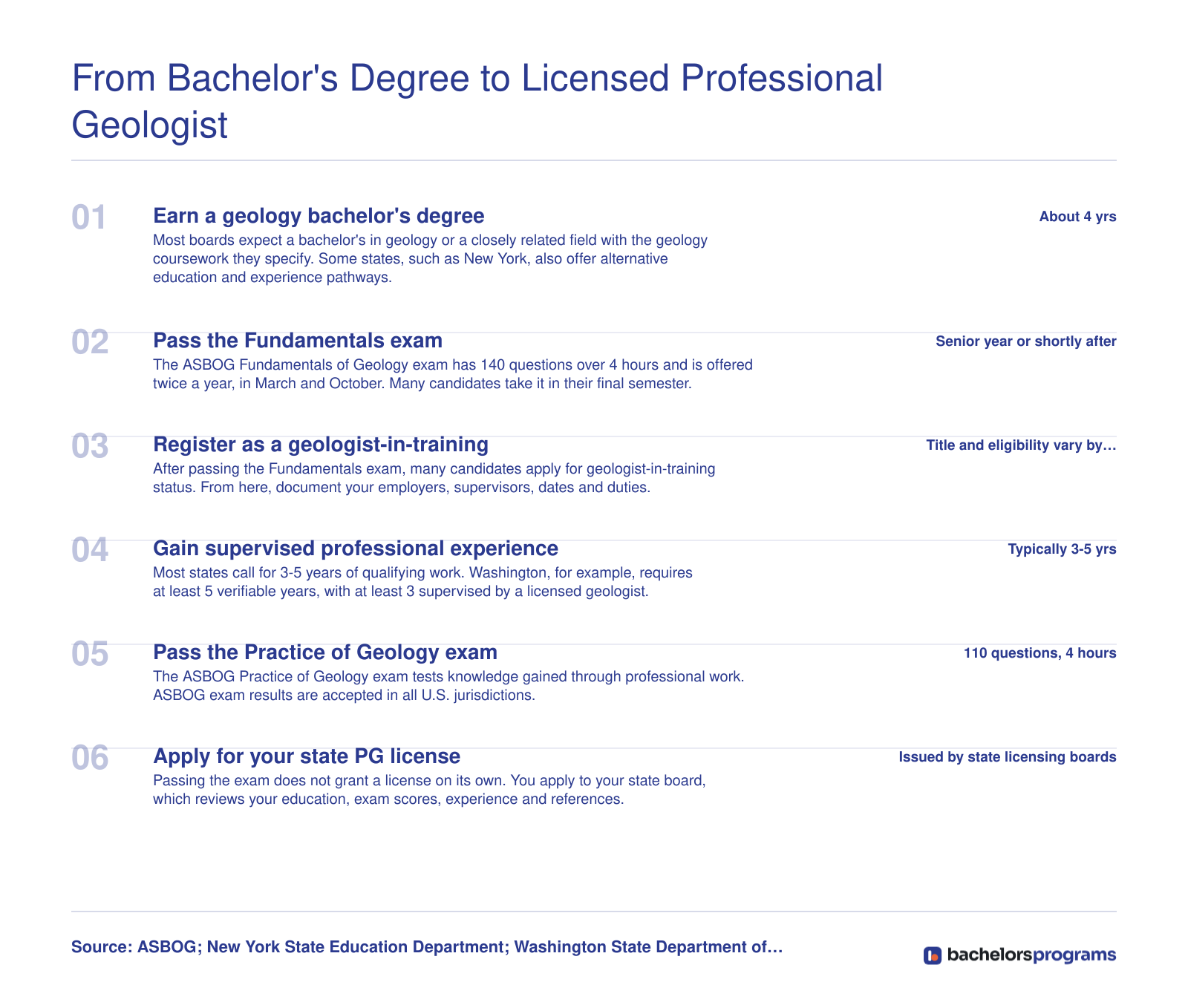
From Bachelor's Degree to Licensed Professional Geologist
About 30 states plus Puerto Rico license, register or certify geologists in 2026, and each state board sets its own rules, so check your target state before you plan. In those states, the Professional Geologist (PG) credential is generally what allows you to sign off on geologic reports in environmental and engineering geology work. The typical path takes about 7-9 years from freshman year to license.
Hydrology Pays Well Too
Water-focused geoscience is one of the stronger specializations to consider with a bachelor's degree in geosciences.
Questions to Ask Yourself
Do you want to spend your working life outdoors or in front of a screen?
Will the career you are aiming at eventually require a Professional Geologist license?
Can you fit a multi-week summer field camp into your schedule, and how will you fund it?
Are you open to energy and mining employers, or are you targeting environmental and water work?
Geosciences programs by state
Geosciences Degree FAQs
Are research rankings a reliable indicator of undergraduate teaching quality?
Are there accredited online bachelor's degrees in geosciences?
Can you get a geosciences job without a master's degree?
Do I need to be strong in math to major in geoscience or geophysics?
Compare Geosciences programs on the data that matters
Explore more Science & Engineering majors or browse every field of study.
All Science & Engineering programs Browse every field of study