Best Cybersecurity Degree Programs
Compare 720+ accredited Cybersecurity programs at 590+ colleges, with net price after aid, graduation rates, earnings and debt from IPEDS and the U.S. College Scorecard.

Cybersecurity bachelor's programs vary enormously in price and far less in what graduates earn in their first years. CUNY John Jay College of Criminal Justice reports an average net price of $3,203 a year after grants; Michigan Technological University reports $14,182. Programs typically award the Bachelor of Science (B.S.) in Cybersecurity, and they share a core of networking, cryptography and systems security.
What separates programs is verifiable: completion rates, debt at graduation, and earnings one year into the workforce. Security hiring managers read a transcript and a certification list, not a brochure.
Key Points
- West Virginia University cybersecurity graduates post the top first-year median: $44,255.
- John Jay College's $15,420 out-of-state sticker price drops sharply after grants.
- Weigh median federal debt against first-year pay before committing to any program.
Top 10 Schools for a Bachelor's Degree in Cybersecurity
These ten programs earned their places on a mix of cost after aid, how many students actually finish a degree, and how much cybersecurity coursework sits inside the major. Every card below gives the average net price, the share of students the school graduates, and program-level earnings where they are reported, with the earnings window stated. Where a school holds a confirmed National Security Agency Cyber Defense designation, that appears too.
Florida International University
#1Miami, FL · ~$9,000/yr (est.)
Best for: Working adults needing full online delivery
Florida International University runs its cybersecurity offerings through Cybersecurity@FIU at the Jack D. Gordon Institute, and the bachelor's program carries multiple concentration options with a fully online path. The average net price comes to roughly $9,300 a year after aid, and the school graduates 74% of its students. The institute also partners with the state on cybersecurity-awareness training for local government officials, which gives students a visible public-sector connection.
- Bachelor of Science in Cybersecurity
- Fully online option available
- Multiple cybersecurity concentrations
- Housed within Cybersecurity@FIU
- Undergraduate, graduate and certificate paths offered
- Professional education courses and fellowships available
Purdue University
#2West Lafayette, IN · ~$15,000/yr (est.)
Best for: Hands-on learners at a large research campus
Purdue's Bachelor of Science in Cybersecurity is ABET accredited and built on 120 credit hours of secure coding, cryptography, digital forensics, UNIX administration and network security. Students take on hands-on projects and use industry partnerships for internships, and the degree runs at the West Lafayette, Indianapolis and Kokomo campuses. Average net price lands near $14,600 after aid, and the school graduates 83% of its students.
- ABET accredited, 120 total credit hours
- 2.0 GPA minimum to stay in the program
- Taught at West Lafayette, Indianapolis and Kokomo
- Coursework in secure coding, cryptography and digital forensics
- Industry partnerships support internships
- C- grade required in prerequisite courses
Binghamton University
#3Vestal, NY · $20,000 – $25,000/yr (est.)
Best for: Computer science majors adding security depth
Binghamton University houses its cybersecurity work inside the computer science BS, where a Cybersecurity Track swaps four standard electives for security coursework in networks, software and cyber defense. That structure suits students who want a full computer science foundation rather than a stand-alone security degree. Average net price is about $21,600 after aid, and the school graduates 82% of its students.
- Four track courses replace standard BSCS electives
- Two required courses plus two electives
- Covers network security, software security and cyber defense
- 3-credit special topics courses can fill elective slots
- Only one of the two advanced security courses counts as an elective
- Advising through the School of Computing undergraduate office
New Jersey Institute of Technology
#4Newark, NJ · $20,000 – $38,000/yr (est.)
New Jersey Institute of Technology offers a B.S. in Computer Science with a Cybersecurity concentration, 120 credits, accredited by the Computing Accreditation Commission of ABET. The concentration sits alongside an artificial intelligence option, and the Newark campus puts students minutes from New York City employers. Average net price is roughly $16,500 after aid for the school overall, with in-state students living on campus seeing an estimated net price near $20,000, and the school graduates 73% of its students.
- ABET accredited, 120 total credit hours
- Cybersecurity concentration alongside an AI option
- Estimated net price near $20,000 for New Jersey residents on campus
- Average grants and scholarships of about $18,900
- R1 research institution minutes from New York City
- Common roles include cybersecurity architect and consultant
California State University-San Bernardino
#5San Bernardino, CA · $4,600/yr (est. net price)
California State University, San Bernardino delivers a Cyber Security concentration inside its B.S. in Information Systems and Technology, taught at the Palm Desert campus with separate roadmaps for first-time freshmen and transfer students. A minor and a stand-alone cyber security certificate let students build credentials in stages. Average net price is about $4,600 after aid, one of the lowest here, and the school graduates 55% of its students.
- Cyber Security concentration within the IST bachelor's
- Taught at the Palm Desert campus
- Separate roadmaps for freshmen and transfer students
- Internship information provided to majors
- Minor in Information Systems and Technology available
- Stand-alone certificate in Cyber Security offered
California State University-Los Angeles
#6Los Angeles, CA · ~$4,000/yr (est.)
California State University, Los Angeles awards a B.S. in Computer Information Systems with a Cybersecurity Option, 120 semester units with 72 in the major and a capstone. The option adds 33 units covering systems and network administration, security risk management and internal controls, computer forensics and network security essentials. Average net price is about $4,000 after aid, the second lowest on this list, and the school graduates 53% of its students.
- 120 semester units, 72 of them in the major
- 39-unit core with a capstone in information systems
- 33-unit cybersecurity option: 15 required plus 18 elective units
- Option courses cover forensics, network security and risk management
- Elective groups include data analytics and enterprise systems
- Data Analytics and Software Development options also offered
Appalachian State University
#7Boone, NC · $8,000 – $25,000/yr (est.)
Appalachian State University offers a Bachelor of Science in Cybersecurity with 120 credit hours, 34 of them in the major, covering networking, programming, ethical hacking, cyber forensics, IT audit and security management. Classes run at the Boone and Hickory campuses, mostly in person with some online options, and an internship is available inside the degree. Average net price is about $16,800 after aid, and the school graduates 75% of its students.
- 120 required credit hours, 34 in the major
- 44 general education credits
- Courses in ethical hacking, cyber forensics and IT audit
- Boone and Hickory campus locations
- Most classes in person, some courses online
- Internship option built into the major
Towson University
#8Towson, MD · ~$17,000/yr (est.)
Towson University offers a B.S. in Computer Science with a Cyber Operations track that pairs security theory with labs and hands-on exercises. Program materials cite National Security Agency recognition as a Center of Academic Excellence in Cyber Operations, and the department runs a Cyber Defense Club and a cybersecurity team alongside an accelerated B.S./M.S. option. Graduates earned a median of $71,484 four years after finishing. Average net price is about $17,400 after aid, and the school graduates 69% of its students.
- ABET accredited computer science degree
- Cyber Operations track with security theory and applications
- Program materials cite NSA Center of Academic Excellence in Cyber Operations recognition
- Accelerated B.S. to M.S. option in computer science
- Cyber Defense Club and cybersecurity competition team
- Internships with government agencies and industry partners
Michigan Technological University
#9Houghton, MI · $10,000 – $15,000/yr (est.)
Michigan Technological University's cybersecurity bachelor's sits in the Department of Applied Computing and holds NSA National Center of Academic Excellence designations in both cyber defense (CAE-CD) and cyber research (CAE-R). Students pick a Software Security concentration or a System and Network Security concentration, with published four-year outlines for each and labs built on industry-standard tools. The College of Computing reports a 93.14% overall job placement rate, and students have interned at the NSA, FBI, Los Alamos National Laboratory, Tesla, Ford and General Motors. Average net price is about $14,200 after aid, and the school graduates 68% of its students.
- NSA CAE-CD and CAE-R designated program
- Two concentrations: Software Security or System and Network Security
- Published four-year plans for each concentration
- Labs use industry-standard security tools
- 93.14% job placement rate reported by the College of Computing
- Student-built cyber range and national competition teams
- Internships and co-ops at the NSA, FBI, Los Alamos, Tesla, Ford and GM
CUNY John Jay College of Criminal Justice
#10New York, NY · ~$3,200/yr (est.)
CUNY John Jay College of Criminal Justice offers a BS in Computer Science and Information Security through its Department of Mathematics and Computer Science, blending programming, software systems, digital forensics and cybersecurity with a focus on evaluating system security. Graduates earned a median of $44,092 one year after finishing, and most go into government, nonprofit or financial-sector security roles. Average net price is about $3,200 after aid, the lowest on this list, and the school graduates 56% of its students.
- Four-year plan and course flowchart published
- Coursework in programming, digital forensics and cybersecurity
- Trains students to assess and evaluate system security
- Senior academic advisor plus a named major coordinator
- Graduates enter government, nonprofit and financial-sector roles
- Pathway to graduate programs in computing and quantitative fields
Cost & outcomes by school
Federal data for the highest-earning Cybersecurity programs, independent of the ranking above. Earnings are this field's bachelor's graduates four years after completing where the Scorecard reports them, else the school's undergraduate median.
| School | Net price / yr | Grad rate | Earnings | Debt | Grads/yr | Format |
|---|---|---|---|---|---|---|
| Stevens Institute of Technology NJ | $41,346 | 87% | $108,772 | $27,000 | — | Campus |
| Boston College MA | $41,704 | 91% | $103,937 | $19,000 | — | Hybrid |
| Georgetown University DC | $40,815 | 95% | $103,494 | $15,500 | — | Online |
| Embry-Riddle Aeronautical University-Prescott AZ | $40,287 | 68% | $98,996 | $19,500 | 23 | Campus |
| Northeastern University MA | $30,915 | 91% | $92,538 | $24,250 | — | Hybrid |
| George Washington University DC | $36,586 | 84% | $90,873 | $20,449 | — | Online |
| California Polytechnic State University-San Luis Obispo CA | $16,665 | 86% | $90,768 | $18,500 | — | Campus |
| Robert Morris University PA | $23,003 | 66% | $90,206 | $26,948 | 54 | Hybrid |
| Capitol Technology University MD | $22,102 | 43% | $85,035 | $20,264 | — | Campus |
| Drexel University PA | $38,509 | 78% | $84,648 | $25,325 | — | Online |
| New Jersey Institute of Technology NJ | $16,504 | 73% | $84,276 | $21,000 | 11 | Campus |
| Missouri University of Science and Technology MO | $16,298 | 64% | $82,957 | $23,250 | — | Campus |
Sources: U.S. Department of Education. Net price, graduation rate, earnings and debt: College Scorecard (earnings and debt for this field's bachelor's graduates where reported, else school-wide); graduates: IPEDS. A dash means no figure is reported.
Cost, debt & payoff
Median earnings of this field's bachelor's graduates (4 yrs after completing, else the school's undergraduate median) vs. their median federal loan debt · U.S. College Scorecard
Across these programs the median graduate earns about $52,574 and finishes with roughly $22,985 in debt — a ratio that clears a common rule of thumb (keep debt below first-year salary). Net price and debt vary widely school to school, so check the per-school figures in the table above before you shortlist.
Behind the List: The Data That Decided Each Spot
A university's overall numbers and a single major's numbers are not the same thing, and a fair comparison has to weigh both. Every school here earned its place on numbers a student actually pays or earns.
What Went Into Each Spot
Five inputs shaped every position: average net price after aid, the institution-wide graduation rate, program-level earnings and median federal debt from the College Scorecard, the number of students completing the program, and delivery format (campus, hybrid or online).
Why Program-Level Earnings Carry the Most Weight
A school-wide earnings average blends nursing, art history, engineering and everything in between. Earnings tied to the cybersecurity program show what graduates of that major take home, which is the outcome you are paying for. Median federal debt works the same way: it reflects borrowers from the program, not the whole campus.
Where the Numbers Fall Short
The graduation rate and the net price cover the whole campus, not the cybersecurity major. A school with a strong overall completion rate may still run a demanding computing program, and net price averages across every student's aid package, so your own bill could land higher or lower. Treat those two figures as context, then confirm specifics with the program's admissions office.
Source and Independence
All figures come from the latest College Scorecard snapshot. No school paid for placement.
Lowest Net Price Among Ranked Cybersecurity Programs
Net price, drawn from 2024 IPEDS and College Scorecard data, is the average yearly cost after grants and scholarships, and it often lands far below the tuition sticker. John Jay College lists $15,420 for out-of-state tuition, yet with nearly 90 percent of its students receiving Pell Grants, its average net price is $3,203. Public universities usually lead on price because state funding keeps in-state tuition low, while private schools tend to post higher sticker prices and rely on institutional aid to close the gap. Turtle Mountain College, a private nonprofit tribal college in North Dakota, breaks that pattern by charging every student $2,794 in tuition regardless of residency; its net price runs higher than its tuition because net price also counts housing, books and other living costs. Treat these figures as approximate averages rather than a personal quote, and run each school's net price calculator to estimate what you would actually pay.
| School | Program | Average Net Price | In-State Tuition | Out-of-State Tuition | Sector | Format |
|---|---|---|---|---|---|---|
| CUNY John Jay College of Criminal Justice (New York, NY) | BS in Computer Science and Information Security | $3,203 | $7,470 | $15,420 | Public | On campus |
| Turtle Mountain College (Belcourt, ND) | Bachelor of Applied Science in Cyber Defense | $3,428 | $2,794 | $2,794 | Private nonprofit | On campus |
| California State University-Los Angeles (Los Angeles, CA) | Computer Information Systems, B.S. (Cybersecurity Option) | $3,967 | $7,160 | $19,760 | Public | On campus |
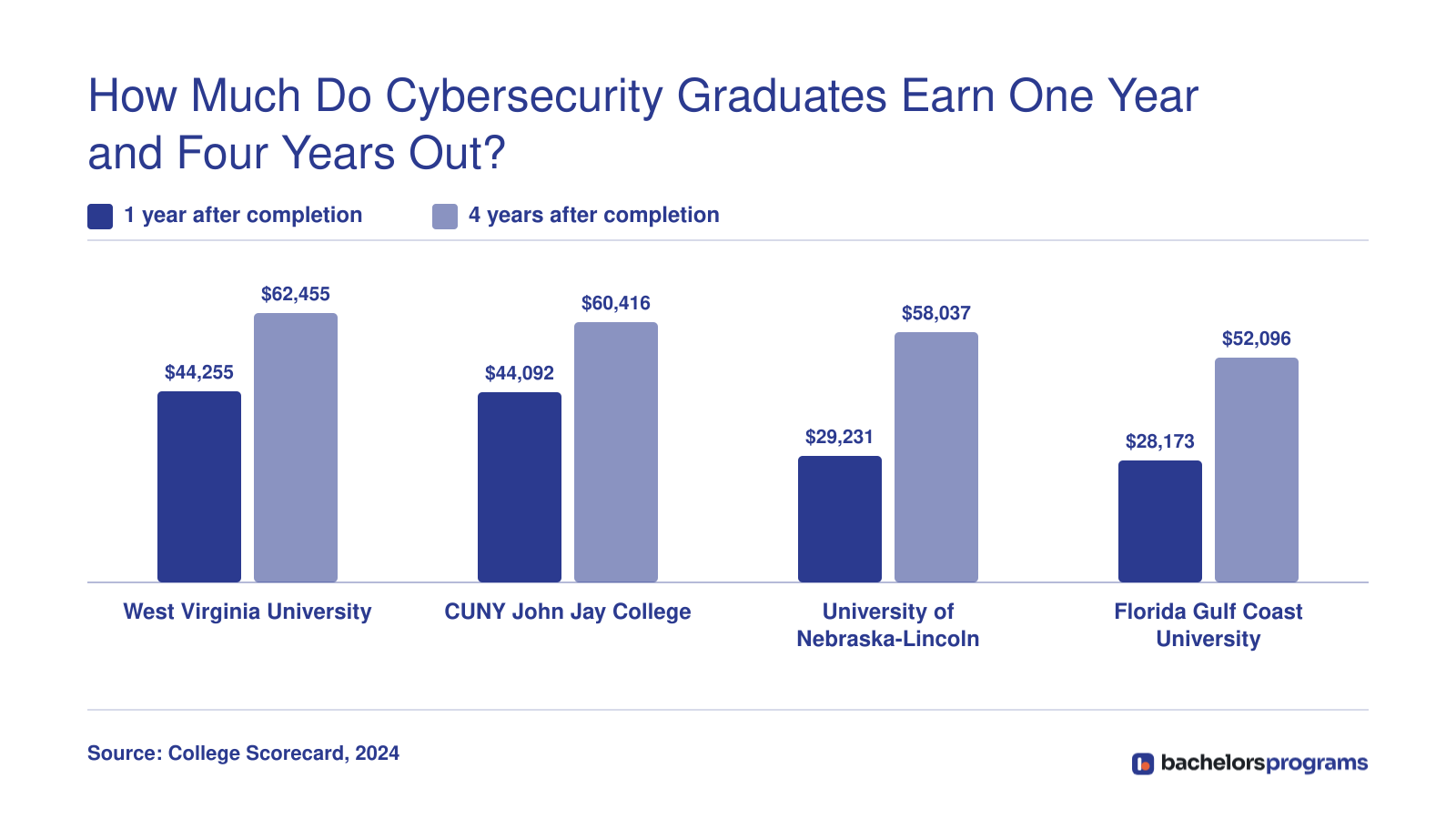
How Much Do Cybersecurity Graduates Earn One Year and Four Years Out?
These bars show College Scorecard program-level median earnings for cybersecurity bachelor's graduates at the schools below, measured one year and four years after completing the program. West Virginia University ($44,255) and CUNY John Jay College of Criminal Justice ($44,092) lead in the first year. Graduates of the University of Nebraska-Lincoln and Florida Gulf Coast University start lower but reach $58,037 and $52,096 by year four. Schools without a published program-level figure are left off the chart.
Debt Load and Monthly Payments: Which Programs Pay Off
Median federal debt is the typical amount a program's graduates owe when they finish, and it converts directly into a standard 10-year monthly payment. Four programs here stand out for the smallest balances, and each figure below is for the program itself, not the whole campus.
The Lightest Debt Loads
- John Jay College (CUNY): $15,500 in median debt, or about $164 a month.
- Florida Gulf Coast University: $19,099, or about $202 a month.
- West Virginia University: $24,121, or about $256 a month.
- University of Nebraska-Lincoln: $25,125, or about $266 a month.
Pasco-Hernando State College makes the list on price, but with no program-level debt figure available it sits out this comparison.
Payment Against First-Year Pay
Dividing each payment by median first-year monthly pay gives a quick payback test. John Jay graduates earn $44,092 in year one, so the $164 payment takes about 4.5% of monthly pay. West Virginia graduates earn $44,255, putting the $256 payment near 6.9%. Florida Gulf Coast graduates earn $28,173, which pushes the payment to roughly 8.6%. Nebraska's first-year median is $29,231, so $266 a month is closer to 11%. Nebraska's figure comes from a small graduating group, so treat it cautiously.
A Quick Health Check
Employment one year out is strong where reported: about 93% at John Jay, 94% at West Virginia and 95% at Nebraska. Florida Gulf Coast's figure is near 100%. Entry-level pay often climbs quickly, so the first-year ratio is the harshest version of the test.
Related Articles
Questions to Ask Yourself
Can you travel to campus for lab weekends or proctored exams, or do you need zero travel?
Do you learn security tools best in a live lab with classmates, or can you practice alone in a virtual cyber range?
Will you work full time while enrolled, making 8-week accelerated terms a help or a burden?
Questions to Ask Yourself
Do you want to break into systems or defend them?
Would you rather write policy and audit controls than spend your day in a terminal?
Are you aiming at a federal agency or a defense contractor?
Cybersecurity programs by state
Quick Answers on Cybersecurity Degrees and CAE Schools
Is a B.S. in cybersecurity better than a computer science degree for landing a security job?
Does attending a CAE-designated school help you qualify for the CyberCorps Scholarship for Service?
What is the best cybersecurity degree to get?
Compare Cybersecurity programs on the data that matters
Explore more Computers & IT majors or browse every field of study.
All Computers & IT programs Browse every field of study