Best Computer Engineering Degree Programs
Compare 370+ accredited Computer Engineering programs at 360+ colleges, with net price after aid, graduation rates, earnings and debt from IPEDS and the U.S. College Scorecard.
A bachelor's degree in computer engineering, usually a Bachelor of Science (B.S.), combines electrical engineering and computer science into one four-year program, and the schools offering it charge very different amounts. Among the programs here, annual net price runs from about $6,500 at the University of Florida to roughly $19,000 at Harvard.
The real question is which undergraduate programs are worth the cost. Most published rankings lean on reputation or graduate-level research metrics and skip undergraduate cost and program-level earnings. Several top programs also admit fewer than one in ten applicants, so price, access, and ABET accreditation matter as much as brand.
Key Points
- Average 2024 net price after aid: $6,541 (Florida) to $13,936 (Georgia).
- ABET-accredited programs typically take four years, often 124 to 134 credits.
- Admission is tough at the top: Harvard 3.7%, UCLA 9.0%.
Best Computer Engineering Schools Ranked: Our Top 10
Ten bachelor's degree programs in computer engineering made this list, and each one pairs a rigorous engineering core with a clear route into hardware, embedded systems, or computing architecture. They run from large public flagships where in-state students pay well under $15,000 net to a small private program with one of the highest completion rates in the country. Net price, graduation rate, credit load, and concentration options are spelled out on every card so you can compare them side by side.
University of Florida
#1Gainesville, FL · ~$7,000/yr (est.)
Best for: Budget-conscious in-state engineers
The University of Florida runs one of the largest engineering colleges in the country, and its computer engineering bachelor's degree reflects that scale: a 126-credit, ABET-accredited curriculum with a cybersecurity specialization. Students draw technical electives from both the computer and information science department and the electrical and computer engineering department, covering architecture, embedded systems, networking, and security. The school graduates 91 percent of its students, and in-state students pay a net price near $6,500 after aid, the lowest on this list. Cooperative education opportunities let students alternate work terms with study.
- ABET accredited under the Engineering Accreditation Commission
- 126 credit hours, including 12 technical elective credits from CISE and ECE
- Cybersecurity specialization
- Two-course design sequence: Computer Engineering Design 1 and 2
- Transfer applicants need a 2.5 GPA in six pre-professional courses
- Minimum C in Calculus 1 through 3, the physics sequence, and differential equations
- Cooperative education opportunities available
University of Michigan
#2Ann Arbor, MI · $18,000 – $61,000/yr (est.)
Best for: Robotics and chip design specialists
Michigan runs computer engineering as a joint major between its computer science and electrical and computer engineering divisions, so students take courses and advising from both sides of the field. Eight optional paths of study span computer architecture, VLSI and chip design, robotics and vision, embedded systems, and system software, and every senior finishes a major design experience. The school graduates 93 percent of its students, with in-state tuition around $18,500 and an average net price after aid near $13,100. A five-year sequential program lets students complete a bachelor's and master's degree together.
- ABET accredited and jointly run by Computer Science and Electrical and Computer Engineering
- 8 optional paths of study, including VLSI systems and embedded systems
- Major Design Experience capstone required in the final year
- Five-year sequential bachelor's and master's option
- ECE master's entry with a 3.4 GPA, no GRE or recommendation letters
- Optional paths include computer architecture, robotics and vision, and system software
- Alumni founded Google and created the iPod
University of California-Los Angeles
#3Los Angeles, CA · $13,000/yr (est. net price)
Best for: Students blending CS and hardware design
UCLA's computer engineering degree is a designated capstone major administered jointly by the computer science and electrical and computer engineering departments. Major preparation alone covers 19 courses, and the degree layers on electives from both disciplines, 12 units of technical breadth, and a two-quarter capstone design sequence. Suggested tracks include networked embedded systems and data science, with an emphasis on building systems that work within real design constraints. The school graduates 93 percent of its students, and California residents pay a net price near $12,500 after aid.
- Designated capstone major with a two-quarter capstone design course
- Jointly administered by Computer Science and Electrical and Computer Engineering
- 19 courses required for major preparation
- 8 units of computer science electives and 8 units of ECE electives
- 12 units of technical breadth coursework
- Suggested tracks: Networked Embedded Systems and Data Science
- Focus on IoT and robotic systems
University of California-San Diego
#4La Jolla, CA · $10,000 – $15,000/yr (est.)
UC San Diego awards its computer engineering bachelor's degree through two departments at once, computer science and electrical and computer engineering, and the curriculum is identical in each. Upper-division work covers algorithm theory and design, hardware and software, and electronic systems, with subject areas running from embedded systems and robotics to cryptography and machine learning. A Fall 2024 revision tightened the CSE and ECE integration, added project-based work, and capped outside electives at 8 units. The school graduates 86 percent of its students, and the median graduate debt is about $18,400.
- Jointly run by Computer Science and Electrical and Computer Engineering
- Outside-department electives capped at 8 units
- Major courses require a C- or better
- Covers embedded systems, robotics, cryptography, and machine learning
- Curriculum updated for Fall 2024
- Sample four-year plans provided for each college
- Graduate CSE or ECE courses can count toward the major
University of California-Irvine
#5Irvine, CA · $14,000/yr (est. net price)
UC Irvine's computer engineering program is a 187-unit bachelor's degree inside the Henry Samueli School of Engineering, built on a core of mathematics, physics, and chemistry. Students take network analysis, digital systems, and electronics before finishing with a two-course senior design project, and they meet a faculty advisor every year to get their study plan approved. The school graduates 87 percent of its students, and California residents pay a net price near $14,300 after aid. The electrical engineering and computer science department also offers graduate degrees for students who want to continue.
- 187 total credit hours
- Core of mathematics, physics, and chemistry
- Two-course Senior Design Project: EECS 159A and 159B
- Three engineering elective courses required
- Faculty advisor approves the program of study each year
- Transfer applicants need two years of approved calculus
- Calculus-based physics with laboratories required for transfers
Georgia Institute of Technology
#6Atlanta, GA · ~$12,000/yr (est.)
Georgia Tech's computer engineering bachelor's degree is built around digital design, computer architecture, computer networks and internetworking, and computer applications. It is a focused, architecture-heavy path for students who want hardware and network systems work rather than a broad survey of computing topics. The school graduates 94 percent of its students, one of the highest completion rates here, and in-state students pay a net price near $12,100 after aid.
- Coursework in digital design
- Computer architecture emphasis
- Computer networks and internetworking focus
- Computer applications built into the curriculum
Harvard University
#7Cambridge, MA · $15,000 – $20,000/yr (est.)
Harvard's Engineering Sciences A.B. with an electrical and computer engineering track is the outlier on this list: a liberal arts concentration rather than a Bachelor of Science in Engineering. Coursework covers the physics of new materials and devices, circuits and next-generation computing platforms, and the algorithms that run on them, with subtopics from power systems and microelectronics to signal processing and telecommunications. The school graduates 98 percent of its students, though its net price near $19,000 after aid is the highest among the schools here. First-year and sophomore advising events plus an engineering guidebook support students before they commit to the concentration.
- Liberal arts concentration rather than a Bachelor of Science in Engineering
- Track covers circuits, next-generation computing platforms, and algorithms
- Topics span power systems, microelectronics, control systems, and signal processing
- Experience in the engineering design process
- Advising events for first-years and sophomores
- Engineering Guidebook supports pre-concentration planning
University of Illinois Urbana-Champaign
#8Champaign, IL · ~$14,000/yr (est.)
Illinois awards a 128-credit computer engineering bachelor's degree through the Grainger College of Engineering, with a 36-hour technical core and 30 hours of technical electives. Students concentrate in subdisciplines such as hardware systems, cyberphysical systems, networking, big data analytics, and AI, machine learning, and robotics. The school graduates 85 percent of its students, and in-state students pay a net price near $14,400 after aid. Study abroad and internship plans can reshape the four-year sequence, and a third level of a language other than English is required.
- ABET accredited, 128 total credit hours
- 9 concentration options, including hardware systems and cyberphysical systems
- 36-hour computer engineering technical core
- 29 hours of mathematics and physics foundation
- 30 hours of technical electives
- 2.0 technical GPA required for ECE courses
- Third level of a language other than English required
- Study abroad and internships can shape the four-year plan
Ohio State University
#9Columbus, OH · $17,000/yr (est. net price)
Ohio State awards a Bachelor of Science in Electrical and Computer Engineering with a computer engineering track, accredited under the ABET criteria for electrical and computer engineering programs. It produces the largest computer engineering graduating class on this list, with more than 400 completions in the most recent data. The program also prepares students for licensure or certification in Ohio, with guidance for students who plan to practice in another state. The school graduates 88 percent of its students, and in-state students pay a net price near $17,300 after aid.
- ABET accredited under electrical and computer engineering program criteria
- Two tracks: electrical engineering and computer engineering
- Prepares students for licensure or certification in Ohio
- State licensure requirement guidance for other states
- Academic advising available through the college
University of California-Davis
#10Davis, CA · $10,000 – $15,000/yr (est.)
UC Davis structures its computer engineering bachelor's degree around explicit unit blocks: 13 units of electronics, 18 units of computer hardware, 12 units of computer software, 10 units of design electives, and 9 units of technical electives. Students can concentrate their electives in one area or spread them across all three, and specialty areas run from processor design and VLSI to computer vision, robotics, and quantum computing. The school graduates 86 percent of its students, and California residents pay a net price near $14,700 after aid, with median graduate debt around $12,700.
- 13 units of electronics, 18 units of computer hardware, 12 units of computer software
- 10 units of design electives and 9 units of technical electives
- Electives can focus on one area or spread across all three
- Specialty areas include VLSI design, robotics, and quantum computing
- Degree checklists for first-year, transfer, and double-major paths
- Prepares students for careers or graduate study
Cost & outcomes by school
Federal data for the highest-earning Computer Engineering programs, independent of the ranking above. Earnings are this field's bachelor's graduates four years after completing where the Scorecard reports them, else the school's undergraduate median.
| School | Net price / yr | Grad rate | Earnings | Debt | Grads/yr | Format |
|---|---|---|---|---|---|---|
| University of California-Los Angeles CA | $12,548 | 93% | $228,705 | $13,500 | 87 | Campus |
| Columbia University in the City of New York NY | $21,590 | 96% | $194,365 | $21,500 | 21 | Campus |
| University of Washington-Seattle Campus WA | $14,091 | 85% | $169,570 | $15,422 | 28 | Campus |
| University of Washington-Tacoma Campus WA | $10,163 | 63% | $169,570 | $15,422 | 10 | Campus |
| University of Washington-Bothell Campus WA | $12,319 | 65% | $169,570 | $15,422 | 13 | Hybrid |
| University of Illinois Urbana-Champaign IL | $14,355 | 85% | $159,855 | $20,500 | 458 | Campus |
| University of Maryland-College Park MD | $15,678 | 89% | $152,422 | $20,417 | 93 | Campus |
| University of California-San Diego CA | $12,470 | 86% | $149,139 | $18,414 | 210 | Campus |
| California Polytechnic State University-San Luis Obispo CA | $16,665 | 86% | $148,950 | $20,556 | 113 | Campus |
| University of Virginia VA | $21,565 | 96% | $148,175 | $16,875 | 60 | Campus |
| University of California-Davis CA | $14,741 | 86% | $145,422 | $12,703 | 106 | Campus |
| University of California-Santa Barbara CA | $16,109 | 83% | $144,703 | $14,410 | 54 | Campus |
Sources: U.S. Department of Education. Net price, graduation rate, earnings and debt: College Scorecard (earnings and debt for this field's bachelor's graduates where reported, else school-wide); graduates: IPEDS. A dash means no figure is reported.
Cost, debt & payoff
Median earnings of this field's bachelor's graduates (4 yrs after completing, else the school's undergraduate median) vs. their median federal loan debt · U.S. College Scorecard
Across these programs the median graduate earns about $78,406 and finishes with roughly $22,934 in debt — a ratio that clears a common rule of thumb (keep debt below first-year salary). Net price and debt vary widely school to school, so check the per-school figures in the table above before you shortlist.
How We Ranked These Bachelor's Degree Programs
Outcomes data tells you what graduates actually earned and owed, a different thing from how academics rate a program's reputation. Our ranking rests on the first kind of evidence.
Our Data Inputs
- Earnings and debt: College Scorecard program-level figures for computer engineering graduates.
- Completion: Institution-wide graduation and retention rates.
- Cost: Average net price after grants and scholarships.
How This Differs From U.S. News
The 2027 U.S. News Best Undergraduate Computer Engineering Programs list, released September 23, 2026, runs on a peer assessment survey.1 Deans and senior faculty at accredited U.S. institutions nominate up to 15 programs per specialty.1 A program needs at least seven nominations to be ranked, and positions follow nomination counts, not average scores.1 In the category for schools without doctoral programs, Cal Poly San Luis Obispo is listed first and Rose-Hulman Institute of Technology second.
That approach shows how respected a program is among engineering educators. It says nothing about what a graduate's first paycheck looks like or how much debt comes with it. Outcomes-based data speaks to those questions, which is why we built on it.
Limits You Should Know
Neither approach is complete, and ours has two clear gaps:
- Net price is an institution-wide average, so what a computer engineering student pays may differ from the figure shown.
- Graduation rate covers the whole institution, not computer engineering specifically.
Treat those two numbers as context, not as a promise about any one major.
Use reputation rankings to see how peers view a program, then use outcomes data to test whether that standing translates into earnings and affordability that work for you.
What a Bachelor's Degree in Computer Engineering Covers
Computer engineering curricula keep absorbing new material, from AI to cybersecurity, yet the core of the degree has stayed remarkably steady. Most ABET-accredited programs run four years, and the credit loads in the examples I reviewed span 124 to 134 semester credits: Sacramento State requires 124, Maryland 124 to 127, Oklahoma 128, and Manhattan 134. ABET sets no universal total, only minimums of 30 semester credit hours of math and basic science and 45 of engineering topics1, so engineering schedules often feel heavier than those of other majors.
The Core Sequence
Early years build the foundation: calculus, calculus-based physics, chemistry at some schools, and intro programming. Next come circuits, digital logic, electronics, data structures, and discrete math. Upper-level work moves into computer architecture, operating systems, signals and systems, networking, and embedded systems. Sacramento State, for example, includes advanced logic design, embedded systems design, and digital VLSI design.2 Exact course order varies by school.
Most programs finish with a senior design capstone, and the format differs. Sacramento State uses two 2-credit courses, Manhattan runs a two-semester capstone, and Grand Valley State splits it into 1-credit and 2-credit courses. ABET requires a major design experience either way.1
Hardware Meets Software
Computer engineering sits between electrical engineering and computer science. You study the circuits and processors, and you also write the code that runs on them.
Hands-On Elements
- Labs: Courses such as Oklahoma's Digital Design Laboratory pair theory with bench work.3
- Team projects: Capstones typically put students in groups building a working design.
- Co-ops and internships: Many programs offer these options, so check each school's details.
- Concentrations: Some schools, like Manhattan, offer tracks in applied AI or cybersecurity.
Related Articles
Computer Engineering Bachelor's Degree Cost by School
Average net price after aid ranges from $6,541 a year at the University of Florida to $13,936 at the University of Georgia. These figures are 2024 U.S. Department of Education averages for public institutions (IPEDS and College Scorecard), so treat them as approximate and not as a quote for any individual student. Every school here is public, and residency is the biggest cost factor. Out-of-state tuition and fees reach $60,946 at the University of Michigan, which can rival a private university's net price, while a private school's published tuition often shrinks sharply once grants apply. Before ruling out any program on sticker price, run its net price calculator with your own family's numbers.
| School | Location | In-State Tuition and Fees | Out-of-State Tuition and Fees | Average Net Price After Aid | Cost Basis |
|---|---|---|---|---|---|
| University of Florida | Gainesville, FL | $6,381 | $28,659 | $6,541 | Public school average annual net price, 2024 |
| California State University-Fullerton | Fullerton, CA | $7,470 | $20,070 | $6,555 | Public school average annual net price, 2024 |
| Florida International University | Miami, FL | $6,565 | $18,964 | $9,288 | Public school average annual net price, 2024 |
| University of Central Florida | Orlando, FL | $6,368 | $22,467 | $10,411 | Public school average annual net price, 2024 |
| Florida State University | Tallahassee, FL | $5,656 | $18,786 | $11,297 | Public school average annual net price, 2024 |
| Georgia Institute of Technology | Atlanta, GA | $12,058 | $34,484 | $12,116 | Public school average annual net price, 2024 |
| University of California-San Diego | La Jolla, CA | $16,758 | $50,958 | $12,470 | Public school average annual net price, 2024 |
| University of California-Los Angeles | Los Angeles, CA | $15,203 | $49,403 | $12,548 | Public school average annual net price, 2024 |
| University of Michigan | Ann Arbor, MI | $17,736 | $60,946 | $13,138 | Public school average annual net price, 2024 |
| University of Georgia | Athens, GA | $11,450 | $31,688 | $13,936 | Public school average annual net price, 2024 |
National Pay for Computer Hardware Engineers
For a sense of where a bachelor's degree in computer engineering can lead, look at federal pay data for the occupation many graduates enter.
Specializations, Online Options, and Combined Bachelor's/Master's Pathways
Choosing a specialization and a delivery format deliberately pays off more than picking a familiar university name. The field splits into distinct hardware tracks, and online study and accelerated master's pathways vary sharply by program.
Specializations That Shape the Degree
Most programs let students shape upper-level electives around a track.
- AI and machine learning hardware: Accelerators, GPU architecture, and efficient computing for models.
- Semiconductors and VLSI: Chip design, verification, and fabrication-aware engineering, a direct pipeline to hardware employers.
- Robotics: Embedded control, sensors, and mechanical interfaces.
- Cybersecurity: Secure hardware, embedded security, and network defense. The University of Florida lists cybersecurity as a computer engineering concentration.
- Embedded systems: Firmware, real-time computing, and device integration.
Michigan lists eight concentration options within its computer engineering major, and Harvard frames its track as Electrical and Computer Engineering.
Online and Hybrid Realities
Computer engineering labs are the main barrier to fully online study. Circuits, embedded systems, and hardware design courses typically require physical equipment and supervised lab work, so most programs remain campus-based. The ranked programs above are campus-based, but verified online and hybrid options exist outside the ranking. National University offers a 100% online Bachelor of Science in Electrical and Computer Engineering; it is ABET-accredited and close in content, though not titled a computer engineering degree.1 Grand Valley State University's B.S.E. in Computer Engineering is ABET-accredited in hybrid and online formats; the hybrid version requires campus attendance more than once per semester.2 Colorado Technical University's online B.S. in Computer Engineering is ABET-accredited and requires 186 credit hours in 5-week courses.3 Liberty University offers its ABET-accredited B.S. in Computer Engineering online and on campus.4
Accelerated Bachelor's to Master's Pathways
Accelerated programs often let eligible undergraduates count graduate coursework toward both degrees and finish in about five years. The University of Missouri pathway requires at least 90 credit hours and a 3.0 cumulative GPA for entry.5 Students may apply up to 15 graduate credit hours to both degrees, and the bachelor's is conferred after 120 total credit hours, including at least 12 dual-enrollment hours; the remaining 18 graduate hours complete the M.S. Total graduation requirements reach at least 144 credit hours. The University of Bridgeport's accelerated B.S.-to-M.S. Engineering pathway in computer engineering is designed for five years and requires a 2.7 GPA to qualify; the computer engineering B.S. alone requires 122 credit hours. Timing matters: Missouri's 90-credit threshold usually places entry in the junior year, and Bridgeport expects students to qualify by the summer after junior year.
Semiconductor Industry Pay for Hardware Engineers
Chip design and fabrication pay well above the field's overall median, which makes a semiconductor focus a strong specialization to weigh.
Computer Engineering vs. Computer Science: Which Degree Fits You?
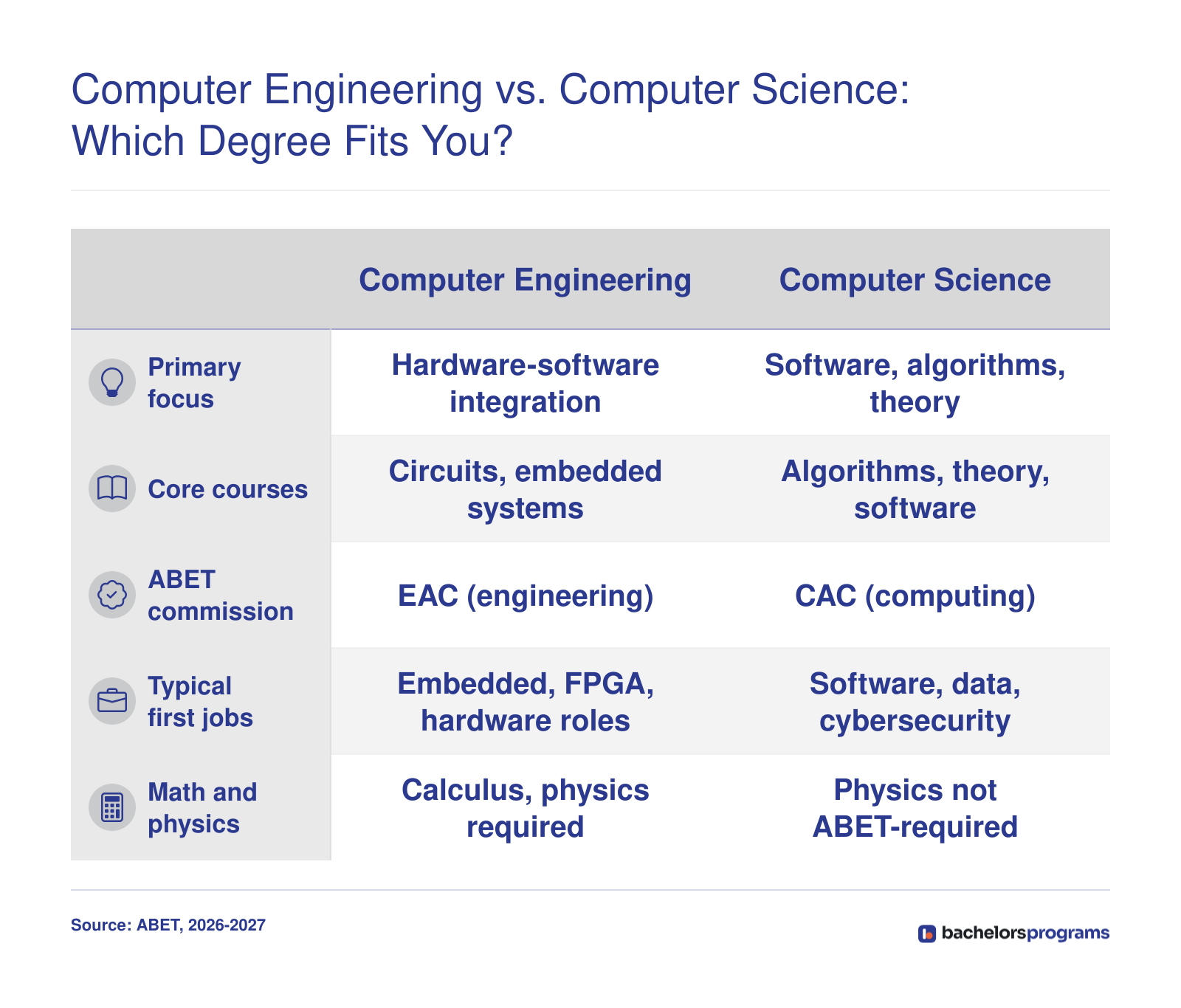
Neither degree is better overall. The right choice depends on whether you want to work close to the hardware: choose computer engineering for circuits, processors, and embedded devices, and choose computer science for software, algorithms, and theory. Computer engineering programs also include programming and algorithms, so graduates can generally move into software roles more easily than computer science graduates can move into hardware design.
How to Choose the Right Computer Engineering Program for You
The strongest computer engineering programs have become harder to enter, but the credential employers and licensing boards look for does not depend on a hard-to-get acceptance letter. The admission rates in the ranking show the spread. Harvard (3.7%), UCLA (9.0%), Georgia Tech (14.1%) and Michigan (15.6%) are reach schools for most applicants. Florida (24.2%), UC San Diego (26.7%) and UC Irvine (28.6%) sit in the middle. UC Davis (41.8%), Illinois (42.4%) and Ohio State (60.6%) are the more attainable options. An ABET-accredited program at a less selective school opens the same licensure path as one at a reach school.
Match the Program to How You Learn
Look past the school name to what you will build. Michigan and Illinois offer many concentration options, UC Davis lists a quantum computing specialty area, and Florida points to embedded systems, networking and security. Ask each department about lab hours, maker-space access for first- and second-year students, and whether undergraduates can join faculty research before junior year.
Prioritize Hands-On Experience
A structured co-op or internship pipeline can matter as much as the curriculum. Florida lists cooperative education opportunities, and Illinois builds internships and study abroad into its sample plans. Paid co-ops can offset part of your costs and often strengthen your starting offers, so ask each program how many students take part and which employers recruit them.
Compare Net Price, Not Sticker Tuition
Weigh what you would actually pay against what graduates earn and owe. Florida's net price is about $6,541, with median first-year program earnings of $87,949 and a typical monthly loan payment near $217. Illinois costs more, at a net price of about $14,355, but its first-year program earnings are $103,123 with the same $217 payment. Ohio State's net price is about $17,339, with a monthly payment near $207. Run the same comparison for every school you are considering.
File the FAFSA early, because it is how you get federal aid and many institutional awards. Then check each engineering college for its own scholarships, which often carry separate deadlines.
Your Next Step
Pick three to five schools from the ranking: at least one reach, a couple of mid-range options and one attainable choice with a strong net price. Request program information from each, and ask about ABET status, co-op placement and scholarship deadlines before you apply.
Computer Engineering programs by state
Compare Computer Engineering programs on the data that matters
Explore more Computers & IT majors or browse every field of study.
All Computers & IT programs Browse every field of study