Best Innovation Degree Programs
Compare 470+ accredited Innovation programs at 460+ colleges, with net price after aid, graduation rates, earnings and debt from IPEDS and the U.S. College Scorecard.

A bachelor's degree in innovation can run $11,603 a year in tuition and fees for in-state students at the University of Wisconsin-Madison, or $72,097 at the University of Southern California. That gap is the first tension to weigh. Everything here covers undergraduate programs only, not graduate study.
These degrees blend entrepreneurship, design thinking, and business strategy for students who want to build products, launch ventures, or drive change inside companies. The top 10 programs appear first, then a comparison of net price, graduate earnings, and online versus campus options.
Most programs sit inside business schools, so the diploma often reads "entrepreneurship" rather than "innovation."
Key Points
- CUNY City College posts the lowest average net price: $3,776 a year.
- Florida International University offers an online food innovation and entrepreneurship concentration.
- Marketing management ranks among the best-paid careers for innovation graduates.
Best Innovation Degree Programs Ranked for 2027
A bachelor's degree in innovation usually shows up as an entrepreneurship major, a concentration inside a business degree, or an interdisciplinary design-and-business program, and the strongest ones put students inside real ventures before they graduate. The best innovation degree program on this list is the University of Wisconsin-Madison's BBA in Entrepreneurship, which pairs 18 credits of entrepreneurship coursework with applied venture creation inside an AACSB-accredited business school. All ten programs are based at U.S. institutions, and each entry lists the campus city and state, the average net price after aid, and the school's graduation rate.
University of Wisconsin-Madison
#1Madison, WI · ~$17,000/yr (est.)
Best for: Aspiring founders in campus venture labs
Madison, Wisconsin is home to the flagship campus whose entrepreneurship major, the BBA in Entrepreneurship, sits inside the AACSB-accredited Wisconsin School of Business. Majors take at least 18 credits in the field plus 3 to 6 credits of applied work such as Venture Creation, and the university is building a Wisconsin Entrepreneurship Hub that connects student and faculty founders with commercialization and venture resources. Average net price after aid is $17,354, and the school's graduation rate is 90%.
- 18 credits of entrepreneurship coursework within the BBA
- Includes Intro to Entrepreneurship and Strategic Management of Innovation
- 3 to 6 credits of applied venture creation work
- 120 total credits; AACSB International accreditation
- 3.0 GPA and prerequisite courses required for admission
- Electives in technology entrepreneurship and new product innovation
- Fall start only; application deadline is mid March
University of Pennsylvania
#2Philadelphia, PA · $29,000/yr (est. net price)
Best for: Wharton business students adding an innovation credential
In Philadelphia, Pennsylvania, the Entrepreneurship and Innovation BS is a Wharton concentration built on 37 course units with a required senior capstone. Students draw on the Goergen Entrepreneurial Management Program and Wharton's Venture Lab, and electives reach into venture capital, intellectual property strategy, product design and negotiations. Average net price after aid is $15,715, and the school's graduation rate is 97%.
- 37 course units including a 0.5-unit senior capstone
- Starts with MGMT 2300 plus social or technological entrepreneurship
- Electives in venture capital, IP strategy, product design, negotiations
- Supported by Goergen Entrepreneurial Management Program and Venture Lab
- Students build real business plans and field projects
- Curriculum applies to students entering fall 2026 and later
Florida State University
#3Tallahassee, FL · ~$11,000/yr (est.)
Best for: STEM majors building startup skills
STEM Entrepreneurship is a full major at Florida State University's Jim Moran College of Entrepreneurship in Tallahassee, Florida, where students pair a STEM focus area with coursework in product development, research methods and data science. Faculty and Entrepreneurs in Residence teach directly, and a combined pathway lets strong students share up to 12 graduate credit hours with the bachelor's degree. Average net price after aid is $11,297 and the school's graduation rate is 86%; program graduates had median earnings of $48,625 one year after finishing and $58,824 four years after finishing.
- Pairs a STEM focus area with entrepreneurship coursework
- Covers innovation, technology commercialization and venture creation
- Taught by faculty and Entrepreneurs in Residence
- Combined pathway shares up to 12 graduate credits
- Offered at the Tallahassee campus
- Scholarships and financial aid available
Fashion Institute of Technology
#4New York, NY · $6,000 – $17,000/yr (est.)
The Fashion Institute of Technology in New York, New York awards a BS in Entrepreneurship for the Fashion and Design Industries through the Jay and Patty Baker School of Business and Technology. The curriculum is written and continuously revised by practicing professionals, and it rests on a liberal arts foundation alongside the business coursework. Average net price after aid is $19,095 and the school's graduation rate is 81%; program graduates had median earnings of $24,387 one year after finishing and $49,627 four years after finishing.
- BS in Entrepreneurship for the Fashion and Design Industries
- Curriculum built and revised by practicing professionals
- Liberal arts foundation alongside business coursework
- Part of the Jay and Patty Baker School of Business and Technology
- Connects students with industry leaders and innovators
University of Washington-Seattle Campus
#5Seattle, WA · ~$14,000/yr (est.)
The University of Washington's Seattle campus runs entrepreneurship as a major inside the BA in Business Administration, a 75 to 77 credit major that includes drafting business proposals and financial plans and connects students to the Buerk Center Innovation Laboratory. Fall and winter admission windows plus roughly 90 Foster School undergraduate scholarships give students scheduling and funding options. Average net price after aid is $14,091 and the school's graduation rate is 85%; program graduates had median earnings of $65,177 one year after finishing.
- 75 to 77 credit major inside the 180-credit BA in Business Administration
- 20 entrepreneurship credits, including ENTRE 370 and finance and marketing courses
- Buerk Center Innovation Laboratory links entrepreneurship to technology development
- Students create business proposals and draft financial and marketing plans
- Fall and winter admission; April 5 and October 5 deadlines
- About 90 undergraduate scholarships from the Foster School
- Honors options and internships available
University of Illinois Urbana-Champaign
#6Champaign, IL · ~$14,000/yr (est.)
Champaign, Illinois hosts two routes into innovation at the University of Illinois Urbana-Champaign: a Strategy, Innovation, and Entrepreneurship BS for business students and the ILEE degree for current Grainger Engineering students, who earn it as a second bachelor's. The engineering track layers 31 ILEE hours onto a technical core that runs from design thinking and need-finding through intellectual property, contracts and high-tech venture marketing. Average net price after aid is $14,355 and the school's graduation rate is 85%.
- 124 total credits with 40 upper-division hours
- 9 hours of skill-building electives plus experiential options
- Third-semester language requirement
- Focus on opportunity identification and venture creation
Brigham Young University
#7Provo, UT · $15,000 – $20,000/yr (est.)
Brigham Young University in Provo, Utah runs Entrepreneurial Management as a 64-credit BS inside the Marriott School, with required entry courses such as Startup Bootcamp and a capstone to close the degree. Electives range from Venture Capital for Startups to an Innovation Practicum, and students must be formally accepted into the program before enrolling. Average net price after aid is $15,564 and the school's graduation rate is 81%; program graduates had median earnings of $64,061 one year after finishing and $97,085 four years after finishing.
- 64 credit hours with a required capstone
- Entry courses include Startup Bootcamp and Intro to Information Systems
- Core covers Entrepreneurial Innovation and Creating New Ventures
- Electives such as Venture Capital for Startups and Innovation Practicum
- Lean experimentation and venture validation
- Formal acceptance into the Marriott School program required
University of Southern California
#8Los Angeles, CA · ~$33,000/yr (est.)
Los Angeles, California is home to the BS Business of Innovation, a joint degree from USC Marshall and the Iovine and Young Academy. Half the curriculum is business and half is design, interactive computing and prototyping, with fabrication labs, 3D printing, laser cutters and a mixed reality studio on hand. Average net price after aid is $32,740 and the school's graduation rate is 92%; program graduates had median earnings of $73,234 one year after finishing and $96,120 four years after finishing.
- Joint degree from USC Marshall and the Iovine and Young Academy
- 44 units of business plus 44 units of academy coursework
- Fabrication labs, 3D printing, laser cutters and a mixed reality studio
- Entrepreneurship training through the Greif Center
- Elective areas include Extended Reality and Transformative AI
- 8 units of integrative business courses
California Polytechnic State University-San Luis Obispo
#9San Luis Obispo, CA · ~$17,000/yr (est.)
California Polytechnic State University in San Luis Obispo adds a 21-unit Entrepreneurship concentration to its BS in Business Administration, with courses on funding and managing startup companies and a recommended senior project on launching technology startups. The learn-by-doing campus suits students who want to build business models rather than only study them. Average net price after aid is $16,665 and the school's graduation rate is 86%.
- 21-unit concentration inside the 120-unit business degree
- Courses in funding and managing startup companies
- Electives include Customer Development and Commercialization of Innovation
- Recommended senior project on launching technology startups
- 2.0 GPA minimum; taught at the San Luis Obispo campus
- Covers service, product and technology companies
Florida International University
#10Miami, FL · ~$9,000/yr (est.)
Florida International University in Miami offers a BS in Hospitality Management with a Food Innovation and Entrepreneurship concentration through the Chaplin School of Hospitality & Tourism Management. The concentration sits alongside other hospitality tracks such as Events & Entertainment Management and Hotel/Lodging Management, giving students a food-and-beverage lens on venture creation. Average net price after aid is $9,288 and the school's graduation rate is 74%.
- BS in Hospitality Management with a Food Innovation and Entrepreneurship concentration
- Awarded by the Chaplin School of Hospitality & Tourism Management
- Sibling tracks include Events & Entertainment and Hotel/Lodging Management
Cost & outcomes by school
Federal data for the highest-earning Innovation programs, independent of the ranking above. Earnings are this field's bachelor's graduates four years after completing where the Scorecard reports them, else the school's undergraduate median.
| School | Net price / yr | Grad rate | Earnings | Debt | Grads/yr | Format |
|---|---|---|---|---|---|---|
| Babson College MA | $40,514 | 93% | $123,938 | $20,000 | — | Campus |
| Bentley University MA | $37,930 | 87% | $120,959 | $25,023 | — | Campus |
| Carnegie Mellon University PA | $31,944 | 94% | $114,862 | $21,750 | — | Campus |
| University of Pennsylvania PA | $28,699 | 97% | $111,371 | $15,715 | 34 | Campus |
| University of Arizona AZ | $16,674 | 68% | $99,722 | $24,425 | 46 | Campus |
| Brigham Young University UT | $15,564 | 81% | $97,085 | $11,069 | 41 | Campus |
| University of Southern California CA | $32,740 | 92% | $92,498 | $18,000 | — | Campus |
| University of California-Berkeley CA | $13,481 | 93% | $92,446 | $13,000 | — | Campus |
| California Polytechnic State University-San Luis Obispo CA | $16,665 | 86% | $90,768 | $18,500 | — | Campus |
| Baylor University TX | $41,104 | 80% | $86,363 | $19,012 | 187 | Campus |
| Washington University in St Louis MO | $21,786 | 94% | $86,182 | $17,500 | 32 | Campus |
| New Jersey Institute of Technology NJ | $16,504 | 73% | $84,276 | $21,000 | — | Campus |
Sources: U.S. Department of Education. Net price, graduation rate, earnings and debt: College Scorecard (earnings and debt for this field's bachelor's graduates where reported, else school-wide); graduates: IPEDS. A dash means no figure is reported.
Cost, debt & payoff
Median earnings of this field's bachelor's graduates (4 yrs after completing, else the school's undergraduate median) vs. their median federal loan debt · U.S. College Scorecard
Across these programs the median graduate earns about $54,665 and finishes with roughly $23,250 in debt — a ratio that clears a common rule of thumb (keep debt below first-year salary). Net price and debt vary widely school to school, so check the per-school figures in the table above before you shortlist.
How We Ranked These Innovation Programs
An innovation program can look affordable on its brochure page and still leave graduates with modest earnings, just as a famous name can carry a price that outlasts the degree. Our ranking weighs both sides of that tradeoff instead of letting any single number decide.
What Goes In
Four measures shape the order. Net price after aid shows what a family actually pays after subtracting grants and scholarships. The institution-wide graduation rate shows whether students who start actually finish. Program-level graduate earnings show what alumni of a given program earn in the years after finishing. Admission rate rounds out the picture as a signal of selectivity, peer quality, and the resources a school can put behind a smaller major.
Why Each One Matters
Net price answers the question families ask first: what will this cost us? Graduation rate speaks to follow-through, since a program that students leave without a credential serves no one. Earnings show payoff over time, which carries extra weight in a field like innovation where outcomes vary widely. Selectivity is a proxy rather than a verdict, but highly selective programs tend to bring stronger alumni networks and better-funded labs.
Where the Numbers Fall Short
Three caveats apply to these numbers. Net price and graduation rate are school-wide averages, not program-specific figures, so a small innovation major inherits the profile of its whole university. Programs with few graduates are sometimes too small for the federal data to report earnings, and those appear in the ranking without an earnings figure. Every delivery format, online and on-campus alike, was eligible. Figures come from the latest federal College Scorecard and IPEDS releases.
What a Bachelor's Degree in Innovation Actually Covers
What will you actually study in a bachelor's degree in innovation? Mostly business, with a heavy emphasis on turning ideas into ventures. The degree usually appears under titles like Entrepreneurship and Innovation (BS), Entrepreneurship (BS or BSBA), or an innovation concentration inside a business major. "Innovation Management" shows up more often as a concentration or focus area than as a standalone bachelor's title, so search under several names.
Typical Core Courses
Most programs pair a business foundation (management, accounting, economics, finance, marketing, law) with an entrepreneurship core. Expect coursework in opportunity assessment, idea validation, business model development, creativity and product development, entrepreneurial finance, and new venture launch. East Carolina University offers Innovation and Opportunity Assessment and New Venture Launch.1 Quinnipiac's sequence runs from Idea Validation and Business Model Development to Business Launch.2 LSU's areas of study include venture capital, intrapreneurship, and social entrepreneurship.3
Credits and Structure
About 120 credits over four years of full-time study is the norm, though published requirements range from 120 to 122 or more. Metro State and Hampton list 120, Point Park lists 121, and Quinnipiac lists 122 or more. The split varies by school. Metro State sets aside 22 foundation credits and a 4-credit capstone.4 East Carolina's major includes 45 semester hours of core plus 18 in a specialty area.1 The rest of the degree is typically general education and electives.
Concentrations and Hands-On Work
Many programs let you focus your degree through an elective track or concentration, such as social entrepreneurship or small business. Most end with an applied experience, though the format differs:
- Venture studio: The University of Dayton's senior capstone runs through its Flyer Nest Venture Studio.5
- Accelerator lab: Wharton's concentration culminates in the Venture Acceleration Lab.6
- Residency plus capstone: Point Park pairs a 6-credit residency with a senior capstone.7
- Strategy capstone: Metro State closes with a case-based strategic management course.4
Not every program has a dedicated venture lab, so check what the final year looks like before you commit.
Which Innovation Programs Cost the Least After Aid?
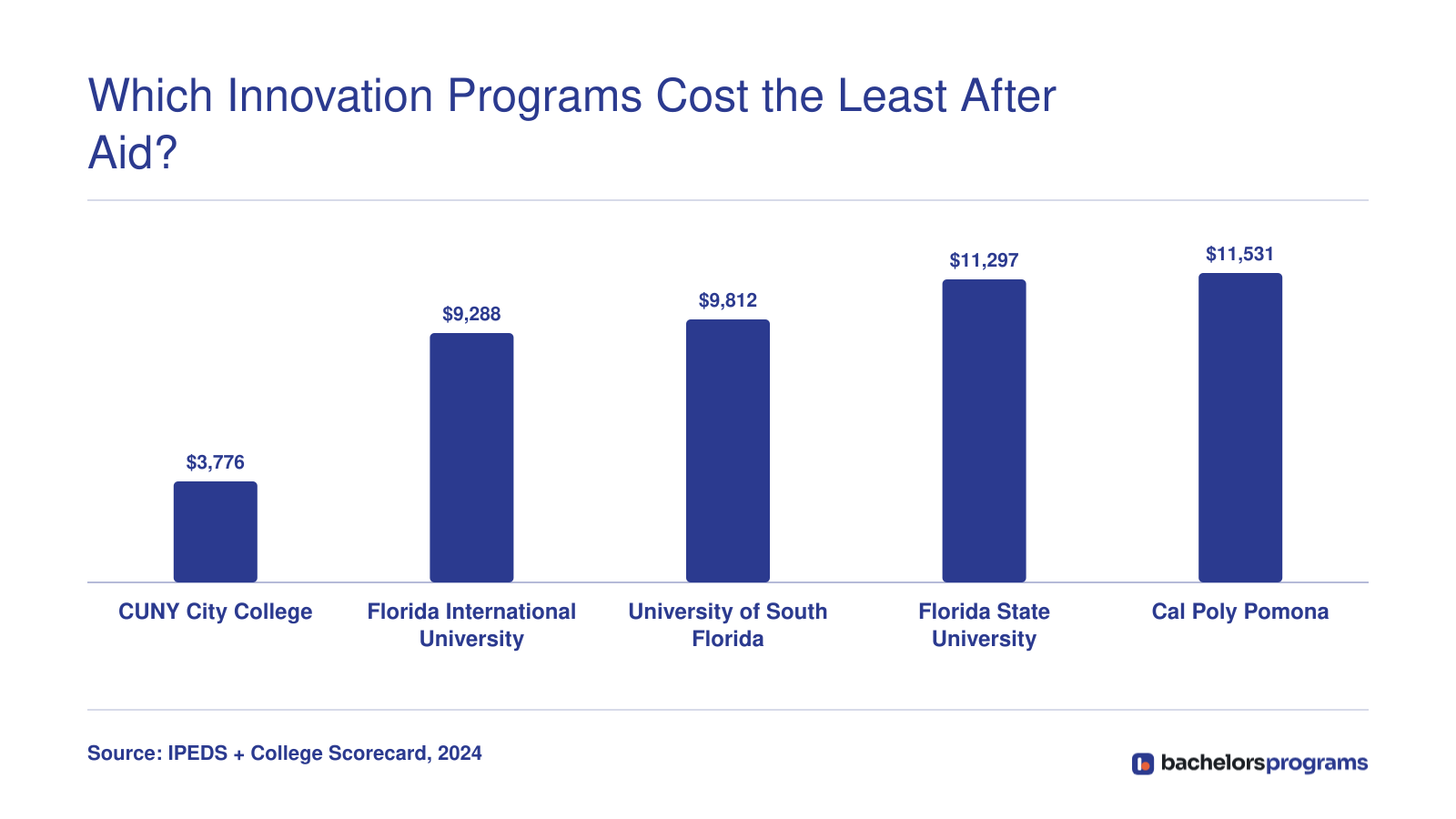
CUNY City College stands out among the most affordable schools in our ranking, with an average net price of $3,776 a year, less than half the next-lowest option. Three Florida public universities and Cal Poly Pomona follow, all between $9,288 and $11,531. These are institution-wide averages after grants and scholarships, so what you actually pay will depend on your family income and the aid package you receive.
Innovation Degree Cost, Debt, and Ways to Pay Less
The cost of a bachelor's degree in innovation is not a single sticker price. It is tuition and fees minus grants and scholarships, plus housing, books, and travel, and then whatever loans remain. That is why two families can face very different bills at the same school, and why published tuition is a poor guide to what most students actually pay.
Sticker Price vs. Net Price
Published tuition is the list price before aid, so it overstates what most students pay. Average net price is the figure after federal, state, and institutional grants. At CUNY City College the average net price is $3,776; at Florida State, $11,297; at Cal Poly Pomona, $11,531; at Virginia Tech, $24,953. Private options run higher: BYU at $15,564, FIT at $19,095, USC at $32,740, and NYU at $37,050.
Program Debt and Monthly Payments
Program-level federal debt figures show what graduates actually borrowed. At Florida State, the median is $16,450, or about $174 a month on a standard 10-year repayment plan. At NYU it is $20,500, about $217 a month; at Virginia Tech, $23,750, about $252 a month. These are program figures, not school-wide averages, so compare them with the net prices above.
Funding Built for Founders
Entrepreneurship-specific aid can cut the bill before loans enter the picture. At the University of St. Thomas, the Schulze four-year full-tuition award targets incoming first-years who intend to major in entrepreneurship; a 3.5 GPA is the minimum and the deadline is January 8, 2027.1 The GHR Fellows program also covers full tuition, the Willis Drake Young Entrepreneurship Scholarship adds $2,000 for the first year, and the Schulze Entrepreneurship Scholarship awards $5,000. The University of New England lists the Keith Myers and Kevin Kuykendall awards at $1,000 each, due November 15, 2026.2 Pitch competitions add venture cash: NYU Entrepreneurs Challenge offers $75,000 in investment funding, McCloskey headlines $50,000, and Harvard's President's Innovation Challenge shares more than $500,000. Pell Grants, capped at $7,395 for 2026-27, remain the base layer for undergraduates without a bachelor's degree.
One Practical Step
Before you apply, use the net price calculator on each school's site. It uses your family's income and assets to estimate aid, so it reflects your bill rather than the average.
Related Articles
Innovation Degree Salary: What Graduates Earn
Starting pay and long-run earning potential are two different measures, and you need both to judge a program. Program-level figures show what recent graduates earn. Federal wage data shows where the careers can go.
Program-Level Earnings by School
New York University's Business, Technology and Entrepreneurship graduates earn more than any other program on this list: $114,572 four years after finishing. At that same four-year mark, the Fashion Institute of Technology's entrepreneurship graduates sit at $49,627. That is a gap of roughly $65,000 for graduates with the same general type of degree.
The five-year view tells a similar story. Virginia Tech's Entrepreneurship, Innovation & Technology Management graduates reach a median of $98,448 five years out, while University of South Florida graduates reach $46,737. Program focus, local job markets, and the industries each school feeds into all shape these numbers. Some programs are small, and their medians can swing from year to year.
Long-Run Potential in Common Careers
Innovation majors often move into analysis, marketing, and leadership roles. Bureau of Labor Statistics median annual wages for 2025 show how those paths can pay over a full career:
- Management analysts: $101,860, with 10% projected growth from 2025 to 2035 and about 94,100 openings a year.
- Market research analysts: $78,760, with 7% projected growth over the same period and about 82,000 openings a year.
- Marketing managers: $166,790, with 6% projected growth. The broader group of advertising, promotions, and marketing managers has a median of $165,780.
- Top executives: $108,780 median.1
Why Early Pay Trails These Medians
The federal medians cover workers at every experience level, including people with decades on the job. Recent graduates are at the start of that curve. Only NYU's four-year figure clears the management analyst median, and most programs here land closer to the market research analyst figure or below it.
Treat the program numbers as a floor and the federal medians as a ceiling you grow toward. Marketing manager and executive pay usually arrives after years of experience and promotions, not at graduation. Compare programs on what their graduates earn at four and five years out, then ask how quickly their alumni move into management roles.
Where Innovation Skills Pay Off
Innovation graduates often move into roles that turn new ideas into products, campaigns, and market strategy, and marketing management is one of the best-paid of those paths.
Online vs. Campus Innovation Degrees
Can you get an innovation degree online? Yes, though the ranked programs here lean heavily toward campus delivery. Florida International University's Food Innovation and Entrepreneurship concentration is the online option on the list, and none of the ranked schools are explicitly listed as both. Working adults will find more choice in online completion programs at Oregon State University, American Public University, CUNY School of Professional Studies, and Louisiana State University at Alexandria.
What You Gain and Give Up
Online study offers flexibility and, often, generous transfer credit. That suits someone with an associate degree or a stack of earlier credits who is also holding down a job.
Campus programs offer what is harder to replicate remotely. Wisconsin-Madison lists innovation competitions and accelerator programs, Penn points to Wharton's Venture Lab, and BYU requires a Startup Bootcamp. Those settings build peer networks and give you a live audience for pitches.
Online venture work varies. LSU Alexandria's clearest example is its ENTR 4001 Entrepreneurship Project.4 For other online programs, ask directly how students launch or test an idea.
Transfer Credit and Per-Credit Pricing
Online bachelor's completion programs often accept up to about 90 credits. American Public University and LSU Alexandria both cite that figure1, and LSU applies it subject to evaluation. CUNY SPS allows up to 105 credits but requires at least 15 at CUNY.2 Eastern Oregon University accepts up to 135 but requires at least 20 of its own credits.3 Accepted credits do not always count toward your major, so request an evaluation before you enroll.
Per-credit rates are not uniform:
- Oregon State: $438 per quarter credit, with fees and materials extra.
- American Public University: $360 per credit1, with other rates for some tuition categories.
- CUNY SPS: $305 per credit2, for part-time New York State residents only.
- Eastern Oregon University: $338 per credit online.3
Compare those with campus in-state tuition and fees, such as about $11,603 a year at Wisconsin-Madison.
Check Accreditation First
Confirm that any online program comes from a regionally accredited institution. Programmatic credentials such as AACSB or ACBSP are a useful extra, but they do not replace institutional accreditation, which governs federal aid eligibility and sets the baseline for transfer credit.
How to Choose the Right Innovation Program: A Checklist
Run every bachelor's degree in innovation through these checks before you apply. Each one protects your money, your credits, or your career options.
- Institutional (regional) accreditationConfirm the college holds institutional accreditation from an accreditor recognized by the U.S. Department of Education. It covers the whole school, not just the innovation major, and federal student aid depends on it. It also affects how other colleges view your credits, though no accreditation guarantees they will transfer.
- AACSB business accreditationIf the program sits in a business school, check for AACSB accreditation, a quality signal employers recognize. Confirm your specific degree falls within the accredited scope. A BBA in innovation often qualifies. A BS or interdisciplinary degree is decided case by case, partly on how much business coursework it includes.
- Hands-on venture experienceLook for an incubator, accelerator, venture lab, or required internship. Building and testing real ideas is what sets a strong innovation degree apart from a general business major.
- Transfer credit and format fitWorking adults should ask how many prior credits will count and whether the online format, pacing, and schedule fit their week. The receiving college decides what transfers, so request a written credit evaluation.
- Net price, aid, and goal fitCompare net price after grants, not sticker tuition, and confirm your aid eligibility. Then match the curriculum to your goal. Aspiring founders need venture coaching and pitch opportunities. Corporate innovators benefit from product, strategy, and design coursework. Compare the ranked programs above and request information from your top choices.
Innovation programs by state
Compare Innovation programs on the data that matters
Explore more Computers & IT majors or browse every field of study.
All Computers & IT programs Browse every field of study