Best Software Development & Engineering Degree Programs
Compare 330+ accredited Software Development & Engineering programs, with net price after aid, graduation rates, earnings and debt from IPEDS and the U.S. College Scorecard.

Employers have spent the past few years rewording software job postings to say "degree preferred" rather than "degree required," yet the bachelor's still sets salary bands at most large firms. What that credential is called varies by school, and every program in this comparison is a bachelor's degree in software development and engineering; graduate study sits outside it.
The tension is money and naming. After aid, net price at these schools runs from roughly $12,000 to $30,000 a year, while first-year earnings for their graduates span about $38,000 to $98,000. Two programs with near-identical course lists can leave students in very different financial positions three years out.
Key Points
- Michigan graduates earn a median $98,117 one year out, against $19,230 debt.
- Rankings weigh graduates' federal earnings and debt data, not prestige surveys.
- Online, hybrid and campus formats appear together, compared by net price.
Best Software Development & Engineering Schools Ranked
Every program below is a bachelor's degree in software development and engineering, and the list covers online, hybrid, and campus delivery so you can compare formats side by side. Each card shows the average net price after aid, the school's overall graduation rate, program location, any concentration, and the details that set the program apart. Shortlist three or four schools, then request program information from each to confirm start dates and how your credits will transfer.
University of Michigan
#1Ann Arbor, MI · $18,000 – $61,000/yr (est.)
Best for: Students who want a design-focused engineering degree
The University of Michigan's software engineering bachelor's program builds a full software lifecycle curriculum around design seminars and a seven to nine credit application sequence in game design, web engineering, information systems, or artificial intelligence. Qualified students can double-count up to nine credits toward a master's in computer and information science, data science, AI, software engineering, or cybersecurity. Request program information to confirm start terms and how transfer credit applies.
- ABET accredited by the Engineering Accreditation Commission
- 120 credit hours required for the degree
- Application sequence options include game design, web engineering, and AI
- Software Engineering I and II plus Software Architecture and Design Patterns
- Two design seminars and team-based work projects
- Accelerated master's option double-counts up to 9 credits
- Reported median earnings: $98,117 one year after graduation
University of California-Irvine
#2Irvine, CA · $14,000/yr (est. net price)
Best for: Transfer students with programming prerequisites
UC Irvine's software engineering major sits in the Donald Bren School of Information and Computer Sciences and follows the whole software lifecycle, from requirements analysis and design through implementation, testing, quality assurance, and project management. A two-quarter capstone has teams build a substantial system with an outside organization, so graduates finish with portfolio material rather than only coursework. Request program details to see current capstone partners and transfer requirements.
- Two-quarter capstone builds a substantial system with an outside organization
- Four upper-division ICS electives of 4 units each round out the major
- Coursework spans requirements analysis, software testing, and quality assurance
- Also covers human computer interaction, software design, and project management
- Transfer applicants need a year of calculus and a year of object-oriented programming
- Graduates work in healthcare, finance, and entertainment
Brigham Young University
#3Provo, UT · $15,000 – $20,000/yr (est.)
Best for: Value-conscious students wanting a faith-based campus
Brigham Young University offers a computer science bachelor's with a software engineering emphasis built on 19 core courses and two software engineering capstone courses. Coursework runs through data structures, algorithms, design, quality assurance and DevOps, web programming, and database modeling, with two electives chosen from 11 computer science options. Request program information to confirm the current academic plan and elective rotation.
- 74 to 76 credit hours, including 19 core courses
- Two software engineering capstone courses required
- Choose two electives from 11 computer science options
- Covers QA and DevOps, web programming, and database modeling
- Senior exit interview with the CS department required
- Grades below C- do not count toward the major
Purdue University
#4West Lafayette, IN · ~$15,000/yr (est.)
Purdue's computer science software engineering concentration pairs 21 credits of core computing coursework with an 18-credit concentration that includes software testing and a team senior project. Students take the degree at West Lafayette or Indianapolis, and electives reach into cryptography, networks, distributed systems, artificial intelligence, and bioinformatics. Request program information to check start terms and how AP, IB, or CLEP credit applies.
- 120 credit hours, with 18 in the software engineering concentration
- CS 30700 Software Engineering I and CS 40800 Software Testing
- CS 40700 senior project runs in teams of 4 to 6 people
- Major courses require a grade of C or better; 2.0 GPA to graduate
- Taught at West Lafayette and Indianapolis
- Electives include cryptography, networks, AI, and bioinformatics
- Reported median earnings: $38,234 one year out, $54,013 five years out
North Carolina State University at Raleigh
#5Raleigh, NC · $9,000 – $33,000/yr (est.)
NC State's computer science department, one of the oldest in the country, awards a BS in computer science with a software engineering concentration and requires a team Senior Design project with an outside sponsor. Elective tracks in security, robotics, and entrepreneurship let students steer the degree, and undergraduates can join faculty research in AI, robotics, and security. Industry partners including Hitachi Energy and Red Hat work with the department on curriculum and research. Request program details to compare tracks.
- Computing Accreditation Commission of ABET accredited
- Team-based Senior Design project with outside project sponsors
- Elective tracks in security, robotics, and entrepreneurship
- Electives include AI, compilers, cryptography, data science, and game development
- Department founded in 1967, housed in Engineering Building II
- Undergraduate research in AI, robotics, and security
- Industry partners include Hitachi Energy and Red Hat
Duke University
#6Durham, NC · ~$30,000/yr (est.)
Duke's computer science BS carries a software engineering and design concentration that stacks prerequisite units, five core courses, a systems core, and an AI core with four concentration electives. Three of those four electives must be computer science courses, and an approved independent study can count toward the total. First-years entering in fall 2026 see AI built into the concentration core. Request program information to confirm elective availability.
- 34 units for the BS; at least 15 required units for the major
- Four prerequisite units plus five core courses and a systems core
- AI added to the concentration core for first-years entering fall 2026
- Three of the four concentration electives must be COMPSCI courses
- Approved independent study can count as a concentration elective
- Course substitutions need Director of Undergraduate Studies approval
- Graduation with Distinction available
University of Washington-Bothell Campus
#7Bothell, WA · ~$12,000/yr (est.)
UW Bothell's computer science and software engineering BS blends programming and people-centered software development with communication, business management, and analysis coursework. Students take the general option or declare the Information Assurance and Cybersecurity option, which prepares them to create, deploy, and manage secure systems. Request program information to compare the two options and review admission requirements.
- General option or Information Assurance and Cybersecurity option
- People-centered software development focus
- Includes communication, business management, and analysis coursework
- Multidisciplinary, hands-on approach to software design and development
- Reported median earnings: $47,112 one year out, $55,787 five years out
Auburn University
#8Auburn, AL · $13,000 – $35,000/yr (est.)
Auburn University awards a Bachelor of Software Engineering that balances computer science theory with applied methodology, using modern software engineering environments and tools. Core topics run from software modeling and design to process management, quality assurance, intelligent and interactive systems, networks, and operating systems, with specialized electives on top. Request program information to confirm credit totals and start terms.
- Bachelor of Software Engineering balances theory with applied practice
- Coursework in software modeling, design, and construction
- Process management and quality assurance training
- Covers intelligent and interactive systems
- Networks, operating systems, and computer architecture included
- Specialized electives available; also prepares students for graduate study
Appalachian State University
#9Boone, NC · $8,000 – $25,000/yr (est.)
Appalachian State's computer science BS covers data structures, programming languages, software engineering, analytics and cloud computing, with front-end design and back-end development work. A minor is not required, and an accelerated bachelor's to master's path lets strong students start graduate coursework while still undergraduates. Request program information to review admission requirements and financial aid options.
- A minor is not required
- Accelerated bachelor's to master's program available
- Covers data structures, programming languages, and software engineering
- Adds analytics and cloud computing coursework
- Includes front-end design and back-end development
- R2 Carnegie research classification
Towson University
#10Towson, MD · ~$17,000/yr (est.)
Towson University's computer science BS offers a software engineering track alongside cyber operations and artificial intelligence tracks, all built on theoretical foundations and current technology. The major is accredited by the Computing Accreditation Commission of ABET, and the Cyber Operations track has held National Security Agency Center of Academic Excellence in Cyber Operations designation since 2012. An accelerated BS to MS path lets students substitute nine graduate credits, though that combined program is not ABET accredited. Request program information to compare tracks.
- Computing Accreditation Commission of ABET accredited major
- Three tracks: Cyber Operations, Software Engineering, Artificial Intelligence
- Cyber Operations track is NSA CAE-CO designated since 2012
- Substitute nine graduate credits through the accelerated BS to MS path
- The combined BS to MS program is not ABET accredited
- Internships with federal, state, and local agencies
- Cyber Defense Club and a competitive cybersecurity team
Cost & outcomes by school
Federal data for the highest-earning Software Development & Engineering programs, independent of the ranking above. Earnings are this field's bachelor's graduates four years after completing where the Scorecard reports them, else the school's undergraduate median.
| School | Net price / yr | Grad rate | Earnings | Debt | Grads/yr | Format |
|---|---|---|---|---|---|---|
| Western Governors University UT | $12,548 | 46% | $131,198 | $12,566 | 99 | Online |
| Stevens Institute of Technology NJ | $41,346 | 87% | $108,772 | $27,000 | — | Campus |
| Boston College MA | $41,704 | 91% | $103,937 | $19,000 | — | Campus |
| Rose-Hulman Institute of Technology IN | $42,513 | 78% | $101,253 | $25,000 | — | Campus |
| University of Notre Dame IN | $26,780 | 95% | $99,980 | $19,000 | — | Campus |
| Park University MO | $21,032 | 38% | $98,256 | $21,685 | — | Online or campus |
| Duke University NC | $29,612 | 97% | $97,800 | $13,000 | 6 | Campus |
| DePaul University IL | $30,902 | 68% | $96,616 | $24,999 | 75 | Online or campus |
| California Polytechnic State University-San Luis Obispo CA | $16,665 | 86% | $90,768 | $18,500 | — | Campus |
| Clarkson University NY | $30,305 | 75% | $89,696 | $26,000 | — | Campus |
| Milwaukee School of Engineering WI | $22,453 | 67% | $89,070 | $27,000 | — | Campus |
| Rochester Institute of Technology NY | $34,906 | 70% | $88,096 | $27,000 | 211 | Campus |
Sources: U.S. Department of Education. Net price, graduation rate, earnings and debt: College Scorecard (earnings and debt for this field's bachelor's graduates where reported, else school-wide); graduates: IPEDS. A dash means no figure is reported.
Cost, debt & payoff
Median earnings of this field's bachelor's graduates (4 yrs after completing, else the school's undergraduate median) vs. their median federal loan debt · U.S. College Scorecard
Across these programs the median graduate earns about $54,357 and finishes with roughly $22,750 in debt — a ratio that clears a common rule of thumb (keep debt below first-year salary). Net price and debt vary widely school to school, so check the per-school figures in the table above before you shortlist.
How We Ranked These Bachelor's Programs
Reputation-based rankings lean on prestige surveys and admissions selectivity. This one is built on outcomes instead: what graduates of each bachelor's program actually earn and owe, measured with federal data.
The Data Behind the Rankings
Program-level figures come from the U.S. Department of Education's College Scorecard. It reports median earnings for graduates one to five years after completion, median federal loan debt and the estimated monthly loan payment. Institution-level data from the same source adds net price, graduation rates and retention rates.
Only bachelor's-level programs in software development and engineering were considered. Graduate degrees, certificates and bootcamps were excluded, so every school ranked here awards a four-year undergraduate credential.
Caveats Worth Knowing
- Graduation rates: These are school-wide figures, not rates specific to the software program.
- Net price: This is a school-wide average after grant aid, not a fixed price. What your family pays will vary with income.
- Earnings: Figures are medians, so half of graduates earn more and half earn less. Some programs have no published program-level earnings, typically because too few graduates were reported.
What the Ranking Does Not Measure
Federal outcomes data says nothing about curriculum quality, internship placement or accreditation. A program with strong earnings may still lack the specialization you want, and a newer program may be excellent before outcomes data exists. A separate comparison of software development, software engineering and computer science degrees explains how the curricula differ. The cost and debt section shows which schools pay off, and the FAQ addresses accreditation. Confirm ABET and institutional accreditation directly with any school before you apply.
Software Development vs. Software Engineering vs. Computer Science Degrees
The best degree for software development depends on your goals, and the official title on a program page is only a starting point. Schools label similar programs differently, so a bachelor's degree you find under one name may match another name's curriculum. Read the course catalog and the accreditation listing before you compare programs.
| Factor | Software Development | Software Engineering | Computer Science |
|---|---|---|---|
| Core focus | Practical, applied preparation for computing careers | Systematic development of complex software systems | Computing theory and how systems work at multiple levels |
| Coursework emphasis | Set by each school, since ABET computing criteria do not prescribe specific courses | Requirements, design and construction, security, verification, validation, engineering processes and tools | Algorithms, programming languages, architecture, operating systems, networking, parallel and distributed computing |
| Math and theory load | Varies by school, often lighter | At least 30 semester credit hours of math and basic sciences, plus discrete math, probability and statistics | Heaviest on theory, with algorithms and complexity and at least 40 semester credit hours of computing topics |
| ABET commission | Not named as an EAC engineering category; the Computing Accreditation Commission (CAC) covers computing disciplines, so confirm the school's listing | Engineering Accreditation Commission (EAC) | Computing Accreditation Commission (CAC) |
| Typical first jobs | Application and software developer roles | Software engineer roles on larger, process-driven systems | Software developer roles, plus systems or research-oriented paths |
| What to check in the catalog | Which core courses are required and how much project work is built in | Whether the program is accredited under EAC and covers verification and security | Whether the core covers algorithms, systems and a capstone project |
| One-line verdict | Best if you want a direct path to building applications | Best if you want an engineering-style, accredited credential | Best if you want the deepest theory and the widest options |
What Software Developers Earn Nationally
Before weighing individual programs, it helps to know what the occupation pays across the country.
Cost, Debt and Earnings: Which Schools Pay Off?
How much should you borrow for a bachelor's in software development, and how quickly does that debt pay for itself? Answer it by setting median debt at graduation and the monthly payment on a standard 10-year plan against what graduates of that same program earn one and five years after finishing.
Where the math works best
Brigham Young University-Idaho carries the lightest load of the programs here: median debt of $9,312 at completion, roughly $99 a month over 10 years, against median earnings of $49,581 one year out and $85,603 five years out. University of Washington-Bothell is close behind, with $15,000 in median debt and about $159 a month, paired with $47,112 one year after graduation and $55,787 at the five-year mark. The software engineering program at the University of Michigan carries somewhat more debt, $19,230 and roughly $204 monthly, but posts the strongest early pay of any program on this page at $98,117 one year out.
Where debt runs ahead of early pay
Purdue's software engineering track shows $20,101 in median debt and about $213 a month, against $38,234 one year after graduation and $54,013 five years out. That is a manageable load, but the first-year figure means repayment starts before the salary catches up. UC Irvine's program shows the heaviest borrowing here at $21,800, about $231 a month, with median earnings of $69,981 four years after completion.
One caution about the broader earnings-to-cost ratios attached to a campus: they are institution-wide figures that blend every major on the roster. Treat them as a rough signal about the school, never as your program's own outcome.
Why first-year pay trails the national median
The national median for software developers sits well above most of these one-year numbers, and that gap is normal rather than alarming. The occupation median counts developers at every career stage, including people a decade or two into the field. Program earnings one year out capture graduates in their first job, often still in a junior title. The five-year columns, where published, show how quickly the gap closes.
A borrowing ceiling worth holding to
Keep total borrowing across all four years below your expected first-year salary. At that ratio, payments typically land near ten percent of gross pay, which leaves room for rent, savings and the possibility that your first offer comes in lower than you hoped.
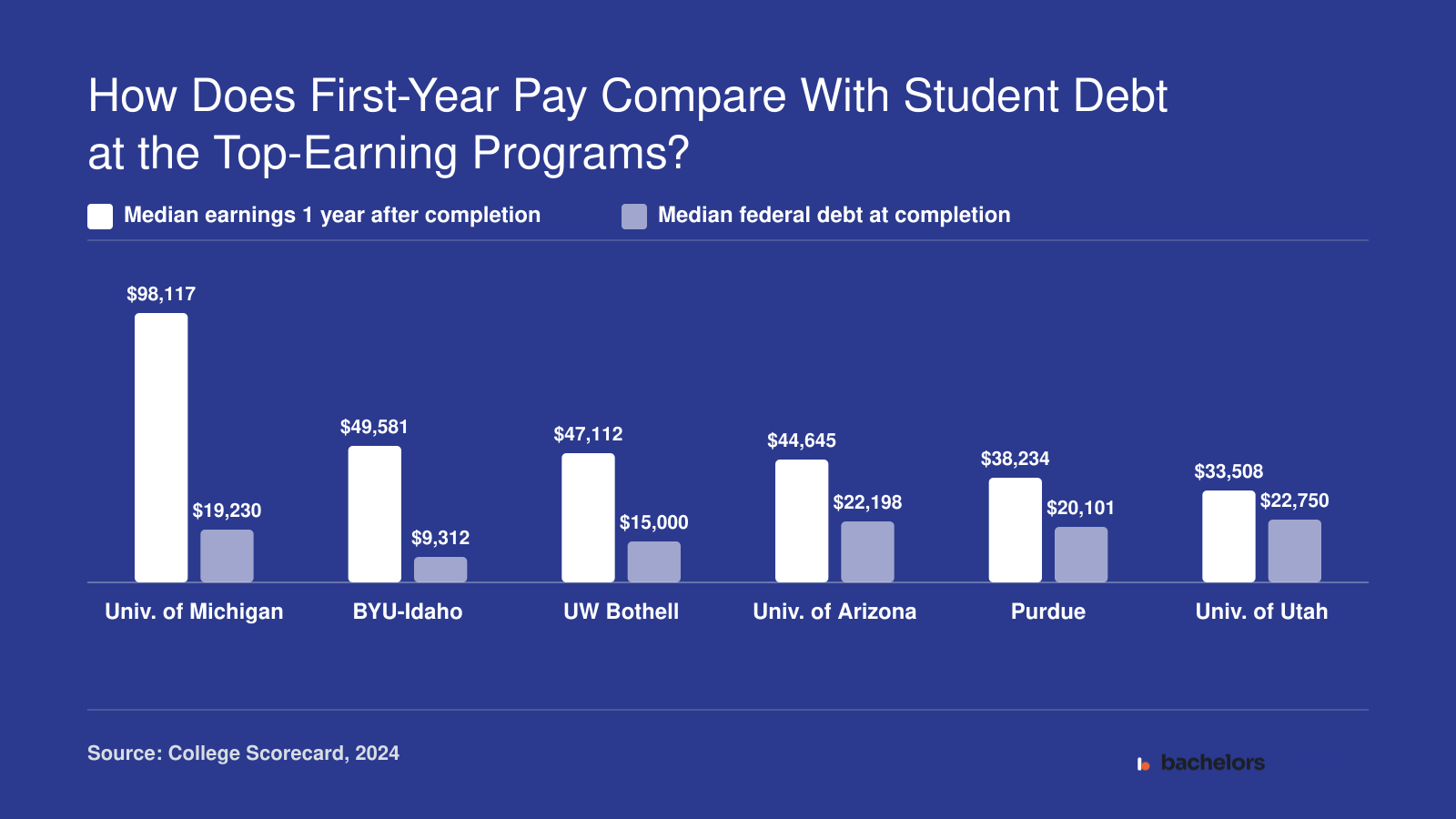
How Does First-Year Pay Compare With Student Debt at the Top-Earning Programs?
At each top-earning program shown here, graduates' median pay one year after completion is higher than the median federal debt they carried at graduation. The University of Michigan shows the widest gap, at $98,117 in first-year earnings against $19,230 in debt. The University of Utah shows the narrowest, at $33,508 against $22,750. On a standard 10-year repayment plan, those debt levels translate to estimated monthly payments of roughly $99-$241, a manageable share of a first-year software salary at each of these schools.
Related Articles
Lowest-Cost Ranked Software Development Programs
The programs below have the lowest average net price after aid among the schools ranked here, based on 2024 IPEDS and College Scorecard data from the U.S. Department of Education. Average net price after aid is the yearly amount students pay once grants and scholarships are subtracted, and your actual cost will vary with family income, so run each school's net price calculator before you compare offers. Eastern Florida State College is the only option here with a fully online path (its Bachelor of Applied Science requires a prior A.S. or A.A. degree), while Miami Dade College and Brigham Young University-Idaho are listed as campus-based programs.
| School | Location | Program | Format | Average Net Price After Aid | Graduation Rate (Institution-Wide) |
|---|---|---|---|---|---|
| Miami Dade College | Miami, FL | B.S. in Information Systems Technology (Software Engineering Concentration) | On campus | $5,463 | 45.9% |
| Eastern Florida State College | Melbourne, FL | B.A.S. in Computer Information Systems Technology (Program Development/Software Development Specialization) | Online or hybrid (online and on campus) | $6,440 | 52.1% |
| Brigham Young University-Idaho | Rexburg, ID | B.S. in Software Engineering | On campus | $8,221 | 55.5% |
Software Development & Engineering programs by state
Software Development Degree FAQ
These are the questions prospective students ask most often about a bachelor's degree in software development and engineering. The answers cover timing, accreditation, international enrollment and cost.
How long does it take to earn a bachelor's degree in software development?
Is ABET accreditation important for a software engineering degree?
Can international students enroll in an online software engineering degree from a US school?
Is there a free or very low-cost online software engineering degree?
Compare Software Development & Engineering programs on the data that matters
Explore more Computers & IT majors or browse every field of study.
All Computers & IT programs Browse every field of study