Best Computer Science Schools in Iowa
Compare 31 accredited Computer Science programs in Iowa at 25 colleges, with net price after aid, graduation rates, earnings and debt from IPEDS and the U.S. College Scorecard.

Iowa State University charges resident undergraduates $10,787 in tuition and fees; Grinnell College charges $68,106. Both award a bachelor's degree in computer science, the Bachelor of Science (B.S.) or Bachelor of Arts (B.A.) credential Iowa employers screen for, though the earnings reported for each differ.
The gap between what a degree costs and what it returns drives nearly every Iowa decision. School size, ABET accreditation and online delivery all shift the arithmetic. Earnings pull applicants toward outcomes, and those outcomes do not track tuition closely.
Key Points
- Grinnell's $68,106 sticker price drops to about $17,648 average net price.
- Iowa's public universities admit by formula; private colleges read applications holistically.
- Check ABET's program search, since not every Iowa computer science major appears.
Top 10 Iowa Schools for a Bachelor's Degree in Computer Science
These ten Iowa colleges and universities award a bachelor's degree in computer science, and they differ sharply in scale, structure and technical focus. The three public flagships anchor the list because of the size of their programs, their industry ties and recent artificial intelligence coursework, while the private colleges below offer smaller cohorts and required capstone projects. Each entry reflects what the school itself publishes about its computer science major.
Iowa State University
#1Ames, IA · $19,000/yr (est. net price)
Best for: AI-focused students eyeing industry projects
The largest computer science program in the state, housed in the College of Liberal Arts and Sciences, with a B.S. that pairs core coursework with undergraduate research and industry-sponsored projects. An artificial intelligence track adds 16 credits of AI coursework, and partners such as NASA, John Deere and Rockwell Collins give students real project exposure. A concurrent graduate degree option is there for students who want to keep going.
- Bachelor of Science offered on campus in Ames
- Concurrent graduate degree option for strong students
- Artificial intelligence track requires 16 credits of AI coursework
- Industry partners include NASA, John Deere and Rockwell Collins
- Undergraduate research with faculty and a dedicated CS help room
- Test-out options and semester-by-semester flowcharts available
- ABET accreditation noted for the program
University of Iowa
#2Iowa City, IA · $11,000 – $33,000/yr (est.)
Best for: Future engineers targeting large tech employers
A large public research university whose B.S. goes deeper in math and science than the B.A. path, aimed at students heading into software engineering, graduate study, or technical roles in health care and finance. A revised curriculum arriving in fall 2026 adds a required Introduction to AI course plus more machine learning options. Honors in the major, a five-year B.S./M.C.S. option and departmental advising round out the experience.
- 120 total credit hours with a 2.0 GPA minimum
- More math and science than the B.A., aimed at technical careers
- Revised fall 2026 curriculum adds a required Introduction to AI
- Electives span databases, data mining, AI and human-computer interaction
- Combined B.S./M.C.S. possible in five years
- Honors in the major and departmental advising available
- AP credit can satisfy some major requirements
University of Northern Iowa
#3Cedar Falls, IA · $10,000 – $22,000/yr (est.)
Best for: Students weighing B.A. versus B.S. flexibility
A mid-sized public university that offers the computer science major as either a B.A. or a B.S., so students can dial math requirements up or down. Both paths share a core in algorithms, data structures and computer organization, then branch into four specialties, each capped by a project course. A 2026 curriculum initiative weaves artificial intelligence through the program.
- 120 total credit hours; B.A. and B.S. share a common core
- Four specialties: foundations, data and applications, software engineering, systems
- B.S. path adds a required undergraduate research course
- B.A. path carries fewer math requirements and more elective room
- Project course required within the chosen specialty
- Grade of C- or better required in major courses
- Artificial intelligence curriculum initiative launched in 2026
Grinnell College
#4Grinnell, IA · $18,000/yr (est. net price)
A highly selective liberal arts college whose computer science department sits in the Division of Science. The B.A. is a compact 32-credit major built on theory, systems and software development, with honors considered for graduating seniors. A lab network of roughly 170 workstations and a curriculum shaped by ACM and IEEE-CS guidance suit students who want depth without an engineering-school scale.
- 32-credit major starting with a 12-credit introductory sequence
- 8 credits of upper-level theory and 4 credits of software development
- At least 20 CSC credits must be taken at Grinnell
- Curriculum shaped by ACM, IEEE-CS and AAAI recommendations
- Honors considered for graduating seniors
- Department lab network of about 170 workstations
- Statistics coursework encouraged for majors
Emmaus Bible College
#5Dubuque, IA · ~$13,000/yr (est.)
A small Christian college where the computer science major sits alongside a substantial Bible and theology core. The B.S. is a four-year, 124.5-credit program pairing programming, networking and security with a senior project and several upper-level electives. It fits students who want a faith-integrated technical degree and a tightly structured, small-cohort curriculum.
- 124.5 semester credit hours, including 48 in computer studies
- 30 credits in Bible and theology plus 37.5 in general studies
- Core covers programming, hardware, networking, security and systems analysis
- Four track electives such as database design, C++ and Java/JavaScript
- 2.0 cumulative GPA and prerequisite courses required
- Application at the start of sophomore year
- Senior project required
Loras College
#6Dubuque, IA · ~$21,000/yr (est.)
A Catholic liberal arts college where computer science blends theory with applied work on large data sets, secure web applications and machine learning systems. Courses in artificial intelligence, graphics and machine learning sit alongside internships with local employers. Small cohorts and an active ACM club give majors a close-knit technical community.
- Coursework includes Artificial Intelligence, Computer Graphics and Machine Learning
- Hands-on work with large data sets and secure internet applications
- Internships with local companies, for credit or non-credit
- ACM Club and Math Club open to computer science majors
- Computer science minor available alongside the major
Central College
#7Pella, IA · ~$23,000/yr (est.)
A liberal arts college with a computer science major built around a required independent senior project, which honors students can expand into a thesis. Students move from data structures through algorithms and computer architecture while programming in Python, Java, SQL and PHP. Classes average 16 students, and an internship network of more than 500 sites gives majors practical experience.
- Coursework from data structures to algorithms and computer architecture
- Required independent senior project; honors thesis option
- Students program in Python, Java, SQL and PHP
- Average class size of 16
- More than 500 internship sites across the U.S. and abroad
- Calculus I and discrete mathematics required
Luther College
#8Decorah, IA · ~$23,000/yr (est.)
A liberal arts college whose B.A. in computer science balances computing theory with applied electives across systems, applications and software engineering. A year-long senior project serves as the capstone, and strong AP Computer Science scores can earn credit toward the major. Flexible supporting coursework makes it easy to pair computing with a second interest.
- Year-long senior project required, with a one-semester option
- Three elective knowledge areas: systems, applications and theory
- AP Computer Science A credit accepted for strong scores
- Supporting courses across disciplines allow dual interests
- Computer science minor available
Coe College
#9Cedar Rapids, IA · ~$19,000/yr (est.)
A private college where computer science majors work in small classes backed by nightly math help sessions and weekly colloquia. Students present research at regional computing conferences, including the MINK Women in Computing Conference, and take internships around the Cedar Rapids area. Scholarships and financial aid are widely available, and one recent graduate works as a software engineer at Google.
- Small class sizes with nightly math help sessions
- Weekly department colloquia and local internships
- Students present at the Midwest Instructional Computing Conference
- Students attend the MINK Women in Computing Conference
- Summer research opportunities on and off campus
- Major and minor offered through the Math and Computer Science Department
Northwestern College
#10Orange City, IA · ~$26,000/yr (est.)
A Christian liberal arts college that teaches computer science as both a technical and a faith-informed discipline. The major covers algorithms, information representation and system design, with hands-on time in a well-equipped lab and a large software collection. A separate Computer Information Systems major serves students who want a business-facing technology path.
- Covers algorithms, information representation and system design
- Hands-on work in a well-equipped lab and workstation network
- Taught within a Christian liberal arts context
- Internships available in Orange City, Chicago and Washington, D.C.
- Separate Computer Information Systems major also offered
Cost & outcomes by school
Federal data for the highest-earning Computer Science programs, independent of the ranking above. Earnings are this field's bachelor's graduates four years after completing where the Scorecard reports them, else the school's undergraduate median.
| School | Net price / yr | Grad rate | Earnings | Debt | Grads/yr | Format |
|---|---|---|---|---|---|---|
| Grinnell College IA | $17,648 | 88% | $109,892 | $16,125 | 75 | Campus |
| Iowa State University IA | $18,589 | 75% | $104,211 | $21,775 | 136 | Campus |
| Simpson College IA | $21,936 | 63% | $91,318 | $25,000 | 10 | Campus |
| Central College IA | $23,377 | 66% | $89,838 | $26,984 | 8 | Campus |
| University of Northern Iowa IA | $15,901 | 68% | $89,305 | $22,770 | 36 | Campus |
| Cornell College IA | $23,634 | 62% | $84,938 | $27,000 | 12 | Campus |
| Drake University IA | $29,127 | 74% | $71,901 | $23,000 | — | Campus |
| University of Iowa IA | $22,531 | 75% | $64,762 | $22,500 | 116 | Campus |
| Mount Mercy University IA | $20,168 | 58% | $60,787 | $23,699 | 6 | Campus |
| Luther College IA | $23,097 | 71% | $59,850 | $27,000 | 13 | Campus |
| Saint Ambrose University IA | $24,691 | 61% | $59,531 | $25,000 | 13 | Campus |
| Loras College IA | $20,716 | 68% | $58,289 | $26,000 | 7 | Campus |
Sources: U.S. Department of Education. Net price, graduation rate, earnings and debt: College Scorecard (earnings and debt for this field's bachelor's graduates where reported, else school-wide); graduates: IPEDS. A dash means no figure is reported.
Cost, debt & payoff
Median earnings of this field's bachelor's graduates (4 yrs after completing, else the school's undergraduate median) vs. their median federal loan debt · U.S. College Scorecard
Across these programs the median graduate earns about $56,201 and finishes with roughly $23,250 in debt — a ratio that clears a common rule of thumb (keep debt below first-year salary). Net price and debt vary widely school to school, so check the per-school figures in the table above before you shortlist.
ABET Accreditation and Specializations at Iowa Computer Science Programs
Choosing an ABET-accredited program over a smaller college's unlisted one is a real tradeoff, and Iowa's schools split along that line.
Which Programs Hold ABET Accreditation
ABET's accredited-program search lists bachelor's-level computing programs at Iowa State University and the University of Iowa. It does not list University of Northern Iowa, Drake University, Grinnell College, Coe College, or Simpson College. Accreditation attaches to individual programs, not whole institutions, and the search result does not confirm whether every track at a listed school is covered.1 For any other school here, check ABET's search yourself.
Why ABET Matters
Employers recognize the credential, some federal positions reference it, and some graduate programs look for it.1 It is a quality signal, not a requirement for most software jobs.
B.S. vs. B.A. Tracks
University of Northern Iowa offers both B.A. and B.S. paths, with four concentration options and an undergraduate research course for the B.S. The University of Iowa lists a B.S. that its own page calls more rigorous than its B.A. Cornell College awards a B.A., while Iowa State and Loras College award a B.S. Typically, the B.S. leans harder on math and science, and the B.A. leaves more room for a second field.
AI, Cybersecurity, and Data Science
The University of Iowa's program page cites AI, databases, and data mining among its topics. Loras College lists artificial intelligence and machine learning courses, plus secure internet applications. Coe College points to student research in data science. These are course and research strengths, not necessarily formal named tracks, so confirm concentration names with the department, especially for cybersecurity.
Weighing Programs Without ABET
Many strong private colleges are not ABET-listed. Look instead at curriculum design (Grinnell's follows ACM, IEEE-CS, and AAAI guidance), required capstones or senior projects, internship access, class size, and where graduates land. If you plan on graduate study or federal work, give ABET more weight.
Related Articles
Admission Requirements for Iowa Bachelor's in Computer Science Programs
Large public universities admit by formula, while smaller private colleges read applications more holistically. Both routes lead to a bachelor's degree in computer science, but what you submit differs.
GPA and Test Policies
Selectivity varies widely. Grinnell College admits about 15 percent of applicants, and Coe College about 64 percent. Iowa State, the University of Iowa, and the University of Northern Iowa admit roughly 84 to 93 percent, and Loras College admits nearly everyone who applies.
Iowa State is test-optional for U.S. first-year applicants.1 It publishes a Regent Admission Index built from ACT/SAT score, GPA, and core high school courses, but no single minimum GPA for all applicants is established.1 UNI is also test-optional and says its committee weighs GPA and course selections.4 Grinnell is test-optional, accepts scores if you send them, and superscores ACT composite and SAT math and reading/writing.5
For the University of Iowa, Drake, Coe, and Simpson, no clear GPA minimum or test policy was confirmed, so check each admissions page directly.
Math Preparation
None of these schools publishes a firm, CS-specific math prerequisite. As general guidance, plan on four years of high school math through precalculus, since most CS majors start in calculus. Iowa State's CS flow chart shows the first-year course sequence, so review it before you apply.
Transfer Credit
Iowa State generally wants at least 24 transferable semester credits and a 2.25 transfer GPA.2 Associate degree holders may be admitted at 2.00.2 Career-technical, developmental, and military credits do not count toward the 24. With fewer credits, you must also meet first-year requirements, including a high school transcript. Iowa State notes that individual programs may set higher bars, and CS's requirement is not confirmed.
The University of Iowa recommends finishing CS:1210, CS:2210, CS:2230, and MATH:1850 before transferring, if available.3 These are suggested plan courses, not formal prerequisites. Grinnell treats you as a transfer applicant once you will hold 12 or more transferable credits earned after high school.5
One Practical Tip
If you are applying to both a selective public school and a smaller private one, build a single strong core: your transcript, your highest math course, and a short note on any coding projects. Then tailor the private college essay and check each school's deadlines separately.
Questions to Ask Yourself
Do you want a large research university's course variety or a small college's faculty access?
Does the employer or graduate school you are aiming for care whether your program is ABET-accredited?
Are you ready for a calculus-heavy first year, or do you need a gentler math on-ramp?
What a Computer Science Bachelor's Degree Costs in Iowa
What an Iowa computer science degree costs depends on which price you compare. Sticker price matters less than most students expect, especially at private colleges.
Sticker Price vs. Net Price
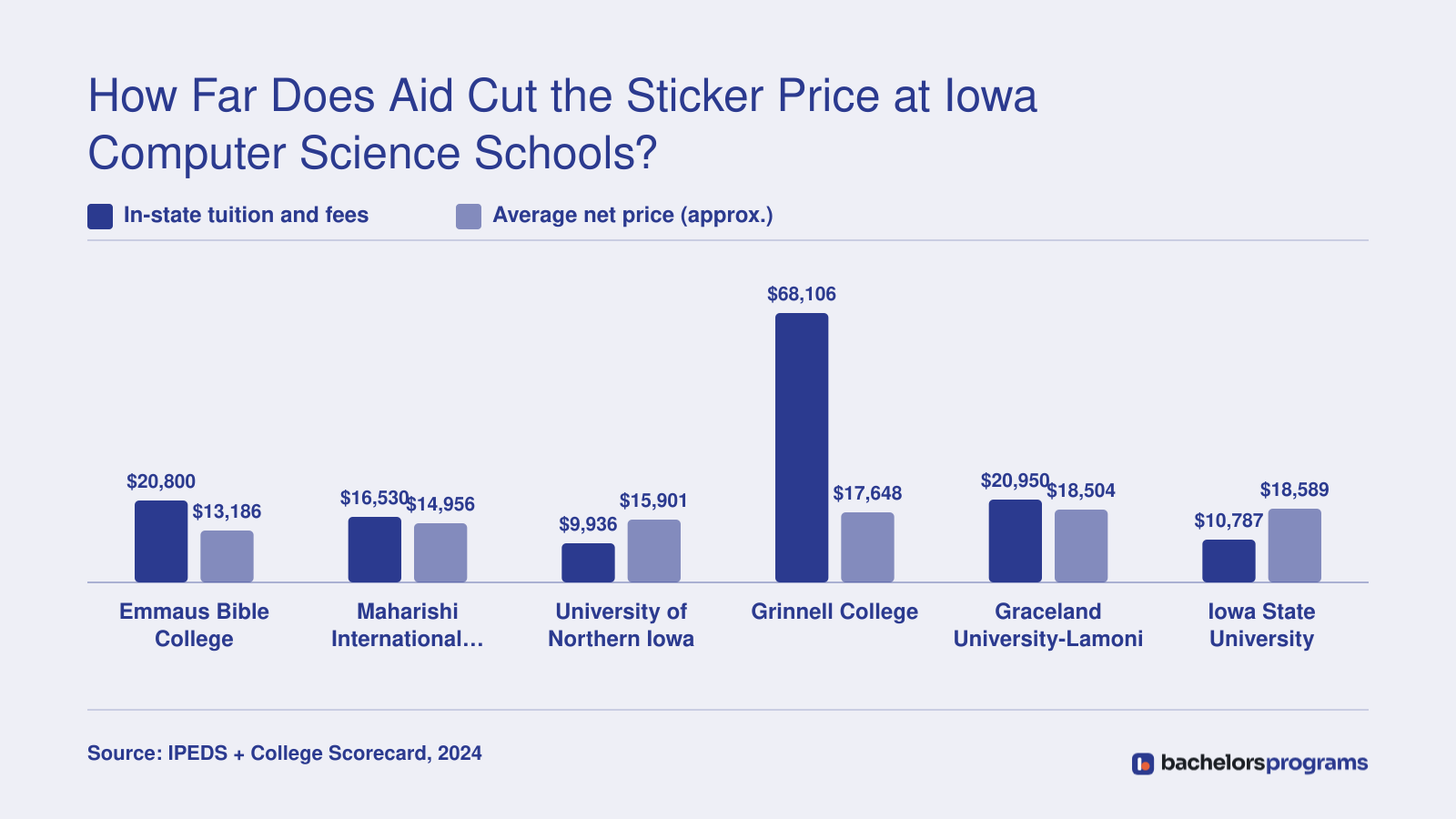
In-state tuition and fees at Iowa State University run $10,787 a year, and at the University of Northern Iowa $9,936. Across Iowa's Regent universities, average tuition and fees for 2026-27 are $11,292.1 Private colleges list far higher: Loras College at $39,824, Coe College at $54,666, and Grinnell College at $68,106.
Net price, the approximate average cost after grants and scholarships, tells a different story. It is a rough average for aided students, not your personal bill.
- Iowa State: $18,589
- Northern Iowa: $15,901
- Grinnell: $17,648
- Coe: $18,745
- Loras: $20,716
- Emmaus Bible College: $13,186
The public-private gap narrows sharply because private colleges discount heavily. Pell Grant share signals how much aid flows: about 70% of Emmaus students receive Pell, compared with roughly 42% at Grinnell, 48% at Coe, 45% at Northern Iowa, 41% at Iowa State, and 37% at Loras.
Iowa Tuition Grant
The Iowa Tuition Grant helps residents attending eligible private not-for-profit Iowa colleges. For 2026-27 the maximum is $7,500, but it is not guaranteed and may be lower depending on state funding.1 It cannot exceed your financial need.
- Iowa residency and eligible citizenship status are required.
- You must file the FAFSA and have a calculated student aid index between -1,500 and 16,000.1
- Enrollment can be as little as 3 credit hours in an associate or bachelor's program.
- Awards cover up to four years of full-time study, or eight full-time awards.
The student FAFSA deadline for 2026-27 was July 1, 2026, so file early for the next cycle. Public universities such as Iowa State and Northern Iowa fall outside this grant. Some other Iowa programs also require the Iowa Financial Aid Application (IFAA). Check amounts and deadlines in Iowa College Aid's Student Financial Aid Guide.
One Way to Cut Costs
Start at an Iowa community college, then transfer into a computer science program. Confirm in writing which courses your target school accepts so credits count toward the major.
How Far Does Aid Cut the Sticker Price at Iowa Computer Science Schools?
Grinnell College shows the widest sticker-to-net gap: $68,106 in published tuition and fees against an approximate average net price of $17,648, a difference of about $50,458. Net price is an average after grants and scholarships and also counts housing, food, and books, which is why Iowa State University and the University of Northern Iowa post net prices above their in-state tuition. Treat the net price bar as the closer estimate of what a year actually costs.
Questions to Ask Yourself
Do you plan to stay in Iowa after graduating, and does your school's internship pipeline reach the employers you want?
Would a paid internship or co-op matter more to you than a higher-ranked name?
Are you comparing a four-year campus path with an online path that lets you keep working?
Iowa Computer Science Bachelor's Degree FAQs
These answers cover the questions Iowa students ask most often about a bachelor's degree in computer science. Confirm details with each school before you apply.
Is Iowa State or the University of Iowa better for computer science?
Can you get a bachelor's degree in computer science online from an Iowa school?
Should I choose a B.S. or a B.A. in computer science?
Does Iowa require a license to work in computer science?
Compare Computer Science programs on the data that matters
Explore more Computers & IT majors or browse every field of study.
All Computers & IT programs Browse every field of study