Best Information Technology Schools in Virginia
Compare 19 accredited Information Technology programs in Virginia, with net price after aid, graduation rates, earnings and debt from IPEDS and the U.S. College Scorecard.

What does a bachelor's degree in information technology cost in Virginia, and what does it return? The degree is usually a Bachelor of Science (B.S.) in Information Technology, and the answer depends on where you enroll. Northern Virginia's federal contracting and data center corridor keeps demand steady, while in-state tuition at the state's public universities swings far more widely.
Admission difficulty splits the field further. Some programs admit nearly every applicant, others a small fraction. Net price after grants, transfer credit from the community college system, and whether the degree runs online reshape the math again.
Accreditation is the quiet variable: institutional approval says nothing about a program's computing-specific standing.
Key Points
- Old Dominion University posts the lowest average net price here.
- University of Virginia charges residents $21,803; nonresidents pay $59,512.
- Liberty admits roughly 99 percent of applicants; University of Virginia, about 17 percent.
Best Information Technology Schools in Virginia: Top 10 Bachelor's Programs
The ten programs below carry Virginia's information technology pipeline, from large public research universities in Charlottesville and Blacksburg to online completion degrees built for working adults. Each card gives location, format, in-state tuition and average net price, and the graduation rate shown is institution-wide, so read it as the share of students these schools graduate overall rather than a rate for the IT major alone. Where a school publishes a distinct concentration, such as cybersecurity or business analytics, the program bullets call it out.
University of Virginia
#1Charlottesville, VA · $22,000/yr (est. net price)
Best for: Working adults completing a degree online
The University of Virginia delivers its IT concentration through the online Bachelor of Interdisciplinary Studies in the School of Continuing and Professional Studies, so students pair five required IT courses with liberal studies seminars and a two-semester capstone. The 120-credit degree requires at least 60 credits earned at UVA, and the typical two-courses-per-term pace is why most students finish in three to four years. Electives reach into Java programming, agile project management, business analytics and cybersecurity, and the wider university connects to the 4-VA consortium and Northern Virginia technology employers. It suits a reader who wants a strong public university name on a degree they can finish without relocating.
- 18-credit IT concentration: five required courses plus one elective
- Fully online option with a two-semester capstone
- 120 credits total, at least 60 completed at UVA
- Typical pace of two courses per fall, spring and summer term
- Electives include Java, agile project management, business analytics, cybersecurity
- Finish in three to four years; up to seven years allowed
- At least 24 elective credits must fall outside IT
Virginia Polytechnic Institute and State University
#2Blacksburg, VA · $25,000/yr (est. net price)
Best for: Business-focused students eyeing analytics roles
Virginia Tech's Pamplin College of Business houses the Business Information Technology degree, an AACSB-accredited program that treats IT as a management discipline rather than a pure engineering track. Students choose among Cybersecurity Management and Analytics, Operations and Supply Chain Management, or Decision Support Systems, and every major completes eight foundational business courses plus four project courses ending in a capstone. A first-year AI literacy course and two co-curricular experiences of at least 100 hours, one a professional work experience, round out the degree. It is built for students who want technology fluency plus a business credential from a large residential campus.
- AACSB International accredited Pamplin College of Business degree
- Concentrations: cybersecurity analytics, operations and supply chain, decision support
- Eight foundational business courses required with a C- or better
- Four project courses ending in a capstone
- First-year AI Literacy in Business course required
- Two co-curricular experiences of 100+ hours, one a work experience
- 2.0 overall and in-major GPA required to graduate
- Majors restricted to current Pamplin students
George Mason University
#3Fairfax, VA · $15,000 – $20,000/yr (est.)
Best for: Career changers near federal cyber employers
George Mason's BS in Information Technology draws on the university's position inside Northern Virginia's technology and cybersecurity corridor, and its six concentrations run from database technology and programming to health IT, cybersecurity, web application development, networking and cloud computing. The program enrolls full-time and part-time students, and it is the largest producer of IT bachelor's graduates among the schools on this list. Commonwealth Cyber Initiative activity in the region puts students near federal contractors, cybersecurity firms and internship pipelines. It rewards readers who want to study where the jobs are.
- Six concentrations including cybersecurity and cloud computing
- Full-time and part-time enrollment options
- Tracks: database and programming, health IT, web development, networking
- Coursework targets IT problem solving in business systems
- Prepares students for management and technical level roles
- Largest IT bachelor's producer among Virginia schools on this list
James Madison University
#4Harrisonburg, VA · ~$23,000/yr (est.)
James Madison University runs a dedicated, on-campus BS in Information Technology with a 62-to-65 credit major inside a 120-credit degree. Core coursework spans programming, information security and privacy, digital electronics, telecommunications and networking, database administration, web technologies and operating systems administration, followed by a two-semester capstone. Admission to the major is gated: 50 to 68 students enter each year after earning a B- in CS 149 and a C in IT 160 and IT 201. A junior-year project for a community partner gives students a portfolio piece before senior electives in applied cryptography, cloud computing and IoT networks.
- 120 credits total, 62 to 65 in the major
- Core includes information security, networking, database administration
- Two-semester capstone plus a junior community project
- 50 to 68 students admitted to the major each year
- B- in CS 149 and C in IT 160 and IT 201 required to advance
- Nine credits of senior IT electives such as applied cryptography
Washington University of Science and Technology
#5Alexandria, VA · ~$14,000/yr (est.)
Washington University of Science and Technology is a small Alexandria institution certified to operate by SCHEV and accredited by ACCSC, with GI Bill benefits approved through the Virginia State Approving Agency. Its BS in Information Technology runs 40 courses across general education, a 24-course core and four concentration courses, with tracks in Cybersecurity, Enterprise Information Management and Software Engineering. Small classes and a Northern Virginia address keep students close to contractor and technology employers, and the university serves a notable share of military-connected students. It fits readers who want a compact, career-focused campus program with defined elective tracks rather than a sprawling research university.
- Three concentrations: cybersecurity, enterprise information management, software engineering
- 40 courses: 12 general education, 24 core, 4 concentration
- Four elective tracks inside the chosen concentration
- ACCSC accredited and certified to operate by SCHEV
- GI Bill benefits approved by the Virginia State Approving Agency
Regent University
#6Virginia Beach, VA · ~$20,000/yr (est.)
Regent University offers its IT concentration inside a Bachelor of Arts in Leadership Studies, a 120-credit degree delivered fully online from the Virginia Beach campus. Coursework blends leadership studies with systems security, network defense and disaster recovery, plus information systems, programming, database fundamentals and IT hardware and software. Online tuition is $415 per credit for full-time students taking 12 or more credits and $470 per credit part time, and sessions start through the year, with the next one in January 2027. The curriculum is anchored in Christian principles, which will appeal to some readers and not others.
- 120-credit online degree with an IT concentration
- $415 per credit full time, $470 per credit part time for 2026-27
- Coursework in systems security, network defense and disaster recovery
- Also covers programming, database fundamentals, IT hardware and software
- Next session starts January 11, 2027
- Military benefits accepted; FAFSA filed under school code 030913
Old Dominion University
#7Norfolk, VA · $13,000 – $34,000/yr (est.)
Old Dominion University teaches its information systems and technology degree in the Strome College of Business, with a curriculum balanced between business analysis and system implementation. Students study on the Norfolk campus or fully online through ODUGlobal, and coursework covers systems analysis and design, project management in information systems, and database concepts. Virginia resident tuition runs $281 per credit, with a $250 per credit rate for active duty military and a separate rate for technology-delivered courses taken outside Virginia. A dedicated transfer advising center makes it a practical landing spot for Hampton Roads community college students.
- On campus in Norfolk or fully online through ODUGlobal
- Coursework in systems analysis and design, project management, databases
- $281 per credit for Virginia residents; $972 per credit for non-residents
- $250 per credit for active duty military students
- Dedicated transfer advising center for community college students
- Housed in the Strome College of Business IT and decision sciences department
- Military benefits and financial aid accepted
Liberty University
#8Lynchburg, VA · ~$29,000/yr (est.)
Liberty University's residential BS in Information Technology requires 120 credits and a capstone, with four specializations: Application and Database Development, Data Networking and Security, Gaming Design, and Web and Mobile Programming. The Data Networking and Security track sits in a program designated a National Center of Academic Excellence in Cyber Defense Education by the National Security Agency and the Department of Homeland Security. The department pairs coursework with industry certifications from Microsoft, SAP, Cisco and Oracle and runs advanced IT labs and a data center. Admission is test optional, and on-campus tuition runs $870 per credit hour part time.
- Four specializations including data networking and security
- Designated Center of Academic Excellence in Cyber Defense Education
- Industry certifications from Microsoft, SAP, Cisco and Oracle
- 120 credits with a required capstone
- $870 per credit hour part time on campus
- Test optional admission; SAT, ACT or CLT results not required
- Washington Fellowship internship opportunities
Shenandoah University
#9Winchester, VA · $30,000/yr (est. net price)
Shenandoah University's BS in Information Technology concentrates 51 credits in the major on the Winchester campus, covering e-commerce applications, network and telecommunications support, IT security support, virtual reality, robotics and the Internet of Things, data analysis and system administration. Admission runs on a rolling basis with holistic review through the year, and transfer students are welcomed with credit available for internships. A 12-credit IT and Cybersecurity Technician Certificate shares classes with the major, giving students a shorter credential along the way. The small-campus setting in the northern Shenandoah Valley works for readers who want close faculty contact without leaving the region.
- 51 credits in the major, taught on the Winchester campus
- Coursework in virtual reality, robotics, IoT, data analysis, system administration
- Rolling admissions with holistic review through the year
- Transfer students welcome; credit available for internships
- 12-credit IT and Cybersecurity Technician Certificate shares classes
- Member of the NCWIT Academic Alliance
University of Management and Technology
#10Arlington, VA · $5,000 – $10,000/yr (est.)
The University of Management and Technology in Arlington offers a 120-credit BS in Information Technology with 60 upper-level credits and at least 30 general education credits. Students choose between Information Systems, which emphasizes managing systems design and development projects, and Software Engineering, which targets application systems design and development. The core covers management information systems, program logic and design, data communications, security implementation, cybersecurity, database systems, intelligent systems and IT project management. It is an online option with a Virginia base, useful for students who want project-management coursework alongside technical training.
- 120 credits, including 60 upper-level credits
- Two tracks: Information Systems or Software Engineering
- Core spans cybersecurity, database systems and intelligent systems
- IT project management and information security solution design
- At least 30 credits of general education required
Cost & outcomes by school
Federal data for the highest-earning Information Technology programs, independent of the ranking above. Earnings are this field's bachelor's graduates four years after completing where the Scorecard reports them, else the school's undergraduate median.
| School | Net price / yr | Grad rate | Earnings | Debt | Grads/yr | Format |
|---|---|---|---|---|---|---|
| Virginia Polytechnic Institute and State University VA | $24,953 | 86% | $144,103 | $20,500 | 527 | Campus |
| University of Virginia VA | $21,565 | 96% | $142,041 | $16,547 | 656 | Online |
| George Mason University VA | $17,915 | 68% | $110,754 | $21,000 | 892 | Online or campus |
| James Madison University VA | $23,322 | 80% | $104,806 | $19,500 | 188 | Campus |
| Old Dominion University VA | $14,638 | 46% | $95,485 | $23,925 | 138 | Online or campus |
| Marymount University VA | $29,137 | 54% | $82,795 | $27,000 | 30 | Online or campus |
| Strayer University-Virginia VA | $19,578 | 36% | $82,304 | $37,500 | 106 | Online or campus |
| Liberty University VA | $29,357 | 65% | $82,116 | $26,765 | 276 | Campus |
| Virginia Military Institute VA | $17,113 | 76% | $77,369 | $22,996 | — | Campus |
| University of Management and Technology VA | — | 33% | $68,530 | — | 7 | Online |
| ECPI University VA | $22,965 | 43% | $66,214 | $32,477 | — | Online or campus |
| Shenandoah University VA | $30,298 | 67% | $58,433 | $25,000 | 5 | Campus |
Sources: U.S. Department of Education. Net price, graduation rate, earnings and debt: College Scorecard (earnings and debt for this field's bachelor's graduates where reported, else school-wide); graduates: IPEDS. A dash means no figure is reported.
Cost, debt & payoff
Median earnings of this field's bachelor's graduates (4 yrs after completing, else the school's undergraduate median) vs. their median federal loan debt · U.S. College Scorecard
Across these programs the median graduate earns about $72,950 and finishes with roughly $25,000 in debt — a ratio that clears a common rule of thumb (keep debt below first-year salary). Net price and debt vary widely school to school, so check the per-school figures in the table above before you shortlist.
Most Affordable Bachelor's in Information Technology Programs in Virginia
This table sorts Virginia bachelor's programs in information technology by average annual net price, the cost after grants and scholarships, using 2024 IPEDS and College Scorecard data from the U.S. Department of Education. Old Dominion University has the lowest net price here at $14,638 a year. Norfolk State University has the lowest in-state sticker price at $10,180, and Strayer University-Virginia charges the same $13,920 rate to residents and nonresidents alike.
| School | City | Program | Format | In-State Tuition and Fees | Out-of-State Tuition and Fees | Average Net Price | Graduation Rate |
|---|---|---|---|---|---|---|---|
| Old Dominion University | Norfolk | Information Systems & Technology (B.S.B.A.) | Campus and online | $12,750 | $33,780 | $14,638 | 46% |
| Norfolk State University | Norfolk | Bachelor of Science in Information Technology | Campus | $10,180 | $21,682 | $15,282 | 38% |
| Virginia Military Institute | Lexington | Computer Science, Information Technology Track | Campus | $21,046 | $52,638 | $17,113 | 76% |
| George Mason University | Fairfax | Information Technology (B.S.) | Campus and online | $14,220 | $38,688 | $17,915 | 68% |
| Strayer University-Virginia | Arlington | Bachelor of Science in Information Technology | Campus and online | $13,920 | $13,920 | $19,578 | 36% |
What Computer and IT Jobs Pay Statewide in Virginia
Most IT roles fall under the computer and mathematical occupations group, and Virginia pays this group well.
Online and Hybrid Bachelor's in Information Technology Options at Virginia Schools
Public universities that offer both formats are the strongest online route to an IT bachelor's in Virginia, but read each degree title closely. Several fully online options award a related credential rather than a standard B.S. in Information Technology.
Online, Campus or Both
- Both formats: George Mason University's B.S. in Information Technology offers full-time and part-time study. Old Dominion University's Information Systems & Technology (B.S.B.A.) has a fully online option.
- Fully online: University of Management and Technology offers a B.S. in Information Technology. Regent University offers a B.A. in Leadership Studies with an IT concentration. The University of Virginia offers a Bachelor of Interdisciplinary Studies with an IT concentration and requires at least 60 credits completed at UVA.
- Campus: Virginia Tech (Business Information Technology), James Madison University, Washington University of Science and Technology, Liberty University's residential B.S. and Shenandoah University.
Degrees vs. Certificates
Bachelor's degrees in this field are easy to confuse with shorter credentials. Shenandoah, for example, offers a 12-credit IT technician certificate alongside its degree. That certificate is not a bachelor's. Confirm that the program you choose awards a full bachelor's degree. UVA, Regent, UMT, Liberty and JMU each list 120 total credit hours.
Who Each Format Suits
Working adults get the most flexibility from the online programs at UMT, Regent and ODU, or from part-time study at Mason. Military-connected students should look at ODU, which lists an active-duty rate of $250 per credit, and Regent, which accepts military benefits. If you want Northern Virginia internships, a campus seat in Fairfax at Mason or Alexandria at Washington University of Science and Technology keeps you close to that job market.
Residency still matters online at a public school. ODU lists $281 per credit for Virginia residents and $972 for non-residents. Regent, a private school, lists a flat $415 per credit.
Accreditation: What to Verify for an IT Bachelor's Program
Cybersecurity designations now sit beside traditional program accreditation as a way IT degrees signal quality, and the two are easy to confuse. Each answers a different question.
## The Three Credentials That Matter
- **Regional (SACSCOC):** Institutional accreditation is the baseline. It affects whether credits transfer and whether you can use federal financial aid, so confirm it before anything else. - **ABET:** Its Computing Accreditation Commission reviews individual computing programs, not whole universities. - **AACSB:** This applies when information systems sits inside a business school. It covers the school, not the IT major itself. - **NSA CAE-CD:** This cybersecurity designation is awarded at the institution level. It does not mean every IT bachelor's program at the school is validated.
## What We Could Confirm
George Mason University holds ABET accreditation for its B.S. in Information Technology.[[CITE:907337]] Its business school is AACSB-accredited,[[CITE:907338]] and the university's CAE-CD designation runs through 2027.[[CITE:907336]] James Madison University's Computer Information Systems BBA is ABET-accredited.[[CITE:907339]] Its CAE listing names the B.S. in Cybersecurity as a validated program of study.[[CITE:907336]]
Old Dominion University is identified as AACSB-accredited and holds CAE-CD, plus Cyber Operations and Research designations. Virginia Polytechnic Institute and State University holds all three of those CAE designations.[[CITE:907336]] Liberty University holds CAE-CD through 2028.[[CITE:907336]] Its business programs carry ACBSP accreditation, and AACSB status was not established.
ABET status for a program titled Information Technology could not be confirmed at Virginia Tech, Old Dominion or Liberty. Treat that as unconfirmed, not as a lack of accreditation. The same applies to the other schools here, so ask them directly.
## Quick Ways to Check
Search ABET's accredited program tool by school name and look for your exact degree title. Then check the NSA CAE institution list for the school and see whether a specific program of study is named.
Questions to Ask Yourself
Do you want a general IT degree or a cybersecurity track?
Do you need online or hybrid study, or can you commute for internships?
Are you starting at a Virginia community college?
Admissions Requirements: GPA, Test Policy and Transfer Credit
Admission rates across these Virginia programs span an enormous range: Liberty University admits roughly 99 percent of applicants, Old Dominion about 90 percent and George Mason about 87 percent, while the University of Virginia admits about 17 percent and Washington University of Science and Technology reports about 7 percent. Those figures describe entry to the university, not always entry to the IT major, a distinction that matters at several of these schools.
GPA and test policy
Virginia Tech sets a 2.0 GPA minimum for its business information technology major and restricts the major to students already enrolled in its business college, so the real hurdle is internal rather than at the application stage. James Madison University runs its IT program as a cohort, admitting roughly 50 to 68 students a year across fall and spring starts, with prerequisite coursework and a minimum B- in the introductory computer science course required to advance. Liberty University states that no entrance exam is required and that SAT and ACT scores are optional. Shenandoah University uses rolling admissions.
George Mason, Old Dominion, Regent, the University of Management and Technology, Washington University of Science and Technology and UVA's interdisciplinary bachelor's do not publish a single minimum GPA or a fixed test requirement for the IT major on their program pages. Treat those as case-by-case reviews and confirm current requirements with the admissions office before you apply, since policies shift from one cycle to the next.
Transfer credit
Transfer rules matter more here than at most majors, because many Virginia IT students arrive with community college or military coursework. UVA's interdisciplinary bachelor's requires at least 60 of the 120 credits to be completed at UVA, which effectively caps incoming credit at about half the degree. Old Dominion operates a dedicated transfer advising center. Shenandoah states that transfer students are welcome and awards credit for internships. Washington University of Science and Technology accepts military education benefits, which is relevant across Hampton Roads and Northern Virginia.
The quick takeaway
For the widest access, Liberty, Old Dominion and George Mason admit the large majority of applicants, and Shenandoah's rolling review suits students applying late. UVA and Virginia Tech are the most competitive paths, and James Madison adds a second gate at the major level even after you are admitted to the university. Build your list with at least one of each.
Transferring From a Virginia Community College Into an IT Bachelor's Program
Two years at a community college plus two at a four-year school, or four years straight through: the community college route trades paperwork for a smaller total bill.
How Guaranteed Admission Works
Virginia's 23-college community college system holds guaranteed admission agreements with more than 30 four-year institutions, and individual colleges report 40 or more. Read the fine print: most agreements guarantee a place at the university, not a place in the IT major, and each sets its own GPA, prerequisite courses, and application deadline. An Information Technology associate degree is the usual starting point.
What the Receiving Schools Ask For
- Virginia Tech: the Business Information Technology agreement accepts an A.S. in Business Administration or an A.S. in Information Technology, with a C or better in every required roadmap course. GPA cutoffs run from 3.0 to 3.4 depending on the agreement.
- University of Virginia: 3.4 in community college coursework, 45 transferable credits earned after high school, at least 24 taken at the degree-granting college, and a C or better in every attempt. Its guarantee covers transfer-oriented associate degrees rather than IT specifically.
- Old Dominion University: Information Systems Technology associates, including the cybersecurity certificate track, feed its business IT degree.
Practical Steps
Complete the associate degree rather than transferring course by course, because the guarantee attaches to the credential. Check course equivalencies one at a time before you register, since a misapplied elective can add a semester. Two years at community college rates followed by two at a four-year price is where the savings come from.
Cost of a Bachelor's Degree in Information Technology in Virginia
Three numbers decide what an information technology bachelor's degree costs in Virginia: published tuition, net price after grants, and debt carried at graduation.
Sticker Price Versus Net Price
At the schools ranked here, in-state tuition runs from $12,750 a year at Old Dominion University to $23,118 at the University of Virginia; George Mason University charges $14,220 and James Madison University $13,966. Out-of-state rates are far steeper, from $31,312 at JMU to $61,591 at UVA. Net price after aid is the figure that matters: about $14,638 at Old Dominion, $17,915 at George Mason, $19,923 at Regent University, $21,565 at UVA and $23,322 at JMU. Each is an institution-wide average across all majors, not an IT-specific number, so treat it as a ballpark.
State Aid Worth Filing For
Virginia's Tuition Assistance Grant pays up to $5,250 a year in 2026-27 to residents at eligible private nonprofit colleges such as Regent, provided the program itself qualifies.1 It is not need-based, and the priority deadline is September 15, 2026.2 Distance learners receive less: $3,400 if grandfathered, $2,625 if new or returning.1 The Commonwealth Award is need-based, goes to undergraduates at public colleges, and covers up to tuition and required fees with no separate application.3 G3 at public two-year colleges covers leftover tuition for residents at or below 400% of the federal poverty line, enrolled at least half time in a high-demand program, plus $2,250 for full-time Pell recipients.4 SCHEV lists no statewide scholarship reserved for IT majors; the nearest is the Space Grant Consortium STEM award, up to $1,000 with a $1,000 bonus.4
Debt and Ways to Cut the Bill
Median federal debt among graduates who borrowed runs from $17,500 at UVA to $24,000 at Old Dominion. The most reliable saving is two years at a Virginia community college, ideally with G3 covering tuition if the IT track qualifies, then transferring into a four-year program. Staying in state at a public option such as Old Dominion or George Mason keeps net price near $15,000 to $18,000, and students considering a private college should file for VTAG well before the September deadline.
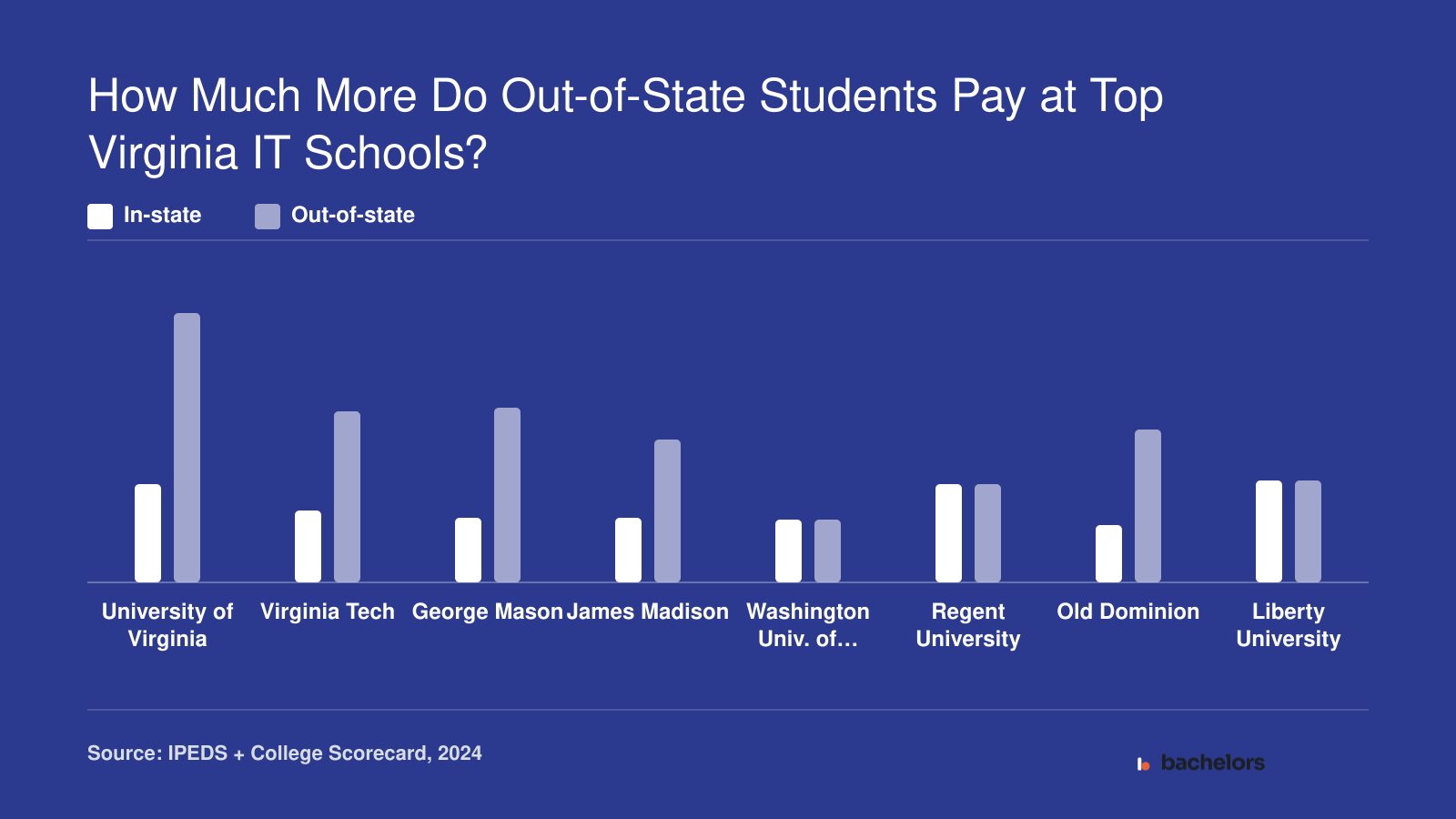
How Much More Do Out-of-State Students Pay at Top Virginia IT Schools?
Virginia residency matters most at public universities. Out-of-state students pay roughly $17,000 to $38,000 more per year. At the University of Virginia, tuition and fees run $21,803 for residents and $59,512 for nonresidents, and George Mason, Virginia Tech and Old Dominion each add more than $21,000. Private schools such as Regent University, Liberty University and Washington University of Science and Technology charge one rate regardless of where you live.
Related Articles
Compare Information Technology programs on the data that matters
Explore more Computers & IT majors or browse every field of study.
All Computers & IT programs Browse every field of study