Best Mobile App Development Degree Programs
Compare 12 accredited Mobile App Development programs, with net price after aid, graduation rates, earnings and debt from IPEDS and the U.S. College Scorecard.

A standalone mobile major is rare. More often, a bachelor's degree in mobile app development is a concentration inside a computer science or software development degree, and that structure shapes whether you graduate with real iOS and Android skills.
Cost varies widely too. Net prices range from $10,258 at Weber State University to $30,770 at DeVry University-Illinois.
Because the track rather than the degree title determines what you can build at graduation, look harder at the curriculum than at the program name.
Key Points
- Most mobile app degrees are concentrations within computer science or software engineering.
- Weber State University, a public Utah school, is the lowest-cost option here.
- Software developers earned a median $135,980 in May 2025, per BLS.
Best Schools for a Bachelor's Degree in Mobile App Development
The ten programs below all pair a computer science or software development core with a named mobile or application development track, and most build a portfolio or capstone into the final year. Five are offered in both online and campus formats, three are campus-only, and two are fully online.
Weber State University
#1Ogden, UT · ~$10,000/yr (est.)
Best for: Self-paced online learners
Weber State University in Ogden, Utah runs its computer science bachelor's degree fully online with a mobile development emphasis, and the asynchronous classes let students log in any time of day. The university is open-enrollment and holds a Center of Academic Excellence in Cyber Defense Education designation sponsored jointly by the NSA and the Department of Homeland Security. The approximate average net price after aid is about $10,300, and schools offering this program graduate 46% of students.
- Mobile development emphasis inside an online computer science bachelor's
- Entire degree delivered online with asynchronous classes
- Choice of the general degree or the mobile development emphasis
- Coursework in operating systems, software engineering and graphics
- NSA and Department of Homeland Security Center of Academic Excellence
- Prepares graduates for software developer and systems analyst roles
- Same department offers an in-person CS Flex associate degree
Fairleigh Dickinson University-Metropolitan Campus
#2Teaneck, NJ · $15,000/yr (est. net price)
Best for: North Jersey game and mobile designers
Fairleigh Dickinson University's Metropolitan Campus in Teaneck, New Jersey awards a Bachelor of Science in Computer Science accredited by the Computing Accreditation Commission of ABET, with a Game and Mobile Application Development concentration. That concentration is five courses and 15 credits, and students work in on-site labs for apps development, cyber defense, networking and robotics. The approximate average net price after aid is about $15,400, and schools offering this program graduate 53% of students. Students can also add a 4 Plus 1 pathway to a master's degree.
- ABET Computing Accreditation Commission accredited
- Game and Mobile Application Development concentration, five courses, 15 credits
- 120 total credit hours with three concentration options
- Labs for apps development, cyber defense, networking and robotics
- Member of the Cisco Networking Academy
- Three 4 Plus 1 pathways to a master's degree
- Two computer animation electives recommended from the art school
- Careers include app developer, web developer and systems analyst
DeVry University-Illinois
#3Lisle, IL · $31,000/yr (est. net price)
Best for: Transfer students with prior credits
DeVry University's Lisle, Illinois location awards a Bachelor of Science in Software Development with a Web and Mobile Application Development concentration, and students choose between online and on-campus classes. The ABET-accredited degree runs 120 credits across 36 courses, starts new classes every eight weeks, and accepts up to 80 qualifying transfer credits. The approximate average net price after aid is about $30,800, and schools offering this program graduate 37% of students.
- ABET accredited, 120 credits across 36 courses
- Web and Mobile Application Development concentration
- Finish in 8 semesters at 15 credits per term
- Transfer up to 80 qualifying credit hours
- New classes start every 8 weeks
- Cross-platform apps, game programming and VR coursework
- Preparation for CompTIA and Python Institute certifications
- Offered fully online and on campus
Tiffin University
#4Tiffin, OH · ~$27,000/yr (est.)
Tiffin University in Tiffin, Ohio offers a Bachelor of Science in Computer Science with a software development concentration, delivered online or on campus. A 150-hour professional internship sits in the final course, and coursework prepares students for up to 20 industry certifications, with most exams taken at the on-campus testing center. The approximate average net price after aid is about $26,500, and schools offering this program graduate 40% of students. The business school holds ACBSP accreditation.
- Software development concentration with web and mobile app coursework
- 150-hour professional internship required in the final course
- Preparation for up to 20 industry certifications
- Certified Cisco Academy and Amazon Web Services Academy member
- On-campus Certiport and Pearson Vue testing center
- ACBSP-accredited School of Business
- Available fully online or on campus
DeVry University-New Jersey
#5Iselin, NJ · ~$27,000/yr (est.)
DeVry University's Iselin, New Jersey location teaches a Bachelor of Science in Software Development with an Application Development specialization, offered online or on campus. The ABET-accredited program runs 120 credits and 39 classes, covers Python and Java plus AI-assisted coding and secure development practices, and starts new classes every eight weeks. The approximate average net price after aid is about $26,600, and schools offering this program graduate 71% of students.
- Application Development specialization, one of four options
- 120 credits and 39 classes over 8 semesters
- Python and Java programming plus AI-assisted coding
- Secure development practices and SQL database integration
- Prepares students for AWS AI Practitioner and CSSD exams
- Classes start every 8 weeks
- Free application
- ABET accredited
Clarke University
#6Dubuque, IA · ~$24,000/yr (est.)
Clarke University in Dubuque, Iowa awards a Bachelor of Arts in Digital Media Studies with a concentration in web and mobile design development, drawing on the computer science, art and design, and communication departments. Every major completes at least one internship and a senior capstone with a professional portfolio and thesis presentation, working in labs equipped with iMacs, a 3D printer, a laser cutter and VR gear. The approximate average net price after aid is about $24,500, and schools offering this program graduate 56% of students.
- Concentration in web and mobile design development
- Coursework across computer science, art and design, and communication
- Internship required for every major
- Senior capstone with portfolio and thesis presentation
- Front-end coding in HTML, CSS and JavaScript
- Labs with 18 iMacs, a 3D printer, a laser cutter and VR
- School reports 100% job placement in field within six months
Grand Canyon University
#7Phoenix, AZ · ~$22,000/yr (est.)
Grand Canyon University in Phoenix, Arizona offers a Bachelor of Science in Software Development with an emphasis in Mobile App Development as an on-campus program. The 120-credit degree covers native and cross-platform mobile development, advanced mobile development, cloud computing and application security, and closes with a two-course senior project. Admission requires a 2.8 unweighted GPA, or a 2.5 GPA with ACT or SAT scores, and up to 90 transfer credits are accepted. The approximate average net price after aid is about $22,500, and schools offering this program graduate 43% of students.
- Emphasis in Mobile App Development within the software development bachelor's
- 120 credits: 72 in the major, 34 to 40 general education
- Native and cross-platform mobile app development coursework
- Cloud computing, application security and advanced mobile development
- Two-course senior project capstone
- Admission needs a 2.8 unweighted GPA, or 2.5 with ACT or SAT
- Up to 90 transfer credits accepted, 84 lower division
- Campus courses run 15 weeks
DeVry University-Texas
#8Irving, TX · ~$17,000/yr (est.)
DeVry University's Irving, Texas location offers the Bachelor of Science in Software Development with an Application Development specialization, taught online or on campus. The 39-class, 120-credit program covers Python and Java, SQL database integration, secure software design and 3D modeling, and students pick from four specializations. It is ABET accredited and new classes start every eight weeks.
- 120 credits across 39 classes and 8 semesters
- Application Development specialization among four options
- Python and Java, AI-assisted coding and SQL integration
- Named courses include 3D Modeling and Animation
- Simulation and Game Design coursework
- Prepares students for AWS AI Practitioner and CSSD credentials
- Free application for the January 4 session
- Online or campus classes starting every 8 weeks
DeVry University-Florida
#9Orlando, FL · $29,000/yr (est. net price)
DeVry University's Orlando, Florida location teaches the Bachelor of Science in Software Development with a Web and Mobile Application Development concentration, available online or on campus. Students build apps for mobile devices, wearables and smart gadgets, study dynamic HTML and CSS, and work with AI development assistants across 120 credits and 36 courses. The program is accredited by the Computing Accreditation Commission of ABET, classes start every eight weeks, and up to 80 credits transfer. The approximate average net price after aid is about $29,500, and schools offering this program graduate 33% of students.
- Web and Mobile Application Development concentration
- Build apps for mobile devices, wearables and smart gadgets
- 120 credits over 36 classes and 8 semesters
- Dynamic HTML and CSS plus AI development assistants
- AI coursework on large language models
- Portfolio-building lab classes
- Industry certification exam reimbursement
- Content partnerships with CompTIA and ACI Learning
DeVry University-Ohio
#10Columbus, OH · ~$25,000/yr (est.)
DeVry University's Columbus, Ohio location awards a Bachelor of Science in Software Development with a Web and Mobile Application Development concentration, delivered online. The 120-credit degree includes 57 credits in the major and 12 technical elective credits, and an accelerated schedule of three year-round semesters can finish it in as little as two years and eight months. Coursework spans cloud computing, secure cyber coding, AI and machine learning, databases, user experience design and a senior project. The approximate average net price after aid is about $25,000, and schools offering this program graduate 39% of students.
- Web and Mobile Application Development concentration
- 120 credits, 57 in the major plus 12 technical electives
- Finish in as little as 2 years and 8 months with year-round study
- Cloud computing, secure cyber coding and AI coursework
- User experience and interface design, 3D modeling and animation
- Prep for CompTIA Data+, CompTIA Project+ and Python PCAP exams
- Senior project required
- Delivered fully online
Cost & outcomes by school
Federal data for the highest-earning Mobile App Development programs, independent of the ranking above. Earnings are this field's bachelor's graduates four years after completing where the Scorecard reports them, else the school's undergraduate median.
| School | Net price / yr | Grad rate | Earnings | Debt | Grads/yr | Format |
|---|---|---|---|---|---|---|
| Fairleigh Dickinson University-Metropolitan Campus NJ | $15,404 | 53% | $57,273 | $25,000 | 4 | Campus |
| Weber State University UT | $10,258 | 46% | $56,287 | $15,113 | 13 | Online |
| Clarke University IA | $24,479 | 56% | $55,396 | $26,717 | — | Campus |
| DeVry University-New Jersey NJ | $26,565 | 71% | $47,440 | $41,879 | — | Online or campus |
| DeVry University-Illinois IL | $30,770 | 37% | $47,440 | $41,879 | 22 | Online or campus |
| DeVry University-Texas TX | — | 33% | $47,440 | $41,879 | — | Online or campus |
| DeVry University-Florida FL | $29,477 | 33% | $47,440 | $41,879 | — | Online or campus |
| DeVry University-Ohio OH | $25,001 | 39% | $47,440 | $41,879 | — | Online |
| DeVry University-California CA | $33,744 | 22% | $47,440 | $41,879 | — | Online or campus |
| Grand Canyon University AZ | $22,472 | 44% | $42,186 | $22,114 | — | Campus |
| Tiffin University OH | $26,500 | 40% | $35,942 | $27,000 | 5 | Online or campus |
| The University of Arizona Global Campus AZ | $31,266 | 11% | $35,404 | $31,250 | 1 | Online |
Sources: U.S. Department of Education. Net price, graduation rate, earnings and debt: College Scorecard (earnings and debt for this field's bachelor's graduates where reported, else school-wide); graduates: IPEDS. A dash means no figure is reported.
Cost, debt & payoff
Median earnings of this field's bachelor's graduates (4 yrs after completing, else the school's undergraduate median) vs. their median federal loan debt · U.S. College Scorecard
Across these programs the median graduate earns about $47,440 and finishes with roughly $36,565 in debt — a ratio that clears a common rule of thumb (keep debt below first-year salary). Net price and debt vary widely school to school, so check the per-school figures in the table above before you shortlist.
How We Ranked These Mobile App Development Schools
Most bachelor's degrees in mobile app development are built as a concentration inside a computer science or software engineering major, so a ranking has to look past the program title to what graduates actually earn.
What We Compared
Five plain measures drive the order. Program-level earnings, measured a few years after graduates finish, carry the most weight. Next is what students actually pay once grant aid is applied, then median borrowing and the monthly payment that debt implies. Completion and retention rates show whether students finish what they start, and online availability matters for readers who need to keep working while enrolled.
Our Data Sources
Figures trace to two federal sources: College Scorecard program and institution outcomes, and IPEDS cost data. The snapshot reflects the most recent release available as of 2026.
What the Ranking Cannot Tell You
Graduation rates and net price are reported for the whole institution, not the app development track, so a strong campus average can mask a weaker program. Small cohorts sometimes have no published earnings at all, which is why a school with a solid local reputation may sit lower than you would expect.
Only bachelor's-level programs were eligible. Graduate certificates and master's degrees in mobile computing answer a different question than the undergraduate path does.
Online vs. Campus Mobile App Development Degrees
Yes, you can earn a bachelor's degree in mobile app development online, and the format labels in the ranked list above (online, campus, or both) show which schools offer each route. Employer research from 2026 suggests format matters less than skills and work experience. In one U.S. hiring experiment, in-person candidates were chosen 51.6% of the time versus 48.4% for online candidates, and in industries with a strong online presence the gap was not statistically significant. Treat the table below as general guidance, since specific programs vary.
| Factor | Fully Online | Campus | Both (Online and Campus Options) |
|---|---|---|---|
| Flexibility and pacing | Highest flexibility. Many programs allow part-time study and asynchronous classes, so you can work while you learn. | Fixed class schedules and a set semester calendar. Pacing is usually full-time and structured. | Mix of both. You can often shift between online and on-site courses as your schedule changes. |
| Device testing and lab access | You test on your own phones and tablets or on emulators. Physical device labs are generally not available. | On-site labs and shared test devices are often available, along with in-person help from instructors. | Lab access on campus when you need it, with remote work for coursework you can do from home. |
| Team and capstone projects | Group work happens through video calls and shared code repositories. It can mirror remote developer teams, but takes more self-organization. | Face-to-face teamwork and in-person capstone demos, with easy peer feedback. | Teams can combine in-person and remote collaboration, depending on the program. |
| Internship and recruiting access | Internships are typically self-directed. Career services and virtual career fairs may be available, though local networking is harder. | Easier access to on-campus recruiting, career fairs, and local employer ties. | Campus recruiting is open to you, and online options let you pursue internships elsewhere. |
| Cost factors | Tuition may be lower or comparable. You skip commuting and housing, but you usually supply your own computer, test devices, and software, which adds to total cost. | Tuition plus housing, transportation, and fees. Some labs and devices are provided on site, which can reduce hardware spending. | Costs depend on how much time you spend on campus. You may still need your own hardware for remote work. |
| Employer perception (2026 research) | Surveyed employers that had hired online graduates reported paying the same starting salaries as for traditional graduates. 79% of HR professionals rated accredited online degrees as equal in quality to on-campus ones. | On-campus degrees remain the quality benchmark. Employers weigh work experience and skills more heavily than modality. | Same employer findings apply. A portfolio of shipped apps and internships matters more than format. |
Mobile App Development Degree Cost, Debt, and Financial Aid
Net Price: Public vs. Private
Net price, what students actually pay once grant aid is applied, separates these schools more clearly than sticker tuition does. Weber State University, a public school in Utah, is the lowest-cost option at about $10,258 a year. The private options start higher: Fairleigh Dickinson University-Metropolitan Campus at about $15,404, then Grand Canyon University at about $22,472. Clarke University, Tiffin University, and the DeVry University campuses fall roughly between $24,500 and $30,800.
Debt Figures
Program-level debt data is thin. Where it is published, DeVry's software development program shows a median federal debt of $32,159 and a median monthly payment of about $444 on a 10-year plan. These are program-level figures, so treat them as a reference point rather than a prediction for your own loans. Most other schools here do not report program-level debt, so ask each admissions office what graduates typically borrow.
Costs Beyond Tuition
- A Mac: Xcode, Apple's development tool, runs only on a Mac, so iOS work means owning or having access to one. Prices vary by model, so check Apple's current lineup before budgeting.
- Apple Developer Program: $99 per membership year. You do not need it to download Xcode or test on your own devices, only to distribute apps. Accredited educational institutions can request a fee waiver.1
- Google Play developer registration: Google charges a registration fee to publish apps. Confirm the current amount in the Play Console before you plan to launch.
- Test devices: Real phones and tablets catch bugs that emulators miss, and you may want both iOS and Android hardware.
- Technology fees: Online programs may charge them per credit, per term, or as a flat amount. Ask for the exact structure in writing.
Ways to Lower the Bill
Starting at a community college can cut the first two years of tuition sharply, provided the credits transfer. Some schools here accept generous transfers: Grand Canyon University takes up to 90 credits and DeVry up to 80. Get a written credit evaluation before you enroll. Then file the FAFSA as early as possible, since some aid is limited and awarded on a first-come basis.
Highest First-Year Earnings Among Ranked Programs
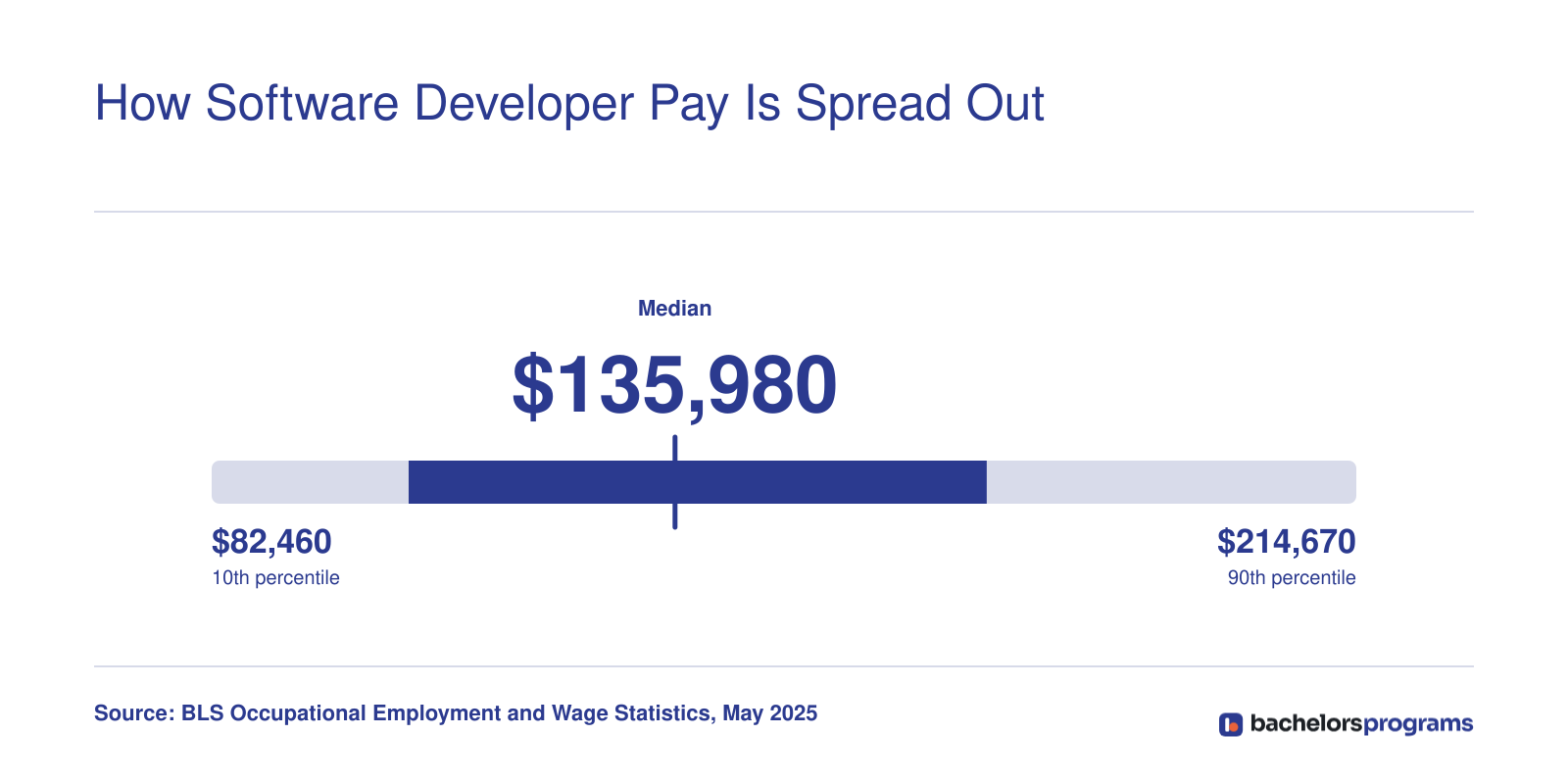
How Software Developer Pay Is Spread Out
Bureau of Labor Statistics data for software developers overall, which includes mobile developers, shows annual wages from $82,460 at the 10th percentile to $214,670 at the 90th, with a median of $135,980 in May 2025. New graduates with a bachelor's degree in mobile app development tend to start closer to the lower percentiles, roughly in the $82,460 to $105,210 band. Mobile specialists who build a portfolio of shipped apps and develop deep iOS or Android expertise are best positioned to climb toward the upper percentiles over time.
Related Articles
Questions to Ask Yourself
Do you want to build the app's architecture, design its interface, or launch it as a business?
Does the program teach both Swift and Kotlin, or only one platform?
Will you finish with at least one published app in the App Store or Google Play?
How much math and computer science theory do you want alongside the mobile coursework?
Mobile App Development programs by state
Mobile App Development Degree FAQs
These answers draw on the 2025 Stack Overflow Developer Survey and a secondary hiring report. Neither is specific to mobile developers, so treat the figures as directional.
Do you need a degree to become a mobile app developer?
Is a mobile app development degree worth it?
How long does a bachelor's degree in mobile app development take if you transfer in an associate degree?
Should I choose a bootcamp instead of a mobile app development degree?
Compare Mobile App Development programs on the data that matters
Explore more Computers & IT majors or browse every field of study.
All Computers & IT programs Browse every field of study