Best Software Engineering Degree Programs
Compare 140+ accredited Software Engineering programs, with net price after aid, graduation rates, earnings and debt from IPEDS and the U.S. College Scorecard.

Employers hiring software engineers rarely ask which ABET-accredited program a candidate attended. They ask what the candidate has built. The credential still functions as a filter, though: the bachelor's degree in software engineering, usually a Bachelor of Science (B.S.) in Software Engineering, remains the standard entry point, and the BLS projects continued demand for software developers through 2035.
Cost and curriculum separate these programs more than reputation does. Annual tuition runs from about $6,700 to $69,000 before aid, and online and campus routes reach the same degree on different timelines. This ranking weighs College Scorecard earnings and borrowing for each program.
Key Points
- ABET accredits individual programs, so verify the software engineering major itself.
- UM-Dearborn's $15,640 in-state tuition fell to a $9,492 average net price.
- Brigham Young graduates have the lowest median loan payment here: $117 monthly.
Best Schools for a Bachelor's Degree in Software Engineering, Ranked
This ranking covers every format at once, so online, on-campus and hybrid bachelor's degree in software engineering programs compete on the same footing. Placement leans on College Scorecard outcomes, including what graduates of each program earn and what they borrow to get there.
University of California-Irvine
#1Irvine, CA · $14,000/yr (est. net price)
Best for: Career changers with no prior programming experience
UC Irvine treats software engineering as its own discipline rather than a computer science add-on, and undergraduates take at least ten dedicated software engineering courses before finishing a three-quarter capstone built for an outside client, often a real company. The campus sits in Orange County's tech corridor, so internships in medical software, enterprise systems and startups are close at hand. Students arrive with and without prior programming experience and both groups finish the degree.
- Three-quarter capstone builds a real system for an outside client
- Nearly two dozen electives let students choose a specialty
- At least ten courses are dedicated to software engineering
- Open to students with no prior programming experience
- Alumni go on to prestigious Ph.D. programs
- Orange County tech industry nearby for internships
Duke University
#2Durham, NC · ~$30,000/yr (est.)
Best for: CS majors drawn to AI and design
Duke houses Software Engineering and Design as one of four concentrations inside a 34-unit Bachelor of Science in computer science. The degree pairs a demanding systems core with software engineering and design electives, and students entering in Fall 2026 add two artificial intelligence courses. Small cohorts and a research-heavy faculty suit students who want design depth alongside computing theory.
- Software Engineering and Design is one of four concentrations
- 15 units in the CS major inside a 34-unit Bachelor of Science
- Two AI courses added for students entering Fall 2026
- Systems core required alongside design electives
- 3 of the 4 concentration electives must be COMPSCI courses
- Independent study and Graduation with Distinction available
University of Notre Dame
#3Notre Dame, IN · ~$27,000/yr (est.)
Best for: Engineers who want a broad liberal core
Notre Dame awards a Bachelor of Science in Computer Science through the College of Engineering, with Software Engineering as one of five tracks. The degree mixes 26 hours of University Core Curriculum with 23.5 hours of CS core, and every track requires a project course, so the software engineering path adds four specialized courses rather than replacing the foundation. Students who want engineering rigor inside a broad liberal arts setting tend to land here.
- Software Engineering is one of five concentration tracks
- 124 credit hours including 26 hours of University Core
- The software engineering track is four courses (12 hours)
- A project course is required in every track
- 23.5 hours of CS core in data structures and algorithms
- 15 hours of CSE electives plus 9 technical and 3 free
- Course schedule applies to students entering Fall 2026
Brigham Young University
#4Provo, UT · $15,000 – $20,000/yr (est.)
BYU's software engineering emphasis sits inside a 74-credit computer science degree and stacks 19 core courses, including QA and DevOps, software design, database modeling and two software engineering capstone courses. Tuition is among the lowest of any school on this list, which reshapes the debt picture for graduates. A C- floor in major courses and a senior exit interview keep the cohort accountable.
- 74 to 76 credit hours in the major
- 19 core courses including two software engineering capstones
- Covers QA and DevOps, software design and database modeling
- Choose 2 of 11 computer science electives
- No grade below C- allowed in major courses
- Senior exit interview with the CS department required
- 2026-27 major academic plan posted
California Polytechnic State University-San Luis Obispo
#5San Luis Obispo, CA · ~$17,000/yr (est.)
Cal Poly San Luis Obispo built its reputation on learn-by-doing, and the software engineering BS follows that model with a two-quarter team capstone. The 120-unit degree adds quality assurance, testing, metrics, maintenance and configuration management on top of a computer science base, plus extra mathematics and engineering method coursework. The program is accredited by ABET's Engineering Accreditation Commission.
- 120-unit degree with a suggested four-year plan
- Two-quarter Software Engineering Capstone I and II
- Covers quality assurance, testing, metrics and configuration management
- Accredited by ABET's Engineering Accreditation Commission
- 2.0 GPA and 40 units of upper-division coursework required
- Cooperative or internship courses count for up to 12 units
- No major or support course may be taken credit/no credit
University of Washington-Bothell Campus
#6Bothell, WA · ~$12,000/yr (est.)
UW Bothell delivers a combined computer science and software engineering bachelor's with an emphasis on people-centered development processes. Students build analysis techniques, communication skills and an understanding of the full software lifecycle, and the Information Assurance and Cybersecurity option adds a security path for those who want it. The Bothell location places students in the Puget Sound tech market at a smaller scale than the Seattle campus.
- Emphasizes people-centered software development processes
- Information Assurance and Cybersecurity option available
- Capstone requirement
- Builds analysis, problem-solving and communication skills
- Covers software design and the development lifecycle
- Prepares students to build and manage secure systems
San Jose State University
#7San Jose, CA · ~$14,000/yr (est.)
San Jose State's software engineering degree sits in the Computer Engineering department and draws on Silicon Valley employers for projects and hiring. The curriculum covers engineering methodologies, design, coding, validation and measurement for large-scale systems, and the department also runs a five-year BS and MS path. Undergraduate advising runs through the Engineering Student Success Center.
- B.S. in Software Engineering in the Computer Engineering department
- Accredited by the Engineering Accreditation Commission of ABET
- Covers design, coding, validation and measurement at scale
- SAGE Program completes the BS and MS in five years
- Four-year roadmap posted for the 2026-27 catalog
- Engineering Student Success Center handles advising
Purdue University
#8West Lafayette, IN · ~$15,000/yr (est.)
Purdue's software engineering concentration is an 18-credit track inside a 120-credit computer science BS, led by Software Engineering I, Software Testing and a capstone-style senior project. Teams of four to six students build the senior project in the final or next-to-final semester. The major requires a C or better in every required course and runs on both the West Lafayette and Indianapolis campuses.
- 120-credit BS in Computer Science with an 18-credit concentration
- Includes Software Engineering I, Software Testing and a senior project
- Senior project teams of 4 to 6 people
- Students choose compilers or operating systems
- Grade of C or better required in all major courses
- Offered on the West Lafayette and Indianapolis campuses
- AI working competency required
University of Illinois Chicago
#9Chicago, IL · ~$11,000/yr (est.)
UIC offers a software engineering concentration inside a 128-credit computer science BS in the College of Engineering. The curriculum front-loads 55 hours of engineering coursework and requires two dedicated software engineering courses plus software design and systems programming. Chicago's employer base gives students access to enterprise, financial and healthcare software work while they study.
- 128 credit hours, including 12 hours of technical electives
- Requires Software Engineering I and II plus Software Design
- 55 hours inside the College of Engineering
- Only one of the 12 technical elective hours may fall outside CS
- Two lab science courses required
- Semester-by-semester four-year plan of study in the catalog
The University of Tennessee-Knoxville
#10Knoxville, TN · ~$19,000/yr (est.)
UT Knoxville carries software engineering and infrastructure as one of four concentrations in its Bachelor of Science in Engineering. The 129-credit program layers programming, data structures, algorithms, networking, cloud computing, DevOps, cybersecurity and machine learning on top of a traditional engineering core and senior design. uTrack milestones set course and GPA targets each term so students stay on sequence.
- Software Engineering and Infrastructure is one of four concentrations
- 129 credit hours including Vol Core requirements
- Coursework runs through cloud computing, DevOps and cybersecurity
- Project-based practicum courses required
- uTrack milestones set course and GPA targets each term
- Senior design required
Cost & outcomes by school
Federal data for the highest-earning Software Engineering programs, independent of the ranking above. Earnings are this field's bachelor's graduates four years after completing where the Scorecard reports them, else the school's undergraduate median.
| School | Net price / yr | Grad rate | Earnings | Debt | Grads/yr | Format |
|---|---|---|---|---|---|---|
| Duke University NC | $29,612 | 97% | $174,522 | $14,500 | 114 | Campus |
| University of Washington-Bothell Campus WA | $12,319 | 65% | $169,570 | $15,422 | 13 | Campus |
| California Polytechnic State University-San Luis Obispo CA | $16,665 | 86% | $148,950 | $20,556 | 113 | Campus |
| Brigham Young University UT | $15,564 | 81% | $133,111 | $11,000 | 51 | Campus |
| University of California-Irvine CA | $14,251 | 87% | $132,357 | $19,000 | 291 | Campus |
| Stevens Institute of Technology NJ | $41,346 | 87% | $124,037 | $26,930 | 103 | Campus |
| Rochester Institute of Technology NY | $34,906 | 70% | $123,027 | $28,000 | 209 | Campus |
| Utah Valley University UT | $6,376 | 45% | $121,466 | $13,421 | 58 | Campus |
| Purdue University IN | $14,600 | 83% | $121,462 | $22,875 | 455 | Campus |
| Virginia Commonwealth University VA | $23,433 | 63% | $118,273 | $23,605 | 25 | Campus |
| George Mason University VA | $17,915 | 68% | $117,942 | $25,500 | 65 | Campus |
| Drexel University PA | $38,509 | 78% | $117,537 | $27,000 | 98 | Campus |
Sources: U.S. Department of Education. Net price, graduation rate, earnings and debt: College Scorecard (earnings and debt for this field's bachelor's graduates where reported, else school-wide); graduates: IPEDS. A dash means no figure is reported.
Cost, debt & payoff
Median earnings of this field's bachelor's graduates (4 yrs after completing, else the school's undergraduate median) vs. their median federal loan debt · U.S. College Scorecard
Across these programs the median graduate earns about $70,550 and finishes with roughly $23,000 in debt — a ratio that clears a common rule of thumb (keep debt below first-year salary). Net price and debt vary widely school to school, so check the per-school figures in the table above before you shortlist.
How We Ranked These Software Engineering Schools
A school's overall track record and its software engineering graduates' results don't always tell the same story, so this ranking weighs both. Every figure comes from the U.S. Department of Education's College Scorecard. Institution-wide data reflects the 2024 release, and program-level outcomes reflect the 2022 data year.
What Feeds the Ranking
- Cost: average net price after grants and scholarships.
- Student success: institution-wide graduation and retention rates.
- Graduate outcomes: median earnings and median federal loan debt for graduates of the specific software engineering program.
Only bachelor's-level software engineering listings were ranked. That includes computer science degrees with a formal software engineering concentration or track.
Program-Level vs. Institution-Wide Figures
Graduation and retention rates cover every student at a school and are measured from the point of entry. Earnings and debt cover only graduates of the specific degree and are measured after they finish. A university with a modest overall graduation rate can still produce well-paid software engineers, and the reverse is also true.
What Net Price Does Not Tell You
Net price is an average for students receiving federal aid, and it is reported differently by sector: public schools report it for in-state students, while private schools report it for all aided students. Your actual cost depends on your family income and the aid package you receive. Start there, then run each school's net price calculator before comparing offers.
Software Engineering vs. Computer Science: Which Bachelor's Is Right for You?
Many schools offer software engineering only as a concentration inside a B.S. in Computer Science, so searchers looking for the best software engineering degree programs for computer science majors will often find a track rather than a standalone major. Details vary by school, and the comparison below draws on published curricula from Cal Poly, Penn State Behrend, Clarkson, Arizona State, and others. The verdict: both paths lead to developer jobs, but the dedicated software engineering degree adds a stronger lifecycle and team-engineering emphasis, while computer science keeps a broader theory and algorithms foundation. If you want to learn how software is designed, tested, and delivered by teams, the dedicated degree fits best. If you want flexibility across the computing field, choose computer science with a software engineering track.
| Factor | B.S. in Software Engineering | B.S. in Computer Science (Software Engineering Track) |
|---|---|---|
| Core focus | Programming principles, object-oriented design, software design, and software verification, plus information systems, operating systems, and data communications | The traditional computer science foundation, with software engineering building on it (Cal Poly notes the two differ) |
| Engineering emphasis | Stronger emphasis on mathematics and on using engineering methods in software design | Broader computer science orientation, with software engineering courses layered on top of the core |
| Math load | Sequence that can include Calculus III, Elementary Differential Equations, and Probability or Probability & Statistics, plus a 3-credit discrete mathematics course | Discrete Mathematical Structures, Calculus I and II, and either Calculus III or Logic in Computer Science |
| Capstone or team project | Year-long capstone sequence in which student teams build a large software system, or a faculty-mentored senior project, depending on the school | Two-course capstone sequence, such as a 16-week project in the junior or senior year, focused on real-world technical problems and process skills |
| Accreditation commission | Typically reviewed by ABET's Engineering Accreditation Commission | Typically reviewed by ABET's Computing Accreditation Commission |
| Typical first roles | Software developer or engineer, often in roles tied to design, testing, and team delivery | Software developer, with wider paths into data, systems, or research-oriented computing work |
ABET Accreditation for Software Engineering: What It Covers and How to Verify It
Two programs can both describe themselves as "ABET accredited" while only one holds accreditation for the software engineering degree you would actually enroll in. ABET accredits individual programs, not schools, departments, or colleges, so the claim has to attach to a specific degree.1
Which Commission Reviews Which Degree
A Bachelor of Science in Software Engineering is ordinarily reviewed by the Engineering Accreditation Commission (EAC), under criteria for software and similarly named engineering programs.2 Those criteria require coverage of computing fundamentals, software design and construction, requirements analysis, security, verification and validation, plus discrete mathematics, probability, and statistics.2
Computer science sits elsewhere. CS programs are generally reviewed by the Computing Accreditation Commission (CAC), and the degree title, objectives, and curriculum determine which commission a program falls under.3
Why Program-Level Scope Matters
A school may hold ABET accreditation for its computer science degree while a software engineering concentration, a second campus, or an online version is not separately accredited. Online and hybrid delivery are evaluated against the same criteria as on-site study, but each program must appear in ABET's records on its own.
How to Verify a Program
- Open ABET's Accredited Program Search on abet.org.
- Search by institution name.
- Confirm the program name matches the degree you would enroll in, word for word.
- Check the commission listed and the accreditation dates.
When It Matters Most
ABET accreditation carries the most weight for students heading toward professional engineering licensure, for some government and defense employers, and for graduate school applications.
Related Articles
Most Affordable Software Engineering Programs and Their True Cost
Published tuition is the sticker price, while average net price is what aided students actually paid after grants and scholarships in 2024 federal data. That gap is why UM-Dearborn's $15,640 in-state tuition drops to a $9,492 average net price, and why public in-state rates usually win: the University of West Florida charges Florida residents $6,360 against $19,241 for nonresidents, while BYU-Idaho, a private school, charges every student $4,800. For value, compare price with pay. Software engineering graduates earned a median $76,193 one year out at BYU-Idaho and $79,022 at UM-Dearborn, where pay reached $111,740 four years after graduation. Keep in mind that net price is an average across aided students, so your own cost will rise or fall with family income.
| School | Average net price | In-state tuition & fees | Out-of-state tuition & fees | Median graduate debt (school-wide) | Program median debt | Program 10-year monthly payment | Program median earnings (1 year after graduation) |
|---|---|---|---|---|---|---|---|
| Brigham Young University-Idaho (Rexburg, ID) | $8,221 | $4,800 | $4,800 | $13,969 | N/A | N/A | $76,193 |
| University of West Florida (Pensacola, FL), Computer Science B.S., Software Engineering concentration | $9,364 | $6,360 | $19,241 | $16,624 | N/A | N/A | N/A |
| University of Michigan-Dearborn (Dearborn, MI) | $9,492 | $15,640 | $32,896 | $22,500 | $21,064 | $223 | $79,022 |
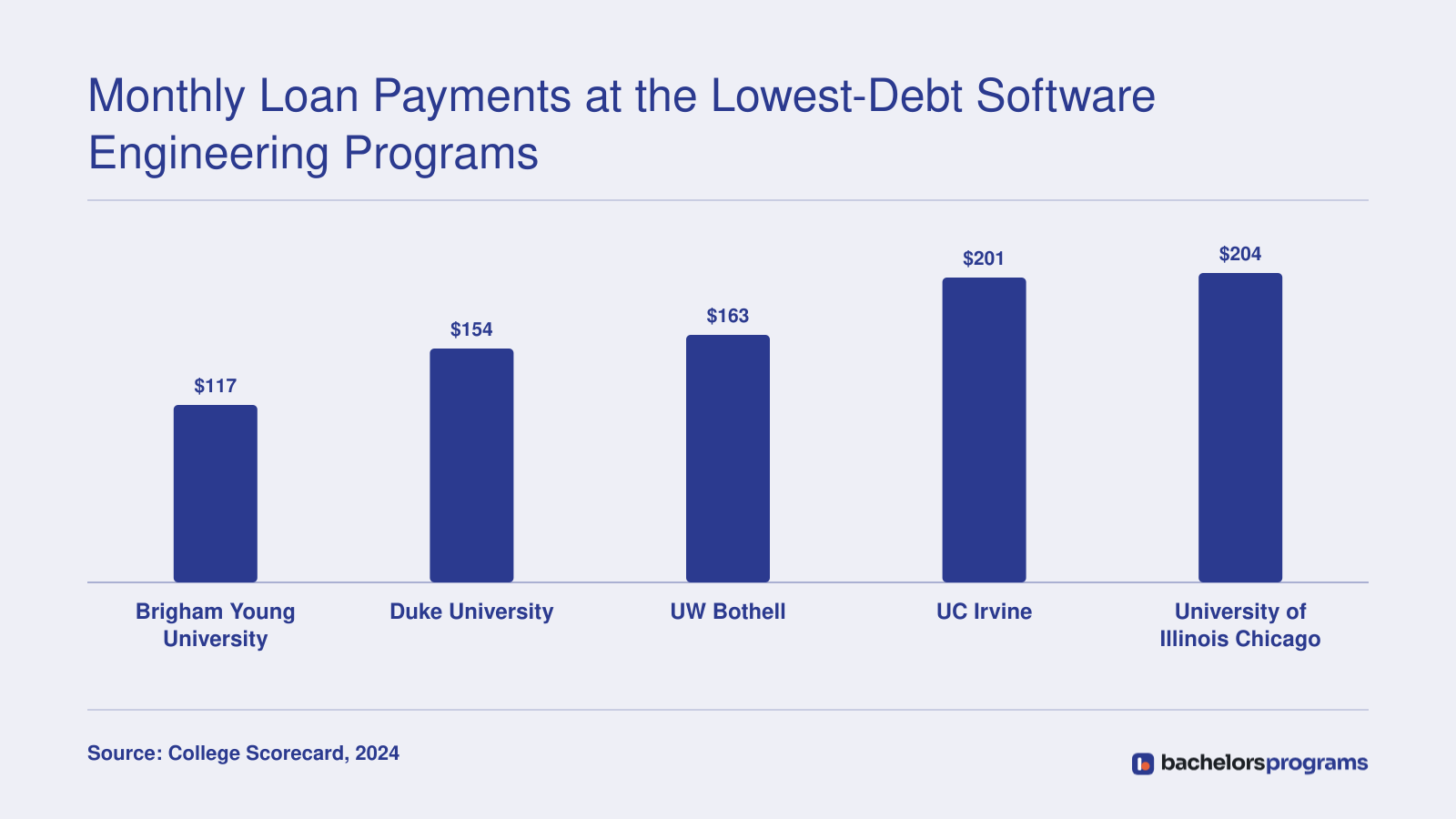
Monthly Loan Payments at the Lowest-Debt Software Engineering Programs
These are median monthly payments on a standard 10-year repayment plan for federal loans, measured only among graduates who completed the software engineering bachelor's program at each school, not institution-wide borrowing. Payments run from $117 a month at Brigham Young University to $204 at the University of Illinois Chicago, on median debt of $11,000 to $19,250. Set against each program's median first-year earnings, that monthly bill takes less than 4% of a typical graduate's gross pay, so debt is unlikely to be the deciding factor among these programs.
How Long Does a Software Engineering Degree Take?
A full-time track and a part-time or working-professional track can lead to the same B.S. in Software Engineering, but they run on very different calendars. Published program pages put the credit load at 120 to 122 credits: Keiser, Grand Valley State, Drexel and Arizona State list 120, while St. Cloud State lists 122. Four years of full-time study is the usual expectation, though not every school states a duration. Keiser publishes about 40 months for its 120-credit degree and calls that an estimate that shifts with course load, transfer credits and pace.1
Part-Time Study and Transfer Credit
No school here publishes a standard part-time length, so treat any figure you hear, often five to seven years, as a planning guess. St. Cloud State's 122-credit online program is built for working professionals and flexible scheduling, which stretches the timeline in practice.3
Transfer credit is the fastest way to cut the timeline. St. Cloud State accepts up to 90 credits toward its 122.3 Liberty University allows up to 75% of a degree to come from transfer work.4 Arizona State separates students with fewer than 24 transferable hours from those with more, and lists a 2.75 minimum transfer GPA.2 Credit is not automatic, though. Schools judge course equivalency and accreditation, and St. Cloud State reviews credits during admission, so get an evaluation before you enroll.
Co-op and Accelerated Options
Co-op can add time. The University of Pittsburgh's 2026-2027 handbook tells engineering students to plan on extending graduation, and its co-op calls for two six-month rotations, three alternating terms or one year-long placement.5 Rochester Institute of Technology requires two semesters and a summer of co-op before the senior project.6 Drexel offers zero to three co-op options. Many students accept the extra months for paid, résumé-ready experience.
To move faster, ask about summer terms and credit by exam. Availability and limits vary by school, so confirm them with an advisor before you build a schedule around them.
Software Developer Median Pay Nationwide
This is the most recent national pay figure from the Bureau of Labor Statistics for the occupation most software engineering graduates enter.
Software Engineering programs by state
Compare Software Engineering programs on the data that matters
Explore more Science & Engineering majors or browse every field of study.
All Science & Engineering programs Browse every field of study