Best Fire Science Degree Programs
Compare 60+ accredited Fire Science programs, with net price after aid, graduation rates, earnings and debt from IPEDS and the U.S. College Scorecard.

A bachelor's degree increasingly separates the crew from the command staff. Fire officer, inspector, and investigator postings routinely list a four-year degree.
Cost varies more than most firefighters expect: average net price after grants and scholarships among the ranked schools runs from roughly $3,200 to $25,600 a year, driven by residency, online delivery, and aid policy as much as sticker tuition.
That money gets spent around 24-hour shifts, so delivery format matters as much as curriculum. The degree title (fire science, fire administration, fire science management) matters less than the accreditation behind it. A program that ignores either reality is a poor fit, however good the curriculum looks on paper.
Key Points
- Southern Illinois University-Carbondale posts the highest program-level median earnings ranked here.
- FESHE recognition aligns curriculum with National Fire Academy courses; it isn't accreditation.
- Compare course lists, not titles like fire science or fire administration.
The 10 Best Fire Science Degree Programs, Ranked
Each school below earned its spot by delivering a fire science credential at a reasonable price, with outcomes you can check in federal data. Format, location, degree level and concentration sit alongside average net price and completions, so a California wildland program can be compared directly with an online administration degree. Graduation rates are reported for the whole institution, not for the fire science major.
California Polytechnic State University-San Luis Obispo
#1San Luis Obispo, CA · ~$17,000/yr (est.)
Best for: Aspiring wildland fire practitioners
Cal Poly's San Luis Obispo campus runs a BS in Forest and Fire Sciences with a Wildland Fire concentration, accredited by the Society of American Foresters, and students train on the 3,200-acre Swanton Pacific Ranch. The university's Wildland-Urban Interface Fire Institute shares the Cal Poly Technology Park with San Luis Obispo County Fire and CAL FIRE, and students take part in prescribed-fire operations with those agencies. Students at this school graduate at 86%, and the program suits people aiming at fuels management, forestry or fire ecology rather than municipal suppression.
- Society of American Foresters accredited degree in forest and fire sciences
- Wildland Fire concentration covers fuels, fire policy and fire as a management tool
- 120 units total, including 22 units of concentration coursework
- Meets Wildland Fire Practitioner Certification through the Association of Fire Ecology
- Fieldwork at the 3,200-acre Swanton Pacific Ranch
- Prescribed-fire work with CAL FIRE and the U.S. Forest Service
- Admission needs a 2.0 GPA and 40 upper-division units
University of Florida
#2Gainesville, FL · ~$4,800/yr (est.)
Best for: Working firefighters needing online classes
UF Online delivers a Bachelor of Science in Emergency Services entirely at a distance, with a Fire Management specialization built for people already in the fire service. Upper-division transfers need 60 credits and a 2.3 GPA, and up to 18 credits of emergency service coursework from prior industry programs can count toward the degree. Students at this school graduate at 85%. The degree does not certify anyone as a firefighter or award EMS certification, so it works as a management credential rather than a recruit academy.
- Fully online BS in Emergency Services with a Fire Management specialization
- Transfer applicants need 60 transferable credits and a 2.3 overall GPA
- Up to 18 credits of emergency service electives accepted from prior programs
- Out-of-state tuition is $352.62 per credit hour, including fees
- Prepares students for fire department, EMS and emergency management roles
- Does not certify firefighters or provide EMS certification
California State University-Los Angeles
#3Los Angeles, CA · ~$4,000/yr (est.)
Best for: Transfer students with fire units
Cal State LA's BS in Fire Protection Administration and Technology was built with input from local, state and national fire service groups, and it can be finished entirely through distance education. The 120-unit degree accepts up to 24 semester units of community college fire coursework, which makes it a practical capstone for people who already hold an associate degree in the field. Students at this school graduate at 53%.
- 120-unit BS in Fire Protection Administration and Technology
- Can be completed entirely through distance education
- Up to 24 semester units of community college fire coursework accepted
- Curriculum developed with local, state and national fire service representatives
- Covers tactical, technical and management knowledge for fire protection careers
- Transfer preparation requires at least 18 semester units of fire coursework
CUNY John Jay College of Criminal Justice
#4New York, NY · ~$3,200/yr (est.)
John Jay College of Criminal Justice, part of CUNY, offers a BS in Fire Science that treats fire as a public safety and engineering problem: fire growth and suppression, built-environment evaluation, protection system design and fire safety policy. Paid internships for fire science majors are listed through the college's job platforms, and one semester of physics is required. Students at this school graduate at 56%. It suits people aiming at fire protection engineering, consulting or code enforcement rather than engine company work.
- BS in Fire Science inside CUNY's criminal justice college
- Coursework covers fire growth and suppression and protection system design
- One semester of physics required; MAT 241 is prerequisite for General Physics I
- Paid fire science internships listed through Handshake and Simplicity
- Analyzes fire vulnerabilities to reduce loss of life and property
- Prepares graduates for fire safety design, consulting and management roles
Oklahoma State University
#5Stillwater, OK · ~$17,000/yr (est.)
Oklahoma State's Fire Protection and Safety Engineering Technology degree has been taught at Stillwater since 1937 and is accredited by TAC/ABET, with Qualified Academic Program status from the Board of Certified Safety Professionals. Coursework leans technical: life safety design criteria, detection and extinguishing systems, industrial hygiene and hazardous materials response. Students at this school graduate at 68%. Graduates move into alarm and suppression design, fire inspection, safety engineering and fire marshal roles.
- TAC/ABET accredited BS in Fire Protection and Safety Engineering Technology
- Taught at Stillwater since 1937
- Qualified Academic Program status from the Board of Certified Safety Professionals
- Covers life safety design criteria plus detection and extinguishing systems
- Includes industrial hygiene and hazardous materials incident response
- Leads to fire marshal, protection designer and safety engineer roles
California State University-San Marcos
#6San Marcos, CA · $10,000/yr (est. net price)
Cal State San Marcos runs a BS in Wildfire Science and the Wildland Urban Interface, an asynchronous online degree-completion program that takes five semesters and was developed with fire associations including CAL FIRE. Entering students need 60 transferable units and prerequisite coursework, and active-duty military receive a tuition discount. Students at this school graduate at 55%. It is designed for firefighters who want to move beyond battalion chief into fire ecology, emergency management or command roles.
- $490 per unit for the online degree-completion program
- Five-semester, asynchronous, cohort-based format
- Entry requires 60 transferable units plus prerequisite courses
- Developed with fire associations and a CAL FIRE partnership
- Credit for prior learning accepted; military benefits supported
- Priority application deadline of April 7, 2027 for fall 2027
- Coursework covers fire ecology, emergency management and human impact
Colorado State University-Fort Collins
#7Fort Collins, CO · ~$21,000/yr (est.)
Colorado State's online BS in Fire and Emergency Services Administration is a 120-credit completion degree with 11 core courses covering fire service leadership, budgeting, human resources, legal considerations and emergency management, capped by an integrated management simulation. Applicants are expected to have some prior college credit plus two or more years of fire or EMS experience or a fire science associate degree. Students at this school graduate at 67%. Most students take three to four years at about two courses a semester.
- $490 per credit for the online fire and emergency services administration degree
- 120 credits including 42 upper-division credits and 30 upper-division at CSU
- 11 core courses totaling 37 credits plus an integrated management simulation
- Prefers a 2.7 high school GPA or a 2.5 college GPA
- Prefers two or more years of fire or EMS experience
- Deadlines are June 1 for fall, November 1 for spring, May 1 for summer
- Same CSU diploma as on-campus students
American Public University System
#8Charles Town, WV · $5,000 – $10,000/yr (est.)
American Public University, the academic side of American Military University, runs an online BS in Fire Science Management accredited by the International Fire Service Accreditation Congress and mapped to the U.S. Fire Administration's Executive Fire Officer Program. Up to 90 transfer credits are accepted, courses start monthly in 8- and 16-week sessions, and there is no application fee or entrance exam. Students at this school graduate at 57%. It is built for working firefighters and military members who need to start in any month.
- IFSAC-accredited BS in Fire Science Management, 120 credits total
- $360 per credit, $250 under the preferred military rate
- Up to 90 transfer credits accepted; no application fee or entrance exam
- 69 semester hours of major coursework including a senior capstone
- Monthly starts in 8- and 16-week sessions
- Meets academic requirements of the Executive Fire Officer Program
Southern Illinois University-Carbondale
#9Carbondale, IL · $10,000 – $15,000/yr (est.)
Southern Illinois University Carbondale offers a BS in Public Safety Management with a Fire Service Management specialization, delivered online or in hybrid form and accredited by the International Fire Service Accreditation Congress. Public Safety Management requires a screening step beyond general university admission, and qualified students can use the Capstone Option to cut the core curriculum from 39 to 30 credit hours. Students at this school graduate at 62%.
- BS in Public Safety Management with a Fire Service Management specialization
- Accredited by the International Fire Service Accreditation Congress
- Online or hybrid delivery only
- Requires a screening step beyond general university admission
- Capstone Option trims the core curriculum from 39 to 30 credit hours
University of Cincinnati
#10Cincinnati, OH · ~$26,000/yr (est.)
The University of Cincinnati's BS in Fire and Safety Engineering Technology is an open-learning degree with distance fire service courses and short residency workshops that can finish a course in five days. Admission accepts an associate degree in fire science or its equivalent, and credit is granted for state training, military training and prior learning. Students at this school graduate at 75%. The program is accredited by the National Fire Academy and points graduates toward fire protection engineering, fire insurance and industrial safety.
- BS in Fire and Safety Engineering Technology accredited by the National Fire Academy
- Distance fire service courses plus five-day residency workshops
- Admits students with an associate degree in fire science or the equivalent
- Credit granted for state training, military training and prior learning
- Open-learning format built around duty assignments
- U.S. Fire Administration DDP partner
Cost & outcomes by school
Federal data for the highest-earning Fire Science programs, independent of the ranking above. Earnings are this field's bachelor's graduates four years after completing where the Scorecard reports them, else the school's undergraduate median.
| School | Net price / yr | Grad rate | Earnings | Debt | Grads/yr | Format |
|---|---|---|---|---|---|---|
| Anna Maria College MA | $28,333 | 46% | $110,044 | $23,250 | 50 | Hybrid |
| Southern Illinois University-Carbondale IL | $13,297 | 62% | $108,135 | $15,000 | 27 | Hybrid |
| Waldorf University IA | $19,693 | 21% | $100,060 | $18,750 | 40 | Online |
| Oklahoma State University OK | $17,447 | 68% | $99,557 | $26,000 | — | Campus |
| Colorado State University-Fort Collins CO | $21,279 | 67% | $98,019 | $20,000 | 9 | Online |
| Purdue University Global IN | $7,770 | 50% | $97,967 | $29,363 | 65 | Online |
| University of Florida FL | $6,541 | 91% | $97,839 | $15,000 | — | Online |
| University of Florida FL | $4,815 | 85% | $97,839 | $15,000 | 46 | Online |
| California Polytechnic State University-San Luis Obispo CA | $16,665 | 86% | $90,768 | $18,500 | — | Campus |
| Columbia Southern University AL | $14,580 | 33% | $88,735 | $20,895 | 1,141 | Online |
| American Public University System WV | $9,597 | 57% | $87,428 | $23,688 | 43 | Online |
| Embry-Riddle Aeronautical University-Daytona Beach FL | $41,272 | 67% | $84,131 | $23,666 | — | Online |
Sources: U.S. Department of Education. Net price, graduation rate, earnings and debt: College Scorecard (earnings and debt for this field's bachelor's graduates where reported, else school-wide); graduates: IPEDS. A dash means no figure is reported.
Cost, debt & payoff
Median earnings of this field's bachelor's graduates (4 yrs after completing, else the school's undergraduate median) vs. their median federal loan debt · U.S. College Scorecard
Across these programs the median graduate earns about $56,950 and finishes with roughly $20,979 in debt — a ratio that clears a common rule of thumb (keep debt below first-year salary). Net price and debt vary widely school to school, so check the per-school figures in the table above before you shortlist.
Our Scoring Formula: What Moved a School up or Down
A scoring formula is just a consistent set of questions asked of every school in the same order, so that a well-marketed program cannot outrank a cheaper, better-performing one on reputation alone. We asked four.
The Four Pillars
- Cost: The average net price students actually pay once grants and scholarships are applied, not the sticker tuition on the admissions page.
- Outcomes: Program-level earnings and student debt for fire science and related majors, where the federal data publishes them.
- Completion and retention: How many students finish and how many come back for a second year, measured across the whole institution.
- Flexibility: Whether the degree runs fully online, on campus, or blended around shift work.
Cost and outcomes carried the most weight, since they decide whether the degree pays for itself. Completion and retention served as a check on institutional stability. Flexibility broke ties and lifted programs that let a working firefighter finish without trading shifts.
Where the Figures Come From
Every number here comes from federal reporting: IPEDS and the College Scorecard. No school paid for placement, and none was contacted for input before publication.
What These Numbers Cannot Tell You
Graduation and retention rates are reported for an entire institution, not for its fire science department, so a strong university number does not guarantee a strong department. Net price averages all aid recipients, so it is not a quote for your situation. And smaller fire science programs often enroll too few graduates for earnings to be published at all, which is a gap in the data rather than a mark against the program.
How to Use the Ranking
Treat it as a shortlist generator. Pick three schools that fit your budget and format, then check FESHE recognition and transfer credit policies with each one directly.
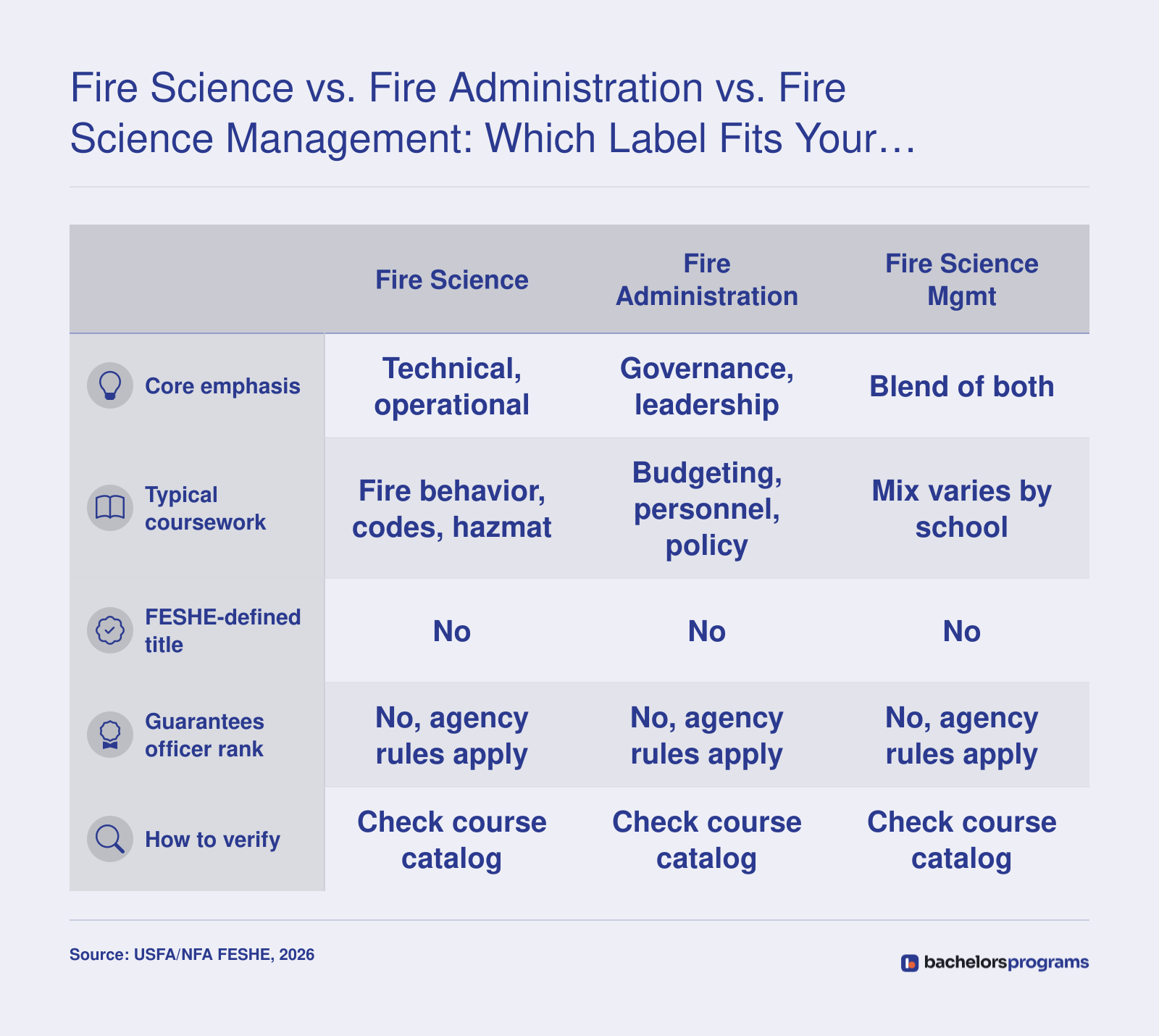
Fire Science vs. Fire Administration vs. Fire Science Management: Which Label Fits Your Goals?
These three degree titles overlap heavily because the USFA/National Fire Academy's FESHE initiative standardizes course content, not degree names. The course list matters far more than the label on the diploma. Start with the FESHE model curriculum as your baseline, then open each school's Required Courses or Degree Plan page to see whether it keeps technical courses like fire behavior, building construction, fire protection systems, strategy and tactics, and hydraulics, or swaps some of them for budgeting, personnel management, labor relations, public administration, and policy. On that same page, check whether the program targets pre-service students or working firefighters and officers, confirm regional accreditation and credit for FESHE or NFA training, and see which courses transfer. Then use the BLS Occupational Outlook Handbook entries for firefighters, administrative services and facilities managers, and emergency management directors for pay and outlook data. Look to the IAFC, NFPA, IFSTA, and IAFF for role guidance, and ask your target department's chief and program advisors which degree actually counts for promotion.
FESHE, IFSAC, and Institutional Accreditation: Three Different Seals
What does "FESHE recognized" mean? It means a program's curriculum aligns with the National Fire Academy's FESHE model courses. It is a recognition, not an accreditation. IFSAC accredits individual programs, and regional or institutional accreditation is the seal that governs federal aid and credit transfer. Recognition and accreditation status can change, so check the current official lists for any school you are considering before you enroll.
| Factor | FESHE Recognition | IFSAC Degree Assembly Accreditation | Regional/Institutional Accreditation |
|---|---|---|---|
| Who grants it | National Fire Academy and U.S. Fire Administration | IFSAC Degree Assembly | Accrediting agencies recognized by the U.S. Department of Education or CHEA |
| What it evaluates | Whether a fire, fire prevention, fire administration, or EMS management degree aligns with FESHE model courses and professional-development criteria | Individual fire, emergency-services, and public-safety academic programs, after the institution first earns Degree Assembly membership | The overall quality and standing of the college or university |
| Type of credential | Recognition certificate, not an accreditation | Program-level accreditation, so a school may be listed without every program accredited | Institution-wide accreditation |
| Affects federal financial aid | No. The school must already hold regional or national accreditation to qualify | No | Yes. Aid eligibility depends on accreditation by a federally recognized agency |
| Helps with transfer or promotion | Can signal a standardized curriculum to fire departments and may ease course alignment between 2-year and 4-year programs. Departments set their own promotion rules | Can signal program quality to employers. Departments set their own promotion rules | Yes. It is the main factor in whether other colleges accept your credits and whether employers and graduate schools respect the degree |
| Where to verify it | USFA FESHE recognized-programs list (the listing page has been temporarily unavailable, so email [email protected] if needed) | IFSAC institutions and programs directory | CHEA database or the U.S. Department of Education accreditation database |
Related Articles
Most Affordable Fire Science Bachelor's Degree Options
These are the lowest-cost options in our data, ranked by average annual net price after grants and scholarships, based on federal College Scorecard figures. Your actual cost will depend on your aid package and residency, and median debt reflects borrowers from the fire science program itself where that figure is reported. Veterans using the Post-9/11 GI Bill at the maximum level have net tuition and mandatory fees covered at the in-state public rate, with a $30,908.34 cap at private schools for 2026-27, and the Yellow Ribbon Program can help close private or out-of-state gaps if you have 100% eligibility and the school participates with space available. Service members should confirm current Tuition Assistance caps with their base education office, and firefighters should ask their department, union local, and state about fire-service scholarships or tuition waivers, since these awards have separate rules and may not combine automatically.
| School | Program | Format | Average Net Price (After Aid) | Pell Grant Recipients (School-Wide) | Median Program Debt |
|---|---|---|---|---|---|
| St. Petersburg College (St. Petersburg, FL) | Public Safety Administration B.A.S. (Fire Science concentration) | Online | $1,471 | 80.8% | N/A |
| CUNY John Jay College of Criminal Justice (New York, NY) | B.S. in Fire Science | Campus | $3,203 | 89.6% | $16,500 |
| California State University, Los Angeles (Los Angeles, CA) | Fire Protection Administration and Technology | Hybrid | $3,967 | 86.9% | $11,750 |
Earning a Fire Science Degree Online While Working 24-Hour Shifts
An online fire science bachelor's is the same four-year degree as the campus version, delivered through a learning management system instead of a classroom. For a firefighter working 24-hour shifts, the practical question is not whether it can be done. It is which program bends around the shift calendar instead of fighting it.
Yes, and the Format Is Built for Shift Work
Most of the programs ranked here are offered fully online, and several run hybrid formats that squeeze seat time into short residencies. Cincinnati, for one, describes its fire science program as an open-learning format built around duty assignments. Three details do the real work: asynchronous delivery, so a Tuesday evening lecture never collides with a shift; multiple start dates, so a missed term does not cost you a year; and 7- or 8-week terms, so you can stack courses between academy classes and promotion cycles. American Public University, for example, runs 8- and 16-week sessions.
The Associate Degree and the Certifications You Already Hold
A fire science AAS is the standard on-ramp, and generous transfer ceilings make it count. Eastern Oregon accepts up to 135 previous college credits and requires only 20 credits in residence.1 Liberty caps transfer at 75% of its 120-credit fire administration degree. There is no national rule for how much of an associate applies to the major, so read the ceiling and the residency minimum together to see your real headroom.
Certifications are where the savings sit, and they are awarded school by school. MSU Denver may grant up to 40 credits toward its online BS in Fire and Emergency Response Administration to holders of IFSAC or Pro Board certification, Firefighter I/II, or EMT-Basic.2 Purdue Global holds articulation agreements with fire academies and associations and may accept IFSAC, Pro Board, and DoD firefighter certifications. Transferability is not guaranteed, and testing may not apply to every course. Blinn awards 24 credits for an IFSAC- or Texas Commission on Fire Protection-accredited fire school paired with current firefighter certification, plus 6 credits for EMT coursework with NREMT or Texas DSHS certification.3 Phoenix College caps prior learning at 12.5 credits and values BLS at half a credit.4
Request a Transcript Evaluation Before You Apply
None of this is standardized, and most schools do not itemize what each credential is worth until someone reads your file. Request the evaluation in writing before you pay an application fee. Ask specifically whether the awards stack, whether Firefighter I and II are counted separately, and what documentation the school wants to see, whether Pro Board certificates, ACE-evaluated military transcripts, or department training records. The answer you get in writing is the number your degree plan will actually use.
Questions to Ask Yourself
Will the school put in writing how many of your academy and certification hours count toward the degree?
Are courses fully asynchronous, or will a mandatory live session collide with your shift rotation?
Does your department's tuition reimbursement require a regionally accredited or FESHE-recognized program?
If you deploy or catch a long campaign fire, can you pause a term without penalty?
Top Program-Level Earnings Among Ranked Fire Science Schools
Southern Illinois University-Carbondale posts the highest program-level median earnings among the ranked fire science schools.
Is a Fire Science Degree Worth It? Incentive Pay, Tuition Reimbursement, and Promotion Rules
Tuition is due this semester; the return arrives years later, in a monthly stipend, a percentage bump, or a promotion line you cannot collect until you hold the paper. That gap between paying now and earning later is the whole question, and the answer depends less on the degree itself than on the rank you intend to hold. The short version: it pays off for firefighters aiming at officer, inspector, investigator, or emergency management roles, and much less for those who plan to stay at firefighter rank.
Does the Money Show Up?
Yes, at many departments, though the amounts vary more than most recruits expect. Salisbury pays a 5% incentive for a bachelor's against 2.5% for an associate.1 Gwinnett runs 6% and 3% on the same ladder.2 Round Rock pays $240 a month for a bachelor's, Cedar Park $225, Fort Worth $120.3 Houston's schedule runs $3,640 a year for a bachelor's.4 Frisco's FY26 schedule keeps education pay rank-specific and starts it after field training officer completion, a reminder to read the eligibility language and not just the dollar figure.5
Tuition reimbursement is the second lever, and both Fort Worth and Gwinnett list it.3 Ask for the written policy: the annual cap, approved institutions, and whether a fire science degree specifically qualifies.
The Promotion Side
This is where the degree earns its keep. Firefighters who stay at firefighter rank can bank incentive pay and stop there. Those aiming at captain, battalion chief, inspector, or emergency management will find credit-hour and degree expectations stacking up. Cedar Park's promotion schedule calls for 30 college credit hours as of October 2026 and 45 by October 2029.6 The National Fire Academy's Executive Fire Officer Program requires a baccalaureate degree just to apply. CPSE's Chief Fire Officer credential requires battalion-chief rank or above plus 150 education and experience points, with a bachelor's worth 100 and a master's or doctorate worth the full 150.7
Running the Math
Set the annual incentive against the net price in the affordable table. A $3,640 annual bump repays a modest in-state net price quickly; a $720 bump does not. Multiply by the years you expect to serve, add the promotion ceiling the degree opens, then compare. The degree is worth it when the incentive and that ceiling together clear the price within your first few years of service, not your last.
Fire Science programs by state
Compare Fire Science programs on the data that matters
Explore more Criminal Justice & Law majors or browse every field of study.
All Criminal Justice & Law programs Browse every field of study