Best Online Fire Science Degree Programs
Compare 40+ accredited online Fire Science programs, with net price after aid, graduation rates, earnings and debt from IPEDS and the U.S. College Scorecard.
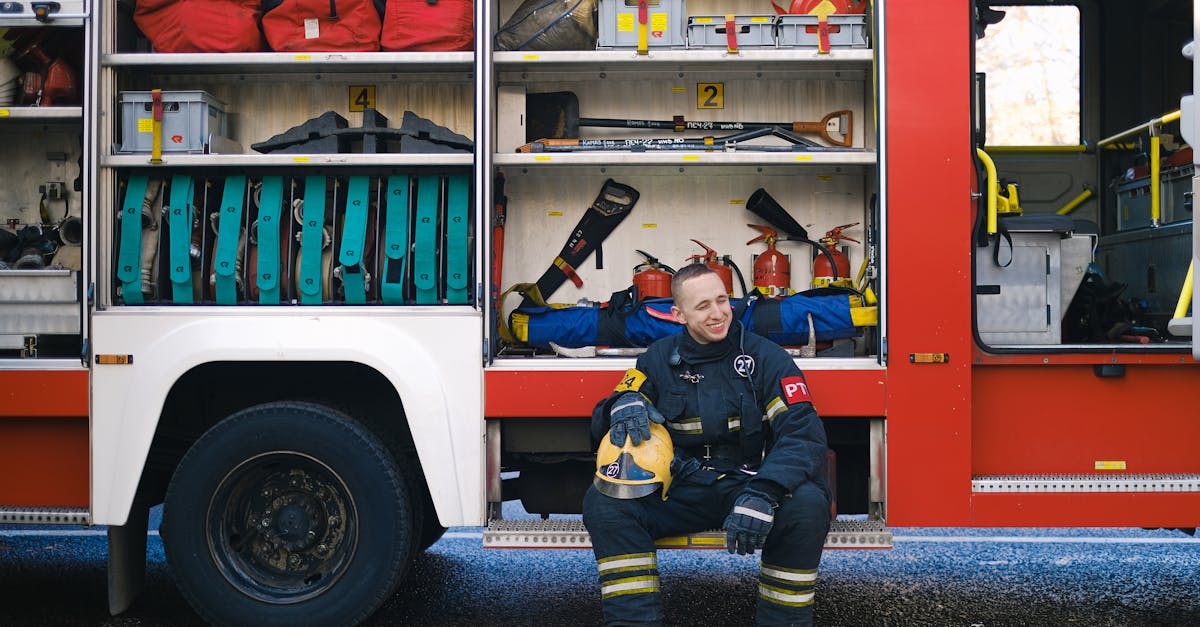
Can a working firefighter or EMT earn a bachelor's for promotion eligibility without giving up shift work or driving to campus? Yes. Every program here is 100% online, and hybrid programs are excluded. Average annual cost after grants and scholarships ranges from $1,471 to $24,022.
Beyond price, four things separate one program from another: accreditation (FESHE recognition versus IFSAC), how much academy and certification training converts to credit, realistic completion times, and earnings data.
That net price spread is more than tenfold, which makes the choice of school a bigger financial decision than the choice of degree title.
Key Points
- University of Florida graduates about 85 percent; Seminole State, about 41.
- Regional accreditation comes first; FESHE and IFSAC recognition are fire-specific bonuses.
- Expect 120 semester credits, or about 180 quarter credits at Purdue Global.
The 10 Best Online Fire Science Degree Programs (Fully Online, No Campus Visits)
Every program on this list can be completed entirely online, with no campus visits, residency weekends, or in-person lab requirements. Hybrid and partially online programs were excluded. Order reflects a blend of net price after aid, completion outcomes, and graduation rate rather than a sort on tuition alone.
University of Florida
#1Gainesville, FL · ~$4,800/yr (est.)
Best for: Upper-division transfer students in emergency services
The University of Florida delivers its Bachelor of Science in Emergency Services through UF Online, and the Fire Management specialization sits alongside EMS management and emergency management tracks. Transfer applicants enter at the upper division with 60 transferable credits, a 2.3 GPA, and relevant certification or professional experience. Up to 18 credits of emergency service electives from prior industry training can count toward the degree. Graduates target fire department management, EMS administration, insurance, and government roles; the degree does not certify students as firefighters.
- Three specializations: Fire Management, EMS Management, Emergency Management
- Upper-division entry with 60 transferable credits and a 2.3 GPA
- Accepts up to 18 credits of emergency service electives from prior training
- Certification, internship, or professional experience supports admission
- Out-of-state tuition is $352.62 per credit, including fees
- Prepares for department management, EMS, insurance, and government roles
- Does not certify students as firefighters or provide EMS certification
American Public University System
#2Charles Town, WV · $5,000 – $10,000/yr (est.)
Best for: Working firefighters with prior credit to transfer
American Public University System runs a Bachelor of Science in Fire Science Management built around fire behavior, suppression, protection systems, and fire service leadership, with a senior capstone. The program holds specialty accreditation from the International Fire Service Accreditation Congress and meets the academic requirements of the U.S. Fire Administration's Executive Fire Officer Program. Courses start monthly in 8- and 16-week sessions, there is no application fee or entrance exam, and up to 90 transfer credits are accepted.
- Accredited by the International Fire Service Accreditation Congress
- Meets academic requirements of the Executive Fire Officer Program
- 120 credits total, including 69 semester hours of major coursework
- Up to 90 transfer credits accepted
- $360 per credit, with a $250 preferred military rate
- Monthly starts in 8- and 16-week sessions
- No application fee and no entrance exam; high school diploma or GED required
- Capstone in fire science required for graduation
California State University-San Marcos
#3San Marcos, CA · $10,000/yr (est. net price)
Best for: Wildland fire crews advancing into leadership
California State University San Marcos offers a Bachelor of Science in Wildfire Science and the Wildland Urban Interface, an asynchronous degree-completion program delivered through Extended Learning and described as the only one of its kind in California. The cohort-based curriculum covers fire ecology, emergency management, and human environmental impact, and was developed with fire associations and a state fire agency partnership. Students enter with at least 60 transferable units plus prerequisites, and credit for prior learning is available. Graduates move into wildland firefighting, fire ecology, and fire captain or chief roles.
- Five-semester, cohort-based degree completion program
- Asynchronous online classes built for working professionals
- Entry requires 60 transferable units and prerequisite coursework
- $490 per unit; military benefits and scholarships accepted
- Rolling admissions with a priority deadline of April 7, 2027 for fall 2027
- Developed with fire associations and a CAL FIRE partnership
- Credit for Prior Learning available for fire service training
- Coursework in fire ecology, emergency management, and environmental impact
Colorado State University-Fort Collins
#4Fort Collins, CO · ~$21,000/yr (est.)
Colorado State University's online Bachelor of Science in Fire and Emergency Services Administration is a 120-credit degree with 42 upper-division credits, 30 of which must be completed through CSU. Eleven core courses cover fire service leadership, strategy and tactics, budgeting, human resources, legal considerations, and emergency management, followed by electives such as incident command systems and prevention program management. Admission expects prior college credit and prefers two or more years of fire or EMS experience or a fire science associate degree. The degree can be finished in two years, though most students take three to four while averaging two courses a term.
- 120 credits, including 42 upper-division and 30 upper-division CSU credits
- Eleven core courses (37 credits) plus 6 credits of electives
- $490 per credit; asynchronous online delivery
- Two-year completion possible; most students take three to four years
- Prior college credit required; fire or EMS experience preferred
- Applicants with a fire science associate degree are strongly positioned
- Nine optional minors can be added to the degree
- Same CSU diploma as on-campus students
Seminole State College of Florida
#5Sanford, FL · ~$9,000/yr (est.)
Seminole State College of Florida awards a Bachelor of Science in Public Safety Administration with a Fire Science specialization inside a 120-credit degree. The curriculum is modeled on the federal Fire and Emergency Services Higher Education recommended outcomes, and the fire science specialization totals 21 credits on top of 18 foundation credits, ending in a capstone. An Associate in Science in Fire Science Technology satisfies the foundation requirements, and admission requires an associate or bachelor's degree or 60 college credits with a 2.0 GPA. Most classes enroll fewer than 30 students, and graduates target command staff, fire inspector, and fire marshal roles.
- 120 credits with 21 credits in the Fire Science specialization
- 18 foundation credits; an A.S. in Fire Science Technology satisfies them
- Curriculum modeled on FESHE recommended learning outcomes
- Admission with an associate or bachelor's degree, or 60 credits and a 2.0 GPA
- Most classes enroll fewer than 30 students
- Capstone includes a video presentation
- Prepares for command staff, fire inspector, and fire marshal roles
- Concentrations also offered in Criminal Justice and Emergency Medical Services
St Petersburg College
#6St. Petersburg, FL · ~$1,500/yr (est.)
St. Petersburg College offers a Bachelor of Applied Science in Public Safety Administration with a Fire Science sub-plan, delivered fully online in eight-week courses. Students choose among sub-plans in Criminal Justice, Cybercrime, Emergency Management and Homeland Security, Fire Science, or Cross Discipline, and the program awards academic credit for prior experience or training. Graduation requires 36 general education credits, a grade of C or better in every course, and completion of the Florida Civic Literacy Examination. The college estimates total program cost at $10,024.16, making it one of the lower-cost routes on this list.
- Fully online, eight-week course format
- Five sub-plans, including Fire Science and Emergency Management
- Academic credit awarded for prior experience or training
- 36 general education credits required for graduation
- 18 lower-division public safety credits for students without a public safety A.S.
- Florida Civic Literacy Examination required
- Faculty are experienced public safety professionals
- Estimated total program cost of $10,024.16
University of North Texas at Dallas
#7Dallas, TX · ~$6,000/yr (est.)
The University of North Texas at Dallas offers a Bachelor of Applied Science in Emergency Services Administration entirely online, with a curriculum built on the U.S. Fire Administration's FESHE model. Students complete 36 hours of emergency services administration coursework at UNT Dallas, while up to 84 credit hours, including the Texas core, can transfer into the 120-hour degree. Coursework centers on management, leadership, and community risk reduction for fire and EMS agencies. Qualifying Texas firefighters may apply the Texas Firefighter's Tuition Exemption toward the program.
- Curriculum follows the U.S. Fire Administration FESHE model
- 36 emergency services administration credit hours at UNT Dallas
- Up to 84 transfer credits accepted into the 120-hour degree
- Qualifying Texas firefighters may use the Texas Firefighter's Tuition Exemption
- Focus on management, leadership, and community risk reduction
- Prepares for fire investigator, inspector, marshal, and chief roles
- Also relevant to emergency management coordinator and hazmat roles
Bowling Green State University
#8Bowling Green, OH · ~$24,000/yr (est.)
Bowling Green State University awards a Bachelor of Science in Fire Administration through its Department of Political Science, a degree-completion program delivered 100 percent online. Coursework covers public administration, data analysis, employment law, finance, leadership, and technology, aimed at students moving into chief officer roles. Transfer credit is accepted for prior coursework and approved certifications, and there is no residency requirement, though a minimum of 30 BGSU credit hours must be earned. The university is accredited by the Higher Learning Commission, and the program does not lead to professional licensure.
- 100 percent online degree-completion format
- No residency requirement; minimum of 30 BGSU credit hours
- Transfer credit accepted for prior coursework and approved certifications
- Coursework in public administration, data analysis, employment law, and finance
- Prepares graduates for chief officer roles
- Institution accredited by the Higher Learning Commission
- Does not lead to professional licensure
- Personalized advising included
Weatherford College
#9Weatherford, TX · $10,000/yr (est. net price)
Weatherford College offers a bachelor's degree in Organizational Leadership with a Fire Science concentration, built for current firefighters who want management training alongside their technical background. The 120-credit degree includes 45 prescribed elective credits in an occupational or technical field; within the concentration, students take 18 credits of approved fire science courses and 27 credits of business. Students select a concentration at admission, and that choice requires consultation with and pre-approval from the program director. Some concentration courses carry prerequisites or are offered only in a specific semester or modality, so sequencing deserves an early conversation with an advisor.
- 120 credits, including 45 prescribed elective credits
- 18 credits of approved fire science coursework
- 27 credits of business coursework within the concentration
- Open to current firefighters and fire service personnel
- Concentration requires pre-approval from the Program Director
- Some courses carry prerequisites or run in select semesters
- Prepares students for fire service management roles
Pierce College District
#10Lakewood, WA · ~$10,000/yr (est.)
Pierce College awards a Bachelor of Applied Science in Fire Services Leadership and Management, a leadership degree built as a guided pathway that extends an Associate in Applied Science in Fire Services Leadership and Management. The program is primarily taught online and is designed for fire service professionals, including current and former U.S. military members affiliated with a fire department. Admission is selective: applicants submit transcripts, a 300 to 400 word personal statement, a professional resume, a reference letter, and a letter from their fire department. Students without a fire services associate degree are not eligible, so this is a completion route rather than an entry point.
- Builds on the AAS-T in Fire Services Leadership and Management
- Primarily taught online
- Associate degree in a fire services field required for admission
- Personal statement of 300 to 400 words required
- Professional resume, one reference letter, and department affiliation letter required
- Open to current and former U.S. military members
- Focused on leadership and management for fire service professionals
Cost & outcomes by school
Federal data for the highest-earning Fire Science programs, independent of the ranking above. Earnings are this field's bachelor's graduates four years after completing where the Scorecard reports them, else the school's undergraduate median.
| School | Net price / yr | Grad rate | Earnings | Debt | Grads/yr | Format |
|---|---|---|---|---|---|---|
| Anna Maria College MA | $28,333 | 46% | $110,044 | $23,250 | 50 | Hybrid |
| Southern Illinois University-Carbondale IL | $13,297 | 62% | $108,135 | $15,000 | 27 | Hybrid |
| Waldorf University IA | $19,693 | 21% | $100,060 | $18,750 | 40 | Online |
| Colorado State University-Fort Collins CO | $21,279 | 67% | $98,019 | $20,000 | 9 | Online |
| Purdue University Global IN | $7,770 | 50% | $97,967 | $29,363 | 65 | Online |
| University of Florida FL | $6,541 | 91% | $97,839 | $15,000 | — | Online |
| University of Florida FL | $4,815 | 85% | $97,839 | $15,000 | 46 | Online |
| Columbia Southern University AL | $14,580 | 33% | $88,735 | $20,895 | 1,141 | Online |
| American Public University System WV | $9,597 | 57% | $87,428 | $23,688 | 43 | Online |
| Embry-Riddle Aeronautical University-Daytona Beach FL | $41,272 | 67% | $84,131 | $23,666 | — | Online |
| Embry-Riddle Aeronautical University-Worldwide FL | $18,725 | 21% | $84,131 | $23,666 | — | Online |
| Eastern Kentucky University KY | $11,040 | 50% | $80,497 | $27,000 | 55 | Hybrid |
Sources: U.S. Department of Education. Net price, graduation rate, earnings and debt: College Scorecard (earnings and debt for this field's bachelor's graduates where reported, else school-wide); graduates: IPEDS. A dash means no figure is reported.
Cost, debt & payoff
Median earnings of this field's bachelor's graduates (4 yrs after completing, else the school's undergraduate median) vs. their median federal loan debt · U.S. College Scorecard
Across these programs the median graduate earns about $56,950 and finishes with roughly $20,979 in debt — a ratio that clears a common rule of thumb (keep debt below first-year salary). Net price and debt vary widely school to school, so check the per-school figures in the table above before you shortlist.
What Our Ranking Measures, and What 'Fully Online' Actually Means Here
The University of Florida graduates about 85 percent of its students, while Seminole State College of Florida graduates about 41 percent. A gap like that matters when you are paying for a degree between shifts. A good online fire science program should be affordable on a firefighter's pay and should actually graduate the students it enrolls. The ranking therefore weighs net price, graduation rate, program-level outcomes where they exist, and whether the degree can be completed online.
Limits Worth Knowing
Graduation rates cover the whole institution, not the fire science students alone. Net price averages aid recipients across the whole institution, so your own bill may land higher or lower. Accreditation was verified separately rather than scored, so it works as a pass-or-fail check and does not add points.
Formats You Will Actually Meet
Delivery varies more than the label "online" suggests.
- UF Online: Coursework is primarily asynchronous and runs on a semester calendar.1 Some courses may add live components, including scheduled exams at the professor's discretion.
- Columbia Southern University: Courses are open 24/7, and the school offers 11 start dates a year.
- Purdue Global: Terms run 10 weeks, with starts staggered across Tracks A, B and C. A typical load is one or two courses per term.
- American Public University System: Courses run in 8- and 16-week sessions with rolling starts.
- St. Petersburg College: Courses are eight weeks long and fully online.
- Colorado State University: Classes are asynchronous and self-paced, with no strict timeline.
- Cal State San Marcos: Classes are asynchronous but cohort-based, with a fall start.
Published details on format, term length and start dates were thin for Waldorf University, Eastern Oregon University and University of Maryland Global Campus. Confirm those directly with admissions before you apply.
Proctoring and On-Site Requirements
UF Online uses Honorlock for online exams, which means a webcam and a scheduled testing environment.1 None of the sources reviewed lists a residency requirement at UF Online or Purdue Global2, and Purdue Global's internship is not mandatory. Proctoring rules for most other schools were not confirmed, so ask before enrolling.
If you work rotating shifts, favor asynchronous courses with flexible weekly deadlines. Scheduled live sessions and timed exams are the formats most likely to collide with a 24-hour duty rotation. Accelerated 8- or 10-week terms suit a lighter load, while 15- or 16-week semesters give you more breathing room during a heavy overtime stretch.
Accredited Online Fire Science Degree Programs: Regional, FESHE, and IFSAC Compared
Institutional (regional) accreditation is the non-negotiable baseline for any online fire science degree. FESHE recognition and IFSAC degree accreditation are fire-service-specific quality signals that sit on top of it, and a school can hold one, both, or neither. Public sources do not establish a complete, current list of online bachelor's programs holding either designation, so this page does not name specific programs as holders. Confirm each school you are considering directly on the USFA FESHE directory and the IFSAC Degree Assembly roster, because recognition lists change.
| Factor | Institutional (Regional) Accreditation | FESHE Recognition | IFSAC Degree Accreditation |
|---|---|---|---|
| Who grants it | Accrediting agencies recognized by the U.S. Department of Education | National Fire Academy and USFA (FEMA) | IFSAC Degree Assembly |
| Scope | The whole institution, including distance education | A specific program | A specific program, from certificate through master's |
| What it signals | The college meets institution-wide quality and governance standards | The program meets NFA/FESHE professional-development criteria | The program meets Degree Assembly standards |
| Financial aid | Generally the category tied to federal Title IV aid eligibility | Does not replace institutional accreditation; the college may be regionally or nationally accredited | Not Title IV; separate from institutional accreditation |
| Tuition reimbursement | Often expected by employers, but policies vary, so check with your department | No source confirms it guarantees reimbursement or credit transfer | No source confirms it guarantees reimbursement or credit transfer |
| Role in your search | Baseline requirement | Optional quality signal | Optional quality signal |
| How to verify | The accreditor's own directory and the Department of Education's accreditation database | USFA FESHE Degree Programs Directory | IFSAC Degree Assembly accredited program listings |
Related Articles
Most Affordable Online Fire Science Degrees by Net Price
Each figure below is the school's average annual net price, meaning what undergraduates actually paid after grants and scholarships according to federal College Scorecard data, shown next to published annual tuition and fees. Because net price is an institution-wide average rather than a fire science figure, firefighters using employer tuition reimbursement often pay less. Military students should also check each school's own pricing page: Purdue Global lists $165 per credit for active duty, Guard/Reserve, and eligible DoD civilians (not combinable with other Purdue Global reductions) and participates in Yellow Ribbon for eligible Post-9/11 GI Bill students; UMGC charges $250 per credit for its military rate from Summer 2026 through Spring 2027; and Liberty University charges $250 per credit for 2026-27 and offers a first-responder discount. On the scholarship side, IAFF members pay $230 per credit at Purdue Global, the IAFF's McClennan Scholarship awards $2,500 a year to children of firefighters killed in the line of duty (apply by February 1), and filing the FAFSA is the first step toward federal grants and loans.
| School | Program (Concentration) | Location | Average Annual Net Price (After Aid) | In-State Tuition and Fees | Out-of-State Tuition and Fees | Graduation Rate |
|---|---|---|---|---|---|---|
| St. Petersburg College | Public Safety Administration B.A.S. (Fire Science) | St. Petersburg, FL | $1,471 | $2,682 | $9,286 | 38% |
| University of Florida | Fire and Emergency Services (Fire Management) | Gainesville, FL | $4,815 | $3,876 | $16,579 | 85% |
| Eastern New Mexico University | Bachelor of Applied Arts and Sciences (Fire and Emergency Services Administration) | Portales, NM | $4,904 | $7,194 | $9,174 | 45% |
Fire Science Degree Transfer Credits: Getting Credit for Academy, EMT, and Officer Certs
Your academy hours, certifications, and service record can shorten a bachelor's degree, but nothing here is automatic. Schools review each credential individually, so treat any figure below as a starting point, not a promise.
The Main Paths to Credit
- Associate degree: A completed associate degree in fire science is the most predictable route, since credits usually move in as a block, subject to the school's cap.
- IFSAC or Pro Board certifications: Purdue Global says certifications from these accreditors, including the DoD Firefighter Certification System, may be eligible. Awards depend on the credentialing body and Purdue's review. Columbia Southern University (CSU) handles firefighter certifications case by case.
- NFA courses: CSU partners with the National Fire Academy and lists individual ACE-recommended courses. Credit varies by course, and not every course applies to every degree.
- EMT and paramedic training: CSU names specific EMT and paramedic programs as transfer sources, but amounts are not fixed.
- Military training: Both schools evaluate the Joint Services Transcript. Purdue Global reports that its average military graduate received 45% of bachelor's credits through transfer. That is an average, not what you should expect.
What the Policies Say
CSU's B.S. in Emergency Management, Fire Science requires 90 credits. Its policy caps experiential learning at 25%, which works out to 22.5 credits on that degree. That cap applies to experiential learning, not necessarily to all transfer credit, so confirm the separate transfer maximum with an advisor. CSU uses ACE recommendations to evaluate training, licenses, and military experience.
Purdue Global does not guarantee transferability from any source, and its catalog controls prior-learning policy. Fire academy and fire-service association articulation agreements may also produce credit.
Before You Apply
- Request a free transcript or prior-learning evaluation before you enroll.
- Send certificates, academy records, NFA completion records, and your JST together.
- Get the credit award in writing, listing each course it replaces.
The Residency Catch
Most schools require a minimum number of credits to be earned at the degree-granting institution, and that limit can cap your transfer total no matter how much training you hold. Ask for the exact residency requirement, and check whether your certifications count toward the degree's required courses or only toward electives.
How Long Does an Online Fire Science Degree Take?
A bachelor's in fire science runs 120 semester credits at most U.S. schools, and about 180 quarter credits where the institution runs on quarters, as Purdue Global does. The credit count, not the online format, sets your timeline.
Four Years From Scratch, Full Time
With no transferable credit, the math comes out to roughly four years of full-time study. American International College publishes four years for the full-time version of its fire science and emergency services bachelor's, and LSU's 120-credit fire and emergency services administration degree is built on the same assumption.
Where the Timeline Actually Shortens
Prior college credit does more for your calendar than any scheduling trick. LSU's program is a 2+2 completion degree: the final 60 hours are taken at LSU, entered with a related associate degree of typically 60 credits, and possibly more if your associate coursework does not transfer cleanly. Anna Maria College's degree-completion option is 60 credits and requires 60 credits in hand, with up to 15 additional transfer credits possible for specified credentials and coursework.2 American International College's transfer pathway runs two years and asks for at least 39 college-level credits or an associate degree.3 Transfer caps vary: American Public University accepts up to 90 credits4, Liberty University up to 75%, and Eastern Kentucky University up to 90 with 30 that must be earned in residence.5
Accelerated terms compress the calendar, not the credits. Liberty teaches in 8-week courses and American Public University in 8- to 16-week courses.
Quarter Credits Do Not Convert One to One
One semester credit is about 1.5 quarter credits, so one quarter credit is roughly 0.67 semester credits. A 180-quarter-credit program is not a 180-semester-credit program, and a conversion formula at the registrar's desk still does not guarantee course-for-course transfer.
A Part-Time Pace Around Shifts
Purdue Global runs 10-week terms at one to two courses per term and publishes a two- to four-year range. Its average of just over two years reflects transfer credit and prior experience, so plan on the upper end if you are starting close to zero.
Fire Science vs. Fire Administration vs. Occupational Safety: Which Degree Focus Fits You?
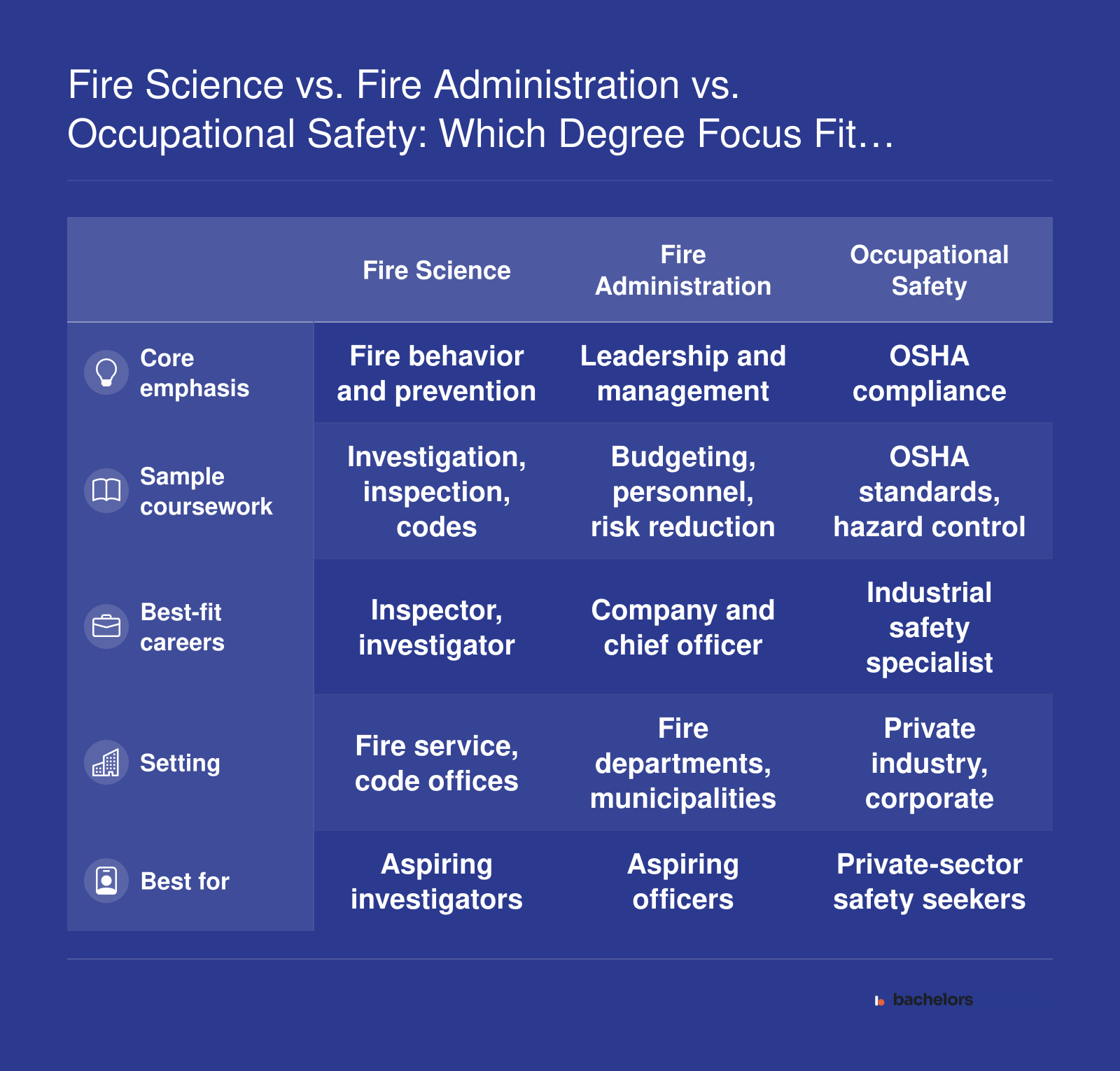
Fire science studies how fires start, spread, and can be prevented, so it suits an aspiring fire investigator or inspector. Fire administration studies how to run a department, covering leadership, budgeting, personnel, and community risk reduction, so it suits a firefighter aiming for lieutenant, captain, or chief. Occupational safety shifts the focus to OSHA compliance and industrial or private-sector workplace safety, which makes it a better fit for safety roles outside the fire service.
Questions to Ask Yourself
Are you studying for a lieutenant or captain exam where leadership and budgeting coursework will show up?
Would you rather work a fire scene as an investigator or inspector than run a crew?
Could a private-sector safety or emergency management role be a second career after retirement from the fire service?
Fire Inspector and Investigator Median Pay
Inspection and investigation roles are among the specialized career paths an online fire science degree can support.
Fire Science programs by state
Compare Fire Science programs on the data that matters
Explore more Criminal Justice & Law majors or browse every field of study.
All Criminal Justice & Law programs Browse every field of study