Best Criminal Justice Degree Programs
Compare 930+ accredited Criminal Justice programs at 870+ colleges, with net price after aid, graduation rates, earnings and debt from IPEDS and the U.S. College Scorecard.

At schools offering a bachelor's degree in criminal justice, average net price after aid runs from $1,300 a year at Texas A&M University-Central Texas to $19,680 at Michigan State University. Over four years, that gap becomes a major debt decision. The Bachelor of Science (B.S.) in Criminal Justice is the common credential, though some schools award a B.A. or A.B. instead.
The school you pick affects what you owe and which careers you can reach, from patrol work and probation to federal agencies and cybercrime investigation.
Most agencies screen on the degree, background checks, and fitness standards rather than the school's name. Price, format, and internship access are where programs differ most.
Key Points
- Texas A&M University-Central Texas has the lowest net price here: $1,300 yearly.
- BLS median pay runs from $58,850 for correctional officers to $129,180.
- Online options use 8-week asynchronous courses and accept the most transfer credit.
Top 10 Schools for a Bachelor's Degree in Criminal Justice
This list balances average net price after aid, institution-wide graduation rates, and what graduates go on to earn, and it spans online, campus, and hybrid formats. Each entry highlights the internships, capstones, and concentrations that hiring agencies in law enforcement, courts, and corrections tend to recognize.
University of Georgia
#1Athens, GA · ~$14,000/yr (est.)
Best for: Policy-minded students seeking research internships
Georgia's criminal justice major is jointly run by the Franklin College of Arts and Sciences and the School of Public and International Affairs, and the program is nearing its 50th year in Athens. A required semester-long agency internship doubles as an academic practicum built around a student-designed research project. Average net price after aid is about $13,936, the institution-wide graduation rate is 90 percent, and graduates report median earnings of $37,405 one year after finishing.
- Semester-long internship with a criminal justice agency
- Internship counts as an academic practicum course
- Research project of the student's own design
- Analytic essays tie classroom learning to the placement
- Jointly administered by Franklin College and SPIA
- Coursework in theory and research methods
Florida State University
#2Tallahassee, FL · ~$11,000/yr (est.)
Best for: Working adults needing a fully online pathway
Florida State's College of Criminology and Criminal Justice awards a BS or BA in criminology with a criminal justice focus, and the coursework can be completed online through distance learning open to all students. The 120-credit degree includes 36 hours in criminology, four core courses, and an optional full-time internship semester. Average net price after aid is about $11,297, the institution-wide graduation rate is 86 percent, and graduates report median earnings of $34,922 one year after finishing.
- 120 credit hours, including 36 in criminology
- Four core courses completed with a C or higher
- Optional one-semester, 15-credit internship
- Fully online option available to all students
- Required minor of 12 to 15 credit hours
- Up to 12 graduate credits through a bachelor's to master's pathway
- 2.00 GPA required to progress to the upper division
Strayer University-Florida
#3Tampa, FL · ~$16,000/yr (est.)
Best for: Career switchers eyeing digital forensics
Strayer University's Tampa campus runs the same Bachelor of Science in Criminal Justice online and in person, built for adults balancing full-time work with school. Courses run 11 weeks, and six concentrations cover artificial intelligence, digital forensics and cybersecurity, national security, emergency response, and probation and parole. Average net price after aid is about $16,064, with employer tuition reimbursement and military benefits accepted, and graduates report median earnings of $43,405 one year after finishing.
- Six concentration options, including digital forensics and cybersecurity
- 40 courses, each running 11 weeks
- 67.5 credit hours in criminal justice coursework
- 18 credits in a required concentration
- $1,555 per course plus a $65 technology fee each term
- Transfer up to 28 classes
- No-cost general education courses through Sophia Learning
- Military benefits and employer reimbursement supported
Texas A&M University-Central Texas
#4Killeen, TX · under $5,000/yr (est.)
Texas A&M University-Central Texas in Killeen delivers its 120-credit Bachelor of Science in Criminal Justice entirely online, which suits working officers and transfer students who need to keep a full-time job. Upper-level classes cover law enforcement, corrections, courts, victims, and offenders, bookended by a proseminar in the first semester and a capstone in the last. Average net price after aid is about $1,300, and graduates report median earnings of $45,976 one year after finishing.
- 120 total credit hours, delivered online
- Proseminar in the first semester, capstone in the last
- Upper-level courses on courts, corrections, victims and offenders
- Alpha Phi Sigma honor society chapter on campus
- Criminal Justice Association membership available
University of Central Florida
#5Orlando, FL · ~$10,000/yr (est.)
The University of Central Florida offers its 120-credit criminal justice bachelor's degree on campus in Orlando and fully online. Students pick a Professional Track that embeds academy training, certifications, and a required internship with a network of more than 100 community partners, or a Scholar's Track that adds graduate seminars for those holding a 3.2 GPA. Average net price after aid is about $10,411, the institution-wide graduation rate is 78 percent, and graduates report median earnings of $36,563 one year after finishing.
- 120 credits with a 30-credit core and 30 credits of restricted electives
- Professional Track embeds academy training and certifications
- Scholar's Track adds nine hours of graduate seminars, 3.2 GPA required
- Required internship with 100+ community partners in the Professional Track
- Capstone in criminal justice ethics
- Six undergraduate certificate options
- Offered fully online or on campus
Florida International University
#6Miami, FL · ~$9,000/yr (est.)
Florida International University awards a Bachelor of Science in Criminal Justice from its Miami campus and through FIU Online. The degree layers 18 credits of core coursework, including criminological theory, research methods, and a senior capstone, with 18 credits of criminal justice electives. Full-time justice employees with three years of experience can petition to swap the introductory course for ethics. Average net price after aid is about $9,288, the institution-wide graduation rate is 74 percent, and graduates report median earnings of $36,839 one year after finishing.
- 18 credits of core courses and 18 credits of criminal justice electives
- Senior capstone required
- Core includes criminological theory and research methods
- Two Global Learning courses required
- Second-semester foreign language sequence required
- Internship encouraged but not required
- Available on campus and through FIU Online
CUNY John Jay College of Criminal Justice
#7New York, NY · ~$3,200/yr (est.)
John Jay College of Criminal Justice, part of the City University of New York, devotes its whole curriculum to criminal justice and forensic study, and its BA in Criminal Justice: Crime Control and Prevention treats crime as a social problem rather than a set of procedures. Students build analytical and ethical reasoning skills and critique how the system currently functions, with a linked BA/MA option for those continuing. Average net price after aid is about $3,203, the institution-wide graduation rate is 56 percent, and graduates report median earnings of $37,284 one year after finishing.
- One of 31 undergraduate majors at the college
- Frames crime as a social problem
- Emphasis on analytical skills and ethical reasoning
- Coursework critiques the structure of the justice system
- Linked criminal justice BA/MA option
San Diego State University
#8San Diego, CA · $15,000/yr (est. net price)
San Diego State University's criminal justice bachelor's degree looks at how the justice system delivers, or fails to deliver, justice, with an explicit social justice policy lens. Courses such as Law in Society and Juvenile Justice sit alongside internships and exchange options in Madrid, Edinburgh, and Berlin. The degree runs through the School of Public Affairs at the main campus, SDSU Imperial Valley, and SDSU Global Campus. Average net price after aid is about $15,364, the institution-wide graduation rate is 76 percent, and graduates report median earnings of $33,261 one year after finishing.
- Offered at the main campus, Imperial Valley and Global Campus
- Social justice policy lens on crime and justice
- Sample courses include Law in Society and Juvenile Justice
- Internships available with justice agencies
- Exchange options in Madrid, Edinburgh and Berlin
- Prepares students for law school or graduate study
Michigan State University
#9East Lansing, MI · $16,000 – $44,000/yr (est.)
Michigan State University's East Lansing program prepares students for entry-level roles in public and private justice agencies, with coursework in juvenile justice, police administration, adult corrections, and security. An optional Cyber Investigations concentration adds a digital forensics angle, and graduates land with the FBI, Secret Service, and police agencies as well as tech and auto sector security teams. Average net price after aid is about $19,680, the institution-wide graduation rate is 81 percent, and graduates report median earnings of $40,390 one year after finishing.
- Optional Cyber Investigations concentration
- Core and social science coursework combined
- Covers juvenile justice, police administration and adult corrections
- Experiential learning requirement
- Student organizations available
- Graduates hired by the FBI, Secret Service and police agencies
University of Washington-Tacoma Campus
#10Tacoma, WA · $13,000 – $43,000/yr (est.)
The University of Washington Tacoma takes a multidisciplinary, ecological systems approach to crime and justice, examining how harm falls unevenly across groups and places and what restorative responses look like. A credit-bearing internship can place students with police agencies, courts, corrections, victim services, or policy and advocacy groups. Campus applicants need 45 college-level quarter credits, online degree-completion applicants need 90, and the online major admits for autumn only. Average net price after aid is about $10,163, the institution-wide graduation rate is 63 percent, and graduates report median earnings of $40,669 one year after finishing.
- Available on campus and fully online
- Campus admits autumn, winter and spring; online admits autumn only
- 2.00 cumulative GPA required for the major
- 45 quarter credits for campus entry, 90 for online completion
- Credit-bearing internship with police, courts, or victim services
- Ecological systems and restorative justice approach
Cost & outcomes by school
Federal data for the highest-earning Criminal Justice programs, independent of the ranking above. Earnings are this field's bachelor's graduates four years after completing where the Scorecard reports them, else the school's undergraduate median.
| School | Net price / yr | Grad rate | Earnings | Debt | Grads/yr | Format |
|---|---|---|---|---|---|---|
| Boston College MA | $41,704 | 91% | $103,937 | $19,000 | 7 | Online or campus |
| Boston University MA | $24,402 | 89% | $83,238 | $23,250 | 1 | Campus |
| University of New Hampshire NH | $23,805 | 76% | $81,768 | $26,814 | — | Online |
| George Washington University DC | $36,586 | 84% | $80,070 | $19,500 | 88 | Campus |
| Saint Mary's University of Minnesota MN | $11,704 | 66% | $79,464 | $21,500 | 24 | Campus |
| Northeastern University MA | $30,915 | 91% | $77,477 | $20,889 | 104 | Campus |
| Mount Saint Mary's University CA | $21,413 | 53% | $72,379 | $25,949 | — | Online or campus |
| University of Florida FL | $6,541 | 91% | $71,588 | $15,000 | — | Online or campus |
| University of Florida FL | $4,815 | 85% | $71,588 | $15,000 | — | Online or campus |
| University of Detroit Mercy MI | $15,232 | 67% | $71,030 | $23,250 | 13 | Campus |
| Farmingdale State College NY | $10,867 | 53% | $69,781 | $14,718 | — | Campus |
| Herzing University-Kenosha WI | $23,066 | 72% | $69,601 | $19,310 | 2 | Online |
Sources: U.S. Department of Education. Net price, graduation rate, earnings and debt: College Scorecard (earnings and debt for this field's bachelor's graduates where reported, else school-wide); graduates: IPEDS. A dash means no figure is reported.
Cost, debt & payoff
Median earnings of this field's bachelor's graduates (4 yrs after completing, else the school's undergraduate median) vs. their median federal loan debt · U.S. College Scorecard
Across these programs the median graduate earns about $53,916 and finishes with roughly $24,212 in debt — a ratio that clears a common rule of thumb (keep debt below first-year salary). Net price and debt vary widely school to school, so check the per-school figures in the table above before you shortlist.
How We Ranked the Best Criminal Justice Schools
What makes one criminal justice school better than another when the degrees look so similar on paper? Here, "best" comes down to four things you can measure: what the school costs, whether students finish, how graduates fare afterward, and how flexibly the school delivers the degree.
What We Measured
- Affordability: Average net price, what students typically pay once grants and scholarships are subtracted from the sticker price.
- Completion: The school's overall graduation rate, a signal of whether students get the support they need to finish.
- Outcomes: Program-level earnings and debt for criminal justice graduates, where the College Scorecard publishes them.
- Format flexibility: Schools that offer the degree online, or both online and on campus, rank higher because they serve working adults, career changers, and people already working in public safety.
Every figure comes from federal sources: the U.S. Department of Education's College Scorecard and the Integrated Postsecondary Education Data System (IPEDS). Reputation surveys and paid placements play no role, and no school can buy its way onto this list.
What the Data Can't Tell You
Federal data has limits. Your own cost depends on family income, residency, and your aid package, so the published average will not match your bill exactly. Graduation rates cover the entire institution, not the criminal justice program alone. Some programs have too few graduates for earnings to be published, so those schools are judged on cost, completion, and flexibility.
Verify Before You Apply
Use the ranking as a starting shortlist. Confirm that each school holds institutional accreditation from a recognized accreditor; federal agencies and many police departments look for a degree from an accredited school. Then check current tuition and fees directly with the admissions or financial aid office, because prices change from year to year.
What a B.S. in Criminal Justice Covers
Every criminal justice degree balances breadth against focus: the shared core teaches how the whole justice system works, while a concentration points you toward one part of it.
How Long the Degree Takes
Most programs require about 120 credit hours, or roughly four years of full-time study. Transfer credit or an associate degree can shorten that considerably. How credits are split varies by school. East Carolina University divides its 120 credits into 40 general education credits, 18 core credits, 33 criminal justice electives, and 29 credits for a minor or general electives.2 Northern Michigan University's total includes a 42-credit major block.1
Core Courses Most Programs Share
Course titles differ by campus, but the core usually includes:
- Introduction to criminal justice
- Criminology and criminological theory
- Criminal law and procedure
- Policing
- Corrections
- Courts and sentencing
- Research methods
- Ethics and justice policy
Many programs close with a capstone, applied project, or internship. The University of Missouri, for instance, requires a course called Applied Research in Justice Systems.3
Concentrations and Who They Suit
Formal concentrations are not universal, and names vary. Charter Oak State College allows a 15-credit concentration within its major.4
- Cybercrime: Suits students drawn to digital evidence and online fraud. Some schools, such as Northern Michigan, offer it as a course rather than a full track.
- Forensic psychology: Fits those interested in offender behavior or victim services. Purdue Global lists it as a concentration in its 2026-2027 catalog.
- Homeland security: A match for students eyeing federal agencies or emergency management.
- Corrections: Geared toward probation, parole, and institutional careers, though many schools fold it into the core.
- Law and courts: A natural pick if you're weighing law school, paralegal work, or court administration.
Criminal Justice vs. Criminology
Much of the choice between the two comes down to this distinction. Criminal justice studies the system: how police, courts, and corrections operate. Criminology studies why crime happens, drawing on sociology and psychology. If you want to work inside the system, a B.S. in Criminal Justice is usually the more direct route. If research or policy analysis appeals more, criminology may fit better.
Online vs. Hybrid vs. Campus Criminal Justice Programs
The right format depends on how much schedule flexibility you need and how many credits you already have. Online programs profiled here run asynchronously in 8-week courses and accept the most transfer credit. Hybrid programs use 7-week classes and a lower transfer cap. Campus details vary by school, so confirm specifics with admissions.
| Factor | Online | Hybrid | Campus |
|---|---|---|---|
| Course delivery | 100% online and asynchronous | Combination of on-campus and online courses | On-campus courses, with some online options at certain schools |
| Class schedule | No set class times; log in when convenient | Mix of online coursework and on-campus courses | Set meeting times; confirm with the school |
| Term length | 8-week courses | 7-week classes | Varies by school |
| Transfer credit limit | Up to 90 transfer credits | Up to 60 credits may transfer | Varies by school |
| Degree credit requirement | 90-credit-hour Bachelor of Applied Science in Criminal Justice (example program) | 90-credit-hour Bachelor of Applied Science in Criminal Justice (example program) | Varies by school |
| Completion structure | Degree-completion program for transfer students and working professionals | Finish in 3 years or less when transferring in prior credit | Varies by school; ask about transfer pathways |
| State enrollment eligibility | Check that the school is authorized to enroll residents of your state (NC-SARA participation) | Check state authorization, since part of the program is online | Confirm with admissions |
Related Articles
Most Affordable Criminal Justice Schools by Average Net Price
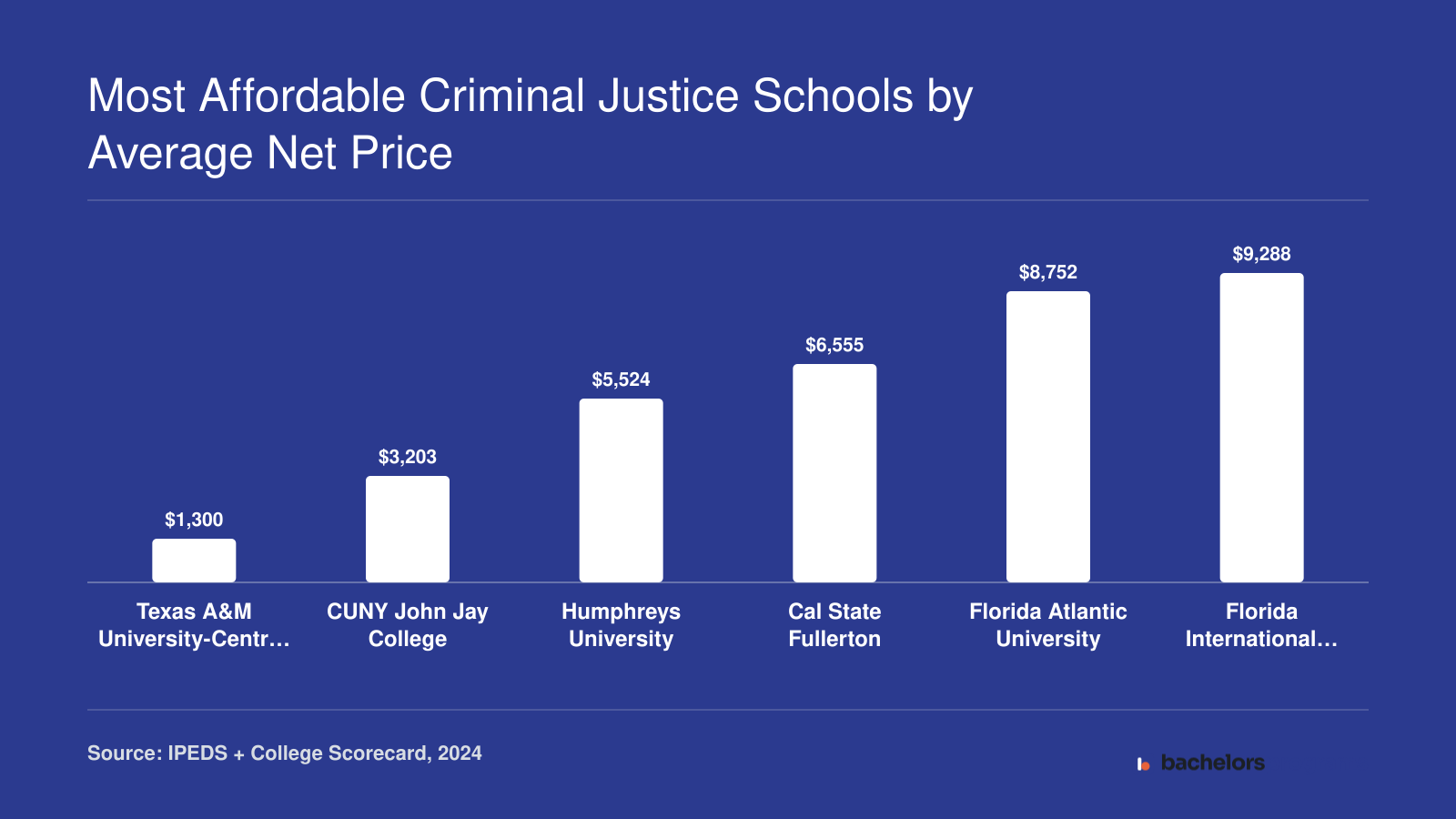
Texas A&M University-Central Texas has the lowest average net price for a bachelor's degree in criminal justice among the schools here: $1,300 a year after grants and scholarships. CUNY John Jay College of Criminal Justice follows at $3,203. These are averages, so your cost will shift with family income and the aid you receive; run each school's net price calculator before comparing offers.
What Police Officers Earn Nationally
Patrol work is the most common entry point for criminal justice graduates. Here is what that role pays across the U.S.
Jobs You Can Get With a Criminal Justice Degree and What They Pay
A bachelor's degree in criminal justice leads to work in law enforcement, corrections, the courts and security. U.S. Bureau of Labor Statistics data puts median pay between $58,850 for correctional officers and $129,180 for information security analysts as of May 2025, and growth figures below are projected for 2025 through 2035. A bachelor's degree is the typical entry credential only for probation officers, correctional treatment specialists and information security analysts, and law enforcement and corrections roles also typically require agency training such as a police academy plus a background check, so the degree is only one part of qualifying.
| Occupation | Median Annual Wage | Projected Job Growth | Typical Entry Education |
|---|---|---|---|
| Information security analysts | $129,180 | 21% | Bachelor's degree |
| Police officers and detectives (including criminal investigators) | $77,310 | 3% | High school diploma or equivalent |
| Fish and game wardens | $74,060 | -6% | N/A |
| Probation officers and correctional treatment specialists | $66,270 | 3% | Bachelor's degree |
| Paralegals and legal assistants | $62,890 | 0% | Associate's degree |
| Correctional officers | $58,850 | N/A | High school diploma or equivalent |
What Police Academies and Federal Agencies Require Beyond the Degree
A bachelor's degree in criminal justice opens doors, but every law enforcement employer adds its own screening. Local police standards are set by each department and its state POST board, so they vary. Federal agencies publish their own rules.
- Academy and POST certificationMost police hires complete a state-approved academy and earn certification through their state's Peace Officer Standards and Training (POST) board. Requirements differ by state.
- Age and citizenshipMany departments set a minimum age around 21 and require U.S. citizenship. Confirm the exact rule with each department you apply to.
- ScreeningExpect a background investigation, physical fitness test and drug screening. Many agencies also use a polygraph.
- FBI special agentsApplicants need U.S. citizenship, a bachelor's degree, generally three years of full-time professional work experience, and must be at least 23. The FBI's published upper age limits vary by notice, and waivers exist for veterans.
- FBI screening and fitnessCandidates face a polygraph, drug testing and a Top Secret clearance review. The fitness test covers sit-ups, push-ups, a sprint and a 1.5-mile run.
- DEA and ATFBoth agencies set their own education, experience and age standards. Check their official career pages before applying.
- Driver's license and clean recordA valid license is standard. The FBI requires at least six months of driving experience, no felony convictions and being current on taxes and student loans.
Questions to Ask Yourself
Do you want to be a sworn officer, a federal agent, or work in courts, corrections, or cybercrime?
Will you meet the age and background rules for your target agency by graduation?
How many credits can you transfer, and do you need asynchronous classes around a job or shift work?
Can you get an in-person internship near home if you study online?
Criminal Justice programs by state
Compare Criminal Justice programs on the data that matters
Explore more Criminal Justice & Law majors or browse every field of study.
All Criminal Justice & Law programs Browse every field of study