Best Homeland Security Degree Programs
Compare 120+ accredited Homeland Security programs, with net price after aid, graduation rates, earnings and debt from IPEDS and the U.S. College Scorecard.

Which bachelor's degree in homeland security actually leads to work at DHS, FEMA, TSA, CBP or CISA? The diploma matters less than the hiring requirements around it: U.S. citizenship, a background investigation and, for many roles, a security clearance. The usual title is the Bachelor of Science (B.S.) in Homeland Security, though some schools call it emergency management or criminology. Everything ranked here is a bachelor's program, not a graduate one.
The schools here deliver coursework online, on campus and in hybrid formats. Average net prices among the top schools run from $9,597 to $23,805 a year.
Employers in this field weigh clean records, internships and prior service or public-safety experience alongside the degree itself.
Key Points
- Elizabeth City State University offers the lowest net price: $6,364 a year.
- George Mason graduates earn a $143,972 median four years after completion.
- Most programs require about 120 credits, including Embry-Riddle's B.S. in Homeland Security.
The 10 Best Homeland Security Degree Programs for 2027
This ranking weighs cost, on-time completion and program-level earnings across online, campus and hybrid formats, so schools of very different shapes can be compared on the same footing. Each entry below is a regionally accredited institution that confers a bachelor's degree in homeland security or a closely related field, and the notes on every card cover what students actually study and what graduates go on to earn.
American Public University System
#1Charles Town, WV · $5,000 – $10,000/yr (est.)
Best for: Working adults with military or public safety careers
American Public University System is built for adults already working in or around public safety, and its homeland security program is fully online, taught in part by faculty who hold government and public safety posts. Students take a senior seminar as their final course before graduation. The school graduates 57% of its students, and graduates of the homeland security program earned a median of $77,122 four years after finishing.
- 120 total credit hours
- Fully online option available
- 18 semester hours of major core courses
- 45 elective semester hours
- Faculty hold government and public safety posts
- Senior seminar taken as the last course before graduation
- Eight-course general concentration spans emergency planning and cyber
- Minor and certificate credits count toward electives
George Mason University
#2Fairfax, VA · $15,000 – $20,000/yr (est.)
Best for: Virginia students targeting intelligence and counterterrorism
George Mason University builds its homeland security offering on a criminology and law foundation, and the Fairfax campus sits close to the federal agencies many graduates hope to join. Students choose either an internship or an area of specialization, and a capstone is required either way. The school graduates 68% of its students, and graduates of the program earned a median of $143,972 four years after finishing.
- 120 total credit hours
- Homeland Security and Justice concentration: five courses, 15 credits
- Internship or area of specialization required
- Capstone required
- Up to 18 transfer credits from the Virginia Community College System
- Honors track requires a 3.50 GPA across CRIM 491 and 492
- Accelerated Master's Pathway courses available
- 2.0 GPA minimum for admission
Arizona State University
#3Tempe, AZ · ~$15,000/yr (est.)
Best for: Aspiring emergency managers needing flexible formats
Arizona State University runs its emergency management and homeland security degree through the Watts College of Public Service and Community Solutions, with the same program available on the Downtown Phoenix campus, through ASU Online, or at ASU Local sites. Coursework centers on risk assessment, continuity of operations and emergency operations centers, and an accelerated path can award both a bachelor's and a master's in about five years. The school graduates 68% of its students.
- 120 total credit hours
- Downtown Phoenix, ASU Online or ASU Local
- Accredited by the Higher Learning Commission
- Not eligible for the STEM-OPT extension
- Accelerated bachelor's plus master's in as little as five years
- WUE reduced nonresident tuition rate
- Study abroad on global disaster management
- 2.0 GPA minimum for change-of-major applicants
University of North Texas
#4Denton, TX · $11,000 – $21,000/yr (est.)
The University of North Texas delivers its homeland security concentration inside a Bachelor of Applied Arts and Sciences, a hybrid format that mixes in-person and online coursework and is aimed partly at current or former police officers. The concentration is noted on diplomas and transcripts, and the coursework runs from computer crime to domestic and international terrorism. The school graduates 61% of its students, and program graduates earned a median of $63,622 four years after finishing.
- Combines in-person and online coursework
- Concentration is noted on diploma and transcripts
- Targets law enforcement and threats from radical groups
- Designed for current or former police officers
- Coursework includes Domestic and International Terrorism and Computer Crime
- Emergency-management elective chosen with an academic advisor
University at Albany
#5Albany, NY · ~$17,000/yr (est.)
The University at Albany houses its program in a college devoted to emergency preparedness, homeland security and cybersecurity, and students complete 100 hours of approved training plus an experiential option such as a Washington internship. Alumni have gone on to the CIA, FBI and New York State Police, and up to 12 credits can double-count toward a combined master's finished in five years. The school graduates 61% of its students, and program graduates earned a median of $69,365 four years after finishing.
- Homeland Security concentration: Terrorism and Counter-Terrorism plus Homeland Security Risk
- 100 hours of approved training required
- Washington internship option
- Fully online option available
- Combined master's finished in five years, with up to 12 credits double-counted
- Honors thesis adds seven credits
- Alumni employers include the CIA, FBI and New York State Police
- About four years to complete full time
Middle Tennessee State University
#6Murfreesboro, TN · ~$13,000/yr (est.)
Middle Tennessee State University frames its degree around practical emergency management skills, from hazard analysis to community response planning and mass care operations, and students can take it on ground or fully online. The curriculum examines both global and local threats to public safety and aims at management and leadership roles in the field. The school graduates 54% of its students.
- On ground and fully online options
- Focus on global and local threats to public safety
- Build emergency action plans and hazard analyses
- Create community response plans and mass care operations
- Prepares students for management and leadership roles
- Career paths include air marshal, border patrol agent and CIA analyst
Thomas Edison State University
#7Trenton, NJ · $5,000 – $10,000/yr (est.)
Thomas Edison State University is built for adults bringing prior college credit and professional training, and its homeland security and emergency management degree is fully online. Policy work follows the five National Preparedness System mission areas, and graduates can continue into a master's in homeland security or management at the same institution. The Order of the Sword & Shield national honor society recognizes students in this field.
- 120 total credit hours
- Fully online option available
- Follows the five National Preparedness System mission areas
- Coursework in homeland security, emergency management and public safety
- Business continuity coursework included
- Transfer credit accepted for prior coursework
- Continue to an M.S. in Homeland Security or M.S. in Management
- Order of the Sword & Shield national honor society
Arkansas Tech University
#8Russellville, AR · $10,000 – $15,000/yr (est.)
Arkansas Tech University teaches the four pillars of emergency management, mitigation, preparedness, response and recovery, and lets students stack certificates in emergency management, cybersecurity or global security alongside the bachelor's. Program materials describe it as the first accredited emergency management program, and industry-experienced faculty teach the courses. The school graduates 49% of its students, and program graduates earned a median of $53,142 four years after finishing.
- Curriculum covers the four pillars of emergency management
- Offered on campus and online
- Certificates in Emergency Management, Cybersecurity and Global Security
- Program materials describe it as the first accredited emergency management program
- Industry-experienced faculty teach courses
- Master of Science in the same field also available
University of New Hampshire
#9Durham, NH · $24,000/yr (est. net price)
The University of New Hampshire holds a National Center of Academic Excellence in Cyber Defense Education designation from the NSA and the Department of Homeland Security, and its homeland security core runs 56 credits with a capstone plus an internship or senior thesis. Full-time students typically finish in three to four years, and internships have placed students with the FBI, FEMA and the Secret Service. The school graduates 76% of its students, and program graduates earned a median of $71,129 four years after finishing.
- 128 total credit hours, including 56 in the homeland security core
- NSA/DHS National Center of Academic Excellence in Cyber Defense Education
- Full-time students finish in three to four years
- Capstone plus an internship or senior thesis
- 32 credits must be taken in residence at UNH
- Internships with the FBI, FEMA and Secret Service
- Accelerated master's in as few as five years
- Reduced tuition rate for New England residents
University of Akron
#10Akron, OH · $10,000 – $15,000/yr (est.)
The University of Akron places its program in the School of Disaster Sciences and Emergency Services, with a traditional four-year path, a step-up route for responders who already hold an associate degree, and a three-year accelerated option for students arriving with college credit. The degree is accredited by the International Fire Service Accreditation Congress and includes a capstone and a three-credit internship that requires a background check. The school graduates 52% of its students.
- 120 total credit hours
- Accredited by the International Fire Service Accreditation Congress
- Three-year accelerated option for eligible students
- Step-up pathway from responder-related associate degrees
- Capstone plus a 3-credit internship
- Service learning with county emergency agencies
- Internship requires a background check
- 15-credit specialty block and 25 credits of electives
Cost & outcomes by school
Federal data for the highest-earning Homeland Security programs, independent of the ranking above. Earnings are this field's bachelor's graduates four years after completing where the Scorecard reports them, else the school's undergraduate median.
| School | Net price / yr | Grad rate | Earnings | Debt | Grads/yr | Format |
|---|---|---|---|---|---|---|
| George Mason University VA | $17,915 | 68% | $143,972 | $21,479 | 116 | Campus |
| Grand Canyon University AZ | $22,472 | 44% | $84,553 | $25,616 | 196 | Online |
| Excelsior University NY | — | — | $78,493 | $13,769 | 8 | Online |
| American Public University System WV | $9,597 | 57% | $77,122 | $24,942 | 457 | Online |
| Colorado State University Global CO | $16,510 | — | $76,813 | $25,000 | — | Online |
| University of Scranton PA | $32,568 | 80% | $74,652 | $27,000 | — | Campus |
| Columbia Southern University AL | $14,580 | 33% | $73,703 | $21,628 | 109 | Online |
| Western New England University MA | $27,290 | 64% | $73,157 | $25,500 | — | Campus |
| University of New Hampshire NH | $23,805 | 76% | $71,129 | $26,814 | 60 | Campus |
| St. John's University-New York NY | $29,999 | 66% | $69,571 | $25,000 | — | Campus |
| University at Albany NY | $17,167 | 62% | $69,365 | $20,000 | 150 | Online or campus |
| Thomas Edison State University NJ | — | — | $69,331 | $12,500 | — | Online |
Sources: U.S. Department of Education. Net price, graduation rate, earnings and debt: College Scorecard (earnings and debt for this field's bachelor's graduates where reported, else school-wide); graduates: IPEDS. A dash means no figure is reported.
Cost, debt & payoff
Median earnings of this field's bachelor's graduates (4 yrs after completing, else the school's undergraduate median) vs. their median federal loan debt · U.S. College Scorecard
Across these programs the median graduate earns about $49,917 and finishes with roughly $23,704 in debt — a ratio that clears a common rule of thumb (keep debt below first-year salary). Net price and debt vary widely school to school, so check the per-school figures in the table above before you shortlist.
How We Ranked Bachelor's Degree in Homeland Security Programs
College Scorecard, the U.S. Department of Education's public database, supplies most of the numbers behind this ranking. Every program in this ranking is a bachelor's degree in homeland security. We matched Scorecard's program data to each school by CIP code and credential level, so associate, certificate and graduate offerings never mix in.
What We Weighed
- Net price: the average cost after grants and scholarships, as reported in College Scorecard.
- Graduation and retention: institution-wide rates showing how many students finish and how many return after the first year.
- Earnings: median earnings of graduates after completing the specific program.
- Debt: median federal debt at completion.
- Delivery format: online, on campus or hybrid, so you can compare options that fit your schedule.
Where the Data Has Limits
Net price is an average, not a quote, and it reflects students who received aid. Your own figure depends on income, residency and the aid you qualify for, so run each school's net price calculator before you decide. Graduation and retention rates describe the whole institution, not the homeland security program alone. Treat them as a signal of student support rather than a program outcome.
Some programs show no published earnings because their graduating cohorts are too small to report. We left those figures out rather than guess. Earnings and debt also reflect past graduates, so they show where earlier cohorts landed, not what your result will be.
Independence
No school paid for placement. Everything comes from public federal sources, College Scorecard and IPEDS, which you can check yourself.
What You Study in a Bachelor's Degree in Homeland Security
Credit Structure
Most bachelor's programs in this field run about 120 credits. Embry-Riddle Aeronautical University lists 120 for its B.S. in Homeland Security, and Tulane requires 120 with 30 of them in the major.1 The rest goes to general education and electives. UMGC, for example, publishes 41 general-education credits alongside 33 required major credits.2 General education usually covers communication, math, sciences, humanities and American government.
Core Courses
Core coursework tends to span intelligence, emergency management, terrorism, infrastructure and cybersecurity. Examples from the programs here include:
- Introduction: UMGC's HMLS 302 Introduction to Homeland Security.2
- Emergency management: Sam Houston State's SCST 2365 Introduction to Emergency Management.3
- Risk: Arizona State's PAF 261 Hazards and Risk Management.4
- Intelligence: Embry-Riddle's INTL 250 Indications and Warning.
- Applied practice: Tulane's HMLS 2750 Homeland Security Challenge.1
Concentrations and Career Tracks
Structures vary. Some schools offer formal concentrations, while others use minors, elective blocks or related degree titles. Embry-Riddle, for instance, pairs the degree with a Cybersecurity Application and Management minor, which suits students aiming at technology-risk and information-security roles. Intelligence options lead toward analyst work, and emergency management options toward preparedness and disaster response. Counterterrorism is often built into the core or offered as an advanced elective rather than a standalone track, so check each curriculum.
Internships and Capstones
Capstones are common. Embry-Riddle requires a 3-credit Senior Capstone and allows a senior thesis or a co-operative education placement. UMGC requires a 3-credit capstone course.2 Virginia Commonwealth lists an internship course worth 1 to 6 credits.5 Applied experience matters: federal employers weigh relevant work history, so a DHS internship or similar placement can set a graduate apart.
Related Articles
Online vs. Campus Homeland Security Degrees
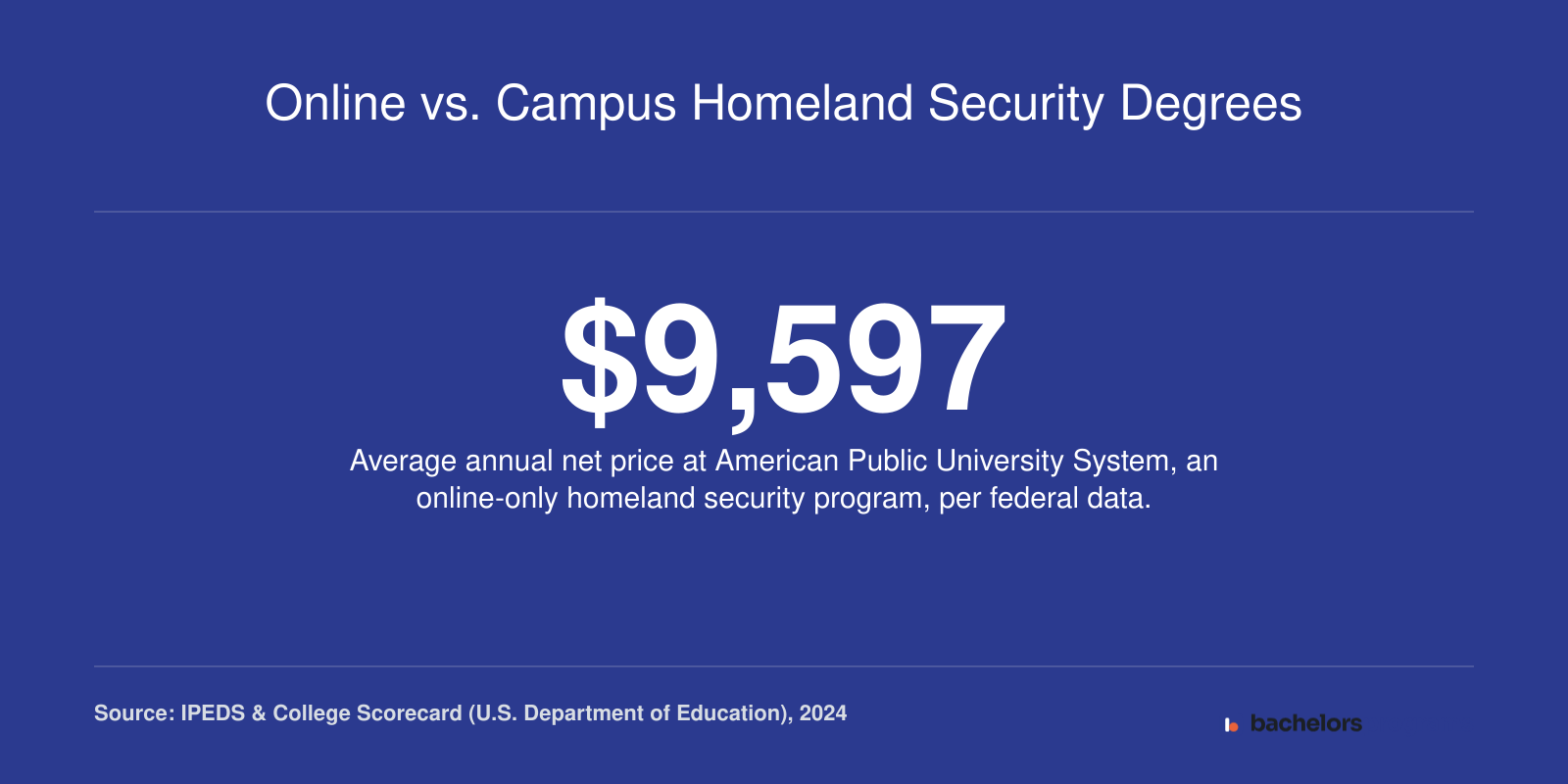
Online programs such as American Public University System and Thomas Edison State University suit working adults and military members who need flexible schedules. Campus programs like George Mason University and the University of New Hampshire add in-person networking and internships with agencies such as the FBI, FEMA and the Secret Service, while Arizona State University, University at Albany and Arkansas Tech University offer both formats. Federal employers do not treat an accredited online degree differently from a campus one, so internships and clearance-ready experience should drive your choice.
Homeland Security Degree Cost, Debt and Financial Aid
What Students Actually Pay
Average net price after aid for the schools ranked here runs from $6,364 to $13,335 a year. The three lowest-cost options are Elizabeth City State University ($6,364), Savannah State University ($8,172) and American Public University System ($9,597). Pell Grant shares at those schools are high, roughly 86%, 85% and 87% of students, so they serve many lower-income learners.
Debt at Completion
Where program-level debt is published, it is moderate. Median federal debt at completion is $22,372 at Arkansas Tech University, $24,942 at American Public University System and $26,979 at Eastern Kentucky University. Median monthly payments on a 10-year plan are $237, $264 and $286, respectively. Pell shares for those three are about 75%, 87% and 65%.
Military Savings
Service members have several ways to cut the bill:
- Tuition Assistance and GI Bill: Arkansas State University explicitly names Tuition Assistance, the Montgomery GI Bill and the Post-9/11 GI Bill1. Confirm benefit eligibility with each school, since acceptance is not uniform across programs.
- Military rates: Columbia Southern University and Trident University International list $250 per credit for qualifying military students, and Liberty University lists $250 against $410 for standard full-time undergraduates.
- Military credit: Arkansas State may evaluate Joint Services Transcripts, CCAF coursework and ACE, CLEP and DSST credit, though not every military course is guaranteed to count1. Liberty requires an official military transcript and may consider service, law enforcement training and professional experience.
Transfer-Credit Savings
Transfer limits are set program by program. Columbia Southern accepts up to 90 credits. Liberty allows up to 75% of the degree, which works out to about 90 credits only on a 120-credit program. Idaho State University waives up to 24 credits for associate degree holders, and the University of Alaska Fairbanks accepts prior A.A.S. or certificate credit. Keiser University and Trident decide case by case, and Trident also offers prior learning assessment2.
Before you enroll, request an official credit evaluation in writing. Each credit you transfer or test out of with CLEP or a similar exam is a credit you do not pay for, so the evaluation is the clearest way to see your real cost.
Top Program-Level Earnings Among Ranked Schools
George Mason University posts the highest program-level earnings among the schools ranked here.
What Jobs Can You Get With a Homeland Security Degree?
A homeland security degree leads to roles in federal agencies, state and local government, and private companies. The roles below are the ones graduates most often pursue. Where the U.S. Bureau of Labor Statistics tracks the occupation, the wage shown is a national median from May 2025.4
Common Roles, Pay and Employers
- Emergency management director: $93,330 median.2 Typical employer: state and local emergency management agencies, with FEMA as the federal counterpart.
- Information security analyst: $129,180 median.1 Typical employer: CISA and other federal agencies, defense contractors and private companies.
- Police and detectives: $77,310 median for police officers and detectives overall.3 Detectives and criminal investigators earn a median of $93,790.3 Typical employer: state and local government.
- Intelligence analyst: BLS does not publish a single figure for this title.4 Typical employer: DHS components and other federal agencies, where entry pay follows the General Schedule. Postings often start somewhere in the GS-5 to GS-9 range, depending on education and experience.
- CBP officer or agent: Federal pay scale. Entry-level postings commonly start around GS-5 to GS-7, depending on qualifications. Typical employer: U.S. Customs and Border Protection.
- Transportation security officer: TSA sets its own pay bands rather than using the General Schedule, so check current postings for starting pay. Typical employer: TSA.
- Private-sector security or risk role: Pay varies widely by employer and specialty. Typical employer: corporations, consulting firms and critical-infrastructure operators.
What the Degree Alone Won't Cover
The degree is a starting credential, not a guarantee of the title. Emergency management directors usually need several years of related experience first, so many graduates begin as coordinators or planners. CBP officers and agents go through federal hiring screens and agency academy training. Police roles require a police academy and department testing.
Demand differs by occupation. Cybersecurity and emergency management tend to draw steady hiring interest, while federal openings can shift with budgets. Check the BLS Occupational Outlook Handbook for the latest 10-year projection for any role you are considering, and compare federal listings on USAJOBS for current grade levels.
Is a Homeland Security Degree Worth It?
Four years after completion, graduates of George Mason University's Homeland Security and Justice concentration show median earnings of $143,972 against median debt of $21,479. That is the strongest program-level earnings-to-debt profile among the schools here. The University at Albany follows at $69,365 four years out against $20,000 in debt. The University of North Texas reports $63,622 four years out and $68,149 at five years, against $17,023 in debt.
School-wide context
Thomas Edison State University shows school-wide earnings of $69,331 ten years after enrollment against $12,500 in median debt. That figure covers every graduate of the university, not homeland security majors, so treat it as background only.
The trade-off
The degree pays off most in federal, state and local public-safety work, including emergency management, border security, transportation security and law enforcement. Those employers often pay on fixed scales, so expect steady advancement rather than private-sector salary jumps. A cybersecurity or intelligence concentration widens your options in corporate security and risk roles.
Who gets the most from it
Veterans and current law enforcement or military members have a clear edge. Existing experience plus a bachelor's degree can qualify you for higher GS entry grades than either would alone. The University of North Texas builds its hybrid program with current and former police officers in mind. If you are starting from scratch, the degree is worth it when you are committed to public service and pick a program with a manageable debt load.
Homeland Security programs by state
Homeland Security Degree FAQs
These answers cover the questions prospective students ask most about studying homeland security, including international enrollment, federal hiring and online formats. Always confirm current rules with the school, the hiring agency and official government sources.
Are there good homeland security degree programs for international students?
Can non-U.S. citizens work in homeland security jobs?
Do you need a homeland security degree to work for DHS?
Can you earn a homeland security degree completely online?
Compare Homeland Security programs on the data that matters
Explore more Criminal Justice & Law majors or browse every field of study.
All Criminal Justice & Law programs Browse every field of study