Best Corrections Degree Programs
Compare 100+ accredited Corrections programs, with net price after aid, graduation rates, earnings and debt from IPEDS and the U.S. College Scorecard.

Correctional officers earn a median of $58,850, and probation officers and correctional treatment specialists earn $66,270, according to the U.S. Bureau of Labor Statistics. A bachelor's degree in corrections is the usual route into the second group, and it also leads to case management, parole, and reentry roles. Every program below is a bachelor's degree, not a graduate credential.
Programs are offered online, on campus, and in hybrid formats, and published tuition varies widely from school to school.
Most state prison jobs ask only for a high school diploma, so the degree pays off mainly for people aiming at probation, supervision, and community-based work.
Key Points
- Probation officers earn a $66,270 median; correctional officers earn $58,850.
- Probation work requires a bachelor's; many prison jobs accept a GED.
- Florida Atlantic University and Thomas Edison State deliver corrections programs online.
Best Schools for a Bachelor's Degree in Corrections
The ten programs below all lead to a bachelor's degree in corrections, either as a dedicated corrections major or as a criminal justice degree with a corrections concentration. Each entry includes the campus city and state, the delivery format, an approximate average net price after aid, and the school's institution-wide graduation rate. Where program-level earnings are reported, they reflect students in that field of study after finishing.
San Diego State University
#1San Diego, CA · $15,000/yr (est. net price)
Best for: Social work majors drawn to case management
San Diego State University is the largest campus in the California State University system and offers corrections study through its School of Social Work rather than a criminal justice department. The Community Corrections Case Management specialization is a small cohort, admitted through a separate application, and places its senior interns with agencies such as San Diego County Probation. Students also have access to corrections-focused field study courses that bring them inside state prison facilities. The school graduates about 76% of its students, and the average net price after aid is roughly $15,400.
- Specialization admits a small cohort of roughly 10 students per year
- Requires a 3.0 overall GPA and a separate application with essay
- Applicants must be able to pass a background check
- Three specialization electives are taken through criminal justice courses
- Senior field internship placed with county probation and case management programs
- Corrections coursework includes probation and parole and juvenile justice
- First semester carries 15 units, including upper division writing
California State University-Stanislaus
#2Turlock, CA · ~$6,000/yr (est.)
Best for: Central Valley students seeking low net cost
California State University, Stanislaus sits in the Central Valley and organizes its criminal justice major around four concentrations, one of which is Corrections. The department also runs a juvenile justice concentration it describes as the only one in California. Graduates move into probation and parole work, correctional officer and case manager roles, and crime analysis, with the California Department of Corrections and Rehabilitation among the listed employers. The school graduates about 53% of its students, and the average net price after aid is roughly $6,100, the lowest in this group.
- Four concentrations, including Corrections and Juvenile Justice
- Corrections track prepares students for probation and parole work
- Coursework covers correctional and law enforcement management
- Also offers forensic science major and MA in Criminal Justice
- Listed employers include state corrections and federal border agencies
Florida Atlantic University
#3Boca Raton, FL · $4,900 – $17,000/yr (est.)
Best for: Working adults who need a fully online path
Florida Atlantic University delivers its corrections coursework through a Bachelor of Public Safety Administration that is fully online, with a Law Enforcement and Corrections concentration. The program is designed for working adults, and it is supported by a dedicated enrollment and success team. FAU's online bachelor's offerings are ranked in the top tier nationally, and the criminal justice and law enforcement track has been cited among the most affordable online options. The school graduates about 63% of its students, and the average net price after aid is roughly $8,800.
- Fully online, with a Law Enforcement and Corrections concentration
- Second concentration option available in Disaster Management
- Freshman deadlines of March 14 and September 15
- Designed for administrative application of law and corrections
- Dedicated enrollment and success team for online students
College of the Ozarks
#4Point Lookout, MO · $5,000 – $10,000/yr (est.)
College of the Ozarks is a work college in the Missouri Ozarks where students work campus jobs in place of tuition, which is why its published net price is unusually low. The criminal justice major carries a Corrections emphasis alongside Law Enforcement, and majors take field trips to prisons, jails and other justice system sites. Juniors and seniors can earn academic credit through an internship with a criminal justice agency. The school graduates about 64% of its students.
- Corrections and Law Enforcement emphases
- Field trips to prisons, jails, and justice agencies
- Junior and senior year internship for academic credit
- Criminal Justice Club offers police ride-alongs
- Graduates work for state probation and parole and federal agencies
University of Mississippi
#5University, MS · $10,000 – $15,000/yr (est.)
The University of Mississippi offers a criminal justice bachelor's degree with a Corrections emphasis that covers managing prisoners, adult parolees and probationers, and juvenile supervision. The degree runs eight semesters and 42 credit hours, and it is available online as well as at the Oxford campus and four regional sites. The department maintains transfer agreements with community colleges, and strong students can move into an accelerated master's program. The school graduates about 72% of its students, and the average net price after aid is roughly $13,300.
- Corrections, Homeland Security, and Law Enforcement emphases
- Eight semesters and 42 credit hours total
- Available online and at Oxford, Tupelo, Grenada, Booneville, and DeSoto
- Affiliated program for community college transfers
- Corrections emphasis covers rehabilitation and counseling
- Accelerated master's option for current students
Farmingdale State College
#6Farmingdale, NY · $11,000/yr (est. net price)
Farmingdale State College is a SUNY technology campus on Long Island that folds corrections into a single criminal justice degree covering police, courts and corrections. The major requires 121 to 122 credits and includes coursework in probation and parole, courts and the judiciary, law enforcement administration and intelligence analysis. Upper division students complete a senior paper or project along with technical electives, and internships and faculty research are available. The school graduates about 53% of its students, and the average net price after aid is roughly $10,900.
- 121 to 122 total credits, with 48 upper-division credits
- Includes probation and parole and courts coursework
- Senior paper or senior project required
- Internships and one-on-one faculty research available
- Honor societies include Alpha Phi Sigma and Sword and Shield
Texas A&M University-Central Texas
#7Killeen, TX · under $5,000/yr (est.)
Texas A&M University-Central Texas in Killeen serves a large share of military-connected students and offers its criminal justice degree both on campus and online. The 120-hour program treats community and institutional corrections as an area of study alongside policing, courts and homeland security. Students can join the Criminal Justice Association and the local chapter of Alpha Phi Sigma. The average net price after aid is roughly $1,300, reflecting the high share of students receiving grant aid, though the school does not publish an institution-wide graduation rate.
- 120 credit hours, offered on campus and online
- Community and institutional corrections areas of study
- Coursework includes supervision and management and applied ethics
- Criminal Justice Association and Alpha Phi Sigma chapter
- Prepares students for federal, state, and local agency roles
Florida Gulf Coast University
#8Fort Myers, FL · ~$13,000/yr (est.)
Florida Gulf Coast University offers a criminal justice bachelor's degree with six specializations, including corrections, and makes the upper division available online. Students who hold an AA or an articulated AS degree from a Florida public community college can finish the final 60 credits at a distance, which suits professionals working shifts. The core covers the justice system, probation and parole, and the relationship between the victim, the offender and society. The school graduates about 57% of its students, and the average net price after aid is roughly $12,600.
- Six specializations, including Corrections and Juvenile Justice
- Upper division 60 credits available fully online
- AA or articulated AS degree accepted from Florida public colleges
- Core coursework covers probation and parole
- Internship combines theory and supervised practice
Thomas Edison State University
#9Trenton, NJ · $5,000 – $10,000/yr (est.)
Thomas Edison State University is New Jersey's online public institution for adults, and its criminal justice degree is built around prior learning. The 120-credit curriculum follows Academy of Criminal Justice Sciences criteria and covers corrections, criminological theory, law adjudication and law enforcement. Students can transfer credits and convert college-level knowledge from military service or industry work into academic credit, and multiple start dates are offered. The school graduates about 66% of its students, and the average net price after aid is roughly $12,500.
- 120 credits, delivered fully online
- Curriculum consistent with Academy of Criminal Justice Sciences criteria
- Transfer credits accepted, plus credit for military or industry experience
- Multiple start dates throughout the year
- Coursework covers administration of justice and corrections
University of Massachusetts-Lowell
#10Lowell, MA · ~$17,000/yr (est.)
UMass Lowell houses criminal justice in its School of Criminology and Justice Studies, and the Corrections Option draws electives in community and institutional corrections theory and practice. Concentrations are optional, so students who skip one complete the General Option with free choice of electives. A five-year BS and MA track lets juniors and seniors with a 3.000 GPA count up to three graduate classes toward both degrees. The school graduates about 65% of its students, and the average net price after aid is roughly $17,200.
- Corrections Option emphasizes community and institutional corrections
- Six options, including Crime and Mental Health and Paralegal
- 120 credit hours total
- Concentrations optional; General Option is the default
- BS and MA completable in five years with a 3.000 GPA
- Option must be declared within the first two criminal justice electives
Cost & outcomes by school
Federal data for the highest-earning Corrections programs, independent of the ranking above. Earnings are this field's bachelor's graduates four years after completing where the Scorecard reports them, else the school's undergraduate median.
| School | Net price / yr | Grad rate | Earnings | Debt | Grads/yr | Format |
|---|---|---|---|---|---|---|
| Saint Mary's University of Minnesota MN | $11,704 | 66% | $79,464 | $21,500 | 24 | Campus |
| Franklin Pierce University NH | $27,154 | 54% | $70,125 | $27,000 | 23 | Online or campus |
| Norwich University VT | $22,257 | 60% | $70,075 | $26,000 | 81 | Campus |
| Farmingdale State College NY | $10,867 | 53% | $69,781 | $14,718 | — | Campus |
| Thomas Edison State University NJ | — | — | $69,331 | $12,500 | 21 | Online |
| Westfield State University MA | $16,721 | 54% | $67,363 | $21,500 | 116 | Campus |
| Western Connecticut State University CT | $17,604 | 52% | $66,510 | $24,000 | 70 | Campus |
| University of Massachusetts-Lowell MA | $17,163 | 65% | $66,258 | $21,502 | 160 | Online or campus |
| Minnesota State University-Mankato MN | $19,139 | 54% | $64,585 | $21,500 | 96 | Campus |
| DeSales University PA | $31,643 | 72% | $64,020 | $27,000 | 29 | Campus |
| Pace University NY | $30,892 | 60% | $63,514 | $24,098 | 47 | Campus |
| University of Indianapolis IN | $21,602 | 56% | $62,307 | $26,254 | 15 | Campus |
Sources: U.S. Department of Education. Net price, graduation rate, earnings and debt: College Scorecard (earnings and debt for this field's bachelor's graduates where reported, else school-wide); graduates: IPEDS. A dash means no figure is reported.
Cost, debt & payoff
Median earnings of this field's bachelor's graduates (4 yrs after completing, else the school's undergraduate median) vs. their median federal loan debt · U.S. College Scorecard
Across these programs the median graduate earns about $53,916 and finishes with roughly $24,213 in debt — a ratio that clears a common rule of thumb (keep debt below first-year salary). Net price and debt vary widely school to school, so check the per-school figures in the table above before you shortlist.
How We Ranked Corrections Degree Programs
Four criteria decided the order of the programs below, and the data behind them is public, so you can check our work before you apply.
What Qualified for the List
Only bachelor's-level programs with a clear corrections focus were eligible: a standalone corrections major, a correctional program support services degree, or a criminal justice degree with a declared corrections concentration. Delivery format was not a filter. Fully online, on-campus, and hybrid programs competed on the same terms, because the credential that matters to a hiring agency is the degree, not the classroom it came from.
The Criteria
- Average net price after aid: what students actually pay, not the sticker tuition.
- Graduation and retention rates: whether students who start tend to finish.
- Earnings and median debt: program-level figures from College Scorecard where they are published for the corrections or criminal justice program.
- Corrections specificity: how much of the coursework is genuinely built around institutional corrections, community supervision, and offender rehabilitation rather than general policing.
Where the Data Falls Short
Know the limits before you compare two schools. Net price, graduation rate, and retention are institution-wide numbers, so they describe the university rather than the corrections department inside it. Earnings are reported over different windows depending on the program, which makes direct comparison between two schools imperfect.
The ranking also says nothing about faculty experience, course rigor, or whether a school can place you in a practicum at a state facility. Those answers come from the department, so call and ask before you commit.
Corrections Degree vs. General Criminal Justice Degree
Both paths meet the bachelor's requirement for probation work, and the U.S. Bureau of Labor Statistics reports pay by occupation, not by degree title: $58,850 median for correctional officers and $66,270 for probation officers and correctional treatment specialists. The real difference is focus and flexibility. Choose dedicated corrections if you are set on institutional or community corrections, and choose broad criminal justice if you want options.
| Factor | Dedicated corrections degree | Criminal justice degree with a corrections concentration or one corrections course |
|---|---|---|
| Core coursework focus | Mostly corrections topics such as institutional management, offender rehabilitation, community supervision, and reentry | Broad coverage of policing, courts, and criminology, with a smaller set of corrections electives |
| Typical career targets | Correctional officer, probation officer, correctional treatment specialist, reentry or program support roles | Same corrections jobs, plus police, court, and other public safety roles |
| Flexibility to switch into policing or courts | Narrower. Some switching is possible, but fewer courses cover patrol or court operations | Wider. Core classes already cover law enforcement and the court system |
| Internship or field placement depth | Often placed in a jail, prison, or probation office, so the experience tends to be deeper and more specific | Varies by school. Placements may be general, and a corrections site is not guaranteed |
| Fit with entry requirements | A high school diploma is the typical entry level for correctional officers, and a bachelor's is typically required for probation work. The Federal Bureau of Prisons commonly accepts a bachelor's in a related field | Exceeds the typical officer entry level and fits the criminal justice field BLS lists for probation and treatment roles |
| Best-fit student | Someone committed to working inside facilities or supervising people in the community | Someone who wants to keep policing, courts, and corrections open while deciding |
Should You Choose an Online or Campus Corrections Program?
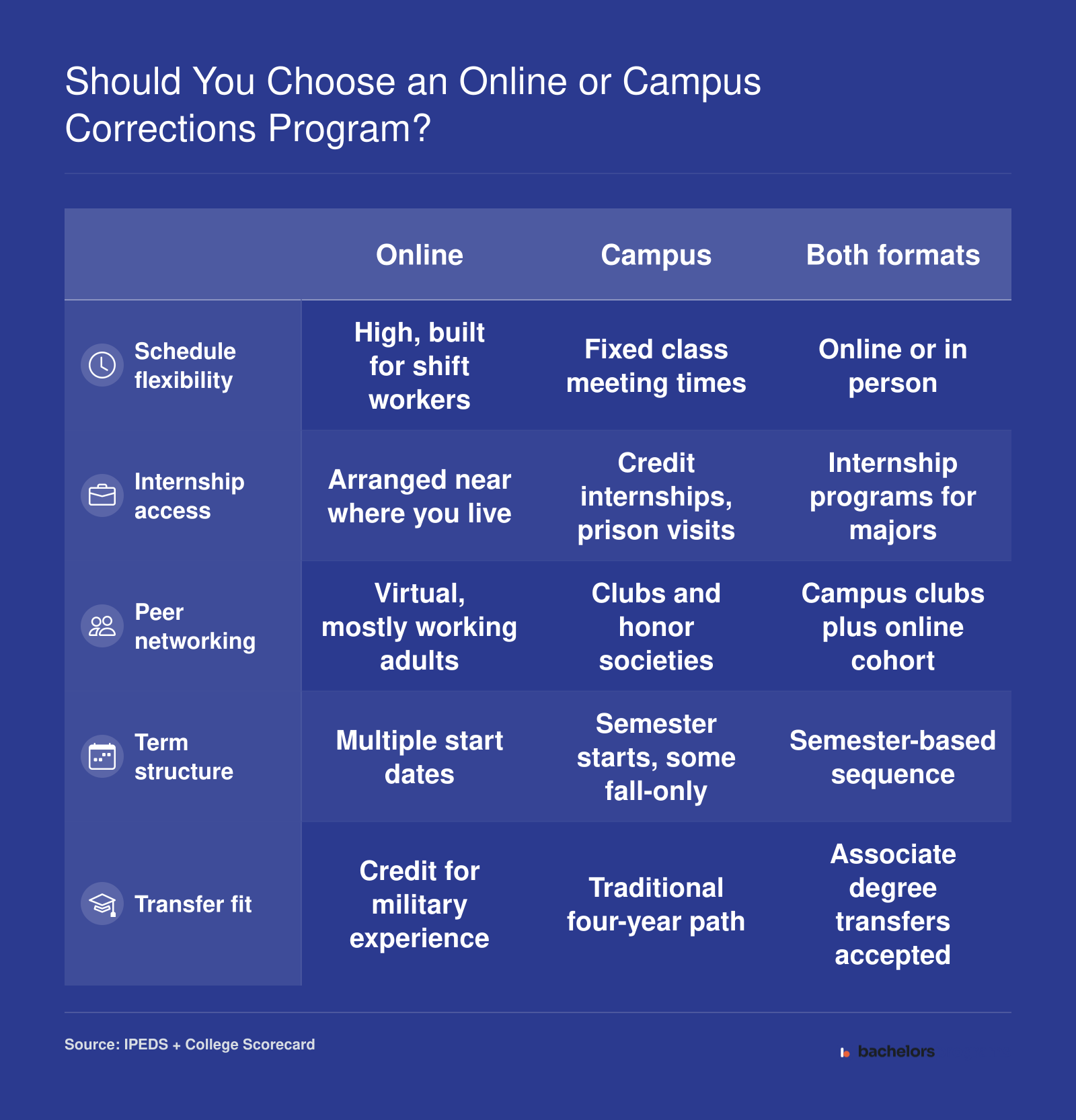
Florida Atlantic University and Thomas Edison State University deliver their corrections programs online. San Diego State, Stanislaus State, College of the Ozarks, and Farmingdale State teach on campus, while Ole Miss, Texas A&M-Central Texas, Florida Gulf Coast, and UMass Lowell offer both formats. Online study works well for employed officers seeking promotion, while campus programs suit students who need internships with local agencies.
Related Articles
Affordable and Accredited Corrections Programs: Cost and Value Compared
Average net price below is what students actually pay on average after grants and scholarships, while tuition and fees is the published price before any aid. That gap is widest at Texas A&M University-Central Texas, where an average net price of $1,300 sits against $7,363 in published in-state tuition and fees, and more than 82 percent of students at both it and Stanislaus State receive Pell Grants. Low cost only pays off if the school holds institutional accreditation (traditionally called regional) from an accreditor recognized by the U.S. Department of Education, which is the standard tied to federal aid, credit transfer, and federal hiring. Nationally accredited schools can also qualify for federal aid, but their credits have historically been accepted more selectively, and transfer stays case-by-case: a 2026 federal rule requiring colleges to consider comparable undergraduate coursework and explain denials in writing does not take effect until July 1, 2027. The Academy of Criminal Justice Sciences ended its program certification in 2018 and now offers an optional Program Endorsement for criminal justice and criminology programs, which signals quality but does not replace accreditation, so confirm any school's accreditor in the Department of Education's accreditation database or the CHEA directory before you apply.
| School | Program | Format | Average Net Price (After Aid) | In-State Tuition and Fees (Published, Before Aid) | Share of Students Receiving Pell Grants | Median Program Debt |
|---|---|---|---|---|---|---|
| Texas A&M University-Central Texas (Killeen, TX) | B.S. in Criminal Justice, Corrections (community and institutional) concentration | Online and on campus | $1,300 | $7,363 | 82.2% | $20,375 |
| California State University-Stanislaus (Turlock, CA) | B.A. in Criminal Justice, Corrections concentration | On campus | $6,067 | $8,246 | 82.9% | $12,000 |
| College of the Ozarks (Point Lookout, MO) | Criminal Justice Major, Corrections concentration | On campus | $6,100 | $22,320 | N/A | N/A |
Bachelor of Science in Correctional Program Support Services Salary
Hiring Requirements for Correctional and Probation Officers
Entry requirements split into two tracks, and which track you aim at should shape your choice of major.
Correctional Officer Minimums
Most state prison jobs ask for a high school diploma or GED, a minimum age, a clean background check, a physical fitness component, and completion of an academy. California is a clear example. Applicants must be at least 20 to apply and 21 when they enter the academy, hold a diploma or equivalent, have no felony convictions, and be a U.S. citizen, lawful permanent resident, or otherwise authorized to work.2 The state expected applications to reopen on December 1, 2026.2
The Federal Bureau of Prisons sets a higher bar. Entry-level officers generally need a bachelor's degree or several years of related experience in counseling, assistance, or supervision.1 New hires attend academy training at Glynco, Georgia, within their first 60 days, and the physical abilities test is built around real job tasks. Continuing training runs 16 to 40 hours a year depending on duty location.1
Probation and Parole Officers
These roles usually require a bachelor's degree. North Carolina asks for a degree from an accredited institution, then requires certification plus psychological, drug, background, and physical exams. Its careers page lists six weeks of basic training.4 Within 90 days of hire, officers must obtain a state license and live within 30 miles of their assigned county for two years.4
South Carolina offers several routes: a bachelor's degree with 15 semester hours in social or behavioral sciences, an associate's degree with two years of military or law enforcement experience, or a high school diploma with four years of that experience.5 Training includes the state's academy in Columbia.5
Where a Degree Helps
A degree can stand in for years of experience, as it does at the Bureau of Prisons and in South Carolina. Federal postings may also tie a starting grade, such as GL-07, to education or experience, so read the announcement closely. Written exams, psychological screening, and academy length vary by agency, and rules change.
Before choosing a program, pull up your own state corrections department's current job posting and compare it with what the degree would give you.
Internships, Practicums, and Transfer Credit
East Carolina University requires field education in its criminal justice bachelor's program: 135 contact hours at 3 credits, up to 405 hours at 9 credits, and no more than 9 internship credits counting toward the degree.1
What a Placement Actually Involves
East Carolina students must clear CRIM 1000 and CRIM 2004, hold a 2.0 GPA, and finish 30 credits plus a mandatory orientation before enrolling.1 The coordinator sets exact hours by semester length, and students are expected to work 30 to 40 hours a week at sites such as jails, prisons, probation and parole offices, and reentry nonprofits. Northern Michigan University lists CJ 491 at 4 to 16 credits online, but only 4 count toward the major; the rest land as general electives.2 The University of Arizona builds an internship into its 120-credit online degree, completed virtually or in person.3
Online Fieldwork and Credit for Experience
Online students typically arrange a local placement near home. Methodist University runs a 10-week supervised practicum with 120 fieldwork hours, split between faculty and on-site supervisors.4 Working officers rarely get credit for simply holding a job; East Carolina awards credit only for time served at an approved placement while enrolled. Tarleton State is the exception worth knowing, offering up to 42 semester credits beginning Fall 2026 for documented law enforcement, corrections, military, and academy training, though years of service alone do not convert.5
Transfer Credit and Articulation
- Generous ceilings: Northern Michigan advertises up to 90 transfer credits, Methodist up to 93 (including 64 from a community college), and Liberty up to 75% of a 120-credit degree.2
- Prior learning: Louisville accepts up to 60 community college and 90 four-year credits, plus up to 30 tuition-free prior learning assessment credits.6
- Military pathways: New Hampshire accepts up to 90 credits and maintains an AU-ABC agreement covering Air Force associate degrees.7
Ask First, Apply Second
Request a transcript evaluation before you submit an application or pay a fee. It shows how academy hours and past coursework will post, and whether a placement can be waived.
Questions to Ask Yourself
Do you want to work inside a correctional facility, or in community corrections such as probation and reentry?
Are you already employed by an agency that offers tuition assistance or credit for academy training?
Does the program arrange internship placements near you, or will you have to find your own?
Will your associate credits transfer in full to this program?
Corrections programs by state
Compare Corrections programs on the data that matters
Explore more Criminal Justice & Law majors or browse every field of study.
All Criminal Justice & Law programs Browse every field of study