Best Bachelor's Degrees in Criminal Justice Administration
Compare 370+ accredited Criminal Justice Administration programs, with net price after aid, graduation rates, earnings and debt from IPEDS and the U.S. College Scorecard.

Police departments and correctional agencies keep reporting staffing strain, and the pressure falls on supervisors as much as on new recruits. A bachelor's degree in criminal justice administration is built for that side of the work: it prepares students to lead and manage within policing, corrections, courts, and emergency services, not only to work a beat. The common credential is the Bachelor of Science (B.S.) in Criminal Justice Administration, though some universities award a Bachelor of Arts for similar coursework.
The harder part of the decision is rarely the degree itself. Program titles vary widely, and the same management-focused curriculum may appear as criminal justice, criminology, or justice management, so the course list matters more than the name on the diploma.
Key Points
- Net price after grants starts near $1,300 at the most affordable schools.
- Farmingdale State College graduates post the highest program-level earnings here.
- Expect four years full-time, or 18 to 24 months with transfer credit.
Best Schools for a Bachelor's Degree in Criminal Justice Administration
The ten programs below blend eight public universities with two private colleges, and four of the ten offer a fully online route to the degree. Published net prices after aid among these schools run from about $1,300 to $24,400, and graduation rates range from roughly 53% to 90%. Formats include fully online, hybrid, and traditional campus study, so cost can be weighed against the schedule a reader actually needs.
Florida State University
#1Tallahassee, FL · ~$11,000/yr (est.)
Best for: In-state students wanting a large public research campus
Florida State University is a public research university in Tallahassee that graduates about 86% of its students, with an average net price after aid of roughly $11,300. Its criminology major requires 36 hours in the field, including four core courses, and offers an optional 15-credit internship. The program is available face-to-face in Tallahassee or fully online, and a combined bachelor's-to-master's pathway lets students apply up to 12 graduate credits.
- 120 total credit hours, including 36 in criminology
- Four required core courses, all with a C or higher
- Optional one-semester, 15-credit internship; 3 hours count toward the major
- Fully online option open to all FSU students
- Combined bachelor's-to-master's path with up to 12 graduate credits
- Requires a 12-15 credit minor and a 2.0 GPA to enter the major
CUNY John Jay College of Criminal Justice
#2New York, NY · ~$3,200/yr (est.)
Best for: New Yorkers set on justice-agency careers
CUNY John Jay College of Criminal Justice is a public college in New York City built around justice and public safety fields. The school graduates about 56% of students, and the average net price after aid is roughly $3,200. Its B.S. in Criminal Justice Management puts 48 of 120 credits in the major, ends in a capstone in justice administration, and offers an accelerated route into a criminal justice master's degree or an MPA.
- 120 total credit hours, with 48 in the major
- 15-credit foundation includes Constitutional Law and Institutional Racism
- 21-credit management block covers organizational behavior and fiscal administration
- Capstone seminar in justice administration and planning
- Internship or practicum must be with a criminal justice agency
- Accelerated bachelor's-to-master's option in criminal justice or public administration
Amridge University
#3Montgomery, AL · $5,000 – $10,000/yr (est.)
Best for: Working adults needing fully online coursework
Amridge University is a private institution in Montgomery, Alabama, that delivers its criminal justice bachelor's degree online. The 128-semester-hour program splits into 40 hours of general education, 40 hours of criminal justice, and 48 hours of electives, and undergraduate tuition runs $395 per semester hour at the full-time rate. Students must complete at least 40 hours at Amridge and graduate with a 2.0 GPA.
- 128 semester hours: 40 general education, 40 criminal justice, 48 electives
- $395 per semester hour at the full-time rate
- Required courses include Criminal Law, Evidence, Procedures, and Constitutional Law
- At least 40 of the 128 hours must be taken at Amridge
- 2.0 cumulative GPA required to graduate
- Electives include a criminal justice internship and white collar crime
Texas A&M University-Central Texas
#4Killeen, TX · under $5,000/yr (est.)
Texas A&M University-Central Texas is a public university in Killeen that serves a large share of transfer students. Its Bachelor of Applied Arts and Sciences in Criminal Justice is a 120-hour degree for students who already hold an Associate of Applied Science, and up to 33 hours can come from certifications and non-academic training in the field. The average net price after aid is about $1,300, and the degree runs both on campus and online.
- 120-hour degree built for Associate of Applied Science holders
- Up to 33 hours of credit for certifications and field training
- Offered on campus and fully online
- Coursework spans courts, corrections, victims, offenders, and supervision
- Honor society chapter: Alpha Phi Sigma, Omega Lambda
- Student group: Criminal Justice Association
University of Georgia
#5Athens, GA · ~$14,000/yr (est.)
The University of Georgia is a public research university in Athens that graduates about 90% of its students, with an average net price after aid of roughly $13,900. Its criminal justice A.B. requires coursework in criminal justice administration, criminology, and research methods, then a full-time internship semester. Majors round out the degree with 15 hours of upper-level electives, all delivered on campus.
- Required coursework in criminal justice administration and criminology
- Research methods course required before the internship semester
- Full-time internship semester required for all majors
- 15 hours of major electives
- Interdisciplinary coursework in law, legal institutions, and crime
University of Washington-Tacoma Campus
#6Tacoma, WA · $13,000 – $43,000/yr (est.)
The University of Washington Tacoma is a public campus offering criminal justice both on site and fully online. The school graduates about 63% of students, and the average net price after aid is roughly $10,200. The major takes a multidisciplinary view of crime and justice, with coursework in restorative and rehabilitative approaches, community partnerships, and research methods. Internship placements include police agencies, probation and parole offices, courts, corrections, and victim services.
- Offered both on campus and fully online
- Multidisciplinary study of crime and justice, not one narrow track
- Applies the scientific method to criminal justice questions
- Covers rehabilitative and restorative approaches to crime and justice
- Emphasizes community partnerships and systems thinking
- Internships with police agencies, courts, probation offices, and victim services
California State University-Stanislaus
#7Turlock, CA · ~$6,000/yr (est.)
California State University, Stanislaus is a public university in Turlock, and its criminal justice B.A. includes a Corrections concentration. The school graduates about 53% of students, and the average net price after aid is roughly $6,100. The major is mapped as a junior and senior year plan for transfer students who hold an AA-T or AS-T, with 60 units across the final two years.
- Corrections concentration within the criminal justice B.A.
- Roadmap designed for transfer students with an AA-T or AS-T
- 60 units across the junior and senior years
- Core major courses plus concentration electives
- Writing Proficiency course (CJ 3170) required
- Student Success Skills course built into the plan
Rutgers University
#8New Brunswick, NJ · $24,000/yr (est. net price)
Rutgers University-New Brunswick is a large public research university that graduates about 84% of its students, with an average net price after aid of roughly $24,400. The criminal justice major is a 120-credit B.A. in the School of Arts and Sciences, and declaring it requires Introduction to Criminal Justice with a C or better plus a 2.0 GPA. The major cannot be combined with the criminology minor, and the university also runs statewide hybrid criminal justice pathways through New Jersey county colleges.
- 120 credits, with about 15 credits per semester recommended
- Declaring the major requires Introduction to Criminal Justice with a C or better
- 2.0 cumulative GPA required to declare
- Cannot be combined with the criminology minor
- Coursework covers crime and criminal justice in the U.S. and abroad
- Statewide hybrid pathways with county colleges accept up to 60 credits
California State University-Los Angeles
#9Los Angeles, CA · ~$4,000/yr (est.)
California State University, Los Angeles is a public university that graduates about 53% of its students, and its average net price after aid is roughly $4,000. The B.S. in Criminal Justice sits in the School of Criminal Justice and Criminalistics, part of the College of Health and Human Services. Admission goes beyond the standard university requirements, and the department also offers a separate criminal justice minor.
- Housed in the School of Criminal Justice and Criminalistics
- Part of the College of Health and Human Services
- Supplementary admission criteria beyond standard university requirements
- Department also offers a separate criminal justice minor
College of the Ozarks
#10Point Lookout, MO · $5,000 – $10,000/yr (est.)
College of the Ozarks is a private college in Point Lookout, Missouri, that graduates about 64% of its students, with an average net price after aid of roughly $6,100. Its B.S. in Criminal Justice offers Corrections or Law Enforcement emphases and sends students on field trips to prisons, jails, and agencies. Juniors and seniors can take internships for academic credit with a criminal justice agency, and the Criminal Justice Club adds ride-alongs and defensive tactics practice.
- Two emphases: Corrections or Law Enforcement
- Field trips to prisons, jails, and law enforcement agencies
- Junior and senior internship with a criminal justice agency for credit
- Graduates have entered federal agencies such as ATF, ICE, DEA, and Secret Service
- Criminal Justice Club offers ride-alongs, marksmanship, and defensive tactics
Cost & outcomes by school
Federal data for the highest-earning Criminal Justice Administration programs, independent of the ranking above. Earnings are this field's bachelor's graduates four years after completing where the Scorecard reports them, else the school's undergraduate median.
| School | Net price / yr | Grad rate | Earnings | Debt | Grads/yr | Format |
|---|---|---|---|---|---|---|
| Drexel University PA | $38,509 | 78% | $84,648 | $25,325 | — | Campus |
| University of New Hampshire NH | $23,805 | 76% | $81,768 | $26,814 | — | Online |
| National University CA | $22,878 | 43% | $81,299 | $25,000 | 131 | Online or campus |
| Seattle University WA | $34,662 | 76% | $74,018 | $19,702 | 16 | Campus |
| Saint Anselm College NH | $34,779 | 80% | $73,371 | $27,000 | — | Campus |
| Mercer University GA | $23,847 | 70% | $71,602 | $25,000 | 12 | Online or campus |
| University of Detroit Mercy MI | $15,232 | 67% | $71,030 | $23,250 | 13 | Campus |
| Columbia Southern University AL | $14,580 | 33% | $70,354 | $20,209 | 332 | Online |
| Farmingdale State College NY | $10,867 | 53% | $69,781 | $14,718 | — | Campus |
| Herzing University-Kenosha WI | $23,066 | 72% | $69,601 | $19,310 | 2 | Online |
| George Mason University VA | $17,915 | 68% | $69,511 | $17,750 | 320 | Campus |
| Utah Valley University UT | $6,376 | 45% | $68,296 | $19,586 | 83 | Online or campus |
Sources: U.S. Department of Education. Net price, graduation rate, earnings and debt: College Scorecard (earnings and debt for this field's bachelor's graduates where reported, else school-wide); graduates: IPEDS. A dash means no figure is reported.
Cost, debt & payoff
Median earnings of this field's bachelor's graduates (4 yrs after completing, else the school's undergraduate median) vs. their median federal loan debt · U.S. College Scorecard
Across these programs the median graduate earns about $52,847 and finishes with roughly $24,750 in debt — a ratio that clears a common rule of thumb (keep debt below first-year salary). Net price and debt vary widely school to school, so check the per-school figures in the table above before you shortlist.
How We Ranked These Criminal Justice Administration Schools
Prestige and price are two different filters, and a criminal justice administration program can look strong through one and weak through the other. The question here is narrower: which schools deliver the bachelor's degree in criminal justice administration at a fair price, with solid odds you finish and that the credential pays off.
What Goes Into the Comparison
Cost comes from College Scorecard average net price, the average bill after grants and scholarships, not the sticker tuition. Completion signals come from graduation and retention rates for the entire institution. Earnings and federal debt figures are tracked for graduates of the specific program, and completion counts serve as a rough measure of program size and stability. Larger programs tend to have more sections, more scheduling flexibility, and more alumni to network with.
Where the Numbers Fall Short
School-wide graduation rates cover the whole college, not the criminal justice department, so a strong number says as much about campus culture as about advising. Average net price is exactly that, an average: your own bill shifts with family income, residency, and transfer credits. Some programs publish no earnings data for graduates, and those schools are ranked on cost and completion alone.
Before you apply, confirm two things on your own: that the college holds institutional accreditation and that it is authorized to enroll students in your state. The accreditation step that follows explains what to look for. Most competing rankings publish no methodology at all, which is why this one walks you through the inputs.
Cost and Net Price of a Criminal Justice Administration Bachelor's Degree
The lowest-cost schools ranked here publish in-state tuition and fees of $7,160 to $7,470 a year and out-of-state rates of $15,420 to $19,760, yet their average net price after grants falls to between $1,300 and $3,967; net price is an institution-wide average for all aided undergraduates, not a quote for this major, and public in-state, public out-of-state and private nonprofit costs can diverge sharply. Online programs often bill per credit instead, with 2026 rates of $407 at Texas State University, $427 at UW-Parkside (one rate for in-state and out-of-state students, fees included) and $514 at Northern Kentucky University; at $407 a credit, a full 120-credit degree comes to $48,840 before discounts, but transferring 60 credits from an associate degree halves the remaining load and that bill, American Public University accepts up to 90 transfer credits, and Texas A&M University-Central Texas offers an associate degree transfer pathway plus up to 33 hours of credit for training. Before you commit, budget for general and technology fees and books on top of tuition, and ask each school whether online students pay a flat rate regardless of residency.
| School | Location | Format | In-State Tuition and Fees | Out-of-State Tuition and Fees | Average Net Price After Aid |
|---|---|---|---|---|---|
| Texas A&M University-Central Texas | Killeen, TX | Online or on campus | $7,363 | $17,154 | $1,300 |
| CUNY John Jay College of Criminal Justice | New York, NY | On campus | $7,470 | $15,420 | $3,203 |
| California State University-Los Angeles | Los Angeles, CA | On campus | $7,160 | $19,760 | $3,967 |
Accreditation: What to Check Before You Enroll
A low sticker price or a flexible online schedule only pays off if the school behind the degree holds accreditation that financial aid offices, transfer registrars, and hiring agencies will accept.
Institutional Accreditation Comes First
The credential that matters most is institutional accreditation, which evaluates the whole college rather than a single major. A recognized accreditor is one reviewed by the U.S. Department of Education, the Council for Higher Education Accreditation (CHEA), or both.1 CHEA counts 19 recognized institutional accreditors and roughly 63 programmatic ones.1 Enrolling at an institutionally accredited school typically keeps you eligible for federal financial aid, makes credits transferable, and signals to police departments, courts, and corrections agencies that the degree is legitimate.
Where ACJS Certification Fits
Criminal justice bachelor's programs generally do not carry a separate programmatic accreditation, and no recognized programmatic accreditor is required for them. The Academy of Criminal Justice Sciences (ACJS) publishes certification standards for criminal justice and criminology programs, but ACJS certification is not the same as recognized institutional accreditation. Treat it as a quality signal, not a substitute. A program page that cites ACJS alignment still needs its parent institution verified separately.
A Three-Step Verification Routine
- Search DAPIP: Look up the school in the Education Department's Database of Accreditation of Postsecondary Institutions and Programs. Match the exact name and the campus or online division that grants your degree, and confirm the status is current rather than pending, expired, or withdrawn.
- Cross-check CHEA: Search CHEA's directory by name and state; it covers more than 8,200 institutions.2 Open the profile to confirm the accreditor and the dates.
- Confirm the accreditor: Make sure the accrediting body itself appears on the Education Department's or CHEA's recognized list.
Neither database confirms ACJS certification, so check that claim with ACJS directly if it matters to you.
Red Flags to Watch
- National-only accreditation: Some regionally accredited colleges may decline credits from nationally accredited schools, which can complicate a later transfer.
- Accreditation mills: Agencies with official-sounding names but no Education Department or CHEA recognition offer no real protection.
- Vague claims: Phrases like "fully accredited" or "approved" with no accreditor named are your cue to verify before you enroll.
Related Articles
Online, Hybrid, or on Campus: Picking a Format That Fits Your Schedule
How long does a bachelor's degree in criminal justice take? Plan on about four years full-time for 120 credits with no prior credit, and as little as 18 to 24 months if you transfer in substantial credit. Advertised short timelines almost always assume transfer credit, an accelerated calendar, or both. For the criminal justice bachelor degree online searcher, the format you pick also changes your term length, internship logistics, and state eligibility, so compare these factors before you apply.
| Factor | Online | Hybrid | On Campus |
|---|---|---|---|
| Schedule flexibility | Most flexible. Some programs are asynchronous, others add live sessions, so confirm which one before you enroll | Moderate. Campus visits happen more than once per semester, with additional class meetings online | Least flexible. Face-to-face attendance is required to complete the program |
| Term length | Often accelerated, such as 7 or 8 week courses | Often semester-based, commonly 15 to 16 weeks, with some accelerated calendars | Typically 15 to 16 week semesters, with some accelerated calendars |
| Typical time to finish | About 4 years for 120 credits with no prior credit. Two classes per 7-week term works out to just over 2 years for working adults with transfer credit | Under 3 years on an accelerated three-semester calendar, studied in consecutive semesters | Under 3 years on an accelerated three-semester calendar. About 4 years on a standard calendar |
| Transfer-credit friendliness | Often the most generous. One online program accepts up to 90 credits, leaving as few as 10 courses (about 5 terms) | Varies by school. Request a credit evaluation before applying | Varies by school. Request a credit evaluation before applying |
| Internship access | One program requires 160 hours in the field and allows it locally or at your current workplace if it meets program rules | Internship in the criminal justice field is required. Ask how placements are arranged | Internship in the criminal justice field is required. Ask how placements are arranged |
| State authorization | Confirm the school participates in NC-SARA and can enroll residents of your state. Check this again if your internship is in another state | Matters most if you live outside the school's state, since part of the coursework is online | Rarely an issue if you live and study in the school's state |
| Best fit | Working adults, career changers, and transfer students. Among the schools ranked here, Monroe University offers both online and on-campus versions, while other listings may be online only, so check each school's format | Students who want some in-person contact with faculty and peers without a full commute | Recent high school graduates and students who want a traditional campus experience |
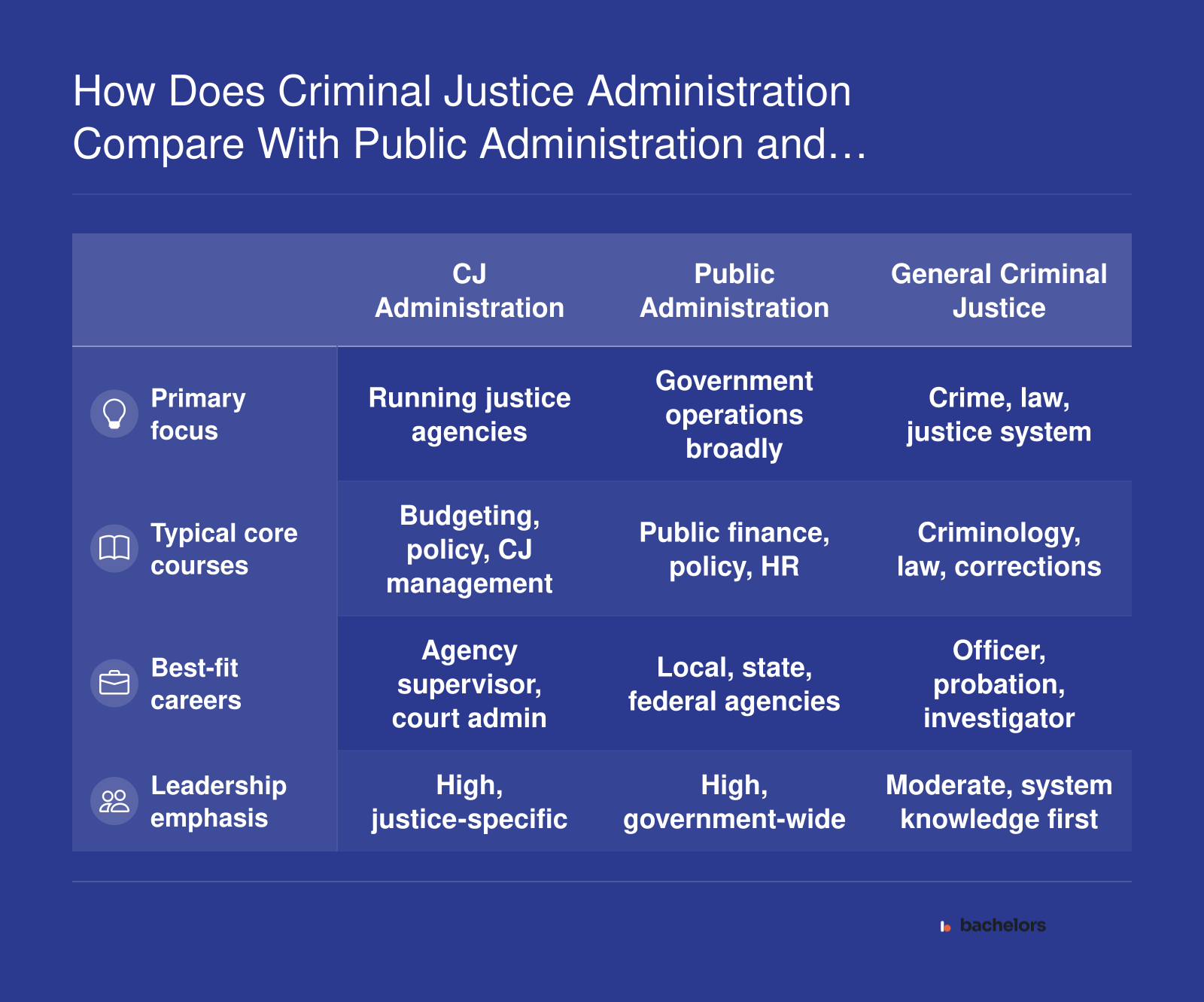
How Does Criminal Justice Administration Compare With Public Administration and General Criminal Justice?
These three bachelor's paths overlap, but each prepares you for a different kind of work. Schools do not label them consistently: the same program may carry a different title, and some colleges offer criminal justice administration only as a concentration inside a public administration degree. Read the required course list, not just the degree title, to see which path a program actually follows.
What Classes Are Required for a Criminal Justice Major?
Criminal justice majors are being rebuilt around a management core, and the required-course list now reads closer to public administration than to a detective manual.
The Courses Nearly Every Major Requires
Across the programs reviewed here, the lower-division sequence rests on the same foundation: introduction to criminal justice, criminology, criminal law and procedure, policing, corrections, research methods and statistics, and ethics. The administration core stacks on top of that, adding organizational leadership, budgeting and financial management, human resources, and policy analysis. John Jay College's criminal justice management major, for example, pairs a capstone in justice administration with a course in the administration of financial resources.
Concentrations and What They Signal
Specialization is usually optional. Purdue Global offers several concentrations but lets students finish without one, folding those courses into major or open electives.2 California State University-Stanislaus lists corrections among its concentration electives, and College of the Ozarks advertises two concentration options. Choose by target agency: corrections and reentry work reward a corrections focus, while emergency management or federal ambitions favor homeland security coursework.
Fieldwork, Practicums, and Capstones
Experiential requirements are common but not universal, so read the catalog line by line. Wilmington University's 45-credit core includes an internship.1 Albertus University requires one6, and Monroe University requires both an internship and a capstone.7 American International College lists a practicum and senior seminar3, the University of Cincinnati places all majors in a field setting4, and Missouri Valley College makes the internship concentration-dependent.5 Capstone credit varies as well: three credits at National University, where it is designed as the final major course, and six at Purdue Global2. Online students usually arrange a placement with a local agency and have a program coordinator approve it, often the experience hiring panels ask about first.
Match the required courses to the job posting you actually want, not to the brochure.
Top Program-Level Graduate Earnings in Our Rankings
Farmingdale State College has the highest program-level graduate earnings among the schools ranked here.
Does a Bachelor's Help You Get Hired or Promoted in Law Enforcement and Corrections?
The answer depends on the employer. A degree is usually the entry ticket at the federal level, often an edge at the local level, and in corrections it increasingly separates applicants who move up from those who stay put.
Federal Agencies: A Degree Is Usually the Entry Ticket
Many federal agent roles, including FBI special agent, require a bachelor's degree from an accredited institution.1 The FBI's 2026 pathway lets applicants qualify at the GL-9 level with a bachelor's plus one year of sworn law-enforcement experience, or with an advanced degree.2 Before July 6, 2026, the same roles called for two years of full-time work plus a bachelor's, or one year plus an advanced degree.2
For general federal hiring, a bachelor's satisfies GS-5 for many positions.3 A degree earned with Superior Academic Achievement, meaning a 3.0 GPA or higher on a 4.0 scale, top class standing, or honor-society membership, can reach GS-7 where the occupational series permits it.4 Series rules differ. Border Patrol and U.S. Marshals accept a bachelor's or equivalent experience at GS-55, and Park Ranger roles pair the degree with 24 semester hours of related coursework.6
State and Local Departments: An Advantage, Not Always a Requirement
Most police departments still require only a high school diploma or equivalent for entry-level patrol, so a degree is not the gate everywhere. Where it pays off is in hiring preferences, pay incentives, and promotion points. State police agencies vary widely, and many local departments attach educational stipends or advancement credit to a bachelor's. Read your target agency's contract and posting rather than assuming.
Probation and Parole: A Degree Is Often Expected
Probation and parole officer postings commonly require a bachelor's in criminal justice or a related field, sometimes with coursework in psychology or sociology.
Check the Posting Before You Pick a Concentration
Pull the current job announcement for the agency you want before you choose electives. Requirements shift from one federal series to the next and between neighboring departments, so a juvenile justice or corrections concentration may fit one posting better than another.
Criminal Justice Administration programs by state
Compare Criminal Justice Administration programs on the data that matters
Explore more Criminal Justice & Law majors or browse every field of study.
All Criminal Justice & Law programs Browse every field of study