Best Forensic Science Degree Programs
Compare 260+ accredited Forensic Science programs at 220+ colleges, with net price after aid, graduation rates, earnings and debt from IPEDS and the U.S. College Scorecard.

Forensic science is a science degree first, whether a school awards it as a Bachelor of Science (B.S.) or a Bachelor of Arts (B.A.). Crime labs hire chemists and biologists who can run instruments, document a chain of custody, and testify. Few postings ask for a TV-style "CSI" résumé.
The practical tension is cost against rigor. Net price swings by tens of thousands of dollars a year across programs, while the strongest curricula are heavy on chemistry, biology, and real lab hours.
Forensic science technicians earned a median of about $72,060 a year as of May 2025, yet openings are limited and competitive, so program quality and hands-on experience matter.
Key Points
- CUNY John Jay costs $3,203 a year net; George Washington, $36,586.
- Forensic science technicians earned a median $72,060 a year in May 2025.
- Expect 120 credits built on chemistry, biology and hands-on lab work.
Best Forensic Science Schools Ranked for 2027
The ten schools on this 2026 list share a science-first core, pairing chemistry, biology and laboratory coursework with an internship, capstone or research requirement. Nine teach on campus and one also offers a fully online route, and they stretch from New York and Massachusetts to Florida, Texas and California. Approximate average net price after aid runs from about $3,200 to roughly $33,000, and as institutions, schools offering this program graduate between 56% and 86% of their students.
Florida State University
#1Tallahassee, FL · ~$11,000/yr (est.)
Best for: Online learners targeting crime scene investigation
Florida State's forensic program sits under its Public Safety and Security umbrella and leans toward crime scene work rather than bench chemistry, with 160 hours of certified field training built into the degree. Students can add an underwater crime scene investigation certificate, a niche credential few programs offer. Graduates move into crime scene investigator, autopsy technician and death investigator roles, and a graduate certificate in law enforcement intelligence extends the pathway for those who want to keep going.
- 160 hours of certified field training built into the degree
- Underwater crime scene investigation certificate available
- Housed under Public Safety and Security
- Prepares for crime scene investigator and autopsy technician roles
- Graduate certificate in law enforcement intelligence available
Texas A&M University-College Station
#2College Station, TX · ~$21,000/yr (est.)
Best for: Research-minded students aiming at laboratory science
Texas A&M houses its forensic and investigative sciences degree in the Department of Entomology, and the science emphasis carries Forensic Science Education Programs Accreditation Commission recognition, one of two such Texas bachelor's programs. Enrollment is substantial at 269 students in 2025-2026, with 41 degrees awarded the year before, and students have access to internships with the FBI and crime laboratories. A separate pre-law emphasis serves students aiming at law school, medical school or federal investigative careers.
- Recognized by the Forensic Science Education Programs Accreditation Commission
- One of two Texas bachelor's programs with that recognition
- 269 students enrolled in 2025-2026; 41 degrees awarded in 2024-2025
- Internships with the FBI and crime laboratories
- Coursework covers molecular, organismal and ecological evidence
- Prepares students for medical, law or veterinary school
- 120 total credit hours
- Internship and research available for course credit
- Includes applied forensic entomology coursework
- Undergraduate Honors Program available
- This track is not FEPAC accredited
- Common career path: FBI special agent or law school
University of Central Florida
#3Orlando, FL · ~$10,000/yr (est.)
Best for: Florida residents pursuing biochemistry and DNA analysis
UCF's forensic science degree dates to 1974, making it the second-oldest program of its kind in the country, and it splits into chemistry and biochemistry tracks with heavy laboratory emphasis. Ties to Florida forensic practice are unusually direct: the Florida Department of Law Enforcement is moving its Orlando toxicology laboratory to UCF's Lake Nona facility, and the two co-hosted a 2025 colloquium on sexual-assault investigation. UCF also belongs to a nuclear forensics consortium funded by the National Nuclear Security Administration, an unusual route into national-security work.
- FEPAC accredited and launched in 1974, the second oldest program in the U.S.
- $212.28 per credit in state; $891.07 out of state
- Polarized light microscopy lab on site
- Chromatography and spectroscopy coursework
- 120 credits, 61 of them in the major
- Meets American Chemical Society certification requirements
- Focus on DNA and other biochemical evidence
- 2.5 cumulative GPA required in specified courses
- Capstone or research methods course required
- 30 upper-division chemistry residency hours required
- Chemistry and math placement tests required before enrolling
San Jose State University
#4San Jose, CA · ~$14,000/yr (est.)
San Jose State runs its forensic science degree through the Department of Justice Studies, offering four concentrations that each meet American Academy of Forensic Sciences forensic education standards. The biology track leans into DNA and molecular work while the crime scene track covers reconstruction, fingerprints and toolmarks, and a three-unit practical requirement can be satisfied with an internship. A four-year roadmap is published, and every major course requires a grade of C or better.
- 120 units: 49 major preparation, 41 major requirements, 23 concentration
- Genetics, forensic molecular biology and genotyping coursework
- 3 units of internship, individual study or directed reading
- Grade of C or better required in all major courses
- Forensic chemistry coursework plus an organic chemistry lab
- Fire and explosion investigation course
- 41 units of major preparation, 47 units of major requirements
- Capstone required for graduation
- Four-year degree roadmap published online
- Documentation and collection of physical evidence
- Crime scene reconstruction, fingerprint and toolmark analysis
- 34 units of major preparation, 51 units of major requirements
- Senior seminar plus a 3-unit practical with an internship option
- 2.0 GPA minimum with C or better in major courses
New Jersey Institute of Technology
#5Newark, NJ · $20,000 – $38,000/yr (est.)
NJIT's forensic science degree requires 120 credits and offers four concentrations, three of which hold Forensic Science Education Programs Accreditation Commission accreditation, with the crime scene track excluded from that approval. Every student completes a capstone through a forensic laboratory internship or co-op, faculty-mentored research, or a senior seminar. Coursework emphasizes modern instrumentation, chain of custody and courtroom testimony, and NJIT reports an average starting salary of $56,320 for graduates.
- Four concentrations: biology, chemistry, digital forensics, crime scene
- FEPAC accredits the biology, chemistry and digital forensics tracks
- Crime scene investigation concentration is not FEPAC accredited
- Capstone via lab internship, co-op, research or senior seminar
- Coursework in DNA analysis, pattern evidence and courtroom testimony
- NJIT reports an average starting salary of $56,320
CUNY John Jay College of Criminal Justice
#6New York, NY · ~$3,200/yr (est.)
John Jay is the largest producer of forensic science graduates in this group, with 160 degrees awarded in the federal data behind this list, and its curriculum is built on organic, analytical and physical chemistry. Students choose criminalistics, molecular biology or toxicology and complete a required internship, and an accelerated bachelor's-to-master's route exists for those who want to continue. The college's criminal justice focus gives forensic majors a deep bench of law and policy courses alongside their science work.
- Chemistry core: organic, analytical and physical chemistry
- Required forensic science internship
- Coursework also spans biology, physics and law
- DNA and molecular biology focus within the major
- Accelerated BS/MS in Forensic Science available
- Toxicology specialization built on a chemistry core
- Prepares graduates for forensic laboratory and research roles
George Mason University
#7Fairfax, VA · $15,000 – $20,000/yr (est.)
George Mason's forensic science bachelor's covers the full sweep of crime laboratory work, from DNA and trace evidence to firearms, questioned documents, fingerprints, arson and drug analysis. It runs an outdoor forensic excavation research and training site, and many courses are taught by practicing professionals from forensic agencies and laboratories. Graduates move into federal, state and local laboratories, homeland security and intelligence agencies, with nearby placement options in the region's federal lab network.
- Outdoor forensic excavation research and training facility
- Courses taught by faculty from forensic agencies and laboratories
- Covers DNA, trace evidence, firearms, documents and fingerprints
- Arson and drug analysis coursework included
- Internship in a professional setting
- Prepares for crime scene investigator, DNA analyst and latent print roles
- Minors available in biology, chemistry and data science
Pennsylvania State University
#8University Park, PA · ~$33,000/yr (est.)
Penn State's forensic science major is an inter-college program in the Eberly College of Science with options in forensic molecular biology and forensic chemistry. Entrance to the major is competitive: students need a 2.00 cumulative GPA, a 2.50 average across eight entrance courses and at least a C in each chemistry, math and physics prerequisite. Students may begin at any Penn State campus, and graduates work as scientists in federal, state or private laboratories or continue to advanced degrees.
- FEPAC accredited inter-college major in the Eberly College of Science
- Options in forensic molecular biology (122 credits) and chemistry (123)
- Entrance requires a 2.50 average across eight entrance courses
- C or better required in eight chemistry, math and physics courses
- Students may begin at any Penn State campus
- Prepares for scientist roles in federal, state and private labs
University of Massachusetts-Lowell
#9Lowell, MA · ~$17,000/yr (est.)
UMass Lowell awards an American Chemical Society-certified chemistry degree with a forensic science option, and the option adds no courses beyond the general chemistry track, so students use free electives for criminal justice and forensic chemistry coursework. It is the only forensic science bachelor's at a public university in Massachusetts, and undergraduates get time on electron microscopes, mass spectrometers and chromatography instruments. Forensic Science I and II and Criminalistics I and II anchor the specialization.
- American Chemical Society-certified chemistry degree
- Forensic option adds no courses beyond the general chemistry track
- Free electives carry the criminal justice and forensic chemistry courses
- Includes Forensic Science I and II and Criminalistics I and II
- Access to electron microscopy, mass spectrometry and chromatography
- Undergraduate research available
- Only forensics bachelor's at a public Massachusetts university
West Chester University of Pennsylvania
#10West Chester, PA · $20,000 – $25,000/yr (est.)
West Chester's forensic and toxicological chemistry degree combines the chemistry of physical evidence with analytical technique and professional laboratory practice, and it holds Forensic Science Education Programs Accreditation Commission accreditation. Laboratory experience comes through coursework and internships, and graduates move into forensic science laboratories, toxicology labs and analytical testing operations. The program notes that many forensic positions require thorough background checks, so applicants should plan for that early.
- FEPAC accredited curriculum
- Combines chemistry, forensic science and analytical technique
- Lab experience through coursework and internships
- Prepares for toxicology and analytical testing laboratories
- Many forensic roles require thorough background checks
- Also prepares graduates for graduate study
Cost & outcomes by school
Federal data for the highest-earning Forensic Science programs, independent of the ranking above. Earnings are this field's bachelor's graduates four years after completing where the Scorecard reports them, else the school's undergraduate median.
| School | Net price / yr | Grad rate | Earnings | Debt | Grads/yr | Format |
|---|---|---|---|---|---|---|
| Florida State University FL | $11,297 | 86% | $93,841 | $18,750 | 45 | Online or campus |
| George Washington University DC | $36,586 | 84% | $90,873 | $20,449 | — | Campus |
| New Jersey Institute of Technology NJ | $16,504 | 73% | $84,276 | $21,000 | 11 | Campus |
| Loyola University Maryland MD | $30,574 | 79% | $82,652 | $27,000 | 36 | Campus |
| Ohio Northern University OH | $24,478 | 76% | $80,928 | $27,000 | 16 | Campus |
| San Jose State University CA | $13,760 | 69% | $78,988 | $15,000 | 67 | Campus |
| Merrimack College MA | $37,927 | 70% | $75,584 | $27,000 | — | Campus |
| Saint Anselm College NH | $34,779 | 80% | $73,371 | $27,000 | 6 | Campus |
| Commonwealth University of Pennsylvania PA | $15,699 | 55% | $73,289 | $25,000 | 57 | Campus |
| Western New England University MA | $27,290 | 64% | $73,157 | $25,500 | — | Campus |
| California State University-East Bay CA | $9,320 | 48% | $71,401 | $16,544 | — | Campus |
| Saint Louis University MO | $24,398 | 80% | $70,783 | $25,000 | 20 | Campus |
Sources: U.S. Department of Education. Net price, graduation rate, earnings and debt: College Scorecard (earnings and debt for this field's bachelor's graduates where reported, else school-wide); graduates: IPEDS. A dash means no figure is reported.
Cost, debt & payoff
Median earnings of this field's bachelor's graduates (4 yrs after completing, else the school's undergraduate median) vs. their median federal loan debt · U.S. College Scorecard
Across these programs the median graduate earns about $51,836 and finishes with roughly $23,750 in debt — a ratio that clears a common rule of thumb (keep debt below first-year salary). Net price and debt vary widely school to school, so check the per-school figures in the table above before you shortlist.
How We Ranked These Bachelor's Degree Programs
The strongest forensic science programs pair a manageable price with outcomes you can verify. This ranking draws on federal College Scorecard and IPEDS data: net price, graduation and retention rates, program-level earnings and debt, and delivery format.
Program-Level vs. Institution-Wide Figures
The two kinds of numbers measure different things. Program-level figures cover graduates of this specific forensic science credential, with earnings measured one to five years after completion. Institution-wide figures cover every student at the school, and the earnings version tracks them 10 years after entry. A university's overall numbers can say little about its forensic science majors, so we kept the two apart.
Factors Considered
- Affordability: Net price, the average cost once grants and scholarships are applied, drawn from institution-wide data.
- Student outcomes: Graduation and retention rates (institution-wide), plus program-level earnings where published.
- Debt burden: Program-level debt for completers of the forensic science credential.
- Format flexibility: Whether a school offers online or hybrid delivery alongside on-campus study.
We did not assign percentage weights to these factors.
Limits of the Data
Graduation rates reflect every student at the school, not just forensic science majors. Some programs graduate too few students to publish earnings or debt, so those schools are judged on the remaining factors. Accreditation status was checked separately and is not part of the federal data.
Treat the rankings as a starting point. Confirm current tuition and lab requirements directly with each school before you apply.
What a Bachelor's Degree in Forensic Science Involves
Forensic science education keeps drifting toward chemistry and biology, and the degree titles on offer are less uniform than the label suggests. Arizona State, Quinnipiac, Bluefield, SUNY Brockport, and Indiana University Northwest each list 120 credits for the full bachelor's, which usually means four years of full-time study at about 30 credits per year. Transfer credits, summer terms, and credit by exam can shorten that path. Some programs run longer if prerequisite sequences or required extra electives push you past the minimum, as Indiana University Northwest notes for its B.S.
Core Coursework
Expect a heavy science foundation: general and organic chemistry, biology, physics, and calculus or statistics. Upper-level work then turns to analysis and casework. Quinnipiac requires Instrumental Analysis with a lab1, and Indiana University Northwest requires Principles of Chemical Instrumentation.2 Bluefield pairs Quantitative and Instrumental Analysis with Biochemistry and Inferential Statistics.3 Arizona State's biology-leaning courses include Genetics and Biochemistry, plus Fundamentals of Forensic Analysis. Loyola University Maryland requires Introduction to Criminalistics.4 Course titles vary, so check each catalog rather than assuming every school teaches the same subjects under the same names. Many programs also cover evidence handling and expert testimony.
B.S. vs. B.A.
A B.S. typically carries more laboratory and natural-science coursework, which is the preparation crime labs tend to look for. A B.A. is generally broader, often blending in criminal justice or investigation. No single national standard defines either one, and labels can mislead: Quinnipiac awards a B.S. in Forensic Studies, and Oregon State's forensic option (39 to 43 credits) sits inside a B.S. in Chemistry.7 Read the actual course list.
Experiential Differentiators
Hands-on components separate stronger programs from thinner ones. Look for:
- Internships: Bluefield includes a Forensic Science Internship3, and SUNY Brockport offers independent study or a criminal-justice internship.6
- Capstones: Ball State requires an internship or capstone.5
- Research: Undergraduate lab research builds instrument skills and gives you something concrete to discuss with employers.
Placements with crime labs or medical examiner offices carry the most weight, so ask each department where recent students have landed.
Forensic Science Degree Cost, Debt, and Earnings
CUNY John Jay College of Criminal Justice reports an average net price of $3,203 a year, while George Washington University sits at $36,586. That spread, more than ten to one, is the biggest cost variable in any forensic science bachelor's program.
Net price: in-state public wins on sticker
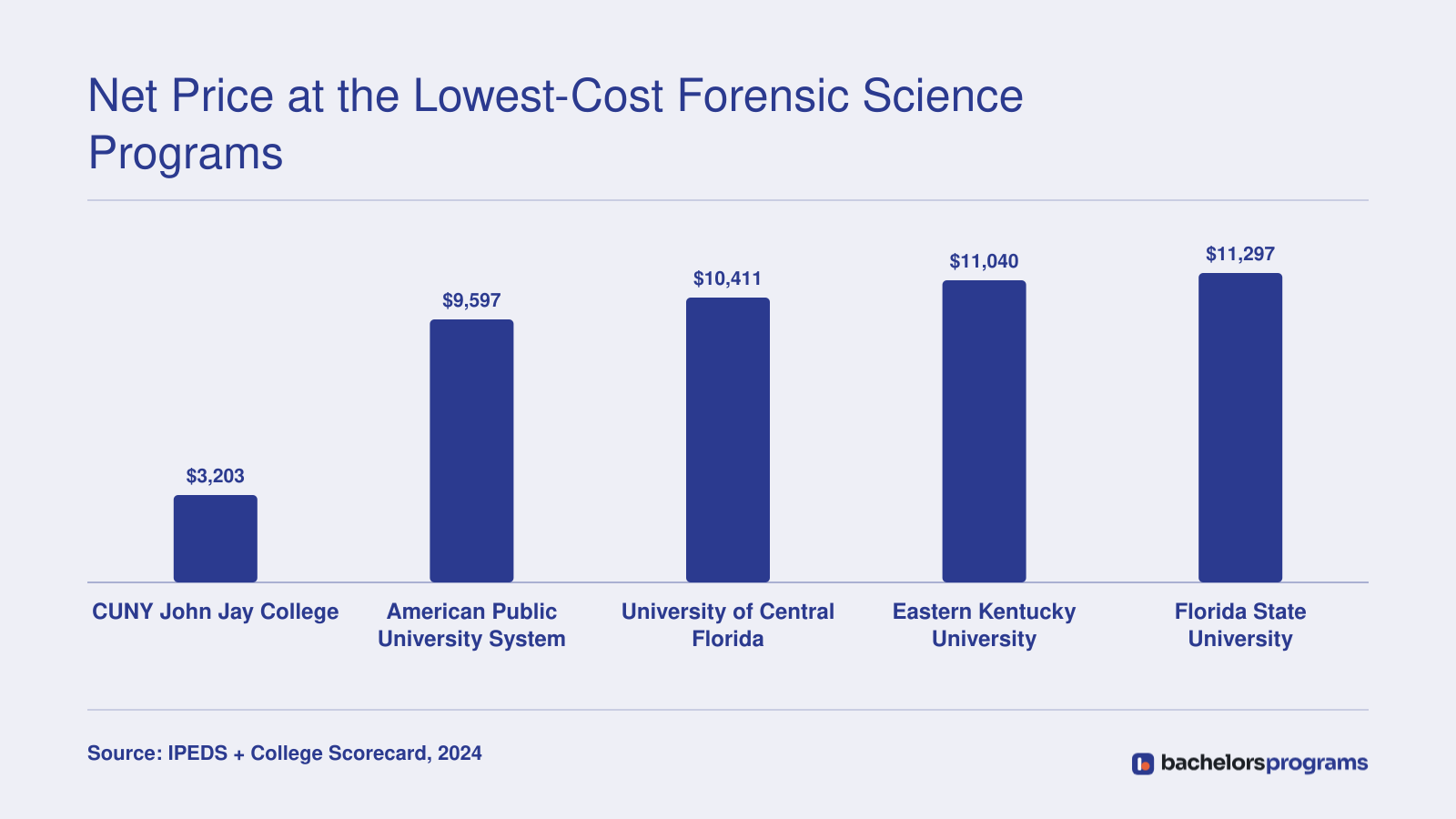
Net price is the average cost once grant and scholarship aid is applied, so it moves with family income. Lower-income students often pay less than the published average; higher-income families frequently pay more. Among the public options, the Florida schools run lean: University of Central Florida at $10,411, Florida State University at $11,297, and Florida Gulf Coast University at $12,568. San Jose State University comes in at $13,760, New Jersey Institute of Technology at $16,504, George Mason University at $17,915, and Texas A&M University-College Station at $21,315. Lewis University, a private school, lands at $17,028 after aid despite a $39,200 published tuition.
Debt, translated into a monthly payment
Median debt among forensic science completers tells you more than tuition does. At John Jay, that figure is $15,500, roughly $164 a month on a standard ten-year repayment plan. Florida State completers borrow a median $18,750 (about $199 monthly), Florida Gulf Coast $19,099 (about $202), and George Mason $23,251 (about $246).
Does it pay off?
Earnings vary widely, and the timing matters. One year after finishing the forensic science bachelor's, median earnings run $58,249 at Florida State, $44,092 at John Jay, $42,100 at George Mason, $38,792 at Texas A&M, and $28,173 at Florida Gulf Coast. Four years out, the same graduates report $93,841 at Florida State, $63,182 at George Mason, $61,633 at UCF, $60,416 at John Jay, $53,792 at Texas A&M, and $52,096 at Florida Gulf Coast.
The practical read: a $199 monthly payment against a first-year median near $58,000 is comfortable; the same payment against $28,000 is not. If you have in-state residency at a public university with a forensic program, that combination usually produces the strongest math.
Net Price at the Lowest-Cost Forensic Science Programs
Net price is the average amount students pay after grants and scholarships. It is calculated across the whole institution, not for the forensic science major alone, so treat these figures as approximate. CUNY John Jay College of Criminal Justice has the lowest net price in our data at $3,203, about $8,100 less than Florida State University's $11,297.
What Forensic Science Technicians Earn
Forensic science technicians earned a median of $34.65 per hour as of May 2025, about $72,060 a year.
Related Articles
Choosing a Specialization: Biology, Chemistry, Criminalistics, or Digital
Crime labs hire by section, and each section expects different science coursework, so pick your concentration based on the unit you want to work in, not on which electives sound interesting. If you want to run DNA cases, load up on biochemistry, genetics, and molecular biology. If toxicology or trace evidence appeals to you, build depth in chemistry, and if you lean toward digital evidence, a computer science or digital forensics track will match what hiring agencies list.
| Specialization | Key Coursework | Typical Job Titles | Employer Degree Expectations |
|---|---|---|---|
| DNA / forensic biology | Biochemistry, genetics, molecular biology, and statistics or population genetics applied to forensic DNA analysis, the coursework the FBI's Quality Assurance Standards expect of DNA analysts | Forensic Scientist III (Biology/DNA Unit) | Bachelor's or advanced degree in biology, chemistry, forensic science, or a related area |
| Toxicology / forensic chemistry | Chemistry-related coursework; North Carolina's crime laboratory guidance lists chemistry among qualifying fields | N/A | B.A., B.S., or advanced degree in biology, chemistry, forensic science, physics, or mechanical engineering |
| Trace evidence | N/A | Forensic Scientist 4, Pattern Evidence assignment (City of Philadelphia) | Bachelor's degree in a science such as chemistry, biology, or physics; certain positions require an advanced degree and specialized training |
| Firearms and toolmarks | N/A | Forensic Scientist 4, Pattern Evidence assignment (City of Philadelphia) | Bachelor's degree in a science such as chemistry, biology, or physics; certain positions require an advanced degree and specialized training |
| Crime scene investigation | Math, statistics, laboratory courses, writing, speaking, note-taking, and observation skills | Forensic Scientist 4, Crime Scene assignment (City of Philadelphia) | Usually at least a bachelor's degree in physical science, biology, or forensic science; some positions accept an associate degree |
| Digital forensics | N/A | Forensic Scientist 4, Digital Evidence assignment (City of Philadelphia) | B.A., B.S., or advanced degree in computer science, digital forensics, networking, information technology, criminal justice, or cyber technology |
| Criminalistics / general forensics | A FEPAC-accredited forensic science curriculum, which the American Academy of Forensic Sciences recommends to prospective students | N/A | Bachelor's degree at minimum; many forensic disciplines require a master's or doctorate |
Admissions, Transfer Credits, and Accelerated Master's Pathways
There is no single national standard for admission to a bachelor's degree in forensic science. Requirements vary by university and by whether you enter the major directly or through a pre-forensic track. Use this checklist to prepare.
- High school courseworkPlan on four years of English and math, three lab sciences, and solid chemistry and biology. At Arizona State University, the first college math course is MAT 210 or MAT 251.
- GPA expectationsForensic majors often expect more than general admission requires. For 2026–2027, Bowling Green State University's direct-admission track requires a weighted GPA of at least 3.75 plus chemistry readiness. Students below that threshold can enter through a pre-forensic route.
- Test scoresArcadia University's typical successful pre-forensic candidate scores about 640 in SAT reading and writing and 650 in math, or 26–27 on the ACT. Confirm each school's current testing policy.
- Transfer creditsIf you start at a community college, ask each program in writing how your chemistry, biology, and math courses will transfer before you enroll.
- Background screeningAsk whether the program or its internship sites require a criminal background check or drug screen.
- Accelerated master's optionsEmporia State's 4+1 requires 75 credit hours and a 3.33 GPA. Saint Louis University accepts applications after 75 credits. George Mason considers students after 60 credits. Le Moyne College pairs its bachelor's degree with a Syracuse master's.
Forensic Science programs by state
Frequently Asked Questions About Forensic Science Degrees
These answers cover the questions prospective students ask most about choosing a bachelor's degree in forensic science and what it leads to. Requirements vary by employer, so check the job postings of agencies you want to work for.
What are the best universities for forensic science in the USA?
How long does it take to get a forensic science degree?
Is a chemistry or biology degree better than a forensic science degree for crime lab jobs?
Can you become a crime scene investigator without a forensic science degree?
Compare Forensic Science programs on the data that matters
Explore more Criminal Justice & Law majors or browse every field of study.
All Criminal Justice & Law programs Browse every field of study