Best Early Childhood Education Schools in Maryland
Compare 8 accredited Early Childhood Education programs in Maryland at 7 colleges, with net price after aid, graduation rates, earnings and debt from IPEDS and the U.S. College Scorecard.

What does it take to become an early childhood teacher in Maryland? A bachelor's degree in early childhood education, plus a state certificate covering birth through Grade 3. Most programs award the Bachelor of Science (B.S.) in Early Childhood Education; several add dual certification in special education or elementary teaching.
Cost divides these schools most sharply. Published tuition and fees run from $7,100 at Coppin State University to $47,700 at Hood College, while average net price after aid tells a different story at the private campuses.
Admission is the second gate: education majors often require a separate application and GPA minimum after sophomore year. Districts verify the state certificate, not the diploma.
Key Points
- In-state tuition runs from $7,100 at Coppin State to $11,728 at Towson.
- Hood College's $47,700 sticker price drops to a $20,873 average net price.
- Maryland's MSDE certificate covers birth through Grade 3 and requires a bachelor's.
Best Bachelor's Degree in Early Childhood Education Programs in Maryland, Ranked
Every program below leads to a bachelor's degree in early childhood education, and several pair it with special education or elementary certification so graduates leave with two credentials instead of one. Where a school's accreditation is confirmed, the card names it, which matters because Maryland programs split between CAEP review and the newer AAQEP review. Tuition, graduation rates and delivery format sit alongside each entry so you can compare the whole picture at a glance.
Towson University
#1Towson, MD · ~$17,000/yr (est.)
Best for: Future teachers seeking dual special education certification
Towson treats early childhood as a screened major, so students apply during their fifth term and must clear the Basic Skills Assessment before coursework begins. The integrated track combines early childhood and special education preparation, with clinical placements in Maryland schools and an edTPA capstone project. The program is approved by the Maryland State Department of Education and built on NAEYC and InTASC standards.
- 3.0 GPA required to stay in the major
- Screened admission in the fifth term, classes start in the sixth
- Basic Skills Assessment must be met before entry
- 65 units of major coursework
- Integrated major pairs early childhood with special education
- Yearlong clinical placements in Maryland school classrooms
- edTPA capstone assessment project required
- Built on InTASC and NAEYC standards
Salisbury University
#2Salisbury, MD · ~$18,000/yr (est.)
Best for: Study-abroad minded education majors
Salisbury's early childhood major is accredited by AAQEP rather than CAEP, and the state approves it for pre-K through grade 3 certification. Students can add an elementary education major for dual certification, and internships run at sites that include Auckland, New Zealand. Teacher candidates join a living learning community and the Kappa Delta Pi honor society, and program graduates report median earnings in the mid $55,000s four years after entry.
- Accredited by AAQEP rather than CAEP
- MSDE-approved for pre-K through grade 3 certification
- Four-year curriculum guide maps each semester to graduation
- Add an elementary education major for dual certification
- International internship sites, including Auckland, New Zealand
- Living learning community for teacher candidates
- Kappa Delta Pi education honor society chapter
- Hosts the annual Children's Literature Festival
Frostburg State University
#3Frostburg, MD · $10,000 – $26,000/yr (est.)
Best for: Western Maryland residents avoiding a long commute
Frostburg offers a dual endorsement in early childhood and elementary education covering pre-K through sixth grade, which the university describes as one of only two such programs in Maryland. Classes run at both the Frostburg and Hagerstown locations, and fieldwork takes place in partner schools. The education program is CAEP-accredited and MSDE-approved, and graduates report median earnings around $51,000 four years after entry.
- Dual certification for prekindergarten through grade six
- University calls it one of only two such dual programs in Maryland
- Classes offered at both Frostburg and Hagerstown
- Early childhood specialization with foundations and methods coursework
- Extensive field experience in partner schools
- Student Education Association chapter on campus
- Children's Literature Center available as a resource
Hood College
#4Frederick, MD · ~$21,000/yr (est.)
Hood runs its early childhood major in four sequential phases, each with a checkpoint students must clear, ending in two internships: one in pre-K or kindergarten and one in a primary classroom. Students observe at the Onica Prall Child Development Laboratory School on campus and complete placements with Frederick County Public Schools. The program follows NAEYC and InTASC standards and is approved by the Maryland State Department of Education.
- Bachelor of Arts housed in the education department
- Four sequential phases, each with a departmental checkpoint
- Phase III requires two internships: pre-K or K, and a primary grade
- On-campus Onica Prall Child Development Laboratory School
- Built on NAEYC and InTASC standards
- Certification needs a passing Praxis II early childhood score
- Exit Folio must be rated Proficient or higher
- Internships with Frederick County Public Schools
Bowie State University
#5Bowie, MD · ~$19,000/yr (est.)
Bowie State, a historically Black university, delivers a combined early childhood and special education degree that prepares teachers for both typical and atypical learners. The 126-credit program includes a 65-hour professional core and a yearlong internship split between early childhood and special education settings, and graduates qualify for dual certification by the state. It is CAEP-accredited and MSDE-approved, and program graduates report median earnings around $61,000 four years after entry.
- 126 semester hours, including a 65-hour professional core
- Dual certification by the State of Maryland
- Yearlong internship split across ECED 401 and SPED 401
- Initial program acceptance interview required
- Yearlong internship entrance interview required
- Praxis Core exams recommended
- Summer sessions and mini-semesters encouraged
- Curriculum covers reading, science, math and social studies methods
Coppin State University
#6Baltimore, MD · $5,000 – $10,000/yr (est.)
Coppin State offers two routes: a 125-credit early childhood education degree aimed at pre-K through grade 3 teaching, and a human development track for students heading into child care administration. The teaching program is MSDE-approved, NAEYC-recognized and CAEP-accredited, with student teaching placed in Professional Development School sites around Baltimore. The university is a historically Black institution.
- 125 total credit hours to graduate
- 45 general education, 22 program and 33 core credits
- 25 credits of methods coursework and student teaching
- MSDE-approved, NAEYC-recognized and CAEP-accredited
- Preschool through third grade teaching focus
- Student teaching placed in Professional Development School sites
- C or higher required in major and prerequisite courses
- 120 total credit hours, 45 general education and 75 in the major
- Teacher concentration or administration concentration
- Prepares early learning center teachers and directors
- Prepares child care center directors and Head Start teachers
- On-site field experiences with partner organizations
Washington Adventist University
#7Takoma Park, MD · $15,000 – $20,000/yr (est.)
Washington Adventist runs its bachelor's in early childhood care and education through the School of Graduate and Professional Studies, with eight-week sessions and evening classes one night a week. The 120-credit degree is built for working adults, and the university says students can finish in as little as 12 to 18 months. Coursework ends with a mentored internship in a child care setting, and students can apply for Maryland's Child Care Career and Professional Development Fund.
- 120 credits: 52 professional education, 31 liberal studies, 38 general
- Eight-week sessions; online, face-to-face or hybrid one night a week
- University says students can finish in 12 to 18 months
- $465 per credit hour for undergraduates
- No GMAT, GRE or entrance exam required
- Mentored internship in a child care setting
- Students may apply to Maryland's child care career development fund
- Covers inclusive practices and infant through primary programming
Cost & outcomes by school
Federal data for the highest-earning Early Childhood Education programs, independent of the ranking above. Earnings are this field's bachelor's graduates four years after completing where the Scorecard reports them, else the school's undergraduate median.
| School | Net price / yr | Grad rate | Earnings | Debt | Grads/yr | Format |
|---|---|---|---|---|---|---|
| Washington Adventist University MD | $18,526 | 29% | $64,249 | $30,500 | — | Online or campus |
| Bowie State University MD | $19,298 | 38% | $60,746 | $22,985 | 67 | Campus |
| Hood College MD | $20,873 | 57% | $57,089 | $25,000 | 7 | Campus |
| Towson University MD | $17,413 | 70% | $56,254 | $17,500 | 132 | Campus |
| Coppin State University MD | $9,977 | 26% | $55,944 | $30,500 | 16 | Campus |
| Salisbury University MD | $17,743 | 68% | $55,807 | $20,500 | 130 | Campus |
| Frostburg State University MD | $16,715 | 50% | $51,478 | $19,938 | 49 | Campus |
Sources: U.S. Department of Education. Net price, graduation rate, earnings and debt: College Scorecard (earnings and debt for this field's bachelor's graduates where reported, else school-wide); graduates: IPEDS. A dash means no figure is reported.
Cost, debt & payoff
Median earnings of this field's bachelor's graduates (4 yrs after completing, else the school's undergraduate median) vs. their median federal loan debt · U.S. College Scorecard
Across these programs the median graduate earns about $56,099 and finishes with roughly $23,993 in debt — a ratio that clears a common rule of thumb (keep debt below first-year salary). Net price and debt vary widely school to school, so check the per-school figures in the table above before you shortlist.
How We Ranked Maryland Early Childhood Education Schools
College Scorecard, the U.S. Department of Education's public database, supplies most of the numbers behind this list. We paired it with each school's net price, the number of students completing early childhood programs, and accreditation status.
What the Numbers Do and Don't Show
Graduation rate and net price describe the whole institution or its sector, not the early childhood program alone. A school's overall graduation rate reflects every major on campus, and net price (tuition and fees minus typical grant aid) is an average across students. Use both as a general guide to how a school performs and what it tends to cost, then confirm program details with the school.
Earnings and debt are different. Those figures come from Scorecard data on people who completed a specific program, so they appear only where the federal government publishes them. Where they are absent, we left them out instead of estimating.
What the List Covers
- Degree level: Bachelor's programs only.
- Format: Campus and online options.
- Location: Schools based in Maryland.
Program titles vary. Some schools pair early childhood with elementary or special education, or frame the major around care and human development. Each is included on the strength of its own program page.
Online and Hybrid Bachelor's Options at Maryland Schools
Which Schools Offer Which Format
On-campus delivery is the norm here: Towson University, Salisbury University, Hood College, Bowie State University and Coppin State University all run their early childhood bachelor's face to face. Frostburg State University is also campus-based, with locations in Frostburg and Hagerstown. Washington Adventist University is the one school here listed with both campus and online delivery. Its evening classes meet one night a week in eight-week sessions.
Satellite Pathways at the Universities at Shady Grove
Towson delivers the early childhood bachelor's at the Universities at Shady Grove (USG) in Rockville. Three routes run through it:
- Towson B.S. at USG: A 24-month, two-year track for transfers holding an Early Childhood Education A.A.T., with a 3.00 GPA minimum.1 Clinical work is in person.2
- ECSE Access Pathway: Part-time, online and evening, for people already working in licensed Maryland child-care settings. Graduates are eligible for dual certification in ECE preK-3 and Special Education birth-3.
- Paraeducator Pathway: A hybrid, 36-month route for current Montgomery County Public Schools (MCPS) paraeducators, funded by MCPS and USG, with year-round minimesters and prior learning credit.3 In-person sessions are at USG Rockville.
Student Teaching for Online and Part-Time Students
Online coursework does not mean remote placements. The Towson B.S. at USG places students in MCPS classrooms, with 6 credits of student teaching and 3 of clinical experience.2 ECSE Access students complete on-the-job internships, so they keep their jobs. Paraeducator Pathway students intern at their existing MCPS worksites. Published materials do not show remote student teaching or placements outside these settings, so confirm placement rules with an advisor before you enroll.
Who Each Format Suits
- Working parents and current child-care staff: ECSE Access or Washington Adventist's evening schedule.
- MCPS support staff: the Paraeducator Pathway.
- Associate degree holders in the Rockville area: the Towson B.S. at USG.
- Recent high school graduates and career changers who can attend daytime classes: the campus programs.
Admissions Requirements for Maryland Early Childhood Education Bachelor's Programs
Transfer-ready applicants have the clearest path into a Maryland early childhood education bachelor's program, and Towson University spells out its requirements in the most detail. Policies elsewhere on this list are far harder to find.
Admission Policies by School
Each entry covers minimum GPA, test policy, and transfer or articulation rules as the schools publish them.
- Towson University: Minimum cumulative GPA of 3.00, calculated across all colleges attended.1 No program-specific SAT/ACT policy is published.1 Transfer applicants must be enrolled in an Early Childhood Education A.A.T. program at a Maryland community college, complete roughly 60 lower-level credits, and meet pre-major prerequisites. They apply to Towson first, then to the program.3
- Salisbury University: No published policy for GPA, tests, or transfer.
- Frostburg State University: No published policy for GPA, tests, or transfer.
- Hood College: No published policy for GPA, tests, or transfer.
- Bowie State University: No published policy for GPA, tests, or transfer.
- Coppin State University: No published policy for GPA, tests, or transfer.
- Washington Adventist University: No published policy for GPA, tests, or transfer.
Community College Transfer at Towson
Towson's route is built for students who start at a Maryland community college.2 The A.A.T. in Early Childhood Education is the specified starting point, and the lower-level prerequisites must be finished before the transfer. The 3.00 GPA applies to every college you have attended, so a weak first semester elsewhere still counts. Plan your community college coursework around these prerequisites, and confirm with an advisor that each course will transfer.
When a Policy Is Unpublished
A missing policy does not mean a school has no standard. It means the standard is not posted where applicants can see it. Contact the admissions office directly and ask four things: the minimum GPA expected, whether SAT or ACT scores are considered, how many transfer credits are accepted, and whether a community college articulation agreement covers early childhood coursework. Get the answers in writing, and ask again before you apply, since requirements can change from year to year.
Related Articles
Cost of an Early Childhood Education Bachelor's in Maryland
Sticker Price vs. Net Price
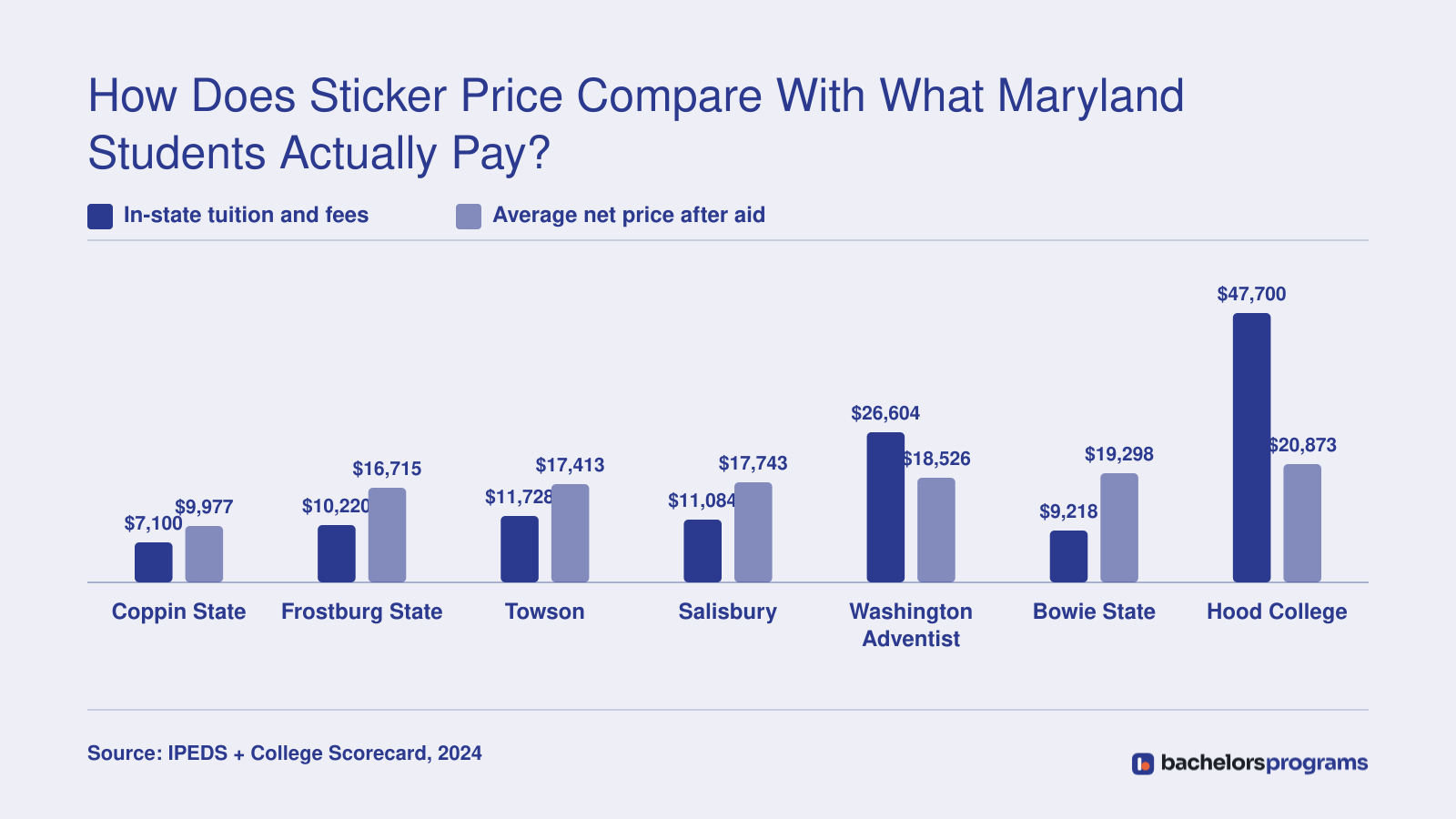
Public universities carry the lowest sticker prices. In-state tuition and fees run from $7,100 at Coppin State University to $11,728 at Towson University. Out-of-state rates run from $14,024 at Coppin to $29,820 at Towson. The private schools charge one rate for everyone: $26,604 at Washington Adventist University and $47,700 at Hood College.
Net price, the average annual cost after grants and scholarships, shows what students typically pay. Coppin State is the most affordable option here at $9,977, and the other publics land between $16,715 (Frostburg State) and $19,298 (Bowie State). Washington Adventist's net price is $18,526, and Hood's falls to $20,873, less than half its sticker price. Once aid is applied, the public-private gap narrows sharply. Treat net price as an approximate average, since your own figure depends on family income and the aid you receive.
For a reality check on borrowing, look at median debt among graduates of the program itself: $17,500 at Towson, $19,938 at Frostburg State, $20,500 at Salisbury and $30,500 at Coppin State.
Maryland Aid for Future Teachers
The Maryland Higher Education Commission's Teaching Fellows for Maryland Scholarship is the state's main teacher-pipeline award. It is open to Maryland residents in programs leading to Maryland professional teacher certification,1 and MHEC has described it as covering tuition, fees, room and board.2 The 2026-27 window opened January 15, 2026 and closed October 15, 2026.3 The award comes with conditions:
- Service: Two years teaching in a Maryland public school or public prekindergarten, in a high-needs school or shortage area.4
- Timeline: Begin Maryland employment within one year of graduating and earn professional certification within two years.4
- Repayment: Not finishing the degree means repaying the award with interest.4
The Sharon Christa McAuliffe Scholarship targets critical-shortage fields.5 Elementary education is excluded, but special education is on the list, so students in dual tracks such as Bowie State's Early Childhood/Special Education program should ask MHEC whether they qualify.
Stacking Aid and Starting Small
File the FAFSA first, then layer state awards on top of federal grants and school scholarships. Finishing general education courses at a Maryland community college can cut total cost. Confirm which credits transfer before you enroll, especially at Towson, where students apply to the major in their fifth term.
How Does Sticker Price Compare With What Maryland Students Actually Pay?
Hood College shows the widest gap among the schools ranked here: in-state tuition and fees of $47,700 against an average net price of $20,873, a difference of $26,827. At the public universities, net price often runs higher than tuition because it covers the full cost of attendance (housing, books and fees) minus grant aid. Washington Adventist University's net price of $18,526 also falls below its $26,604 sticker price. Treat each net price as an approximate average; your own figure depends on income and the aid you receive.
How to Become an Early Childhood Teacher in Maryland: Licensure Steps
Maryland teacher licensure for early childhood is a state certificate, issued by the Maryland State Department of Education (MSDE), that qualifies you to teach children from birth through Grade 3.1 A bachelor's degree is the foundation, but the certificate depends on how you complete your preparation and which assessments you pass.
The Path to Certification
1. Complete a Maryland-approved program. Finish a preparation program approved for early childhood education (birth through Grade 3). The program you choose sets your exact testing sequence. 2. Meet the assessment requirements. These generally include an approved basic-skills test (a 3.0 GPA may substitute for eligible applicants), an early childhood content assessment, and a reading instruction assessment.4 For 2026, MSDE identifies Praxis 5205 with a score of 159, with Pearson 090, 190, or 890 as alternatives.2 Since July 1, 2025, the pedagogy requirement is edTPA or PPAT, with no specific score currently required.3 3. Apply online. Submit your application through the TEACH portal with an official transcript and your Maryland-required assessment results.4 4. Receive your certificate. Most new graduates start with a Standard Professional Certificate I, valid for five years, which builds on three years of satisfactory school-related experience.5 The Resident Teacher Certificate is for employees in approved alternative or residency routes who hold a bachelor's degree or higher and complete at least 90 hours of pre-employment training.5 It is not renewable.
Why an Approved Program Matters
MSDE does not automatically accept out-of-state tests.1 It reviews each applicant under the route and requirements in effect at the time of application. Graduating from an approved program gives you the clearest, most direct route, since the program recommends you and guides your testing. Out-of-state licensed teachers may qualify for test exemptions, but MSDE decides case by case and still requires a performance-based pedagogy assessment.6
Where the Credential Leads
Certification opens roles in pre-K, kindergarten through Grade 3, child care leadership, and Head Start.
Rules change, and scores and exemptions can shift between application cycles. Confirm current requirements on the MSDE website before you test or apply.
Maryland Early Childhood Certification at a Glance
Early Childhood Education Teacher Salary and Job Outlook in Maryland
How much does an early childhood teacher earn in Maryland? The most recent Maryland-specific federal wage estimates available to us date to May 2017, so treat them as a historical reference, not a 2026 figure. BLS publishes current state and metro-area estimates, including for the Baltimore and Washington areas, and those are worth checking before you plan around a number.
Occupation Wages
- Maryland, May 2017: Preschool teachers had a median of $35,810.1 Kindergarten teachers averaged $64,830 and elementary teachers $67,340.
- National, May 2025: Preschool teachers had a median of $38,140.2 Kindergarten teachers had a median of $62,680 and elementary teachers $63,970.3
Preschool pay trails kindergarten and elementary pay by a wide margin. A bachelor's degree with Maryland certification for birth through grade 3 can open both paths.
Graduate Earnings
These are program-level results from federal College Scorecard data, not occupation wages. Four years after finishing, median earnings were about $60,746 at Bowie State University, $56,254 at Towson University, $55,944 at Coppin State University, $55,807 at Salisbury University, and $51,478 at Frostburg State University. Coppin's figure rests on very few graduates. Hood College and Washington Adventist University do not report comparable figures. Graduates may work in roles outside teaching, so these numbers do not equal teacher pay.
Job Outlook
We have no Maryland-specific projection to cite. Nationally, BLS projects preschool teacher employment to grow 4% from 2025 to 2035, adding about 26,200 jobs, with roughly 66,700 openings a year.4 Kindergarten and elementary employment is projected to be flat (0%), though about 99,400 openings a year still come from turnover and retirements.3
- Expect steady preschool demand and replacement hiring in the early grades.
- Compare Maryland district salary schedules and metro wage data before you decide.
Early Childhood Education in Maryland: Common Questions
These answers cover the questions readers ask most after comparing the schools above. Credential rules and transfer details change, so confirm specifics with the school and the Maryland State Department of Education before you enroll.
Can you get a bachelor's degree in early childhood education online in Maryland?
How much do early childhood education teachers make in Maryland?
Do you need a bachelor's degree to teach pre-K in Maryland public schools?
Can I transfer from a Maryland community college into an early childhood education bachelor's program?
How long does the degree take for part-time students?
Compare Early Childhood Education programs on the data that matters
Explore more Education & Teaching majors or browse every field of study.
All Education & Teaching programs Browse every field of study