Best Physical Education Degree Programs
Compare 520+ accredited Physical Education programs at 500+ colleges, with net price after aid, graduation rates, earnings and debt from IPEDS and the U.S. College Scorecard.

Some programs build a bachelor's degree in physical education around a teaching license, while others fold it into a broader kinesiology major with an optional teacher track. That difference decides whether you graduate eligible to teach PE in a public school. The Bachelor of Science (B.S.) in Physical Education is the common credential for future PE teachers and coaches.
The schools ranked here draw from every delivery format, and their average net price runs from $6,555 to $17,354 a year.
Cost matters, but state rules matter more. Each state sets its own exams and student-teaching hours, so a program's real value depends on where you plan to teach.
Key Points
- Rankings weigh five factors from federal College Scorecard data, including net price.
- A PE degree alone won't license you; each state sets its exams.
- Fully online licensure tracks are rare because student teaching happens in person.
Top 10 Physical Education Degree Programs for 2027
The programs at the top of this list tend to get three things right at once: a net price families can absorb, strong completion and retention, and graduates who are earning well within a year of finishing. Graduation figures on each card describe the whole university rather than the physical education major alone, and earnings figures are for the program itself, one year after students finished.
University of Georgia
#1Athens, GA · ~$14,000/yr (est.)
Best for: Future teachers wanting adapted PE experience
A large public flagship in Athens where the College of Education runs a health and physical education degree alongside long-standing partnerships with local school districts, including work observing and supporting students with disabilities in PE settings. Certification candidates spend 15 weeks teaching full time in a school classroom, and the program reports that about 80 percent of graduates move directly into teaching. Students from this program reported median earnings of $43,129 one year after finishing and $56,024 four years out.
- 52 hours of core physical education plus 9 in health education
- Leads to Georgia P-12 certification in health and physical education
- 15 weeks of full-time student teaching in a school classroom
- Adapted physical education included in the certification area
- Non-certification track swaps student teaching for 14 credit hours
- 2.5 GPA required for student teaching eligibility
- Applicants typically enter with about 60 hours completed
- About 80% of graduates begin teaching
University of Illinois Urbana-Champaign
#2Champaign, IL · ~$14,000/yr (est.)
Best for: Kinesiology majors weighing a teaching track
A large public research university whose kinesiology department houses the teacher education pathway next to exercise physiology, motor control and sport psychology. The PreK-12 track carries 48 credit hours inside a 120-hour degree, and a five-year joint BS and MPH option lets strong students share 12 senior-year credits between the two degrees. Program graduates reported median earnings of $46,897 one year after finishing.
- Teacher Education (PreK-12) is one of four concentrations in the major
- Concentration requires 48 credit hours within a 120-hour degree
- 29 hours of major coursework including HK 125, 140, 150, 154, 160, 201, 250
- Human Anatomy and Physiology I and II with labs required
- Third level of a language other than English required
- Five-year BS MPH joint degree open to kinesiology majors
- 12 senior-year credits count toward both the BS and MPH
- Graduates enter education, coaching, corporate wellness or clinical study
California State University-Fullerton
#3Fullerton, CA · $7,000 – $20,000/yr (est.)
Best for: Cost-conscious future PE teachers
An Orange County public university whose kinesiology department carries seven concentrations, including a teacher education track built into a 120-unit degree. The concentration meets part of California's subject matter preparation requirements and feeds directly into a single subject credential program, and in 2025 kinesiology students taught PE at a local junior high under faculty supervision. Graduates reported median earnings of $33,493 one year after completing and $63,798 four years out.
- 120-unit degree with a 30-unit kinesiology core
- Concentration adds 21 units, 18 required and 3 elective
- Meets part of California subject matter preparation requirements
- Feeds into a single subject credential program in physical education
- SMPP-PE students take four teaching methods electives
- C (2.0) or better required in all major courses
- 55 completed units needed before junior-standing kinesiology courses
- In 2025 students taught PE at Ladera Vista Junior High
California State Polytechnic University-Pomona
#4Pomona, CA · $10,000 – $15,000/yr (est.)
A polytechnic public university in Pomona whose kinesiology department operates a motor development clinic in Kellogg Gym that has served the campus community since 1979, giving students supervised hands-on hours. The physical education teacher education option targets middle and high school teaching and positions graduates to enter a single subject credential program, with coursework that pairs pedagogy with practical field experience. Median earnings one year after completion were $40,884.
- Prepares students to teach PE in middle and high schools
- Leads to eligibility for a single subject credential program
- Coursework pairs pedagogy with practical field experience
- Motor Development Clinic operating in Kellogg Gym since 1979
- Anooshian Motor Development Endowed Scholarship supports students
- #2 Top Public School in the West, U.S. News & World Report
- Career outcomes include physical education teacher and coach
San Jose State University
#5San Jose, CA · ~$14,000/yr (est.)
A large public university in Silicon Valley whose kinesiology department offers a teaching preparation track approved by the California Commission on Teacher Credentialing. Students cover adapted physical activity, assessment of psychomotor function and classroom management, and the department reports that majors complete 5 of the 6 adapted physical education authorization courses. A published four-year roadmap shows the full sequence before a student enrolls.
- 120-unit bachelor's degree for middle and high school PE teaching
- 19 units of preparation plus 64 units of major requirements
- CCTC-approved subject matter preparation program
- Meets subject matter competency for a single subject credential
- Degree does not guarantee admission to the credential program
- Includes 5 of the 6 Adapted Physical Education Authorization courses
- C- or better required in all major courses
- Published four-year roadmap available online
Brigham Young University
#6Provo, UT · $15,000 – $20,000/yr (est.)
A private university in Provo where the teacher education department runs a physical education teaching and coaching degree that blends K-12 methods courses with coaching coursework and a coaching internship option. Cohorts start in fall, admission runs through a February 15 application in sophomore year, and admitted students hold a 2.7 cumulative GPA. Median earnings one year after completion were $47,153.
- 56 to 59 credit hours, including 12 hours of student teaching
- Three prerequisites: nutrition, fitness for life, human development
- Professional education component adds eight courses
- Apply by February 15 of sophomore year for a fall start
- 2.7 cumulative GPA required for admission
- Grades below C in required coursework not accepted
- Prepares students for the Praxis II exam
- Meets Utah teacher licensure requirements
Florida International University
#7Miami, FL · ~$9,000/yr (est.)
A Miami public research university whose Department of Teaching and Learning runs a K-12 physical education degree alongside a sport and fitness studies track. Teacher candidates complete school-based field experiences during the program and finish with a full semester of student teaching, and the degree satisfies Florida teacher certification requirements. Graduates reported median earnings of $30,578 one year after finishing.
- BS in Physical Education, Grades K-12
- Meets Florida teacher certification requirements
- Field experiences in schools throughout the program
- One-semester student teaching experience to finish
- Second track offered in Sport and Fitness Studies
University of Wisconsin-Madison
#8Madison, WI · ~$17,000/yr (est.)
A flagship public university in Madison whose School of Education runs the physical education degree through its kinesiology department. Student teaching splits between elementary and middle or high school placements in urban, suburban and rural districts, and the Teacher Pledge covers the equivalent of in-state tuition, fees, testing and licensing costs for graduates who teach in Wisconsin schools. Median earnings one year after completion were $45,966.
- 120 credits with science, kinesiology and pedagogy coursework
- Student teaching split between elementary and secondary settings
- 6 credits each of elementary and middle or high school placement
- Declaration requires second-year standing and a 2.75 GPA
- Teacher Pledge covers in-state tuition for future Wisconsin teachers
- Minors available in Adapted Physical Education or Health Education
- Costa Rica study-abroad course offered
- Meets Wisconsin certification and licensure requirements
University of South Florida
#9Tampa, FL · ~$10,000/yr (est.)
A public research university in Tampa whose physical education degree is a 72-credit-hour, full-time hybrid program blending coursework with school-based field experiences each semester. Students get clinical hours in local schools and in the university's on-campus homeschool PE program, and the degree embeds ESOL and Reading endorsements alongside Florida K-12 certification. Median earnings one year after completion were $47,698.
- 72-credit-hour hybrid program based on the Tampa campus
- Full-time study blending coursework with field experience
- Full-semester internship in local schools
- Students teach in an on-campus homeschool PE program
- Embedded ESOL and Reading endorsements
- Prepares for Florida K-12 teacher certification
- Career paths include PE teacher, coach and wellness educator
University of Central Florida
#10Orlando, FL · ~$10,000/yr (est.)
One of the largest public universities in the country, with a state-approved initial teacher preparation program that lets students specialize in physical education. The 120-hour degree stacks 18 credits of core requirements and 12 credits of education core with 31 credits of specialization and two internships, and the final gate is passing all sections of the Florida Teacher Certification Examination. Median earnings one year after completion were $33,471.
- State-approved initial teacher preparation program
- 120 credit hours: 18 core, 12 education core, 31 specialization
- Two internships of 6 and 12 credits
- 2.5 GPA in major, education core and specialization to graduate
- Must pass all sections of the Florida Teacher Certification Examination
- General education and prerequisites finished before admission
- Two years of high school or one year of college foreign language
- In-state tuition $212.28 per credit, out-of-state $891.07
Cost & outcomes by school
Federal data for the highest-earning Physical Education programs, independent of the ranking above. Earnings are this field's bachelor's graduates four years after completing where the Scorecard reports them, else the school's undergraduate median.
| School | Net price / yr | Grad rate | Earnings | Debt | Grads/yr | Format |
|---|---|---|---|---|---|---|
| Manhattan University NY | $27,256 | 64% | $86,316 | $26,000 | 7 | Campus |
| California State University-Sacramento CA | $9,338 | 56% | $82,062 | $15,000 | 25 | Campus |
| CUNY Brooklyn College NY | $3,103 | 54% | $80,207 | $13,857 | 69 | Campus |
| San Jose State University CA | $13,760 | 69% | $78,988 | $15,000 | — | Campus |
| CUNY Queens College NY | $4,195 | 53% | $76,925 | $15,178 | 120 | Campus |
| University of Louisville KY | $17,988 | 61% | $74,873 | $18,750 | 172 | Campus |
| Citadel Military College of South Carolina SC | $20,723 | 75% | $72,085 | $21,096 | 1 | Campus |
| California State Polytechnic University-Pomona CA | $11,531 | 68% | $71,902 | $21,250 | 51 | Campus |
| Adelphi University NY | $30,783 | 67% | $70,416 | $21,500 | 58 | Campus |
| San Francisco State University CA | $12,278 | 50% | $68,077 | $15,371 | — | Campus |
| Monmouth University NJ | $30,988 | 72% | $67,991 | $27,000 | — | Campus |
| Ramapo College of New Jersey NJ | $18,173 | 70% | $67,541 | $21,000 | — | Campus |
Sources: U.S. Department of Education. Net price, graduation rate, earnings and debt: College Scorecard (earnings and debt for this field's bachelor's graduates where reported, else school-wide); graduates: IPEDS. A dash means no figure is reported.
Cost, debt & payoff
Median earnings of this field's bachelor's graduates (4 yrs after completing, else the school's undergraduate median) vs. their median federal loan debt · U.S. College Scorecard
Across these programs the median graduate earns about $50,331 and finishes with roughly $23,750 in debt — a ratio that clears a common rule of thumb (keep debt below first-year salary). Net price and debt vary widely school to school, so check the per-school figures in the table above before you shortlist.
How We Ranked These Bachelor's Programs
Families comparing teacher-prep degrees now weigh what a program costs against what its graduates earn, not reputation alone. The ranking below follows that logic. It scores each bachelor's degree in physical education on five factors, using federal College Scorecard data and each school's published program format.
The Five Factors
- Cost: Average net price, or what a student typically pays once grants and scholarships are applied to the sticker price.
- Completion: How many students finish their degree, a practical signal of advising and support.
- Earnings: What graduates earn early in their careers and roughly a decade after enrolling.
- Selectivity: Admission rate, which tells you how competitive entry is and what kind of peer group to expect.
- Delivery format: Whether the program runs on campus, online or in a hybrid model. Every format was eligible.
What the Data Measures
Some figures describe the whole school and some describe the physical education program itself. Graduation rate, net price, 10-year earnings and median debt are institution-wide, so they reflect every student at that college. Early-career earnings and debt for program completers are specific to physical education wherever the Department of Education publishes them. Smaller programs often have no published program-level figures, and those schools were compared on the data that does exist.
Net price is a campus-wide average, not a quote for your family. Your cost depends on income, residency and aid. Check each school's net price calculator before ruling a program in or out.
What the Ranking Does Not Capture
Federal data can't measure the quality of student-teaching placements, the strength of partnerships with local school districts or how well a program prepares you for your state's licensure requirements. Those factors matter a great deal for future PE teachers. The licensure path section explains what to ask each program about them.
What a Bachelor's Degree in Physical Education Involves
A physical education bachelor's is a teacher-preparation credential first and a movement-science degree second; the coursework follows that order of priorities.
Coursework Centers on Teaching, Not Just Sport
Classes cover motor development, anatomy and physiology, biomechanics, PE pedagogy, adapted physical education, and health education. The science courses explain how bodies move; pedagogy and adapted PE explain how to teach movement to students of different abilities, including students with disabilities. Introductory education courses and athletic-injury care typically sit alongside the major, though the exact mix varies by institution.
Field Experience and Student Teaching
Licensure-track programs thread field experiences through the upper years, moving from classroom observation to supervised small-group teaching, and end with a full-semester student-teaching placement under a cooperating teacher. That final semester is not optional. It is the capstone a state licensure file depends on.
How Long It Takes
Plan on roughly 120 to 128 semester credits and four years of full-time study, at about 15 to 16 credits per semester. The University of Wyoming requires 120 credits, 48 of them upper division1, and Wayne State University's pathway totals 1242. Students lose time when a late major declaration pushes methods courses into a fifth year, or when a student-teaching slot opens only after specific prerequisites clear.
Transferring Credits and Associate Degrees
Community college entrants often arrive with an associate degree or about 60 transferable credits, but a degree does not automatically map every course onto the licensure curriculum. SUNY Cortland caps two-year college credit at 643, while Illinois State University recommends an AA or AS, accepts up to 70 community college credits, and expects a 2.4 GPA4. Wayne State's Henry Ford College pathway pairs 60 transfer credits with 64 university credits at a 2.5 GPA2, and Wichita State University asks transfer students with 24 or more prior credits to hold a 2.00 GPA before entering teacher education5. Wyoming waives its general education requirements for AA, AS, AB, and ADN holders but not the program's PE courses1. PE methods and professional education courses usually have to be completed at the degree-granting school, because they carry the supervised field hours a state approves.
PE, Kinesiology, and Exercise Science Are Different Degrees
Physical education prepares licensed school teachers. Kinesiology and exercise science are broader movement-science degrees that lead toward clinical rehabilitation, strength and conditioning, fitness, or graduate study rather than a teaching license.
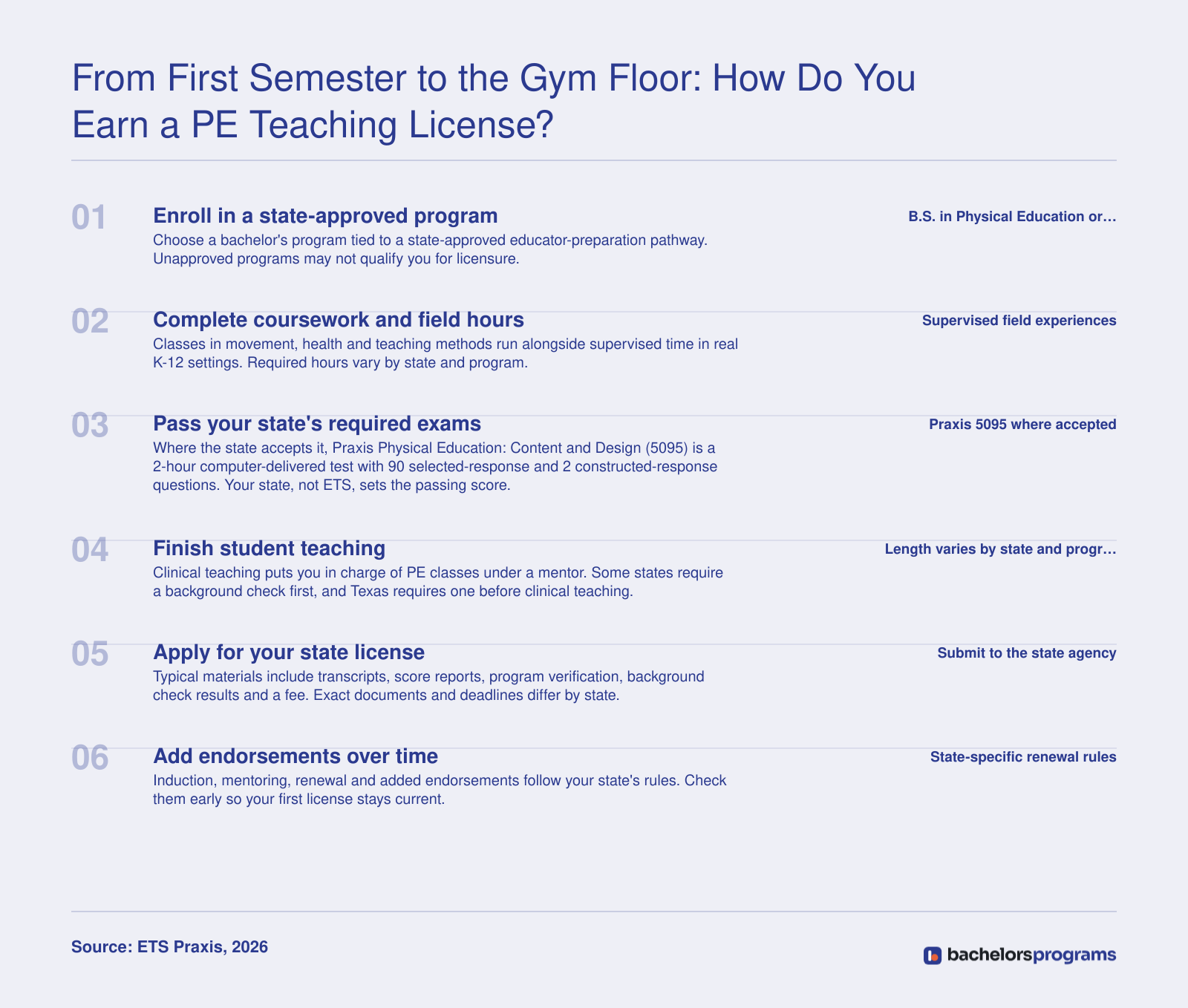
From First Semester to the Gym Floor: How Do You Earn a PE Teaching License?
A bachelor's degree in physical education is the foundation, but the degree alone does not give you a license to teach. Each state sets its own exams, field-experience rules and application process, so confirm every step with your state's licensing agency before you plan your timeline.
Highest Early-Career Earnings Among Ranked PE Programs
Early pay varies widely among the physical education programs ranked here.
Related Articles
Online vs. Campus Physical Education Programs
Fully online physical education teacher-prep bachelor's degrees are rare, because licensure tracks require in-person field hours and student teaching. Several of the schools here list Online or Both formats, but many "online" PE degrees are either non-licensure (wellness or coaching focused) or hybrid with a local placement. Confirm licensure status and placement rules with each school before you apply.
| Factor | Fully Online | Hybrid or Blended | Campus-Based |
|---|---|---|---|
| Coursework delivery | All classes online. Arizona State University and Mayville State University describe 100% online delivery. | Mix of online and campus sessions. Grand Valley State University requires more than one campus visit per semester in its hybrid option. George Mason University blends synchronous and asynchronous online work with face-to-face classes. | Mostly or entirely in person, with some online flexibility. The University of West Georgia is mostly face-to-face. |
| Student-teaching arrangement | Still involves in-person field work and a teaching semester. Whether you can student teach near home varies, so ask each school. | Clinical placements and a full-semester internship in local schools, as at the University of South Florida. George Mason's student teaching is a 12-credit course. | Placements in partner public schools, usually arranged through the program and supervised by faculty. |
| Licensure eligibility | Possible, but tied to the approving state. Arizona State points to an Arizona recommendation and Mayville to North Dakota certification. Check whether your state accepts it. | Typically leads to licensure in the school's state, such as Florida (USF) or Virginia-area pathways with set exam and GPA requirements. | Usually leads to licensure in the school's state, with state exams and field requirements built into the degree. |
| Pacing and flexibility | Most flexible for working adults, though field hours still need daytime school access. | Moderate flexibility. Campus visits and placements set part of your schedule. | Least flexible. Fixed class times and a full-time student-teaching semester. |
| Best-fit student | Career changers or place-bound students who can arrange school access, or those seeking a non-licensure wellness or coaching degree. | Students living near campus who want some online convenience. | Traditional students who want in-person labs, peer cohorts, and school partnerships. |
| Typical availability | Limited. Salem University offers online or blended options, but its licensure route is not clearly established, so verify before enrolling. | More common among licensure-track programs that need local school placements. | Most common format for PE teacher preparation. |
What Licensed PE Teachers Earn Nationally
Physical Education programs by state
Physical Education Degree FAQs
What is the best degree for a physical education teacher?
Do you need a bachelor's degree to teach physical education?
Can I become a PE teacher if my bachelor's degree is in another field?
Can I add a health education endorsement to a PE license?
Compare Physical Education programs on the data that matters
Explore more Education & Teaching majors or browse every field of study.
All Education & Teaching programs Browse every field of study