Best Science Education Degree Programs
Compare 1,500+ accredited Science programs at 1,050+ colleges, with net price after aid, graduation rates, earnings and debt from IPEDS and the U.S. College Scorecard.

Science teaching is licensed by states, not by a national board, so a bachelor's degree in science education has to meet one state's requirements from the first semester.
Programs reach a grades 7-12 license two ways: a dedicated science education major, or a science major plus an education sequence and a student-teaching semester. That structural choice moves the timeline and the bill as much as tuition does.
Average net price after aid at the schools ranked here runs from about $6,500 to $16,700 a year. Choosing on sticker price alone can add a fifth year, and a fifth year usually costs more than the savings.
Key Points
- The ranking weighs net price, completion rates and graduate earnings, not prestige.
- Budget for an unpaid student-teaching semester on top of net price.
- No national science license exists; each state sets grades 7-12 requirements.
Top 10 Schools for a Bachelor's Degree in Science Education
The ten schools below form our 2026 ranking of the best bachelor's degree in science education programs, drawn from a pool that included every delivery format, so campus, online and hybrid options were all eligible. Each card names the format, the average net price after aid, the share of students who graduate, and the specific science program the school lists. The factors behind the order, including how heavily on-time completion and net price weigh, are set out in the methodology section below.
University of California-Los Angeles
#1Los Angeles, CA · $13,000/yr (est. net price)
Best for: Future teachers drawn to urban K-12 partnerships
UCLA runs one of the country's broadest K-12 partnership networks, including the UCLA Lab School and community schools it operates with Los Angeles Unified, which gives science majors direct exposure to classroom practice. The anthropology B.S. pairs cultural coursework with physical science, life science, math and statistics, and it is a common route into medicine, forensic science and scientific anthropology. Every major course must be taken for a letter grade, and students maintain at least a 2.0 grade-point average.
- 36 upper-division units across nine courses
- One course from each anthropology subfield
- Physical science, life science, math and statistics required
- Two sociocultural anthropology courses required
- 2.0 GPA minimum, all major courses for letter grades
- Prepares for medicine, forensic science and scientific anthropology
University of California-San Diego
#2La Jolla, CA · $10,000 – $15,000/yr (est.)
Best for: Bioinformatics-bound biology majors
UC San Diego's School of Biological Sciences awards a wide family of biology degrees, from general and human biology to microbiology, neurobiology and ecology, behavior and evolution, so students can specialize without leaving the division. Bioinformatics appears both as a specialization of the biology B.S. and as a separate bachelor's degree under chemistry and biochemistry, a fit for students who want computation folded into life science. Both appear in the 2026-27 undergraduate catalog as Bachelor of Science programs.
- Bachelor of Science with a named bioinformatics specialization
- Housed in the School of Biological Sciences
- Bioinformatics also stands alone as a chemistry and biochemistry B.S.
- Specialization also available inside bioengineering and computer science
- Bachelor of Science from the School of Biological Sciences
- Environmental Systems concentration option
- Listed in the 2026-27 undergraduate catalog
- One of six biology B.S. tracks in the division
University of California-Irvine
#3Irvine, CA · $14,000/yr (est. net price)
Best for: Pre-med students who want a biology minor
UC Irvine lists its biological sciences degree as a B.S. and repeats it under both a health and medicine heading and a pre-med interest area, which reflects how many students use the major as a route into clinical programs. A biological sciences minor is available alongside the major. Graduates of the program reported median earnings of $56,003 one year after finishing, with 95 percent employed or continuing their education at that point.
- Bachelor of Science in Biological Sciences
- Also available as a minor
- Grouped under a health and medicine focus area
- Listed in the pre-med interest area
University of Michigan
#4Ann Arbor, MI · $18,000 – $61,000/yr (est.)
Michigan's Bachelor of Science is awarded by the College of Literature, Science, and the Arts and is built for breadth: 60 credits in the physical and natural sciences or mathematics, with majors running 24 to 48 credits. Students complete first-year and upper-level writing, a race and ethnicity course, quantitative reasoning, and fourth-term proficiency in a language other than English, with more than 30 languages accepted. Thirty credits outside the major spread across natural sciences, social sciences, humanities and creative expression, and a minor can be added.
- 120 total credit hours
- 2.0 GPA minimum to graduate
- 60 credits in physical and natural sciences and math
- Majors run 24 to 48 credits
- Fourth-term language proficiency required
- 30 credits outside the major
- Over 30 languages meet the language requirement
- Minor may be added to the degree
Vanderbilt University
#5Nashville, TN · ~$16,000/yr (est.)
Vanderbilt's engineering science B.S. is an interdisciplinary degree built around a 24-hour, adviser-approved concentration, and one of the defined concentration areas is secondary education, which makes it a rare engineering pathway with an explicit classroom-teaching thread. Students complete engineering fundamentals and a five-hour senior capstone sequence, and SAT or ACT scores are optional for applicants. The program has not sought accreditation, so graduates do not qualify for engineering licensure in most states.
- 122 total credit hours
- 24-hour concentration, adviser approved
- Concentration areas include secondary education
- Engineering fundamentals plus a 5-hour senior capstone
- Test optional, $50 application fee
- Program has not sought accreditation, limiting licensure
- Business coursework capped at 24 credits
Florida State University
#6Tallahassee, FL · ~$11,000/yr (est.)
Florida State runs computational science through a stand-alone Department of Scientific Computing, and the 54-hour major covers symbolic and numerical computation, applied linear algebra and computational methods, plus three seminars and a three-hour practicum. Students add 18 hours of electives and 26 collateral hours in calculus, programming and two laboratory sciences. Graduates reported median earnings of $50,610 one year after finishing and $57,287 four years out.
- 120 total credit hours
- 54 hours of major coursework
- Three seminars and a 3-hour practicum
- 26 collateral hours in calculus, programming and lab science
- 18 hours of electives
- C minus or better required in every course
- At least 30 of the final 45 upper-division hours in residence
University of Florida
#7Gainesville, FL · ~$7,000/yr (est.)
Florida's environmental science B.S. is a campus-wide interdisciplinary degree in the School of Natural Resources and Environment, drawing on ecology, soil and earth science, hydrology, natural resource management, and environmental policy and law. Students clear 30 to 36 critical-tracking credits and 41 to 47 core credits before the capstone in critical thinking in environmental science, plus at least 28 approved elective credits, holding a 2.5 GPA in tracking courses. Graduates reported median earnings of $47,572 one year after finishing, and about half continue to graduate or professional school.
- 120 total credit hours
- Capstone course EVS 4021 required in year four
- 2.5 GPA across critical-tracking courses
- 41 to 47 core credits plus 28 elective credits
- BA and BS degree options
- Combination BS plus MS in interdisciplinary ecology
- Pre-health track for BS students
California Polytechnic State University-San Luis Obispo
#8San Luis Obispo, CA · ~$17,000/yr (est.)
Cal Poly's biological sciences B.S. is a 120-unit program heavy on laboratory and field work, with a two-unit senior project and four paths: a general biology curriculum plus anatomy and physiology, ecology and conservation, or molecular and cellular biology. The department builds coursework toward a teaching credential and toward professional certification, which suits students aiming at a single-subject science credential. Graduates reported median earnings of $76,020 five years after finishing.
- 120 total credit hours, 34 in the major
- 2.0 GPA minimum to graduate
- Two-unit senior project required
- Four concentration paths including molecular and cellular biology
- Coursework built toward a teaching credential
- 40 upper-division units required
- Max 12 internship units count toward the degree
- No double major with microbiology or marine science
University of Illinois Urbana-Champaign
#9Champaign, IL · ~$14,000/yr (est.)
Chemistry at Illinois is an ACS-certified B.S. in the College of Liberal Arts and Sciences that combines classwork with laboratory learning, undergraduate research placements and internships with companies. A second track, the Chemistry BSLAS, carries fewer technical requirements and is often paired with preparation for the health sciences. The program reports 90 percent of graduates employed or in continuing education and a 72 percent four-year graduation rate.
- ACS-certified B.S. in Chemistry
- Chemistry BSLAS track for health sciences
- Research labs and internships with companies
- 72% finish within four years
- 90% employed or continuing education
- Calculus recommended when the high school offers it
- Students average 4.0 years to the degree
Florida International University
#10Miami, FL · ~$9,000/yr (est.)
FIU's biological sciences department awards a 120-credit B.S. with tracks in biotechnology, forensic biomolecular biology, quantifying biology in the classroom, and honors, along with pre-health advising. The department also offers a Biology Education major through FIU Teach, a direct route for students who already know they want to teach. Chemistry is ACS-certified, and the catalog notes that it prepares secondary science teachers as well as students heading into industry or graduate study.
- 120 total credit hours over four years full time
- Tracks in biotechnology and forensic biomolecular biology
- Quantifying Biology in the Classroom track
- Honors track available
- Pre-health curricula and advising
- Biology Education major offered through FIU Teach
- ACS-certified B.S. in Chemistry
- 120 total credit hours
- Prepares students for secondary science teaching
- Focus areas include drug discovery and medicine
- Laboratory techniques for chemical analysis
- Path into food chemistry and materials work
- 120 total credit hours
- Coursework in biomechanics, exercise physiology and sport psychology
- Prepares for NCCA-recognized certifying exams
- Housed in the College of Arts, Sciences, and Education
Cost & outcomes by school
Federal data for the highest-earning Science programs, independent of the ranking above. Earnings are this field's bachelor's graduates four years after completing where the Scorecard reports them, else the school's undergraduate median.
| School | Net price / yr | Grad rate | Earnings | Debt | Grads/yr | Format |
|---|---|---|---|---|---|---|
| Boston College MA | $41,704 | 91% | $103,937 | $19,000 | 7 | Campus |
| Villanova University PA | $43,756 | 92% | $100,423 | $25,874 | — | Campus |
| University of Notre Dame IN | $26,780 | 95% | $99,980 | $19,000 | — | Campus |
| Vanderbilt University TN | $15,846 | 94% | $91,565 | $14,000 | 4 | Campus |
| California Polytechnic State University-San Luis Obispo CA | $16,665 | 86% | $90,768 | $18,500 | — | Campus |
| Northwestern University IL | $29,167 | 95% | $89,363 | $15,000 | 6 | Online or campus |
| Johns Hopkins University MD | $18,809 | 94% | $87,555 | $10,250 | — | Campus |
| University of Virginia VA | $21,565 | 96% | $86,863 | $17,500 | — | Campus |
| Washington University in St Louis MO | $21,786 | 94% | $86,182 | $17,500 | — | Campus |
| University of California-San Diego CA | $12,470 | 86% | $84,943 | $15,500 | 13 | Campus |
| University of Michigan MI | $13,138 | 93% | $83,648 | $19,500 | 13 | Campus |
| University of Maryland-College Park MD | $15,678 | 89% | $82,860 | $19,000 | 18 | Campus |
Sources: U.S. Department of Education. Net price, graduation rate, earnings and debt: College Scorecard (earnings and debt for this field's bachelor's graduates where reported, else school-wide); graduates: IPEDS. A dash means no figure is reported.
Cost, debt & payoff
Median earnings of this field's bachelor's graduates (4 yrs after completing, else the school's undergraduate median) vs. their median federal loan debt · U.S. College Scorecard
Across these programs the median graduate earns about $51,747 and finishes with roughly $23,750 in debt — a ratio that clears a common rule of thumb (keep debt below first-year salary). Net price and debt vary widely school to school, so check the per-school figures in the table above before you shortlist.
How We Ranked These Science Education Schools
Prestige lists reward reputation. This ranking rewards what a future science teacher can use: what the degree costs, whether students finish, and how graduates fare afterward.
What Goes Into the Ranking
- Net price: What students actually pay once grants and scholarships are counted, not the sticker tuition.
- Graduation and retention: How many students return after their first year and how many go on to finish a degree.
- Earnings and debt: Median earnings and median federal loan debt for graduates of the program itself, drawn from the U.S. Department of Education's College Scorecard.
- Completions: How many students finish the science education program each year.
Completions matter for a practical reason. A program that graduates a steady stream of science teachers usually has working relationships with nearby school districts. That tends to mean established student-teaching placements and mentor teachers who already know what the program expects.
Where the Data Falls Short
Net price and graduation rates are school-wide averages. They describe the whole institution, not the education department, so a science education major's experience may differ from the campus figure. Earnings are medians, and some smaller programs do not publish them at all because too few graduates are counted to report safely. A missing earnings figure usually reflects a small graduating class rather than weak results.
What the Ranking Cannot Tell You
No measure here captures classroom teaching quality or licensure exam pass rates. Those depend on faculty, placements and your own preparation. Before you apply anywhere, confirm that the program is approved by the education agency in the state where you plan to teach. The certification section explains how to verify a program's approval and what a grades 7-12 license requires.
Science Education Degree Cost: Net Price, Debt and the Hidden Student-Teaching Semester
The cost of a bachelor's degree in science education has three layers: the published tuition, the net price after grants and scholarships, and the unpaid student-teaching semester that many programs require. The middle layer, net price, is the number families should use.
Sticker Price vs. Net Price
Among the public schools ranked here, average net price is about $9,784. The private nonprofit option posts $6,100, below that public average. The full spread runs from $6,100 at College of the Ozarks to $12,470 at UC San Diego. Published tuition can look far higher than the bill most students pay. UC San Diego lists $15,788 for in-state students and $47,676 for out-of-state students, yet its net price is $12,470. The University of Florida charges $6,381 for in-state students and $28,659 for out-of-state students, with a net price of $6,541. Net price reflects grants and scholarships, and it can shift with your family income and aid package, but it is still the better starting point than the sticker price.
The Semester That Pays Nothing
Most traditional teacher-preparation programs require a full-time student-teaching semester near the end of the degree. It is usually unpaid. You may still owe tuition and fees, and the schedule can make even part-time work difficult, so the semester carries a cost that never appears on the tuition bill. Paid residencies and district stipends exist in some places, but the amounts, eligibility rules and payment timing vary. Ask the program directly whether student teachers receive pay and whether outside employment is allowed during the placement.
TEACH Grant: $4,000 With a Service Commitment
The federal TEACH Grant can offset part of the cost, but it comes with a commitment. For 2026-27 it awards up to $4,000 a year for full-time enrollment, $3,000 at three-quarter time and $2,000 at half time. You sign an Agreement to Serve or Repay before each award.1 The obligation is to teach at least four years full-time in a high-need field at a low-income school within eight years of leaving the program, with annual documentation.1 Fail to complete or document that service, and all TEACH Grants received convert to Direct Unsubsidized Loans, with interest accruing from each disbursement date.1 Awards first disbursed from October 2020 through September 2026 were reduced by 5.7%, to $3,772; confirm the current amount with the financial aid office.1 Some states add loan forgiveness or service scholarships for STEM teachers; terms change yearly, so check what is active for 2026.
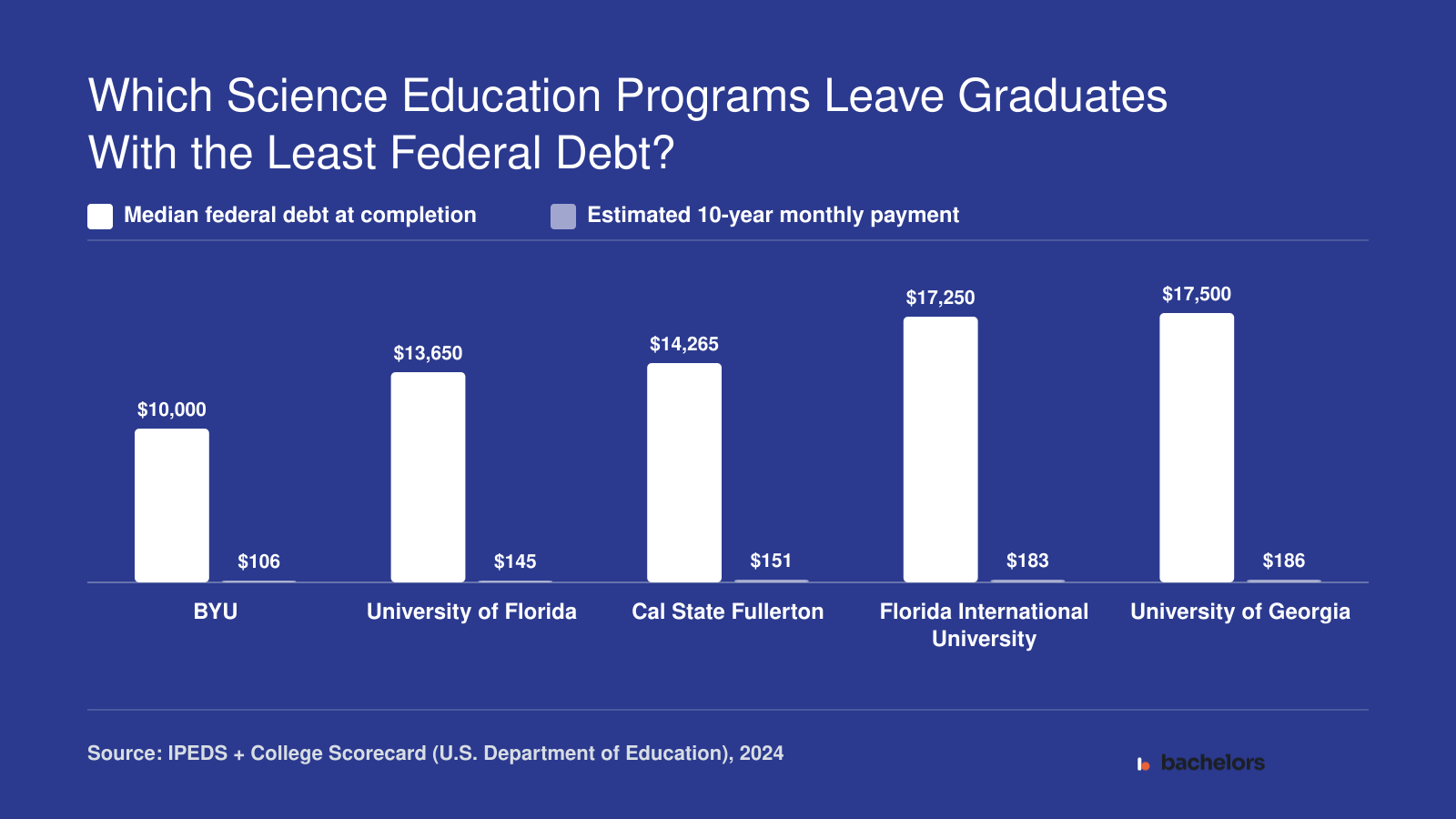
Which Science Education Programs Leave Graduates With the Least Federal Debt?
These figures are program-level medians: the typical federal loan balance held by graduates of each school's science teacher education program at completion, not a campuswide average. The second bar shows the estimated monthly payment on a standard 10-year repayment plan. Brigham Young University posts the lowest median debt here at $10,000, or about $106 a month.
Related Articles
Can You Earn an Online Science Education Degree?
An online bachelor's degree in science education is a teacher-preparation program you can complete mostly from home, but it is not a classroom-free shortcut. Every program in this ranking is listed as campus-based, not online or hybrid, but accredited online and hybrid routes exist. What changes online is where you take general education and methods courses, not whether you ever stand in front of students.
What Still Happens in Person
Lab science is the first limit. Physics education programs at Western Governors University, for example, combine virtual labs with a home kit containing equipment, specimens, and chemicals ordered when a course begins.1 Other biology and chemistry labs may use different formats, so ask for the lab list before enrolling. Student teaching is the second limit, and it happens in a real classroom, typically near where you live. WGU's licensure programs require in-classroom observation, preclinical observation and lesson teaching, and a supervised student-teaching placement of 12 to 20 weeks with a host teacher and university supervisor.2 Students must be 18 or older3 before applying or entering clinical work, and a criminal background check is required before the classroom portion.
Fort Hays State University offers a CAEP-accredited secondary education bachelor's online or on campus, with field experiences and a required student-teaching semester.4 Confirm directly that the online route includes your science subject and how its labs run.
The Out-of-State Check
If you live in a different state from the school, verify two things in writing: that the program is approved to place student teachers in your state, and that the degree leads to the license you want there. WGU states that its science education degrees lead to licensure, but eligibility and grade levels vary by state.3 State authorization and licensure are separate approvals. Ask whether placements are arranged near you, whether your state requires extra coursework or tests, and which science subjects and grade bands the license covers. Get those answers before you enroll, not after you have committed.
Science Teacher Certification: From Degree to Grades 7-12 License
A degree alone does not make you a teacher, and a license alone does not make you a scientist. The path to a grades 7-12 classroom needs both, and no single national science license exists.1 Each state sets its own endorsement titles, exams, coursework and clinical requirements.
The Standard Path
Most states follow a similar sequence for an initial secondary science license:
- Approved preparation: Complete a state-approved educator preparation program, usually built into your bachelor's degree.
- Student teaching: Finish supervised clinical practice. One full semester is a common pattern, but states and programs define the length differently.
- Exams: Pass a content exam, plus a pedagogy exam where your state requires one.
- Background check: Clear fingerprinting and a background review, then submit your application.
Common Exams
Many states use Praxis content tests in Biology, Chemistry, Physics, Earth and Space Sciences, or General Science.1 Others use state-specific tests, and some accept an approved degree or coursework instead. Colorado, for example, lets candidates show content knowledge through a degree, an approved assessment, or 24 semester hours of specified coursework.2 Passing scores are set by each state's licensing agency, not by ETS, so a score that works in one state, field or level may not count in another.3 Praxis Middle School Science should not be assumed to qualify you for grades 7-12.1 Check your state's exact endorsement page before registering.
B.A. vs. B.S.
A B.S. usually carries more lab science credits, which can make it easier to add a second endorsement such as chemistry or physics. A B.A. may offer more flexibility for electives, a minor or a second language. Licensure eligibility depends on whether the program is state-approved, not on the letters on the diploma.
Moving to Another State
The NASDTEC Interstate Agreement involves all 50 states, D.C., Guam, DoDEA and Ontario, but it is not automatic reciprocity.4 It is a collection of individual state agreements. The receiving state decides whether your credential is acceptable and what else it requires, and it generally looks for a standard or professional license, not a temporary or emergency one. South Carolina, for instance, requires a current valid out-of-state credential.4 Expect that a move may still trigger extra exams or coursework. The separate Interstate Teacher Mobility Compact is a different arrangement, and it also preserves state control over licensing.5
Checklist: How to Verify an Accredited Science Education Degree Program
Accreditation, state approval and licensure eligibility are separate checks. Confirm each one before you commit to a bachelor's degree in science education.
- Institutional accreditationConfirm the college holds regional or institutional accreditation by searching the U.S. Department of Education's DAPIP database or the CHEA directory. This verifies the school as a whole, not its teacher-preparation program.
- State approval of the educator preparation programFind the program on your state education department's list of approved educator preparation programs, because state approval is what licensure depends on. Match the subject, grade level, certificate type and delivery format, since approval for one credential does not cover another.
- CAEP or AAQEP national accreditationAccreditation from the Council for the Accreditation of Educator Preparation (CAEP) or the Association for Advancing Quality in Educator Preparation (AAQEP) signals an outside review against national standards, but neither body issues licenses and not every state requires it. Search both directories and note the exact status and whether your specific program is covered.
- Licensure disclosure for your stateFederal rules require licensure-track programs to disclose, state by state, whether they meet, do not meet or have not determined whether they meet licensing requirements. Read the entry for the state where you plan to teach, especially if you study online, and confirm with that state's licensing agency.
- Pass rates and student-teaching placementAsk admissions for the program's recent licensure exam pass rates. Also ask how student-teaching placements are arranged and whether the school secures your classroom site.
What High School Teachers Earn Nationally
A bachelor's degree in science education leads most directly to teaching grades 7-12, so the national high school teacher wage is a useful benchmark for weighing program cost against likely pay.
Science programs by state
Science Education Degree FAQs
These answers cover the questions prospective students ask most often about earning a bachelor's degree in science education and becoming a licensed science teacher. Requirements vary by state, so confirm details with the education department where you plan to teach.
Can you get a bachelor's degree in science education online?
Can you become a science teacher without a science education degree?
Do you need a master's degree to teach high school science?
Can I teach science in another state with my license?
Compare Science programs on the data that matters
Explore more Education & Teaching majors or browse every field of study.
All Education & Teaching programs Browse every field of study