Best History Education Degree Programs
Compare 510+ accredited History Education programs, with net price after aid, graduation rates, earnings and debt from IPEDS and the U.S. College Scorecard.

A bachelor's degree in history education is only worth its price if it ends in a teaching license. Every program here is an undergraduate route into a grades 6-12 history or social studies classroom, not graduate study, and the real question is which one gets you licensed without overpaying.
Cost varies widely. Average net prices run from $9,288 at Florida International University to $29,167 at Northwestern University. The ranking is open to campus, online, and hybrid formats, though the schools here are mostly campus-based.
Licenses are issued by states, and student teaching happens in a real school. Where you complete that placement matters nearly as much as the name on the diploma.
Key Points
- CUNY Brooklyn College's average net price is just $3,103 per year.
- Brigham Young University graduates borrow least: $10,000 median federal debt.
- State program approval, not national accreditation, determines your teaching license eligibility.
Best Schools for a Bachelor's Degree in History Education
The ten schools below take different routes to the same goal: a history classroom of your own. Some award teacher certification with the bachelor's degree, while others prepare you for a credential program afterward. Each card shows the school's average net price after aid and its overall graduation rate, and the methodology section further down explains how the list was built.
University of Michigan
#1Ann Arbor, MI · $18,000 – $61,000/yr (est.)
Best for: Future teachers wanting guaranteed field placements
One of the largest public research universities in the country, Michigan runs secondary teacher certification through the Marsal Family School of Education, where History 6-12 is one of 20 endorsement options. Field placements are guaranteed every semester, and student teaching runs 14 to 15 weeks in grades 7 to 12. Average net price after aid is $13,138 and the school's overall graduation rate is 93 percent.
- History 6-12 endorsement among 20 concentration options
- 120 credits: 36 general studies, 16-18 professional core, 16-17 teaching
- Professional sequence runs in the third and fourth years
- Guaranteed in-school field placements every semester
- Student teaching 14 to 15 weeks, five days a week, grades 7-12
- Enter as a first-year student, transfer, or add to another U-M degree
University of California-Irvine
#2Irvine, CA · $14,000/yr (est. net price)
Best for: California students targeting credential programs
UC Irvine's History for Future Teachers specialization pairs upper-division history seminars with School of Education coursework and a field work requirement, positioning majors for post-baccalaureate credential programs. The department's History Project connects students with K-12 teachers across Orange County. Average net price after aid is $14,251, the school's overall graduation rate is 87 percent, and first-year earnings were $56,003 in the 2022 federal data.
- Combines history requirements with School of Education courses
- Field work requirement built into the specialization
- Positions students for post-baccalaureate credential programs
- Small-group colloquia built on close reading of primary texts
- Advanced research seminar series or independent study option
- Phi Alpha Theta chapter needs a 3.5 major GPA and 3.3 overall
Vanderbilt University
#3Nashville, TN · ~$16,000/yr (est.)
Best for: High achievers considering a double major
A private research university in Nashville, Vanderbilt lets history majors pursue a double major in Secondary Education and History through its teacher licensure pathway, so the teaching credential arrives with the bachelor's degree rather than after it. Average net price after aid is $15,846 and the school's overall graduation rate is 94 percent.
- Double major pairing Secondary Education with History
- Teacher licensure track designed for history majors
- Optional Peabody M.Ed. via a four-semester or one-year track
University of Maryland-College Park
#4College Park, MD · $16,000/yr (est. net price)
Maryland's secondary education program offers a social studies concentration with a history double major option, and the final year is a year-long internship: one day a week in fall, five days a week in spring. Admission to the upper division is selective, requiring 45 completed credits, a 2.75 GPA and a basic skills test. Average net price after aid is $15,678 and the school's overall graduation rate is 89 percent.
- Three concentration options; double major in History, Government or Geography
- 120 credits for the double major, 150 for the double degree
- Admission needs 45 credits, a 2.75 GPA and a basic skills test
- Year-long internship: one day a week in fall, five days in spring
- Leads to a teaching license for grades 7 through 12
- B- or better in TLPL 470 before the internship
University of Georgia
#5Athens, GA · ~$14,000/yr (est.)
Georgia's B.S.Ed. in Social Studies Education offers a History emphasis and leads to Georgia certification for grades 6 through 12. Cohorts are intentionally small, typically 20 to 30 students with a cap of 35, and students enter in the spring of junior year. Average net price after aid is $13,936, the school's overall graduation rate is 90 percent, and first-year earnings were $43,129 with median debt of $20,750 in the 2022 federal data.
- Four areas of emphasis: economics, history, geography, political science
- Earns Georgia certification to teach social studies in grades 6 through 12
- Typical cohort of 20 to 30 students, capped at 35
- 2.8 GPA minimum to apply; 3.50 or higher preferred
- 1,200 to 1,500 word essay required with the application
- Spring junior-year entry; student teaching in local schools
- Double Dawgs B.S.Ed./M.Ed. pathway available
University of Illinois Urbana-Champaign
#6Champaign, IL · ~$14,000/yr (est.)
Illinois pairs a History Teaching concentration with a 39-hour teacher education minor, awarding state licensure to teach high school history in grades 9 through 12. Majors complete at least 33 hours in history plus a full student teaching term, all in an eight-semester plan. Average net price after aid is $14,355, the school's overall graduation rate is 85 percent, and first-year earnings were $46,897 with median debt of $21,500 in the 2022 federal data.
- State licensure to teach high school history in grades 9 through 12
- At least 33 hours in History plus a 39-hour teaching minor
- 120 credit hours; eight-semester minimum time to completion
- 2.5 cumulative GPA needed to stay in good standing
- Honors distinction with a 3.5 history GPA and 3.25 overall
- Internships and study abroad encouraged
Northwestern University
#7Evanston, IL · $29,000/yr (est. net price)
Northwestern treats secondary teaching as a concentration inside the School of Education and Social Policy, leading to an Illinois Professional Educator license with history as one of ten subject areas. Students apply to the teacher education program in fall of junior year and complete both a practicum and full-time student teaching. Average net price after aid is $29,167 and the school's overall graduation rate is 95 percent.
- Illinois Professional Educator license with history as one subject area
- 42 units: 10 foundational, a 12-unit professional core, subject-area work
- Apply to the Teacher Education Program in fall of junior year
- 2.5 overall GPA and 3.0 in the humanities subject area
- Practicum in fall and full-time student teaching in winter
- Teacher Performance Assessment and ILTS content test required
- ESL and bilingual education endorsements available
Florida International University
#8Miami, FL · ~$9,000/yr (est.)
Florida International offers a BA in History with a Social Studies Education major, built for students who plan to teach social studies at the secondary level and apply for temporary Florida certification after graduation. Upper-division work is 30 credits and includes field experiences and an internship. Average net price after aid is $9,288, the lowest on this list, the school's overall graduation rate is 74 percent, and first-year earnings were $30,578 with median debt of $18,802 in the 2022 federal data.
- 120 credits, with 30 upper-division credits in the major
- Admission at 60 lower-division credits and a 2.5 GPA
- FTCE General Knowledge Exam must be passed by 72 credits
- Field experiences and an internship included
- Graduates apply for temporary Florida teacher certification
- Education minor encouraged for certification
North Carolina State University at Raleigh
#9Raleigh, NC · $9,000 – $33,000/yr (est.)
NC State's Teacher Education Concentration sits inside the History BA and prepares students for North Carolina social studies certification, with 18 hours of history at the university including a senior seminar. Students who reach a 3.5 GPA can roll senior-year credits into an accelerated Master of Arts in Teaching. Average net price after aid is $17,303, the school's overall graduation rate is 85 percent, and first-year earnings were $45,211 with median debt of $25,000 in the 2022 federal data.
- 120 credit hours, with 18 hours of history at NC State
- 12 of those history hours at the 400 level, including a HI 491 seminar
- Eligibility for North Carolina social studies certification
- 2.0 GPA minimum overall and in history courses
- 3.5 GPA students may apply senior credits to the M.A.T.
- Student teaching in a high school included
Grove City College
#10Grove City, PA · ~$22,000/yr (est.)
Grove City College, a private Christian liberal arts school in western Pennsylvania, offers a BA in History with Social Studies Secondary Education certification that splits 89 major credit hours between history, related social sciences and professional education. Field experiences are built into every education course, and students can intern at the Smithsonian or the Library of Congress. The school's overall graduation rate is 83 percent.
- 89 major credit hours: 30 history core, 18 related, 41 education
- Field experiences embedded in every education course
- Student teaching in fall or spring of senior year
- Internships with the Smithsonian and Library of Congress
- Certification services for state testing requirements
- History core includes World History I and II and Historiography
Cost & outcomes by school
Federal data for the highest-earning History Education programs, independent of the ranking above. Earnings are this field's bachelor's graduates four years after completing where the Scorecard reports them, else the school's undergraduate median.
| School | Net price / yr | Grad rate | Earnings | Debt | Grads/yr | Format |
|---|---|---|---|---|---|---|
| Boston College MA | $41,704 | 91% | $103,937 | $19,000 | 7 | Campus |
| Vanderbilt University TN | $15,846 | 94% | $91,565 | $14,000 | 4 | Campus |
| Northwestern University IL | $29,167 | 95% | $89,363 | $15,000 | 6 | Campus |
| Saint Joseph's University - Philadelphia PA | $29,689 | 79% | $86,881 | $25,500 | 4 | Campus |
| Drexel University PA | $38,509 | 78% | $84,648 | $25,325 | — | Campus |
| University of Michigan MI | $13,138 | 93% | $83,648 | $19,500 | 13 | Campus |
| Missouri University of Science and Technology MO | $16,298 | 64% | $82,957 | $23,250 | — | Campus |
| University of Maryland-College Park MD | $15,678 | 89% | $82,860 | $19,000 | 18 | Campus |
| Virginia Polytechnic Institute and State University VA | $24,953 | 86% | $81,698 | $21,500 | — | Campus |
| Ohio Northern University OH | $24,478 | 76% | $80,928 | $27,000 | 4 | Campus |
| University of California-Irvine CA | $14,251 | 87% | $80,735 | $15,000 | 7 | Campus |
| CUNY Brooklyn College NY | $3,103 | 54% | $80,207 | $13,857 | 69 | Campus |
Sources: U.S. Department of Education. Net price, graduation rate, earnings and debt: College Scorecard (earnings and debt for this field's bachelor's graduates where reported, else school-wide); graduates: IPEDS. A dash means no figure is reported.
Cost, debt & payoff
Median earnings of this field's bachelor's graduates (4 yrs after completing, else the school's undergraduate median) vs. their median federal loan debt · U.S. College Scorecard
Across these programs the median graduate earns about $52,070 and finishes with roughly $24,000 in debt — a ratio that clears a common rule of thumb (keep debt below first-year salary). Net price and debt vary widely school to school, so check the per-school figures in the table above before you shortlist.
How We Ranked These History Education Schools
Ranking history education programs comes down to a plain question: what does a future teacher pay to earn a bachelor's degree in history education, and what does that degree return once they are standing in front of a classroom? Our order reflects that trade-off, not reputation alone.
The inputs we weigh
- Average net price: what a student pays after grants and scholarships, not the sticker tuition.
- Graduation rate: the share of first-year students who finish at that institution.
- Program completions: how many students actually finish the history education program, which tells you the major is real and staffed.
- Earnings after completion: median pay for graduates of the program a few years out.
- Median federal debt: how much borrowers still owe when they leave.
Every figure traces back to the College Scorecard and IPEDS, both from the U.S. Department of Education, in the most recent federal release reflected in this 2026 edition.
Where the numbers stop short
Graduation rates and net price are school-wide averages, so they describe the whole institution rather than the history education major on its own. Smaller programs sometimes do not publish earnings at all, and those gaps stay gaps here rather than getting filled with guesses.
Why cost and outcomes outrank prestige
Public-school teachers are paid on a district salary scale, and that scale does not budge for a famous diploma. A lower net price and manageable debt shape a teacher's first decade far more than the name printed on the transcript.
Cost, Net Price, and Return on Investment: The Most Affordable Picks
Published tuition is the sticker price a school lists, while average net price is what students actually paid per year after grants and scholarships, which is why CUNY Brooklyn College's $3,103 average net price sits well below its $7,452 in-state tuition (2024 U.S. Department of Education data). For future teachers, the clearest value check is median debt at graduation against early pay: Brooklyn College's subject-area teacher education graduates left with $13,857 in median debt and earned a median $46,233 one year after completion, Florida International University graduates carried $17,250 against $30,578 in first-year earnings, and University of West Florida graduates in the same field report median earnings of $50,019 four years after completion. All three are public universities, so out-of-state students should read the nonresident tuition column first, where rates run roughly two to more than three times the in-state price and can erase much of the savings shown in the net price figures.
| School | Location | Average Net Price After Aid (per year) | In-State Tuition (per year) | Out-of-State Tuition (per year) | Median Debt at Completion | Median Earnings 1 Year After Completion |
|---|---|---|---|---|---|---|
| CUNY Brooklyn College | Brooklyn, NY | $3,103 | $7,452 | $15,402 | $13,857 | $46,233 |
| Florida International University | Miami, FL | $9,288 | $6,565 | $18,964 | $17,250 | $30,578 |
| University of West Florida | Pensacola, FL | $9,364 | $5,776 | $18,658 | N/A | N/A |
Where History Education Graduates Borrow the Least
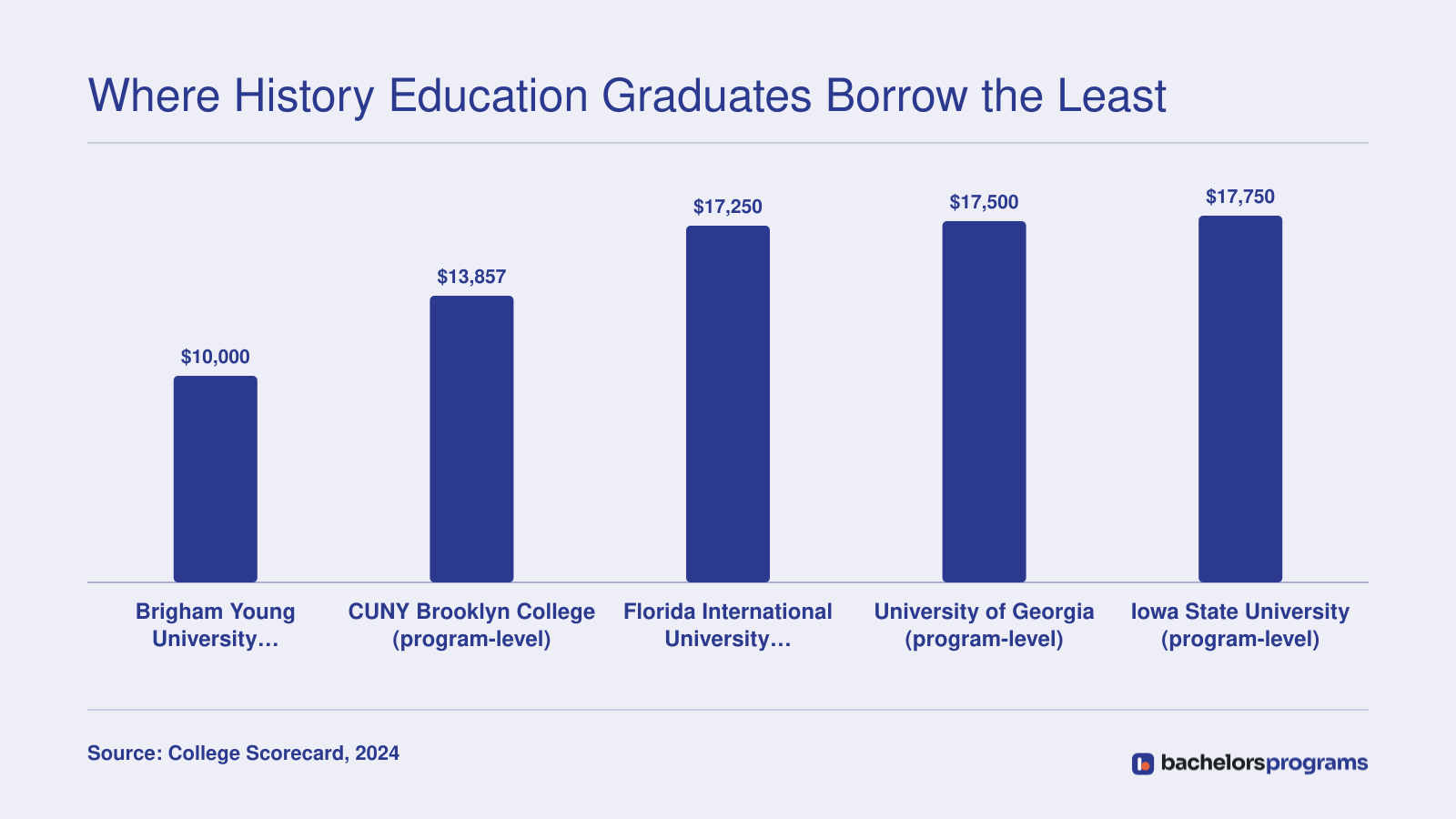
Among the ranked schools, Brigham Young University graduates leave with the lowest median federal debt, $10,000, which works out to an estimated $106 a month on a 10-year repayment plan. Even at Iowa State University, where the median is $17,750, the estimated payment is about $188 a month, and one year after graduation, alumni there earned a median of $47,559. On a starting teacher's salary, low debt keeps loan payments small enough to leave room for rent, savings, and the cost of maintaining your license.
Online vs. Campus History Education Degrees: Can You Student Teach Near Home?
Online study buys flexibility, but licensure still depends on a real classroom, one you can actually reach. Most schools ranked here are campus-based, and Florida International University is listed as hybrid. None is listed as fully online, so a fully online route means looking beyond this list.
The Short Answer
Yes, you can earn a bachelor's degree in history education largely online. No, you cannot student teach online. Supervised, in-person student teaching is required for an initial license, and WGU states that it cannot be waived or replaced by prior classroom experience.2 WGU's licensure programs set the clinical placement at 12 to 20 weeks.1
How Online Programs Arrange Local Placements
WGU generally places students in their state of residence rather than asking them to relocate, and a placement specialist works with districts and teachers to arrange it.1 Near-home placement is not guaranteed, though. Placement can take up to six months, and you may need to help arrange it; some students commute as much as two hours.1 Troy University's online history education track takes a similar approach, with a secondary history internship in the student's local community.4
Where State Limits Apply
WGU says its social studies preparation covers certification in all 50 states, but states set their own testing and licensure rules, and authorization varies by state and program.3 Restrictions can be program-specific. WGU's graduate social studies teaching program currently enrolls only licensure-seeking residents of California, North Carolina, or Utah.2 That example comes from a master's program, not a bachelor's, but it shows why you should check each program individually. Expect a cleared background check, a minimum age of 18, and a state basic-skills test along the way.
Before You Enroll Online
Confirm in writing that the specific program is approved for licensure in your home state, and that the school can place you in a classroom within a realistic distance of where you live. Authorization to enroll you and approval to recommend you for a license are separate questions, so ask about both.
Accreditation and Teacher Licensure: What to Check Before You Enroll
State approval and national accreditation sound like the same thing, but only one of them decides whether you can get a license. The other is a quality signal.
The Two Layers
State approval of the teacher preparation program is the layer that counts for licensure. Your state education agency has to recognize the program before it will accept your degree as the basis for a license. National accreditation from CAEP or AAQEP, two separate accreditors, shows that a program has met outside quality standards. Neither label alone guarantees a license, and accreditation does not replace state approval.
How to Verify a Program
- CAEP: Look up the school in CAEP's accredited provider search.
- State approval: Check your state education department's list of approved educator preparation programs.
- State authorization: For online programs, read the school's state authorization page to confirm it can place students in your state.
Do all three before you pay a deposit.
Licensure Exams
There is no single national license for history teachers. Your state agency, not ETS, sets the required tests and passing scores.1 The Praxis Social Studies: Content and Interpretation test (5081) is one version you may see. The broader 5581 exam covers concepts and methodologies, U.S. history, world history, and government and civics, and states are adopting it on their own schedules. Colorado lists 5581 effective April 1, 2026, along with 5904.2 South Dakota lists 5581 effective September 1, 2026, and still lists 5004.3 West Virginia has accepted 5581 since October 1, 2025, alongside 5004.4
Other requirements differ too. West Virginia lists Praxis Core, a content-specialty test, and a professional-knowledge test.4 Louisiana requires content exams plus the Principles of Learning and Teaching (PLT) or other pedagogy exams.5 Confirm the exact code and date with your state before you register.
Moving to Another State
The NASDTEC Interstate Agreement makes it easier to transfer a license between participating states, but it is not automatic reciprocity. The receiving state decides whether to issue a license and may require its own tests, coursework, or a background check. It may also treat a social studies endorsement differently from a history or broad-field one.
So is the degree valid in any state? It can be. The route is a state-approved program, then each state's added requirements. Check the receiving state's current licensing page before you assume a transfer will go smoothly.
What You'll Study in a History Education Program
A bachelor's degree in history education combines three things: deep content knowledge in history, broader coursework across the social sciences, and professional training in how to teach teenagers. Most programs blend all three rather than treating them as separate tracks.
The Curriculum Mix
The history core usually covers U.S. and world history, with upper-level seminars and often a non-Western requirement. Norfolk State University, for example, requires 27 hours of history, including 12 advanced hours and 6 non-Western hours, plus 30 hours of education courses.1 The University of Colorado Denver asks for 36 history credits, 18 of them upper division.2
The education side adds educational psychology, teaching methods, special education coursework, and classroom field experience. Connecticut's secondary history and social studies endorsement lists 18 credits of professional education, 3 in special education, and 6 for student teaching.3
Credits and Timeline
Expect about 120 credit hours, which full-time students typically finish in four years. Iowa lists 120 credits4, Shenandoah 120 to 1255, and Norfolk State 127.1 Transfer credits, especially general education from a community college, can shorten the path, but confirm what counts: education programs often require specific courses.
History vs. Social Studies Education
Many states license teachers under a broad social studies endorsement rather than history alone. Norfolk State's social studies endorsement runs 42 hours: 18 in history, 18 in political science, 9 in geography, and 6 in economics.1 Its history-only endorsement is 24 semester hours.1 If your program is history-focused, you may need added civics, economics, or geography courses to teach the full range of social studies classes. Iowa State's program, for instance, produces endorsements in American history, world history, and a third social science.6
Student Teaching and Your Budget
Student teaching usually fills the final semester and runs close to a full-time school schedule. That leaves little room for a paying job, so plan savings, aid, or reduced expenses before that semester begins.
What Licensed High School Teachers Earn
A bachelor's degree in history education typically leads to licensure for teaching social studies in middle or high school, and the grade level you choose affects your pay.
Related Articles
Questions to Ask Yourself
Will your target state license you in history alone, or will you need a broad social studies endorsement?
Could a lower net price at a public school in your state beat a bigger-name program once debt is counted?
Do you want to teach dual-credit courses someday, and would an accelerated master's pathway save you time?
History Education programs by state
Compare History Education programs on the data that matters
Explore more Education & Teaching majors or browse every field of study.
All Education & Teaching programs Browse every field of study