Best Elementary Education Degree Programs
Compare 1,050+ accredited Elementary Education programs, with net price after aid, graduation rates, earnings and debt from IPEDS and the U.S. College Scorecard.

A bachelor's degree in elementary education can carry a net price of about $6,500 a year at the University of Florida or about $15,800 at Vanderbilt, and both lead to the same classroom job. The most common credential is the Bachelor of Science (B.S.) in Elementary Education, though some schools award a B.A. or B.S.Ed.
Price is only one variable. States issue teaching licenses, so a program must be state-approved, and moving to another state can mean extra coursework or exams. Online programs still require student teaching in a real school, which complicates scheduling.
Where you plan to teach often matters more than where you study.
Key Points
- Every ranked program places students in real classrooms before student teaching.
- State program approval, not B.S. or B.A. letters, determines licensure eligibility.
- Federal data shows what each program's own graduates borrow and earn.
Best Bachelor's Degree in Elementary Education Programs: Our Top 10
The ten programs below share a strong clinical core: every one puts students in real classrooms well before student teaching, and most build a full year of field work into the degree. The group spans nine states, from Florida and North Carolina to California and Utah, and mixes large public research universities with small private colleges. Net price after aid varies widely across the list, so the entries below focus on what each school does best and what its program asks of students.
University of Florida
#1Gainesville, FL · ~$7,000/yr (est.)
Best for: Online learners seeking K-6 licensure
The University of Florida is a large public research university whose College of Education admits elementary education students as juniors or transfers into a selective cohort. Clinical work in local elementary schools runs alongside coursework every semester, and the senior year is a full-year classroom internship. Graduates earn K-6 certification with Reading and ESOL endorsements.
- Two-year, full-time program starting fall for juniors and transfers
- Typical load of 6 to 16 credits in themed blocks with a cohort
- Supervised clinicals in local elementary schools each semester
- Full-year senior internship as the classroom teacher
- K-6 certification with Reading and ESOL endorsements
- Selective admission: 2.6 GPA, 60 credits, state general knowledge test
- Offered on campus and online
- Median earnings one year out: $46,209; median debt: $14,757
Grove City College
#2Grove City, PA · ~$22,000/yr (est.)
Best for: Students seeking a small Christian college
Grove City College is a small Christian liberal arts college with an elementary education major approved by the Pennsylvania Department of Education. Field experiences start in the freshman year and build to a full semester of student teaching, and each class cohort works with two faculty advisors. An on-campus preschool and a curriculum library give students steady practice with lesson planning.
- 4-year program requiring 79 major credit hours
- Field experiences begin freshman year, student teaching senior year
- Approved by the Pennsylvania Department of Education
- Prepares students for the Praxis exam
- On-campus Early Education Center preschool classroom experience
- Two faculty advisors assigned to each class cohort
- About 95% of graduates go on to jobs or graduate programs
University of North Carolina at Chapel Hill
#3Chapel Hill, NC · ~$12,000/yr (est.)
Best for: Future teachers wanting dual licensure
UNC-Chapel Hill relaunched its undergraduate elementary education degree in fall 2026 as the university's primary route to initial teaching licensure. The program pairs a K-6 elementary license with a second license in special education or English as a Second Language, and students spend a full year student teaching in a nearby public school. It is CAEP accredited and approved by the North Carolina State Board of Education.
- Dual licensure: K-6 elementary plus K-12 special education or ESL
- Year-long student teaching internship at a nearby public school
- Classroom and community experience each semester
- CAEP accredited and approved by the NC State Board of Education
- NC Teaching Fellows forgivable loans up to $5,000 per semester
- Median earnings one year out: $29,897; median debt: $12,000
University of Michigan
#4Ann Arbor, MI · $18,000 – $61,000/yr (est.)
The University of Michigan's Marsal Family School of Education offers elementary teacher education as a 120-credit bachelor's that recommends graduates to the state for certification. Field placements are guaranteed and happen every semester, capped by a 14 to 15 week student teaching term in PK-3 or 3-6 classrooms. Students can add an English as a Second Language endorsement.
- 120 credits: 42 pre-professional, 45 professional core, 16 teaching
- 14 to 15 week student teaching term
- Guaranteed field placements in schools every semester
- Prepares teachers for PK-3 or 3-6 self-contained classrooms
- Optional 17-credit English as a Second Language endorsement
- Recommended to Michigan for elementary teacher certification
- Median earnings one year out: $45,522; median debt: $14,375
San Diego State University
#5San Diego, CA · $15,000/yr (est. net price)
San Diego State University delivers its elementary education preparation through a Liberal Studies major with an elementary emphasis, and the same degree runs at its Imperial Valley campus. The major satisfies general education requirements in full, so students do not need a minor, and coursework blends mathematics and science methods with language and arts courses for the elementary classroom. It is a large public campus in the California State University system.
- 56-unit lower division core plus 39 units of major requirements
- Fulfills General Education requirements; no minor required
- Also offered at SDSU Imperial Valley
- Includes Teaching as a Profession and elementary math methods
- Major coursework must be completed with a C (2.0) or better
- Median earnings one year out: $28,793; median debt: $12,691
Vanderbilt University
#6Nashville, TN · ~$16,000/yr (est.)
Vanderbilt University's Peabody College awards a B.S. in Elementary Education that leads to licensure, taught by a Department of Teaching and Learning known for work in mathematics and science education, literacy, and classroom management. It is a small, highly selective private university, and the elementary track is research grounded and practice intensive. The same department also runs a secondary route for grades 7-12.
- Leads to K-5 teacher licensure
- Housed in Peabody College's Department of Teaching and Learning
- Research-grounded, practice-intensive elementary track
- Faculty focus on math and science education, literacy, and classroom management
- Secondary track available for grades 7-12 in four subject areas
University of Virginia
#7Charlottesville, VA · $22,000/yr (est. net price)
The University of Virginia's School of Education and Human Development awards a B.S.Ed. in Elementary Education that finishes in four years, or two academic years after a student is admitted to the major. Third-year students complete two practicum placements, then a 6-credit fall internship and a 12-credit spring student teaching term. Graduates earn initial Virginia licensure with a preK-6 endorsement.
- 120 credits in four years, or two years after admission to the major
- Two practicum field experiences during the third year
- 6-credit fall internship plus 12-credit spring student teaching
- Initial Virginia licensure with a preK-6 endorsement
- Guaranteed admission to select UVA master's programs within five years
- Transfer entry for first- or second-years and external transfers
- Prepares students for Praxis Elementary: Multiple Subjects
San Jose State University
#8San Jose, CA · ~$14,000/yr (est.)
San Jose State University runs elementary education as a Liberal Studies Teacher Preparation major with four routes, including integrated programs that add a teaching credential or a master's degree. The major is approved by the California Commission on Teacher Credentialing and waives the CSET Multiple Subjects exam for graduates. Students prepare to teach TK-8 within the California State University system.
- Four pathways: Traditional, ITEP, ITEPB, and SAGE
- Waives the CSET Multiple Subjects subject matter exam
- Prepares teachers for TK-8 students
- ITEP adds a Multiple Subject Authorization for K-8
- ITEPB adds a Spanish Bilingual Authorization
- SAGE combines the bachelor's degree with a Master of Arts in Teaching
- Approved by the California Commission on Teacher Credentialing
Brigham Young University
#9Provo, UT · $15,000 – $20,000/yr (est.)
Brigham Young University is a private university in Provo that admits elementary education students through its Teacher Education Department. The major is compact at 64 to 67 credits, and graduation requires meeting Utah licensing requirements, including Praxis II, fingerprint clearance, and state fees. Students are prepared to teach in public schools.
- 64 to 67 credit hours, including 20 major courses
- 12 hours of elementary student teaching or an academic internship
- 2.7 GPA minimum with a C or better in major courses
- Praxis II, fingerprint clearance, and state licensing fees required
- Admission through the Teacher Education Department
- Meets Utah State Office of Education licensing requirements
- Median earnings one year out: $42,475; median debt: $13,385
University of Maryland-College Park
#10College Park, MD · $16,000/yr (est. net price)
The University of Maryland, College Park awards a B.S. in Elementary Education that leads to licensure for grades 1-6 and places students in five field assignments across four nearby county school districts. Seniors spend a year in a single classroom, moving from two days a week to full-time teaching. Methods coursework is research based, and classes average 18 students.
- Leads to teacher licensure for grades 1-6
- 11 research-based teaching methods courses
- Five field placements across four nearby county school districts
- Year-long senior internship, moving from two days a week to five
- Selective admission: 45 credits, 2.75 GPA, basic skills tests
- Classes average 18 students; 158 days inside an elementary school
- Median earnings one year out: $53,054; median debt: $18,625
Cost & outcomes by school
Federal data for the highest-earning Elementary Education programs, independent of the ranking above. Earnings are this field's bachelor's graduates four years after completing where the Scorecard reports them, else the school's undergraduate median.
| School | Net price / yr | Grad rate | Earnings | Debt | Grads/yr | Format |
|---|---|---|---|---|---|---|
| Villanova University PA | $43,756 | 92% | $100,423 | $25,874 | 4 | Campus |
| Bucknell University PA | $40,766 | 86% | $93,807 | $27,000 | 8 | Campus |
| Northwestern University IL | $29,167 | 95% | $89,363 | $15,000 | 2 | Campus |
| Fairfield University CT | $48,095 | 84% | $88,794 | $26,000 | — | Campus |
| Providence College RI | $48,523 | 86% | $87,054 | $27,000 | — | Campus |
| University of Virginia VA | $21,565 | 96% | $86,863 | $17,500 | 24 | Campus |
| Washington University in St Louis MO | $21,786 | 94% | $86,182 | $17,500 | 3 | Campus |
| Missouri University of Science and Technology MO | $16,298 | 64% | $82,957 | $23,250 | 8 | Campus |
| Virginia Polytechnic Institute and State University VA | $24,953 | 86% | $81,698 | $21,500 | 44 | Campus |
| San Jose State University CA | $13,760 | 69% | $78,988 | $15,000 | 164 | Campus |
| Gonzaga University WA | $35,119 | 86% | $78,892 | $24,454 | — | Campus |
| Southern Methodist University TX | $40,892 | 84% | $78,354 | $19,500 | — | Campus |
Sources: U.S. Department of Education. Net price, graduation rate, earnings and debt: College Scorecard (earnings and debt for this field's bachelor's graduates where reported, else school-wide); graduates: IPEDS. A dash means no figure is reported.
Cost, debt & payoff
Median earnings of this field's bachelor's graduates (4 yrs after completing, else the school's undergraduate median) vs. their median federal loan debt · U.S. College Scorecard
Across these programs the median graduate earns about $48,824 and finishes with roughly $24,000 in debt — a ratio that clears a common rule of thumb (keep debt below first-year salary). Net price and debt vary widely school to school, so check the per-school figures in the table above before you shortlist.
How We Ranked Elementary Education Schools
The Factors That Decide a Program's Place
Every program on this list was scored on the factors that shape a teaching degree's real return:
- Affordability: net price after grant aid and published tuition, so a program is judged on what students actually pay.
- Outcomes: program-level earnings one year after graduation and median debt taken on to get there, drawn from federal College Scorecard data.
- Completion: institution-wide graduation and retention rates, which signal whether students who start actually finish.
- Program scale: how many students complete the elementary education award, a rough measure of a program's depth and stability.
- Delivery format: campus, online, or hybrid, because format changes cost, scheduling, and field placement logistics.
Why Cost and Outcomes Sit Side by Side
A low price tag means little on its own. A cheap degree that leaves graduates without licensure or a classroom job is not good value, and neither is a program with strong earnings and punishing debt. Weighing the two together keeps the focus on what a graduate actually walks away with: a credential, a job, and a manageable loan balance.
What Our Data Does Not Confirm
The dataset behind this ranking does not verify accreditation or state program approval. Before you apply, confirm that a program holds CAEP accreditation and that your state's licensure board approves it for initial elementary teacher certification. The accreditation section below explains how to check both, and why a program can look affordable and still fail you at the licensing desk.
What Is the Best Degree for Elementary Education? B.S., B.A., BAE and BSE Compared
For most future teachers, the best degree is a state-approved, licensure-track bachelor's, most often a B.S. in Elementary Education. The degree letters matter less than approval: licensure eligibility depends on whether your state has approved the program, not on whether the diploma says B.S., B.A., BAE or BSE. According to the U.S. Bureau of Labor Statistics, all four credentials meet the same bachelor's entry requirement for elementary teachers, who earned a median of $63,970 per year as of May 2025. A typical bachelor's runs about 120 credits over four years, and transfer credit can shorten that.
| Factor | B.S. in Elementary Education | B.A. in Elementary Education | BAE (Bachelor of Arts in Education) | BSE (Bachelor of Science in Education) |
|---|---|---|---|---|
| Coursework emphasis | Child development, assessment, and teaching methods for math and science | Liberal arts breadth, humanities, and language alongside teaching methods | Education theory and classroom practice within an arts framework | Education methods and learning science within a science framework |
| Typical credit hours | About 120 credits | About 120 credits | About 120 credits | About 120 credits |
| Licensure track built in | Often yes, when the program is state-approved | Varies by school; confirm state approval | Usually yes, as an education-focused degree | Usually yes, as an education-focused degree |
| Typical time to degree | About four years full time | About four years full time | About four years full time | About four years full time |
| Fit for transfer students | Strong when general education credits align with the program | Strong, since broad liberal arts credits often transfer easily | Good; check how education credits count toward the major | Good; check how education credits count toward the major |
| Entry requirement for elementary teachers (BLS) | Bachelor's degree | Bachelor's degree | Bachelor's degree | Bachelor's degree |
Cost, Debt and Earnings: Which Elementary Education Programs Offer the Best Value?
Federal program-level data now lets families judge an elementary education major by what its own graduates borrow and earn, not by a university's overall reputation. That matters because campus-wide salary and debt figures blend teachers with engineers and nurses, so they say little about a teaching degree.
Programs That Pair Low Debt With Solid Earnings
- University of North Carolina at Chapel Hill: Median program debt of $12,000, or about $127 a month on a 10-year plan. Graduates earned a median $29,897 one year after graduation and $49,209 four years after.
- Brigham Young University: Median debt of $13,385 ($142 a month), with median earnings of $42,475 one year after graduation and $50,251 after four years.
- University of Florida: Median debt of $14,757 ($156 a month), with median earnings of $46,209 one year out and $53,079 four years out.
- Boricua College: Median debt of $10,334, with graduates earning a median $40,065 one year after finishing and $55,959 four years later.
Net Price Versus What You Borrow
Yearly net price among these schools ranges from $6,541 at the University of Florida to $29,167 at Northwestern University. Median program debt at the value picks above falls between $10,334 and $14,757, and the 10-year monthly payments run from $127 to $156. A low net price, combined with grants, keeps borrowing in line with a new teacher's paycheck.
Federal Aid Built for Future Teachers
- TEACH Grant: The statutory maximum is $4,000 a year.1 Awards first disbursed on or after Oct. 1, 2020, and before Oct. 1, 2026, were reduced to $3,772, so confirm the current amount with your aid office. You must teach a high-need field at a qualifying low-income school for four complete years within eight years of finishing your program.1 If you miss that, every grant converts to a Direct Unsubsidized Loan, with interest counted from each disbursement.
- Teacher Loan Forgiveness: This program forgives up to $5,000 or $17,500 of eligible Direct and Stafford loans, depending on the subject you teach.2 You must first complete five consecutive years as a highly qualified teacher at a qualifying low-income school.
- Public Service Loan Forgiveness: This program cancels the remaining balance after 120 qualifying monthly payments, which need not be consecutive, made while you work full time for a qualifying employer.3 Any role in a public school system counts. Private school employment needs separate verification.
Teacher Loan Forgiveness and PSLF have separate requirements, so decide which one fits your career plan before your first year in the classroom.
Top Program Earnings One Year After Graduation
Among the elementary education programs ranked here, one stands out for first-year pay.
Related Articles
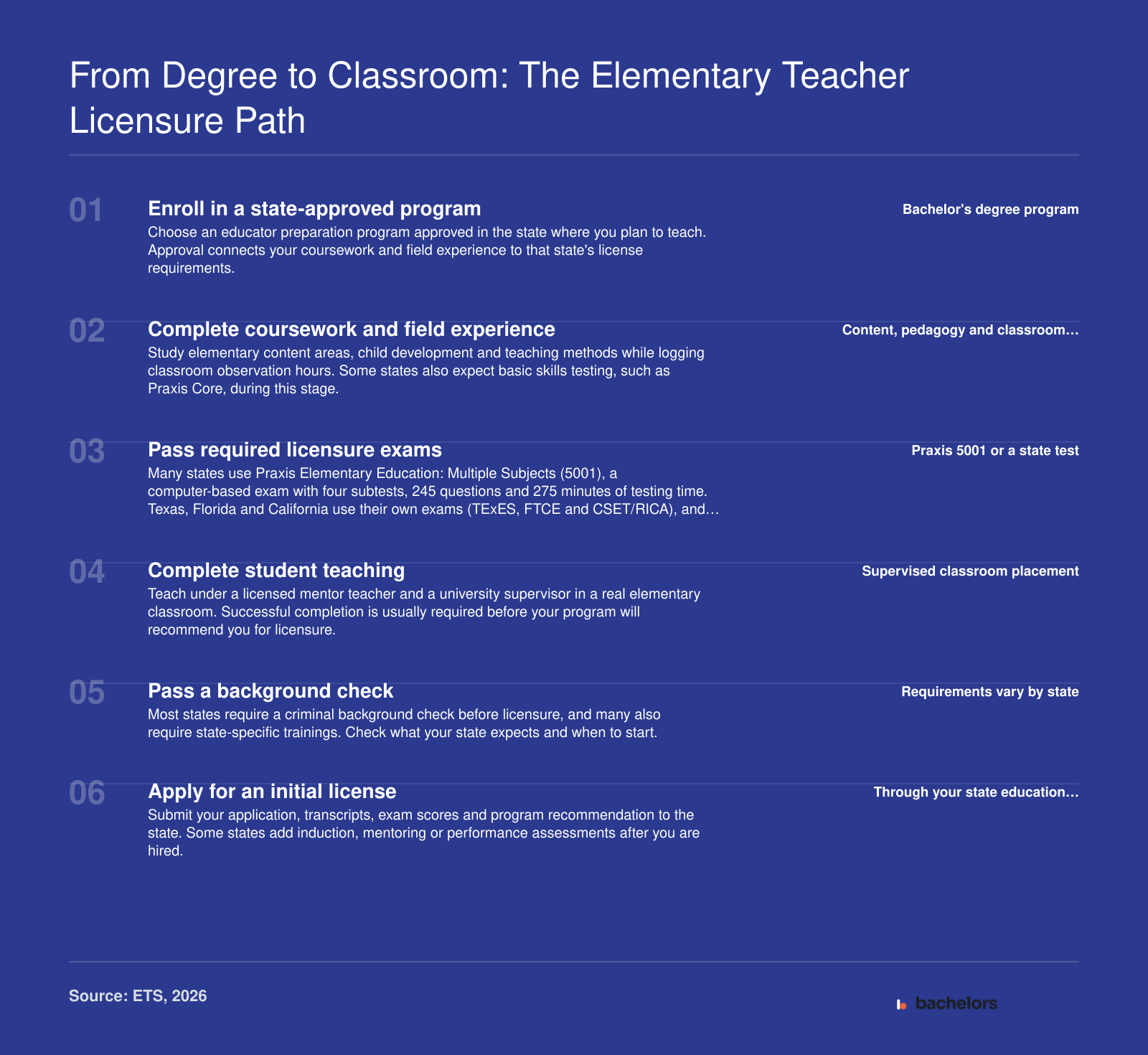
From Degree to Classroom: The Elementary Teacher Licensure Path
Earning a bachelor's degree in elementary education is the first step toward an initial teaching license, but every state controls its own requirements. The sequence below shows the typical route. Exam names, required tests and passing scores vary by state, so confirm the details with your state education agency and your program.
Questions to Ask Yourself
Will this program lead to licensure in the state where you plan to teach?
Can you afford a full-time, unpaid student-teaching semester?
Do you want a dual certification, such as special education or ESL?
How many of your existing credits will transfer toward the 120-credit degree?
Elementary Education programs by state
Compare Elementary Education programs on the data that matters
Explore more Education & Teaching majors or browse every field of study.
All Education & Teaching programs Browse every field of study