Best Early Childhood Education Degree Programs
Compare 640+ accredited Early Childhood Education programs at 560+ colleges, with net price after aid, graduation rates, earnings and debt from IPEDS and the U.S. College Scorecard.

A bachelor's degree in early childhood education can lead to a state teaching license for pre-K through grade 3, or to childcare and Head Start roles that do not require a state license. Programs typically award a Bachelor of Science (B.S.) in Early Childhood Education, though B.A. and B.S.Ed. versions exist.
Delivery and cost add friction. Online coursework still typically requires supervised field hours near your home, and net price after aid can differ by tens of thousands across similar programs. Demand for licensed early educators is steady, but payback depends on the track and the state where you teach.
Key Points
- A bachelor's degree plus a state license unlocks kindergarten teaching pay.
- Online coursework still requires in-person field hours and practicum placements.
- Choose Birth to Grade 3 or Pre-K to Grade 3 licensure first.
Best Schools for a Bachelor's Degree in Early Childhood Education
The ten programs below earned their places on a mix of affordability, completion and program-level outcomes: what students actually finish, what they pay, and where the degree leads. Each card shows the average net price after aid, the institution-wide graduation rate, the format, and any concentration the program lists. Read net price as an average after aid rather than a sticker price, and the graduation rate as a whole-school figure, not a rate for this major alone.
University of Michigan
#1Ann Arbor, MI · $18,000 – $61,000/yr (est.)
Best for: Non-licensure path into Head Start work
One of the nation's largest public research universities, with a Children and Families major that trains students to work with young children and their families outside the traditional classroom. The Child Studies concentration blends child development coursework with early literacy and an apprenticeship in a birth-to-kindergarten setting. It is a deliberate non-licensure path: graduates head into Head Start, childcare centers and early childhood administration rather than a state teaching certificate.
- 31-credit major core, from child development through family preservation
- Child Studies concentration adds 16 credits
- Includes Early Literacy: Birth to Kindergarten and an apprenticeship
- Two concentrations: Child Studies or Social Agency
- Does not lead to teacher certification; Birth-Kindergarten is a separate route
- Graduates work in Head Start, childcare centers and early childhood programs
- Covers physical, intellectual, emotional and social development
Amridge University
#2Montgomery, AL · $5,000 – $10,000/yr (est.)
Best for: Working adults who need fully online study
Amridge University is a private institution in Montgomery, Alabama, built around online and distance study for working adults. Its Human Development bachelor's degree sits in the College of General Studies and is delivered entirely online, so students never need to come to campus. The program suits people already working with young children who need a flexible route to a four-year credential.
- Fully online; no campus attendance required
- Offered through the College of General Studies
- Classified in the human development and family studies field
- One of 40 online programs the university offers
- Free admissions waiver
University of Florida
#3Gainesville, FL · ~$7,000/yr (est.)
Best for: Florida residents aiming for teacher licensure
The University of Florida runs its early childhood teacher preparation through UF Online, so the full four-year degree can be completed at a distance. The program is built around Florida's certification rules for children age three through grade three and layers on reading, ESOL and prekindergarten disability endorsements. It is one of the few options here that pairs fully online delivery with a direct route to a state teaching license.
- Fully online through UF Online
- 54 credit hours; full-time or part-time study; fall start
- Meets Florida teacher certification requirements, age 3 through grade 3
- Endorsements in Prekindergarten Disabilities, Reading and ESOL
- TEACH Early Childhood Scholarship available to eligible students
- Average class size of 15 to 20 students
- Course content linked to field experiences
University of Wisconsin-Madison
#4Madison, WI · ~$17,000/yr (est.)
Wisconsin's School of Human Ecology houses a Human Development and Family Studies major with a Child Development named option, and the campus Child Development Lab gives students recurring observation and practice time with children from six weeks through 4K. A semester-long internship and a capstone are both required, and students can stack credentials in family life education, infant and early childhood mental health, and child life. It is a strong fit for readers who want research grounding alongside hands-on time with young children.
- 120 credits over four years with a required capstone
- Child Development named option within the major
- Semester-long internship; 150 hours earns 3 credits
- 2.750 GPA required for students within the first 60 credits
- Credentials in family life education, infant mental health and child life
- Fall and spring starts; merit and need-based scholarships
- Internships placed in early childhood education centers
University of North Carolina at Chapel Hill
#5Chapel Hill, NC · ~$12,000/yr (est.)
Human Development and Family Science at UNC-Chapel Hill is a Bachelor of Arts in Education housed in the School of Education, with core work spanning prenatal development through age 12. A 9-credit senior internship comes after most major coursework is finished, and students choose between Child and Family Health and Family Life Education concentrations. The degree feeds into education, public health, social work and counseling rather than a single licensure track.
- 48 credit hours including a 9-credit senior internship
- Two concentrations: Child and Family Health and Family Life Education
- Core covers development from prenatal through age 12
- 2.5 GPA recommended; admission each semester, space available
- Prepares students for the Certified Family Life Educator credential
- 45 credit hours must be taken at UNC-Chapel Hill
- Honors thesis open to students at a 3.3 GPA
California State University-Fullerton
#6Fullerton, CA · $7,000 – $20,000/yr (est.)
Cal State Fullerton's Child and Adolescent Studies major is one of the larger early childhood pipelines in California, with an Early Childhood Development and Education track that runs from infant and toddler care through the primary grades. Coursework is aligned with NAEYC's bachelor's-level professional standards and with the state's Child Development Permit Matrix. The track also sets students up for PK-3 early childhood specialist credential programs and early childhood special education.
- Early Childhood Development/Education track spans infancy through primary grades
- Aligned with NAEYC professional standards for bachelor's programs
- Meets California Child Development Permit Matrix requirements
- Prepares students for PK-3 ECE Specialist credential programs
- Five concentration options within the major
- Coursework in observation, assessment and family engagement
- Covers culturally competent work with young children and families
University of Washington-Seattle Campus
#7Seattle, WA · ~$14,000/yr (est.)
The University of Washington's College of Education offers a fee-based Bachelor of Arts in Early Care and Education entirely online, aimed at people already working in early learning settings. Students complete community-based learning placements with partner organizations, and those placements can run across much of the program. Admission is capacity constrained and requires 45 transferable credits plus a personal statement, so it rewards applicants who plan ahead.
- 87 credits of early childhood, child development and related coursework
- Fully online, fee-based degree
- Community-based learning placements with community partners
- Requires 45 transferable credits and a personal statement
- At least 64 major credits completed through UW Seattle
- Serves children from birth through age 8
- Capacity-constrained admission; departmental honors available
Vanderbilt University
#8Nashville, TN · ~$16,000/yr (est.)
Vanderbilt's Child Development major sits in the Department of Psychology and Human Development inside Peabody College, and it approaches early childhood through the lens of developmental science. Students study biological, cognitive and social development from infancy through adolescence, along with the family, school and community contexts that shape it. It is a research-oriented option built for readers aiming at graduate study in psychology, medicine, nursing, social work or policy.
- Major in the Department of Psychology and Human Development
- Covers biological, cognitive and social development
- Focus runs from infancy through adolescence
- Contexts include family, peer, school, community and culture
- Prepares students for graduate study in psychology, medicine or social work
- Minors in Child Psychology and Mental Health, and Language Sciences
Florida International University
#9Miami, FL · ~$9,000/yr (est.)
Florida International University runs two distinct early childhood routes: a fully online Bachelor of Science in Early Childhood Development and a campus Bachelor of Science in Early Childhood Education that leads to Florida certification with reading and ESOL endorsements. The online track does not carry teacher certification, and every undergraduate is paired with a success coach. With three start terms a year, it is built for students balancing study with work.
- 120 credits, fully online
- Does not lead to teacher certification
- Three start dates per year, including spring and summer
- Every undergraduate paired with a success coach
- Covers development, curriculum, assessment and classroom management
- In-state tuition $235.57 per credit hour plus fees
- 120 credits over four years on campus
- Leads to State of Florida teacher certification
- Reading and ESOL endorsements included
- Concentration covers child development and family studies
- Coursework in instructional practices and assessment
University of Virginia
#10Charlottesville, VA · $22,000/yr (est. net price)
The University of Virginia's B.S.Ed. in Early Childhood Education finishes with initial Virginia licensure and a preK-3 endorsement, and students spend real time in preK-3 classrooms alongside their teaching and learning coursework. It admits current UVA undergraduates and transfer students rather than incoming high school students, so most students join after their first year or two. Graduates also earn guaranteed admission to select UVA master's programs for up to five years.
- 120 credits; initial Virginia licensure with preK-3 endorsement
- Two academic years after admission
- Open to current UVA undergraduates and transfer students
- Priority deadline February 1; final deadline June 1
- External transfer applicants apply by March 1
- Guaranteed admission to select UVA master's programs
- Classes meet in person
Cost & outcomes by school
Federal data for the highest-earning Early Childhood Education programs, independent of the ranking above. Earnings are this field's bachelor's graduates four years after completing where the Scorecard reports them, else the school's undergraduate median.
| School | Net price / yr | Grad rate | Earnings | Debt | Grads/yr | Format |
|---|---|---|---|---|---|---|
| Santa Clara University CA | $50,062 | 88% | $109,183 | $19,162 | — | Campus |
| Bucknell University PA | $40,766 | 86% | $93,807 | $27,000 | 8 | Campus |
| University of Virginia VA | $21,565 | 96% | $86,863 | $17,500 | 24 | Campus |
| Tufts University MA | $39,998 | 94% | $83,214 | $16,250 | — | Campus |
| Ohio Northern University OH | $24,478 | 76% | $80,928 | $27,000 | 14 | Campus |
| San Jose State University CA | $13,760 | 69% | $78,988 | $15,000 | 164 | Campus |
| George Mason University VA | $17,915 | 68% | $76,343 | $19,500 | 77 | Campus |
| CUNY Hunter College NY | $2,984 | 57% | $73,857 | $13,920 | 41 | Campus |
| Monroe University NY | $14,522 | 57% | $73,537 | $24,250 | 13 | Campus |
| California State University-East Bay CA | $9,320 | 48% | $71,401 | $16,544 | — | Online |
| Michigan State University MI | $19,680 | 81% | $67,253 | $23,250 | 12 | Campus |
| University of New Hampshire NH | $23,805 | 76% | $66,479 | $26,814 | — | Campus |
Sources: U.S. Department of Education. Net price, graduation rate, earnings and debt: College Scorecard (earnings and debt for this field's bachelor's graduates where reported, else school-wide); graduates: IPEDS. A dash means no figure is reported.
Cost, debt & payoff
Median earnings of this field's bachelor's graduates (4 yrs after completing, else the school's undergraduate median) vs. their median federal loan debt · U.S. College Scorecard
Across these programs the median graduate earns about $48,046 and finishes with roughly $23,350 in debt — a ratio that clears a common rule of thumb (keep debt below first-year salary). Net price and debt vary widely school to school, so check the per-school figures in the table above before you shortlist.
How We Ranked These Early Childhood Education Schools
Bachelor's programs in this field are splitting into licensure tracks and non-licensure tracks, and a single ranking can't fully sort that out. What it can do is compare measurable factors consistently, and those comparisons set the order.
Where the Data Comes From
Every figure comes from the U.S. Department of Education College Scorecard. School-level data reflects the 2024 snapshot, and program-level earnings and debt come from the 2022 outcomes release, the most recent available for these majors.
What We Compared
The order reflects five factors, with no fixed percentage weights:
- Average net price: what students pay after grants and scholarships, not the sticker tuition.
- Graduation rate: the share of students who finish within six years.
- Retention rate: the share of first-year students who return for a second year.
- Program outcomes: median earnings and median federal debt for graduates of the specific major.
- Format availability: whether a fully online option exists alongside on-campus study.
Where the Numbers Fall Short
Graduation and retention rates describe the whole institution, not the early childhood program itself. A school with a strong overall rate may still have a smaller or less supported education department. Some programs also have no published earnings because too few graduates are tracked to report a reliable figure, so those schools are judged on the remaining measures.
What the Rankings Don't Show
The Scorecard says nothing about whether a degree leads to a teaching license, how strong the classroom placements are, or whether the program holds the accreditation you want. Those questions often matter more than a rank. The sections on licensure versus non-licensure paths, online programs and in-person practicum, and accreditation and NAEYC alignment cover them. Read those before you narrow your list.
Licensure vs. Non-Licensure Degrees: Which Path Fits Your Goal?
Start by naming your target state and certification band, either Birth to Grade 3 or Pre-K to Grade 3. Then confirm current requirements with that state's education department or licensure board before you enroll anywhere. Requirements change, so treat the table below as a checklist of what to verify, not a final answer.
| Checkpoint | Licensure-Track Bachelor's | Non-Licensure Bachelor's | Where to Verify |
|---|---|---|---|
| Target state and age band | Must match your state's certification band, such as Birth to Grade 3 or Pre-K to Grade 3 | Not tied to a teaching license; one program focuses on birth to age five | State department of education licensure page |
| Where you can work | Public-school classrooms | Preschools, Head Start and Early Head Start, licensed childcare centers, licensed family childcare homes, registered ministries | District HR pages, NAEYC, state early childhood associations, BLS.gov |
| Student teaching and field hours | Confirm required student teaching hours with the program and the state | No student teaching; one program requires 160 clock hours of field experience in the first fall and spring semesters | University teacher-preparation program page |
| Exams and background checks | Graduates must meet state requirements, including content testing and background checks, before applying; confirm Praxis exams and passing scores | Not a teaching-license requirement of the degree itself | ETS Praxis requirements, state licensing agency |
| Coursework, credits, and fees | Confirm required coursework, application fees, and any state-specific extras | One program requires 120 credit hours; ask about program and any later certification fees | Program advisor, university catalog |
| Path to a teaching license | The route to teaching in public schools | Not eligible for Colorado licensure at one program; in Florida, added coursework can meet alternative certification for the PreK/Primary, Age 3 to Grade 3 credential | State licensure board before you enroll |
| Moving to another state | Check NASDTEC to see which states may accept your license. Vermont, for example, grants an initial license for a non-conditional out-of-state professional license with the same or equivalent endorsement | No license to transfer | NASDTEC Interstate Agreement, receiving state's education agency |
| Extra requirements after a move | Commonly tests, coursework, experience, fingerprints, and fees; confirm each with the receiving state | Not applicable unless you later pursue licensure | Receiving state's licensure office |
Highest First-Year Earnings Among Ranked Programs
Among the schools ranked here, one program stands out for early-career pay.
Cost, Debt, and Earnings: What Graduates Actually Get
The value ratio below divides a school's median earnings for all former students 10 years after entry by its median federal debt at graduation, so it measures institution-wide value, not the outcome of the early childhood program itself. In a modestly paid field, low debt matters more than prestige: Berea College graduates leave with a median of $3,591 in federal loans, and Brigham Young University's early childhood education graduates carry a typical payment of $142 a month against first-year program earnings of $42,475, about 4 percent of monthly gross pay. Program earnings come from U.S. Department of Education College Scorecard data and are shown only where reported for the program itself. Vanderbilt's figure reflects its child development graduates four years after completion.
| School | Program | Average annual net price | Median federal debt at graduation (all graduates) | Median monthly loan payment (program graduates, 10-year plan) | Program median earnings (time after graduation) | School-wide median earnings 10 years after entry | Value ratio (school-wide earnings to debt) |
|---|---|---|---|---|---|---|---|
| Berea College (Berea, KY) | Child and Family Studies, Child Development concentration | $6,106 | $3,591 | N/A | N/A | $43,150 | 12.0 |
| Brigham Young University (Provo, UT) | Early Childhood Education | $15,564 | $11,069 | $142 | $42,475 (1 year) | $75,790 | 6.8 |
| Vanderbilt University (Nashville, TN) | Child Development | $15,846 | $14,000 | N/A | $55,188 (4 years) | $91,565 | 6.5 |
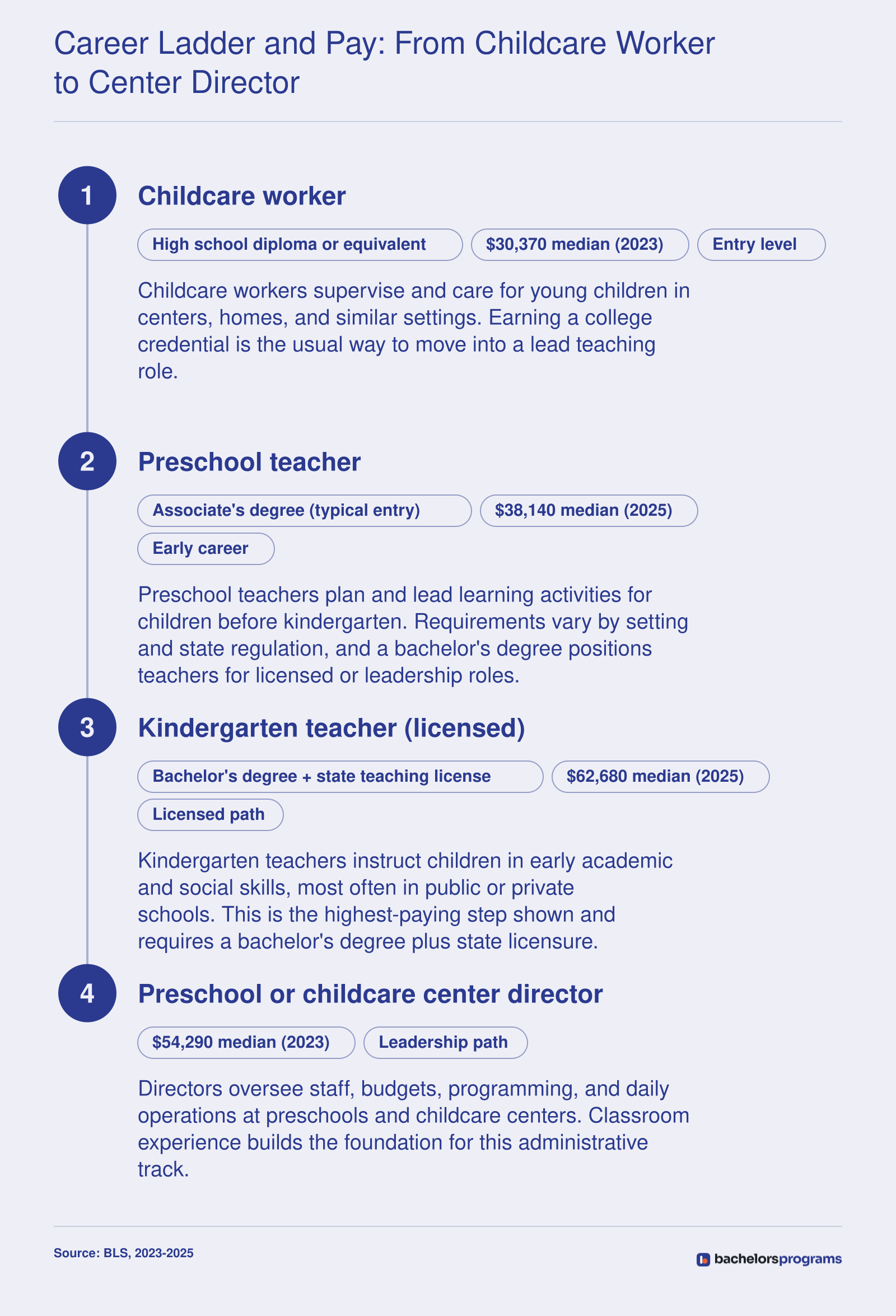
Career Ladder and Pay: From Childcare Worker to Center Director
The biggest pay jumps in early childhood careers come with a bachelor's degree and a state teaching license, which open the path to kindergarten teaching. The figures below are national BLS median wages for each occupation, not earnings reported for graduates of any specific program. Wage years differ by role, so treat the comparison as directional.
Online Early Childhood Education Degrees and In-Person Practicum Requirements
Online delivery is now the default format for working early childhood educators, yet the field hours behind these degrees have not moved online with the coursework.
What "Online" Actually Means for a Bachelor's Degree in Early Childhood Education
Three formats dominate. Fully online programs deliver coursework remotely but still require in-person field work. Hybrid programs mix online classes with regular campus or partner-site visits. Campus programs keep everything in person. In licensure tracks, online almost never means zero in-person hours: the coursework travels, the practicum does not.
How Many Field Hours to Expect
Requirements vary by program and by whether the degree leads to a teaching license, and sources establish no national minimum. The University of Cincinnati's online B.S. in Early Childhood Education requires 150 clinical hours, and the program does not lead to Pre-K through Grade 5 licensure. Campbellsville University's online interdisciplinary program requires 200 fieldwork hours before student teaching across 120 credits, and it prepares students for initial Kentucky certification. Eastern Oregon University lists a 1-credit practicum covering observation, participation, and teaching under a cooperating teacher.1 The University of Florida lists a 3-credit practicum that meets Florida certification requirements. Where a licensure track includes student teaching, it typically runs a full semester.
Who Finds the Placement
Some programs place students with a partner site near home; others expect students to secure their own classroom. Current childcare employment can help, but a job alone rarely satisfies a placement. Approval typically depends on the age group served, the site's licensing or accreditation, and access to a qualified cooperating teacher. Kansas State combines online coursework with field experience in an accredited school near the student, including students elsewhere in the country, and faculty observe and evaluate remotely by video.2
Three Questions for Admissions
- Where: Ask which districts, centers, or Head Start sites the program uses near your ZIP code, and who arranges the match.
- Who supervises: Confirm the cooperating teacher's qualifications and how remote observation is handled.
- State approval: State authorization and professional licensure are separate questions. Confirm the program is approved for licensure where you intend to teach. NC-SARA's field-placement threshold of 10 or more students3 and New Mexico's authorization requirement through its higher education department or SARA4 show how quickly those limits can bind.
Related Articles
Accreditation and NAEYC Alignment: What to Verify Before You Apply
Accreditation claims for early childhood programs layer several reviews on top of each other. Check each one before you apply.
- Institutional accreditationThis review covers the entire college or university. Confirm the school is accredited by an agency recognized by CHEA and/or the U.S. Department of Education. You can search the Department's DAPIP database or CHEA's directory.
- CAEP or AAQEP educator-preparation accreditationBoth accredit the school's educator-preparation provider or unit rather than one specific bachelor's program. This matters most if you want a licensure track. A program can sit inside a CAEP- or AAQEP-accredited unit without holding NAEYC accreditation.
- NAEYC Higher Education AccreditationThis is a program-level review of associate, baccalaureate, and initial master's programs that prepare candidates for beginning early childhood roles. It uses six standards, a three-day peer-review site visit, and a seven-year cycle with a year-four interim report. Search NAEYC's Accredited Higher Education Programs directory for the exact program and check its status (Accredited, Accredited with Conditions, or Not Accredited) and its term. A program that says it is "aligned with NAEYC standards" is not the same as an accredited one. Past NAEYC Recognition through CAEP review is not current accreditation.
- State approval for licensureIf you plan to teach in a licensed classroom, confirm the program is approved by the state where you intend to work.
- Verify at the sourceConfirm every status directly on the accreditor's website, not only on a school's marketing pages.
Early Childhood Education programs by state
Compare Early Childhood Education programs on the data that matters
Explore more Education & Teaching majors or browse every field of study.
All Education & Teaching programs Browse every field of study