Best Special Education Degree Programs
Compare 740+ accredited Special Education programs at 680+ colleges, with net price after aid, graduation rates, earnings and debt from IPEDS and the U.S. College Scorecard.

Most "best special education programs" lists rank graduate degrees, which is no help to someone still seeking a first license. Only bachelor's degrees in special education make the list: a Bachelor of Science (B.S.) or Bachelor of Arts (B.A.).
Net price after aid runs from $6,541 to $24,323 across the schools ranked here. Campus, online and hybrid formats all exist in this field, but every route ends in supervised student teaching.
A license comes from a state, not a school, so pick a program approved in the state where you intend to teach.
Key Points
- BYU special education graduates earned a median $50,331 one year out.
- Kindergarten and elementary special education teachers' median pay hit $65,120 in May 2025.
- State program approval, not national accreditation, qualifies you for licensure.
Best Special Education Schools Ranked: Top 10 Bachelor's Programs
These ten programs reward what future special education teachers actually need: a realistic path to on-time completion, a net price that stays manageable after aid, and fieldwork that starts well before senior year. Every entry below is a bachelor's degree in special education, and each one leads to licensure or a clearly defined alternative path.
University of Florida
#1Gainesville, FL · ~$7,000/yr (est.)
Best for: Early childhood intervention specialists
Campus only, with one of the strongest special education faculties in the country and a national specialty ranking in the top five for four straight years. The school's overall graduation rate is 91%, and average net price after aid is about $6,500 a year, the lowest here. The early childhood track is the only birth-to-age-four route in this ranking.
- Early Childhood concentration, birth through age 4
- Field practicum in early childhood special education
- Second field course covers multicultural issues in early childhood
- Prepares for the Florida Preschool Education subject area exam
- Florida Educator Accomplished Practices assessed at pre-professional level
- Performance ratings recorded in LiveText
Purdue University
#2West Lafayette, IN · ~$15,000/yr (est.)
Best for: Students stacking multiple licensure endorsements
The residential program runs 120 credits over eight semesters of 16-week courses and stacks mild intervention licensure on top of intense intervention. Program graduates reported median earnings of about $48,800 one year after finishing and about $55,300 four years out. Average net price after aid is about $14,600, and the school's overall graduation rate is 83%.
- 120 credits across 8 semesters, 16-week courses
- Indiana licensure in mild and intense intervention, P-12
- Add early literacy (P-5) and blended online teaching (5-12) licenses
- Specialty options: applied behavior analysis, English language learning, gifted and talented
- Field experiences in partner schools and community settings
- Coursework centers on IEPs and data-driven decisions
Vanderbilt University
#3Nashville, TN · ~$16,000/yr (est.)
Best for: Interdisciplinary students adding a second major
A small, field-first major in exceptional learning where students choose high incidence disabilities (K-8 or 6-12) or multiple and severe disabilities, starting observations in the first semester of freshman year. The major pairs with cognitive studies, child studies or human and organizational development. Average net price after aid is about $15,800, and the school's overall graduation rate is 94%.
- Emphasis in high incidence disabilities, K-8 or 6-12
- Or emphasis in multiple and severe disabilities
- Leads to teacher licensure
- Fieldwork begins first semester of freshman year
- Combine with cognitive studies, child studies or human and organizational development
- Interdisciplinary major in exceptional learning
University of Virginia
#4Charlottesville, VA · $22,000/yr (est. net price)
No direct entry from high school: students join after a year at UVA or transfer in, then complete 120 credits over two academic years. The mild to moderate K-12 pathway builds in a weekly internship and a spring student teaching block. Average net price after aid is about $21,600, and the school's overall graduation rate is 96%, the highest in this group.
- 120 credits; two academic years after admission to the major
- Mild to moderate disabilities, K-12
- 6-credit internship three days a week plus 12-credit student teaching
- Student teaching runs January through April
- Praxis Teaching Reading: Elementary before fourth year
- Initial Virginia licensure with general curriculum K-12 endorsement
- Guaranteed admission to select UVA master's programs within five years
University of Georgia
#5Athens, GA · ~$14,000/yr (est.)
A cohort model with unusually early field placements: two days a week for three semesters beginning in the first term. Dyslexia endorsement coursework is built into the degree. Program graduates reported median earnings of about $43,100 one year after finishing, average net price after aid is about $13,900, and the school's overall graduation rate is 90%.
- Certification and non-certification (educational studies) pathways
- Field experiences start first semester, two days a week for three semesters
- Dyslexia endorsement coursework embedded; KPEERI exam required
- 2.8 GPA and prerequisite coursework for admission
- Full-time student teaching in the final semester
University of Maryland-College Park
#6College Park, MD · $16,000/yr (est. net price)
Two separate pathways: elementary/middle special education for grades 1-8 with a severe disability endorsement, and a dual early childhood plus early childhood special education license. Both include a year-long internship, and graduates qualify for Maryland licensure with reciprocity in 49 states. Average net price after aid is about $15,700, and the school's overall graduation rate is 89%.
- Track 1: mild to moderate certification, grades 1-8, plus severe disability endorsement
- Track 2: dual elementary and special education certification
- Year-long teaching internship
- Maryland initial licensure with reciprocity in 49 states
- Admission needs 45 credits, 2.75 GPA and basic skills test
- 12 credits apply toward a master's degree
- Dual teacher licensure in early childhood and early childhood special education
- Year-long internship split across two settings
- Prepares special education teachers for pre-K through grade 3
- Selective admission with 2.8 GPA and two recommendations
Brigham Young University
#7Provo, UT · $15,000 – $20,000/yr (est.)
A 63-credit major with fall and winter practicum terms and a 12-week student teaching placement, all on campus in Provo. Program graduates reported median earnings of about $50,300 one year after finishing. Average net price after aid is about $15,600, and the school's overall graduation rate is 81%.
- 63 major credits, mild/moderate disabilities emphasis
- Fall and winter practicum plus 12-week student teaching
- Praxis 5354 with a score of 160 or higher for licensure
- Utah State Board of Education licensure
- Apply by February 5 for early admission or August 1
- Fingerprinting and FBI background check required
Florida State University
#8Tallahassee, FL · ~$11,000/yr (est.)
A combined bachelor's and master's pathway: 48 undergraduate special education hours plus 36 graduate hours in a fixed three-year cohort that does not run part time. Graduates earn Florida exceptional student education certification K-12 with ESOL, autism and reading endorsements. Average net price after aid is about $11,300, and the school's overall graduation rate is 86%.
- Combined pathway: 48 undergraduate plus 36 graduate hours
- Fixed three-year cohort sequence, no part-time pace
- Florida ESE certification K-12 with ESOL, autism and reading endorsements
- Two FTCE exams at $150 each before student teaching
- Semester-long student teaching; Level II background screening
- 2.5 GPA and 60 credit hours to enter educator preparation
University of Illinois Urbana-Champaign
#9Champaign, IL · ~$14,000/yr (est.)
A 125-credit B.S. that licenses teachers for kindergarten through age 22, with a five-semester professional sequence and clinical hours. Applicants need a 2.5 GPA and 50 hours of experience with people with disabilities before admission. Program graduates reported median earnings of about $51,900 one year after finishing and about $60,700 four years out, and average net price after aid is about $14,400.
- 125 semester hours; five-semester professional education sequence
- Licensure for kindergarten through age 22
- 2.5 GPA plus 50 hours of experience with individuals with disabilities
- Coursework in universal design for learning, special education law, behavior supports
- C- or better in licensure courses; gateway assessments before completion
Auburn University
#10Auburn, AL · $13,000 – $35,000/yr (est.)
An inclusive-education model: the collaborative teacher major prepares K-12 teachers to work alongside general educators, covering most disabilities but not sensory impairments or certain severe disabilities. Campus only, with clinical placements built across the teacher education sequence. Average net price after aid is about $24,300, the highest in this ranking, and the school's overall graduation rate is 82%.
- Campus program preparing K-12 collaborative teachers
- Covers most disabilities except sensory and some severe disabilities
- Evidence-based practice in inclusive general education settings
- Clinical experiences built into the teacher education sequence
Cost & outcomes by school
Federal data for the highest-earning Special Education programs, independent of the ranking above. Earnings are this field's bachelor's graduates four years after completing where the Scorecard reports them, else the school's undergraduate median.
| School | Net price / yr | Grad rate | Earnings | Debt | Grads/yr | Format |
|---|---|---|---|---|---|---|
| Boston College MA | $41,704 | 91% | $103,937 | $19,000 | — | Campus |
| Vanderbilt University TN | $15,846 | 94% | $91,565 | $14,000 | 11 | Campus |
| Fairfield University CT | $48,095 | 84% | $88,794 | $26,000 | — | Campus |
| University of Virginia VA | $21,565 | 96% | $86,863 | $17,500 | 6 | Campus |
| Drexel University PA | $38,509 | 78% | $84,648 | $25,325 | — | Online |
| University of Maryland-College Park MD | $15,678 | 89% | $82,860 | $19,000 | 14 | Campus |
| Loyola University Maryland MD | $30,574 | 79% | $82,652 | $27,000 | — | Campus |
| New York University NY | $37,050 | 88% | $82,509 | $20,500 | — | Campus |
| Saint Mary's College of California CA | $30,378 | 70% | $78,812 | $23,691 | — | Campus |
| Linfield University OR | $26,536 | 71% | $78,638 | $25,000 | — | Online or campus |
| George Mason University VA | $17,915 | 68% | $76,343 | $19,500 | 12 | Hybrid |
| University of Miami FL | $37,244 | 84% | $75,328 | $17,500 | — | Campus |
Sources: U.S. Department of Education. Net price, graduation rate, earnings and debt: College Scorecard (earnings and debt for this field's bachelor's graduates where reported, else school-wide); graduates: IPEDS. A dash means no figure is reported.
Cost, debt & payoff
Median earnings of this field's bachelor's graduates (4 yrs after completing, else the school's undergraduate median) vs. their median federal loan debt · U.S. College Scorecard
Across these programs the median graduate earns about $51,641 and finishes with roughly $23,250 in debt — a ratio that clears a common rule of thumb (keep debt below first-year salary). Net price and debt vary widely school to school, so check the per-school figures in the table above before you shortlist.
How We Ranked These Special Education Programs
A ranking is only a shortcut, and a shortcut is only as good as the numbers under it. For this list, the numbers come from federal College Scorecard data on cost, completion, earnings and debt, combined with one practical question every applicant asks: can this bachelor's degree in special education be finished online, on campus, or through a mix of both?
What Goes Into Each Entry
- Average net price: what students pay after federal, state and institutional aid, rather than the published tuition figure.
- Graduation and retention rates: school-wide figures that describe the whole institution, not the special education department alone.
- Program-level earnings and debt: median earnings and federal loan amounts reported for graduates of each special education bachelor's program, matched to the federal classification for special education.
- Format availability: whether the program is offered online, in person, or in a hybrid arrangement.
Where the Numbers Stop
Net price averages an entire student body, so use it as a starting estimate and confirm your own cost with the financial aid office. Earnings are reported at the program level, and small programs sometimes have too few graduates in the reporting window to publish a figure. In those cases the entry stands on cost, completion and format instead.
Bachelor's Programs Only
Master's degrees, certificates and doctoral pathways were not eligible. That single filter is what separates this list from the graduate-focused rankings that dominate the field.
What a Bachelor's Degree in Special Education Covers: B.S. vs. B.A., Coursework and Specializations
A Bachelor of Science (B.S.) in Special Education usually carries more teaching methods and assessment credits. A Bachelor of Arts (B.A.) trades some of those credits for liberal arts electives or room for a second major. For licensure, what matters is whether your state's education department approves the program. Either degree type can lead to a teaching license if the program holds that approval.
Core Coursework
Course titles vary by school, but most programs build on the same foundation:
- Exceptional learners: How disabilities affect learning, communication and behavior, from specific learning disabilities to intellectual and developmental disabilities.
- IEPs and special education law: Writing Individualized Education Programs and applying the Individuals with Disabilities Education Act (IDEA), the federal law that governs services in public schools.
- Behavior management: Positive behavior supports, functional behavior assessments and classroom strategies that reduce disruptions.
- Assessment: Choosing, giving and interpreting tests that identify student needs and track progress.
- Literacy and math interventions: Structured, evidence-based methods for students who struggle with reading or math.
Specialization Tracks
Many programs ask you to choose a focus, often tied to the license categories your state issues. Common options include:
- Mild/moderate disabilities
- Severe/profound disabilities
- Early childhood special education
- Autism spectrum disorder
- Visual or hearing impairments
Mild/moderate tracks tend to be the broadest and prepare you for resource rooms and inclusion classrooms. Severe/profound and sensory impairment tracks are narrower and lead to more specialized roles.
Many programs also pair special education with elementary education for dual certification. That combination qualifies you for both general and special education classrooms, which gives you more options when you apply for jobs.
Student Teaching Caps It Off
Every licensure-track program ends with a semester of supervised student teaching in a real classroom alongside a licensed special education teacher. The online section below explains how that requirement works when the rest of your coursework is remote.
Cost, Debt and Earnings: Which Special Education Programs Offer the Best Value
Brigham Young University leads on value: its special education graduates earned a median of $50,331 one year after finishing, against a median federal debt of $11,069 for all BYU graduates. CUNY Brooklyn College posts the lowest net price here at $3,103 a year. Program-level monthly loan payment estimates are not reported for these majors, so the table compares debt with early earnings instead. Federal aid can change the math. The TEACH Grant pays up to $4,000 a year, reduced to $3,772 for awards first disbursed before Oct. 1, 2026. In exchange, you must teach full time for four years in a high-need field at a school serving low-income students within eight years of leaving school. If you miss that obligation, every grant converts to a Direct Unsubsidized Loan, with interest charged from each disbursement date. Special education teachers who teach full time for five consecutive years at a qualifying low-income school can receive up to $17,500 through Teacher Loan Forgiveness. Public school teachers whose employer qualifies can have their remaining Direct Loan balance forgiven through Public Service Loan Forgiveness after 120 qualifying monthly payments.
| School | Average annual net price | Median federal debt at completion (all graduates) | Special education program median earnings (1 year after graduation) | Debt vs. early earnings |
|---|---|---|---|---|
| Brigham Young University (Provo, UT) | $15,564 | $11,069 | $50,331 | Median debt equals about 22% of first-year program earnings, and about 94% of graduates were employed one year out. |
| Vanderbilt University (Nashville, TN) | $15,846 | $14,000 | Not reported | Earnings are not yet published for this small major, so weigh the $14,000 median debt against starting salaries in your target district. |
| CUNY Brooklyn College (Brooklyn, NY) | $3,103 | $11,000 | Not reported | The lowest net price and lowest median debt on this table make repayment manageable even on a modest first-year teaching salary. |
What Special Education Teachers Earn Nationally
Kindergarten and elementary special education teachers earned a median of $65,120 in May 2025.
Online vs. Campus vs. Hybrid Special Education Degrees: Student Teaching Still Happens in Person
On-campus programs build your classroom hours into a set schedule. Online programs give you flexibility over coursework and leave the placement logistics to you and the school. You can complete a bachelor's degree in special education online, but the classroom portion never moves onto a screen.
Where the Online Options Sit
The schools ranked above, from the University of Florida to Auburn, deliver their special education bachelor's programs on campus. Fully online routes come from programs such as Western Governors University's B.A. in Special Education (Mild to Moderate) and Arizona State University's online Bachelor of Education in Special Education. Coursework may run asynchronously, on your own schedule, or synchronously, with live sessions. Either way, field experience happens in a real K-12 classroom.
What the In-Person Requirement Looks Like
WGU's program page lists full-time, supervised student teaching of 12 to 20 weeks plus at least 75 hours of classroom observation. Its general student-teaching page cites 65 clinical hours and 60 or more days instead.1 The pages do not explain the difference, so confirm current figures with an advisor. WGU assigns a Placement Specialist to arrange a local school, and you must clear a criminal background check and a state basic-skills test first. ASU Online ends in a full-time student-teaching semester. Campus programs follow similar patterns: BYU uses a 12-week placement, and Georgia's program ends in a full-time final semester.
The Out-of-State Catch
An online degree does not guarantee licensure everywhere. WGU's degree is designed for states with a single K-12 special education license, and the school does not say that structure holds in every state. Before enrolling, read the program's state authorization page and its professional licensure disclosures. Ask whether the school can place you in a district where you live and whether the degree leads to a license in your state.
Part-Time and Transfer Options
Some online programs let you study part time or apply earlier credits, which can suit paraprofessionals and associate degree holders already working in schools. Ask each school how many credits transfer, whether a degree-completion path exists, and whether your current school job can count toward field hours.
Related Articles
Special Education Program Accreditation and License Portability
State approval, not national accreditation, is what qualifies you for a special education license. Accreditation still matters, but it plays a different role.
Two Layers of Approval
State program approval is the state agency's legal authorization for a preparation program to operate and recommend graduates for licensure. It rests on state rules for endorsements, testing and clinical hours. CAEP and AAQEP accreditation is national quality assurance. It reviews a program against professional standards but does not license anyone.
That is why a program can be state-approved without CAEP. Tennessee, for example, lets existing providers demonstrate compliance through CAEP or AAQEP review, yet says accreditation does not guarantee state approval, and new providers need state approval first.2 New Jersey requires both.1
Does a Special Education License Transfer?
Not automatically. The NASDTEC Interstate Agreement is a framework for states to grant some form of authorization based on an out-of-state license.3 It does not create a national license or guarantee full reciprocity. Each state sets its own terms, and special education adds a layer, since states look at your endorsement and grade span, not just whether you hold a teaching license.
Extra requirements are common:
- Arkansas: a $75 application fee, three years of experience, and the Foundations of Reading exam for special education.4
- Wyoming: official transcripts, an institutional recommendation, a background check, and knowledge of the U.S. and Wyoming Constitutions.3
- Vermont: a non-conditional professional license, with recency credits or hours.5
If your endorsement does not match, you may receive only a provisional or temporary license.
A Warning for Online Students
A degree from an approved program in State A may still require extra steps in State B. Check the target state's education department before you enroll.
Quick Checklist
- State approval: Confirm the program is approved for the license you want.
- CAEP or AAQEP status: Look for current accreditation on the program page.
- Licensure disclosures: Find the program's state-by-state statement of where graduates qualify.
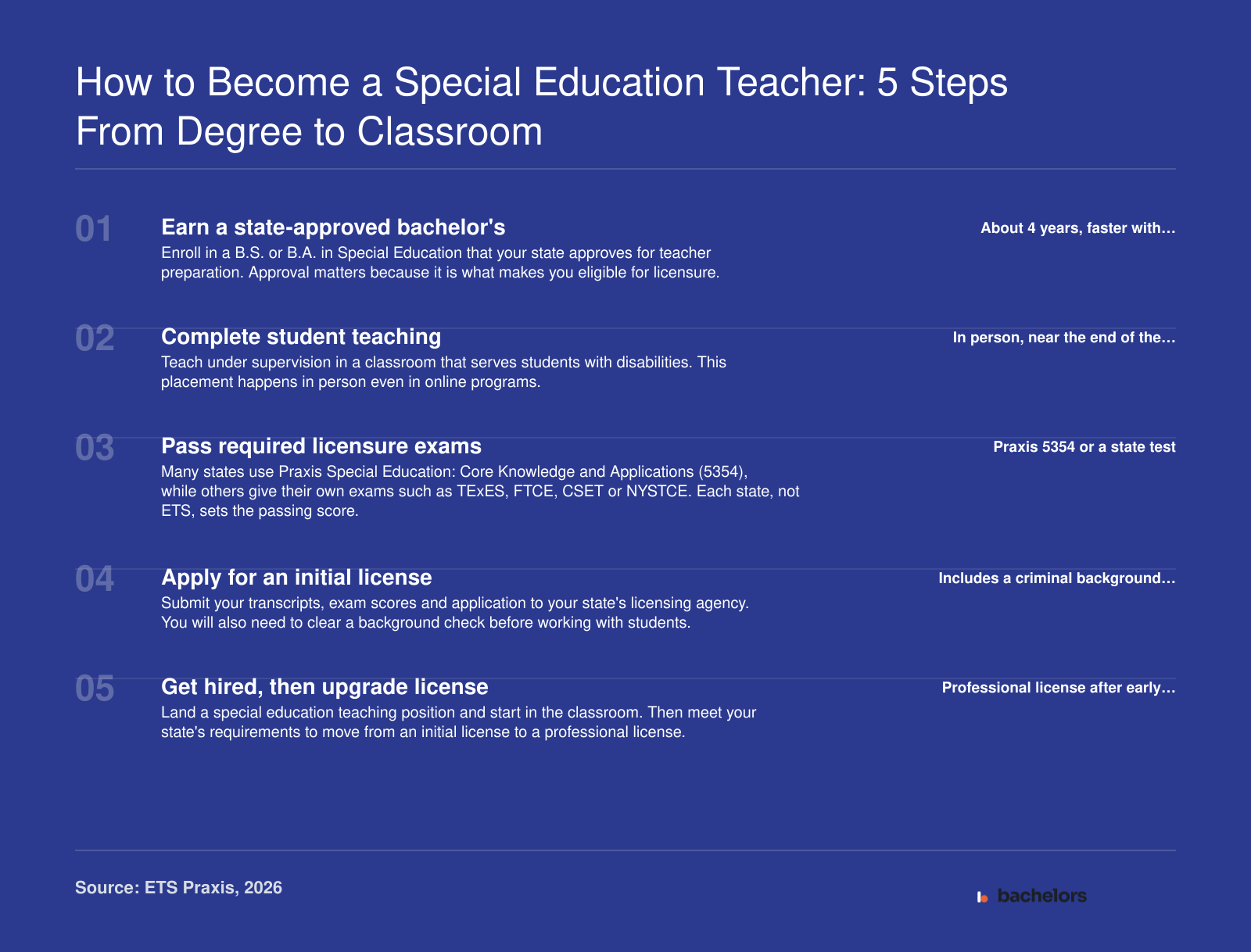
How to Become a Special Education Teacher: 5 Steps From Degree to Classroom
How long does it take? For most students, about four years, the length of a full-time bachelor's degree in special education. Transfer students who bring in credits can often finish faster, but every route still runs through supervised student teaching, licensure exams and a state license.
Special Education programs by state
Special Education Degree FAQs
These answers cover the questions prospective teachers ask most often about degrees, graduate study, timelines and adding special education to an existing license. Requirements differ by state, so confirm details with your state education agency before you enroll.
What is the best degree for special education?
Do you need a master's degree to teach special education?
How long does it take to become a special education teacher?
Can I add a special education endorsement to an existing general education teaching license?
Compare Special Education programs on the data that matters
Explore more Education & Teaching majors or browse every field of study.
All Education & Teaching programs Browse every field of study