Best Mathematics Education Degree Programs
Compare 780+ accredited Mathematics Education programs at 770+ colleges, with net price after aid, graduation rates, earnings and debt from IPEDS and the U.S. College Scorecard.

A bachelor's degree in mathematics education combines a mathematics major, education coursework and supervised student teaching in one four-year path to a classroom. Schools award either a Bachelor of Science (B.S.) or a Bachelor of Arts (B.A.) in Mathematics Education, and either title leads to an initial license in most states.
Districts hire math teachers steadily, so the harder questions are usually money and paperwork. Among the schools ranked here, average net price after grant aid runs from roughly $12,500 to $19,100, and programs appear on campus, online, and in blended form.
Licensure stays state-specific. A program approved in one state may not transfer cleanly to another.
Key Points
- Federal College Scorecard outcomes, not reputation, determine each school's ranked position.
- B.S. and B.A. programs usually lead to the same initial teaching license.
- Online programs still require classroom student teaching; Liberty's runs 16 weeks.
Best Schools for a Bachelor's Degree in Mathematics Education
The strongest mathematics education programs combine a real mathematics major with supervised classroom time and a clear route to state licensure. The ten schools below pair affordable net prices and strong completion rates with fieldwork that starts early, and several report what their graduates earn within a few years of finishing. Each card notes the format, tuition, and the credential each program leads to.
University of California-Los Angeles
#1Los Angeles, CA · $13,000/yr (est. net price)
Best for: Aspiring urban math teachers
UCLA runs this pathway through its mathematics department and the Curtis Center, which supports undergraduates heading into K-12 mathematics teaching. Students take six specialized teaching courses and complete a capstone sequence whose field experience counts toward the 600 clinical hours a California credential requires. Two routes lead to a Single Subject Teaching Credential in Mathematics: one finishes the credential at graduation, the other adds summer coursework and a master's in education. The Los Angeles setting places students in nearby public schools for teacher observations.
- Six specialized K-12 teaching courses, including Math 73XP to 75XP
- Math 105ABC capstone sequence with field experience
- Math fieldwork counts 20 of the 600 clinical hours
- Education coursework adds 280 clinical hours
- Integrated pathway earns the credential at graduation
- Joint pathway adds summer courses and a master's degree
- EdTPA portfolio assessment required for the credential
- Major and minor both offered
University of Michigan
#2Ann Arbor, MI · $18,000 – $61,000/yr (est.)
Best for: Students pairing a math major with certification
Students at the University of Michigan earn a secondary mathematics teaching certificate alongside a Bachelor of Arts, Bachelor of Science or Bachelor of General Studies in Literature, Science, and the Arts, or an education degree from the School of Education. The program requires 30 credits of education coursework, including a 10-credit directed teaching placement, plus mathematics prerequisites in algebra, geometry, probability and analysis. Applications come in the sophomore year, so the prerequisite sequence has to be planned early. Ann Arbor's certificate is built around Michigan licensure for grades 7 through 12.
- Certificate earned alongside a B.A., B.S. or B.G.S.
- Prepares for Michigan certification in grades 7-12
- Requires 10 education courses totaling 30 credits
- Math prerequisites include Math 205 or 215 and Math 217
- Includes a 10-credit directed teaching placement
- Applicants apply in sophomore year, February 1 deadline
- Adds a 20-24 credit concentration or minor in another field
Vanderbilt University
#3Nashville, TN · ~$16,000/yr (est.)
Best for: Research-minded secondary math educators
Vanderbilt's Peabody College awards a Bachelor of Science in Education with either an elementary or a secondary track, and the secondary track licenses graduates to teach mathematics in grades 7 through 12. The Department of Teaching and Learning is known for research in mathematics and science education, language and literacy, and classroom environments and management. Secondary candidates concentrate in mathematics while completing practice-intensive teaching preparation in Nashville.
- Secondary track leads to licensure in grades 7-12
- Mathematics is one of four secondary teaching subjects
- Elementary track is research-grounded and practice-intensive
- Housed in the Department of Teaching and Learning
- Known for mathematics and science education scholarship
University of California-Irvine
#4Irvine, CA · $14,000/yr (est. net price)
UC Irvine houses its mathematics teaching options in the Department of Mathematics, with a specialization in mathematics for education and a separate concentration that adds secondary teaching certification. Students apply by department form and faculty interview no later than the end of junior year. The campus CalTeach program, jointly sponsored by the sciences and the School of Education, supports a four-year route to a secondary credential, and the approved subject-matter program lets graduates waive the subject matter exam for teachers. Graduates of the mathematics program reported median earnings of $56,003 one year after finishing, and 95% were employed.
- Mathematics for Education specialization inside the math B.S.
- Separate concentration adds secondary teaching certification
- Admission by department form and faculty advisor interview
- Apply no later than the end of junior year
- MATH 192 covers learning and teaching of secondary mathematics
- CTC-approved subject-matter program waives the subject matter exam
- Specialization and teaching concentration cannot both be taken
University of California-Davis
#5Davis, CA · $10,000 – $15,000/yr (est.)
UC Davis awards either a Bachelor of Arts or a Bachelor of Science in Mathematics, and upper-division students choose among preparation for graduate study, computational and applied mathematics, or mathematics for secondary teaching. The teaching focus is designed for future middle and high school mathematics instructors. CalTeach/MAST, run with the School of Education, adds classroom internships and courses that let undergraduates test teaching early. The B.S. carries more mathematics coursework, while the A.B. leaves room for subjects outside the major.
- Three upper-division focus areas, including secondary teaching
- Teaching focus prepares middle and high school math instructors
- A.B. leaves room for courses outside the major
- B.S. gives more focused mathematics instruction
- CalTeach/MAST adds classroom internships and teaching courses
- Transfer students should finish lower-division requirements first
University of Maryland-College Park
#6College Park, MD · $16,000/yr (est. net price)
The University of Maryland offers a Bachelor of Science in Mathematics Education for grades 7 through 12, combining pre-professional education courses with a 39 to 44 credit professional sequence. Candidates enter a competitive teacher education program, hold a 2.75 GPA, pass a basic skills test, and finish a yearlong internship in a public partner school. Graduates meet Maryland's Professional Eligibility Certificate requirements, and certification is recognized in affiliated states through the Interstate Reciprocity Agreement. Students in the program reported median earnings of $69,438 five years after finishing.
- B.S. leading to grades 7-12 mathematics licensure
- 39 to 44 credits of education and mathematics coursework
- Yearlong internship in a public partner school
- Maintain a 2.75 GPA after admission to the professional program
- Basic skills test and Praxis II required
- Meets Maryland Professional Eligibility Certificate requirements
- Dual major option can be completed in four years
California Polytechnic State University-San Luis Obispo
#7San Luis Obispo, CA · ~$17,000/yr (est.)
Cal Poly's Bailey College of Science and Mathematics offers a mathematics major with a Mathematics Teaching concentration aimed at a high school teaching credential or graduate study in mathematics education. The degree pairs a core of foundational and advanced mathematics with electives, a capstone, and faculty-mentored undergraduate research. A blended bachelor's and master's route is open to students who apply after two upper-division mathematics courses and before 180 units. Median earnings five years after finishing were $76,020.
- Mathematics Teaching concentration leads to a high school credential
- Core mathematics plus electives and a capstone
- Faculty-mentored undergraduate research available
- Blended bachelor's and master's option for eligible students
- Also prepares students for graduate study in mathematics education
University of Wisconsin-Madison
#8Madison, WI · ~$17,000/yr (est.)
The University of Wisconsin-Madison awards a Bachelor of Arts in Mathematics with a named option in mathematics for secondary education. The major requires eight courses and 24 credits, including linear algebra, analysis, modern algebra, geometry and a capstone on teaching secondary mathematics, plus two courses numbered 500 or above. Students declare after completing the calculus sequence and must hold a 2.000 GPA in mathematics courses. Median earnings were $45,966 one year after finishing and $48,435 four years after.
- B.A. in Mathematics with a named option in secondary education
- 24 credits and eight courses, including a capstone
- Capstone course on teaching secondary school mathematics
- Two MATH courses numbered 500 or above required
- 2.000 GPA in all MATH courses and 15 upper-level credits on campus
- Named options do not support Honors in the Major
William & Mary
#9Williamsburg, VA · $15,000 – $20,000/yr (est.)
William & Mary lists a pre-college mathematics teaching concentration inside its Bachelor of Science in Mathematics, so future teachers study the same core as other mathematics majors. The College of Arts and Sciences also offers applied mathematics, statistics and standard mathematics concentrations, plus a mathematics minor. The concentration sits in a small public research university setting in Williamsburg, Virginia, where undergraduates work closely with faculty. The catalog names the degree as a B.S. in Mathematics with the teaching concentration in the title.
- B.S. in Mathematics with a pre-college teaching concentration
- Same degree offers applied math, statistics and standard tracks
- Housed in the College of Arts and Sciences
- Mathematics minor available alongside the degree
Ohio State University
#10Columbus, OH · $17,000/yr (est. net price)
Ohio State's Bachelor of Science in Education in Science and Mathematics Education lets students choose mathematics among five subject concentrations and prepares them for Ohio licensure in grades 7 through 12. Field experiences begin in the first year, include a required service-learning course in partner schools, and culminate in a semester of student teaching in the senior year, largely in Franklin County districts. It is the largest program in this group by completions, with 212 degrees awarded. Median earnings were $41,944 one year after finishing and $52,459 four years after, with median debt of $23,250.
- B.S.E. in Science and Mathematics Education with a math concentration
- Prepares for Ohio licensure in grades 7-12
- Field experience every year, ending with a semester of student teaching
- First Education Experience Program service-learning required
- Placements in Franklin County schools, including Columbus City Schools
- Honors Program and Global Option study abroad available
Cost & outcomes by school
Federal data for the highest-earning Mathematics Education programs, independent of the ranking above. Earnings are this field's bachelor's graduates four years after completing where the Scorecard reports them, else the school's undergraduate median.
| School | Net price / yr | Grad rate | Earnings | Debt | Grads/yr | Format |
|---|---|---|---|---|---|---|
| Villanova University PA | $43,756 | 92% | $100,423 | $25,874 | — | Campus |
| University of Notre Dame IN | $26,780 | 95% | $99,980 | $19,000 | — | Campus |
| Vanderbilt University TN | $15,846 | 94% | $91,565 | $14,000 | 4 | Campus |
| California Polytechnic State University-San Luis Obispo CA | $16,665 | 86% | $90,768 | $18,500 | — | Campus |
| Saint Joseph's University - Philadelphia PA | $29,689 | 79% | $86,881 | $25,500 | 4 | Campus |
| University of California-San Diego CA | $12,470 | 86% | $84,943 | $15,500 | 13 | Campus |
| University of Michigan MI | $13,138 | 93% | $83,648 | $19,500 | 13 | Campus |
| Missouri University of Science and Technology MO | $16,298 | 64% | $82,957 | $23,250 | — | Campus |
| University of Maryland-College Park MD | $15,678 | 89% | $82,860 | $19,000 | 18 | Campus |
| Bowdoin College ME | $14,398 | 95% | $82,735 | $18,500 | — | Campus |
| Loyola University Maryland MD | $30,574 | 79% | $82,652 | $27,000 | — | Campus |
| University of California-Los Angeles CA | $12,548 | 93% | $82,511 | $14,000 | 9 | Campus |
Sources: U.S. Department of Education. Net price, graduation rate, earnings and debt: College Scorecard (earnings and debt for this field's bachelor's graduates where reported, else school-wide); graduates: IPEDS. A dash means no figure is reported.
Cost, debt & payoff
Median earnings of this field's bachelor's graduates (4 yrs after completing, else the school's undergraduate median) vs. their median federal loan debt · U.S. College Scorecard
Across these programs the median graduate earns about $51,745 and finishes with roughly $23,507 in debt — a ratio that clears a common rule of thumb (keep debt below first-year salary). Net price and debt vary widely school to school, so check the per-school figures in the table above before you shortlist.
How We Ranked These Mathematics Education Programs
This ranking rests on federal data rather than reputation, scoring each program on outcomes a prospective student can verify.
What the Data Covers
We built the list from the U.S. Department of Education's College Scorecard and IPEDS, the two most complete public sources on how a college performs. For every school considered, we looked at net price and tuition, graduation and retention rates, and, where the federal government reports it, program-level earnings and typical debt for bachelor's completers in mathematics education. Cost and completion carry real weight here, because a teaching credential pays back slowly and student debt follows graduates into their first classroom.
Where the Numbers Stop
Two limits matter. Graduation rate and net price describe the whole institution, not the mathematics education department, so a strong education program can sit inside a college with an average completion rate. Program earnings cover only students who received federal financial aid, which means the figures describe a subset of graduates rather than everyone who finished.
What You Still Need to Check
The ranking does not measure licensure pass rates, the quality of student teaching placements, or faculty depth in mathematics. Those are the factors that most directly shape whether you finish licensed and confident, and only the school can give you current answers. Ask each one for its most recent pass rates and where it places student teachers.
Online and on-campus programs were both eligible. Format neither earned nor lost points; a well-run online pathway competes on the same terms as a campus one.
B.S. vs. B.A. in Mathematics Education: Which Degree Fits You?
The B.S. leans toward advanced mathematics, while the B.A. leaves more room for pedagogy and liberal arts. Both prepare you to teach, and in most states a state-approved program of either type leads to the same initial license. Choose based on how much upper-level math you want and how each school structures its teacher education sequence.
| Factor | B.S. in Mathematics Education | B.A. in Mathematics Education |
|---|---|---|
| Math emphasis | Heaviest math load: Calculus I through III, linear algebra, abstract algebra, Euclidean geometry, and statistics, with proof-based courses | Solid math core, but with a lighter upper-level load. At the University of Iowa, the pathway sits on top of a math B.A. or B.S. and adds 41-42 hours of math education content |
| Pedagogy and liberal arts | Fewer electives, since math and professional education courses fill much of the schedule | More room for pedagogy, liberal arts, and, at some schools, a foreign language. Iowa includes 46 semester hours of mathematics professional education |
| Grade-level focus | Secondary licensure, usually grades 6-12 or 7-12, with some schools offering a middle grades option | Same secondary focus. Middle grades options vary by school and state |
| Elementary teaching | Not the usual route. Elementary licensure generally runs through an elementary education major | Not the usual route either, for the same reason |
| Typical admission gates | Teacher education entry GPA often runs 2.75 to 3.0. One B.S. program requires 2.75 cumulative, major, and professional education GPAs, plus a C or better in all math and education courses | Iowa lists a 2.00 minimum major GPA for its teacher education program and a 2.70 threshold for good standing |
| Prerequisites and testing | Calculus readiness before starting the sequence, plus basic skills tests where your state requires them | Same calculus prerequisite and the same state testing requirements |
| License outcome | Same initial license in most states when the program is state-approved | Same initial license in most states when the program is state-approved |
Online vs. On-Campus Mathematics Education Programs
Liberty University's online education students finish with a 16-week student teaching semester that includes at least 150 hours of direct instruction, after three 16-week practicums of at least 30 K-12 classroom hours each. That schedule shows what earning a math teaching license online really requires: the coursework can move to a laptop, but the classroom cannot.
Every program in the ranking above is delivered on campus. Ohio State, for example, schedules field experiences every year and places student teachers in Franklin County partner schools. If you need more flexibility, online and hybrid options exist at other schools, and the rules below apply to them.
Field Experience Still Happens in Person
Online licensure-track programs require supervised time in real K-12 classrooms. Student teaching typically lasts a full semester, roughly 10 to 16 weeks depending on the state and program, and it is usually arranged near where you live. Early field work starts sooner than many students expect: Maryville University begins practicum in the sophomore year with weekly placements and requires experience in at least three partner districts before student teaching.
How Online Programs Handle Placements
Placement support varies. Liberty's field-placement office places students and requires background-check clearance first. ASU Online offers placement help through its college services and advising teams.
State authorization is the bigger hurdle. These rules cover online coursework as well as out-of-state practicums and student teaching, and a state may require its education agency to approve an out-of-state university before it places a student in a local school. NC-SARA membership authorizes some distance education across state lines but provides no professional licensure reciprocity. Ohio State generally does not offer online licensure programs to students in states where the program does not meet local requirements. Columbus State lists only Georgia and Alabama as states where its licensure program meets requirements. La Salle notes that authorization to offer a program does not guarantee you can complete field experiences in your state.
Course format matters too. Synchronous classes meet live at set times, while asynchronous courses let you work on your own schedule. Student teaching, however, follows the school day.
Three Things to Confirm Before Enrolling Online
- State approval: Ask whether the program leads to licensure in the state where you plan to teach, not just where the university is located.
- Placement responsibility: Find out whether the university or you will arrange practicum and student teaching sites.
- Supervision: Confirm you will have a university supervisor observing and evaluating your student teaching.
Related Articles
Three Math Education Programs With the Strongest Return on Investment
The return on investment (ROI) ratio below divides a school's institution-wide median earnings 10 years after enrollment by the median debt its graduates carry, using U.S. Department of Education College Scorecard and IPEDS data. Because both figures cover every graduate of the school, not only math education majors, treat the ratio as a proxy for overall value rather than a promise of what a math teacher will earn. Program-level earnings for mathematics education graduates are reported only for Brigham Young University, so that column is the closest view of actual teaching outcomes.
| School | Location | Average Annual Net Price | Median Graduate Debt (Institution-Wide) | Median Earnings 10 Years After Enrollment (Institution-Wide) | Math Education Program Earnings (Time Window) | ROI Ratio |
|---|---|---|---|---|---|---|
| Brigham Young University | Provo, UT | $15,564 | $11,069 | $75,790 | $52,995 (5 years after graduation) | 6.85 |
| Vanderbilt University | Nashville, TN | $15,846 | $14,000 | $91,565 | Not reported | 6.54 |
| University of California-Davis | Davis, CA | $14,741 | $13,000 | $80,838 | Not reported | 6.22 |
What High School Teachers Earn Nationally
A bachelor's degree in mathematics education prepares you for secondary classrooms, where national pay looks like this:
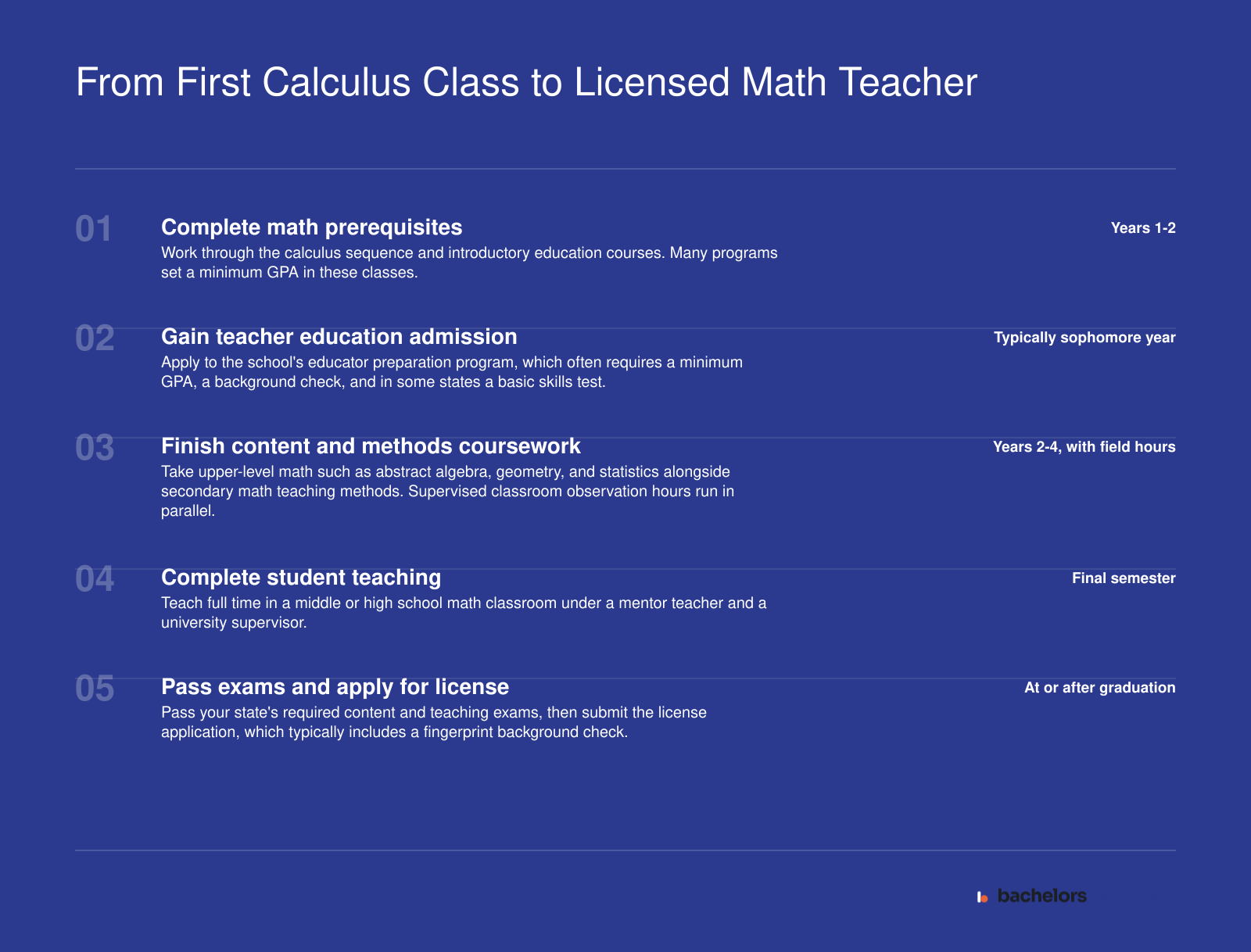
From First Calculus Class to Licensed Math Teacher
A bachelor's degree in mathematics education follows a predictable sequence, and missing a gate early can delay graduation by a semester or more. Exact requirements and exam names vary by state, but most programs move students through the same five stages.
Questions to Ask Yourself
Will this program's state approval carry you into the state where you actually want to teach?
Who finds your student-teaching placement, and how far will you have to travel?
Would a TEACH Grant's four-year service commitment in a high-need school fit your career plans?
Will your community college calculus credits transfer, or will you repeat them?
Mathematics Education programs by state
Frequently Asked Questions About Mathematics Education Degrees
What is the best degree for becoming a math teacher?
How much do math teachers earn with a bachelor's degree?
Can I teach math with a regular math degree instead of a math education degree?
Do I need a master's degree to keep teaching math?
Compare Mathematics Education programs on the data that matters
Explore more Education & Teaching majors or browse every field of study.
All Education & Teaching programs Browse every field of study