Best Early Childhood Education Schools in New Jersey
Compare 6 accredited Early Childhood Education programs in New Jersey, with net price after aid, graduation rates, earnings and debt from IPEDS and the U.S. College Scorecard.

A bachelor's degree in early childhood education in New Jersey can cost anywhere from roughly $14,000 to nearly $40,000 a year in tuition and fees, yet the teaching credential at the end is the same Preschool through Grade 3 endorsement. The common route is the Bachelor of Science (B.S.) in Early Childhood Education, though some schools award a B.A. for the same pathway.
CAEP accreditation, online formats, P-3 certification and career outcomes all factor into the ranking below, and each one shifts where a school lands.
Most programs add a separate GPA and testing bar after enrollment, so the school you pick matters less than clearing that second checkpoint.
Key Points
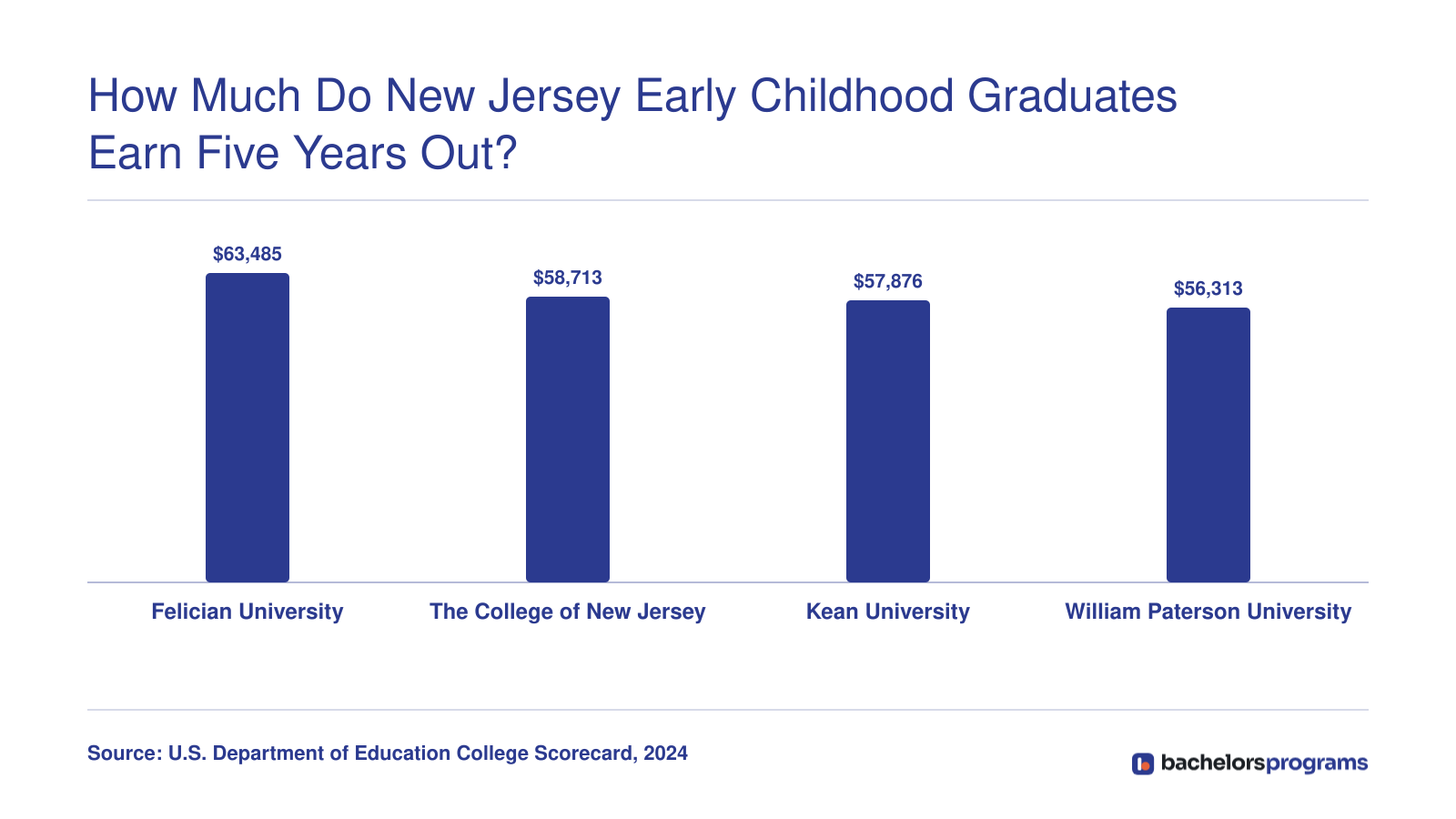
- Graduates earn medians of $56,313 to $63,485 five years after finishing.
- Approved program graduates earn New Jersey's CEAS for the P-3 endorsement.
- Kean requires 60 to 75 in-person classroom hours before student teaching.
Best Bachelor's Degree in Early Childhood Education Schools in New Jersey
The standard credential in this field is the Bachelor of Science in Early Childhood Education, though several New Jersey schools award the Bachelor of Arts for the same P-3 teaching pathway. Every program below is a bachelor's degree that pairs child-development coursework with supervised classroom experience and leads toward New Jersey certification. Schools offering these programs have graduation rates between about 44 percent and 86 percent, and average net prices after aid run from roughly $12,400 to $40,000.
Montclair State University
#1Montclair, NJ · ~$16,000/yr (est.)
Best for: Future teachers wanting an on-campus lab school
Montclair State University pairs a Bachelor of Arts in Early Childhood Education with a second major in Family Science and Human Development, so graduates build a child-development foundation alongside their teaching preparation. The university runs an inclusive on-campus early childhood center and a center for autism and early childhood mental health, and in 2025 it launched a consortium tying its early childhood services, educator preparation, and research together. The graduation rate is about 65 percent and the average net price after aid is $15,566.
- Double major with Family Science and Human Development
- Prepares for P-3 or K-6 teaching certification
- 3.0 GPA required overall and in the major
- Interview, essay and one faculty recommendation required
- Fall deadline February 1; spring deadline September 15
- Transfer applicants need 60 completed credits
- Five-year combined option adds dual certification in special education
- Home to the Ben Samuels Children's Center and an autism center
The College of New Jersey
#2Ewing, NJ · $20,000 – $26,000/yr (est.)
Best for: Dual majors pairing education with content study
The College of New Jersey awards a Bachelor of Science in Early Childhood Education, and every student is a dual major with a second field chosen from twelve approved content areas. Fieldwork and supervised teaching are built into the degree, and graduates qualify for P-3 certification, with K-6 certification available through added coursework and testing. The graduation rate is about 86 percent, and graduates of the early childhood program reported median earnings of $56,231 in the first year after finishing.
- 12 approved content areas for the required second major
- Dual major: early childhood plus a content field
- Leads to New Jersey certification in grades P-3
- K-6 certification available with added coursework and testing
- Fieldwork and supervised teaching built into the degree
- Coursework spans liberal arts, education theory and practice
Rowan University
#3Glassboro, NJ · $22,000/yr (est. net price)
Best for: Students seeking a birth-to-age-eight focus
Rowan University's early childhood degree focuses on children from birth through age eight and is built around New Jersey's teaching standards along with NAEYC professional standards. Candidates clear Praxis Core before entering professional coursework and must hold a 3.0 GPA overall and in the professional sequence with no grade below C-. The graduation rate is about 67 percent and the average net price after aid is $22,408.
- Focus on children from birth through age eight
- Aligned with NAEYC and New Jersey teaching standards
- Praxis Core required before professional coursework
- Combined Praxis Core test #5752; reading 156, writing 162, math 150
- 3.0 overall and professional GPA; no grade below C-
- Praxis II scores due before clinical practice begins
- Clinical practice applications open one year in advance
- Early Childhood Education Club for students
Kean University
#4Union, NJ · $14,000 – $22,000/yr (est.)
Kean University's early childhood degree leads to P-3 certification with a Teacher of Students with Disabilities endorsement, and the College of Education has held educator preparation accreditation since 1955 while the program is recognized by NAEYC. Students can add a content area or a second major, and classes run at the Union campus and at Kean Ocean. The average net price after aid is $12,447, the lowest on this list, and early childhood graduates reported median first-year earnings of $54,447.
- P-3 certification plus Teacher of Students with Disabilities endorsement
- Recognized by NAEYC; educator preparation accreditation since 1955
- State approved program; add a content area or second major
- Fieldwork in public schools and early childhood centers
- Classes at the Union campus and at Kean Ocean
- Early childhood scholarships for students with financial need
William Paterson University of New Jersey
#5Wayne, NJ · $16,000 – $25,000/yr (est.)
William Paterson University offers a bachelor's degree designed specifically for working paraprofessionals, delivered in two phases: a 60-credit undergraduate phase that awards the B.A., followed by a phase required for certification. The university keeps professors in residence in Paterson schools and is expanding its Paterson presence, which fits students who already work in classrooms. The average net price after aid is $18,745 and the graduation rate is about 44 percent.
- Two-phase program built for working paraprofessionals
- Phase I awards the B.A. over 60 credits
- Phase II is required for teaching certification
- Designed for adults already working in classrooms
Felician University
#6Lodi, NJ · ~$40,000/yr (est.)
Felician University is a private university in Lodi whose education degree leads to initial New Jersey licensure in both early childhood (P-3) and Teacher of Students with Disabilities. Fieldwork starts in the first year, with placements in general and special education classrooms, and students can add a co-major in mathematics, biology, art, or psychology. The average net price after aid is $40,045 and the graduation rate is about 47 percent.
- Initial New Jersey licensure in early childhood (P-3)
- Second licensure area: Teacher of Students with Disabilities
- Classroom observation begins in the first year
- Placements in general and special education settings
- Co-major options in mathematics, biology, art or psychology
- Traditional, cohort or working adult program models
- EdAssist tuition benefits for eligible employees of partner employers
Cost & outcomes by school
Federal data for the highest-earning Early Childhood Education programs, independent of the ranking above. Earnings are this field's bachelor's graduates four years after completing where the Scorecard reports them, else the school's undergraduate median.
| School | Net price / yr | Grad rate | Earnings | Debt | Grads/yr | Format |
|---|---|---|---|---|---|---|
| Montclair State University NJ | $15,566 | 65% | $61,415 | $22,000 | 151 | Campus |
| Rowan University NJ | $22,408 | 67% | $59,988 | $20,500 | 119 | Campus |
| The College of New Jersey NJ | $27,646 | 86% | $59,328 | $23,299 | 79 | Campus |
| Kean University NJ | $12,447 | 47% | $58,885 | $25,713 | 132 | Campus |
| William Paterson University of New Jersey NJ | $18,745 | 44% | $57,780 | $20,750 | 52 | Online |
| Felician University NJ | $40,045 | 47% | $57,602 | $25,000 | 10 | Campus |
Sources: U.S. Department of Education. Net price, graduation rate, earnings and debt: College Scorecard (earnings and debt for this field's bachelor's graduates where reported, else school-wide); graduates: IPEDS. A dash means no figure is reported.
Cost, debt & payoff
Median earnings of this field's bachelor's graduates (4 yrs after completing, else the school's undergraduate median) vs. their median federal loan debt · U.S. College Scorecard
Across these programs the median graduate earns about $59,107 and finishes with roughly $22,650 in debt — a ratio that clears a common rule of thumb (keep debt below first-year salary). Net price and debt vary widely school to school, so check the per-school figures in the table above before you shortlist.
How We Ranked New Jersey Early Childhood Education Schools
Every school on this list is a regionally accredited New Jersey institution that offers a bachelor's degree in early childhood education, on campus, online, or in a hybrid format. Montclair State University, The College of New Jersey, Rowan University, Kean University, William Paterson University of New Jersey and Felician University all cleared that first filter.
What We Looked At
- Outcomes: graduation and retention rates, plus the share of graduates repaying their debt.
- Cost: net price after federal, state and institutional aid, not the sticker price.
- Earnings: median earnings of former students 10 years after entry, drawn from federal College Scorecard data, plus program-level earnings and debt where a school publishes them.
What Is Institution-Wide
Graduation rate, net price and 10-year earnings describe the whole institution, not the early childhood major alone. Read them as a signal of how a college performs overall, not a promise about one program's graduates. Where a school does publish a program-level figure, that number took priority over the broader institutional one.
Checked Separately
Accreditation and the P-3 certification pathway were reviewed separately and are covered later. Not every New Jersey program publishes the outcomes data this ranking depends on, so the list stays short.
Online and Hybrid Early Childhood Education Bachelor's Options at New Jersey Schools
Kean University's early childhood candidates spend 60 to 75 hours in a PK-12 classroom before student teaching, nine full school days at minimum, and all of those hours happen in person.1
Which programs you can start online
At these schools, most early childhood bachelor's programs are listed as campus-based. Montclair State University, The College of New Jersey, Kean University and Felician University describe on-campus delivery. Rowan University is primarily on campus but does put some courses online. William Paterson University of New Jersey runs an online Phase I route built for working paraprofessionals, a 60-credit, two-phase program; Phase II is the part that leads to certification. No licensure track at these schools is described as fully online, so expect some campus time.
The hours that stay in a classroom
Every route ends in supervised fieldwork. Rowan splits student teaching into Clinical Practice I and II, two back-to-back semesters in public, charter, daycare and inclusive preschool through third-grade settings. William Paterson also sequences Clinical Practice I and II.2 Kean places candidates only in classrooms that match their certification area.1 Felician begins classroom observation in the first year and places students in both general and special education rooms. Because the credential is New Jersey's P-3 certification, plan on New Jersey classrooms for these hours even when your coursework is online.
A rule of thumb
- Already working in a classroom: William Paterson's online paraprofessional route fits around a full-time teaching aide schedule.
- Commuting and want flexibility: Rowan's blend of online courses and campus sessions.
- Want a cohort and hands-on placement support: a campus program at Montclair State, TCNJ, Kean or Felician, where Felician also offers working adult pacing.
Ask each education department how sites are matched and whether you can propose a school near you.
Admissions Requirements for New Jersey Early Childhood Education Bachelor's Programs
In New Jersey teacher preparation, the toughest checkpoint usually comes after you enroll. Many early childhood programs admit students to the university first, then set a separate GPA and testing bar before education coursework and student teaching begin. When comparing schools, check three things: the GPA you need to stay in the program, whether SAT or ACT scores are required, and how transfer credit is handled.
What the Schools Publish
- Rowan University: The B.A. in Education (Early Childhood Education P-3) requires a 3.0 overall GPA and a 3.0 GPA in education courses to enter professional coursework and clinical practice, with no grade below C-. Rowan is test-optional for admission, and withholding SAT or ACT scores is not penalized. Students must pass the Praxis Core by April 30 for fall entry or November 15 for spring entry into professional courses. Transfer credit limit: No policy published.
- The College of New Jersey: For current TCNJ students moving into the B.S. in Early Childhood Education, the 2024-2025 bulletin lists a 2.75 minimum GPA and a C- or better in specified foundation courses.1 That is a change-of-major standard, not a first-year minimum. Every student in the program also completes a second major.2 Test policy: No policy published in the program bulletin.
- Montclair State University, Kean University, William Paterson University of New Jersey and Felician University: No policy on program-level GPA, testing or transfer credit is published in the materials available. Confirm current requirements with each admissions office.
Many New Jersey students start at a county community college. The NJ Transfer website lets you check how individual courses carry over. Education coursework is less predictable: early childhood programs are sequential, and TCNJ notes that transfer students may need at least one extra year to finish. Rowan's materials do not publish a specific transfer cap or partnership, so request a credit evaluation early.
How to Prepare
Treat a 3.0 GPA as your planning target, since that is the progression bar at Rowan and comfortably clears TCNJ's 2.75 standard. Schedule the Praxis Core well before your program's deadline rather than in your final semester. Requirements also shift between catalog years, so read the current bulletin for your entry term, not an older one.
How Much Do New Jersey Early Childhood Graduates Earn Five Years Out?
Five years after finishing, early childhood education graduates from these New Jersey schools post median earnings between $56,313 and $63,485. Set those figures against the net price in the cost table above to judge value. Felician University shows the highest median, drawn from a smaller graduating group, while The College of New Jersey, Kean University and William Paterson University sit close together. Program-level earnings are not reported for Montclair State University or Rowan University.
Related Articles
New Jersey P–3 Certification at a Glance
What Preschool and Kindergarten Teachers Earn in New Jersey
New Jersey preschool teachers earned a median of $48,225 in 2025. The 10th to 90th percentile range ran from $37,019 to $86,915.
New Jersey Early Childhood Education Degree FAQs
What is the best college in New Jersey for early childhood education?
Which New Jersey colleges offer P-3 certification?
How long does it take to become an early childhood teacher in New Jersey?
Compare Early Childhood Education programs on the data that matters
Explore more Education & Teaching majors or browse every field of study.
All Education & Teaching programs Browse every field of study