Best Educational Studies Degree Programs
Compare 230+ accredited Educational Studies programs at 210+ colleges, with net price after aid, graduation rates, earnings and debt from IPEDS and the U.S. College Scorecard.

A bachelor's degree in educational studies examines how people learn and how schools work, without the state-approved student-teaching sequence that leads to a classroom license. The usual credential is the Bachelor of Science (B.S.) in Educational Studies, though some schools use different names for it. It suits people drawn to training, nonprofits, education policy, or youth programs more than a classroom.
That distinction should shape your choice of program. Most programs here do not lead straight to teacher certification, so graduates who want to teach need a separate route.
Employers outside K-12 are the main destination for these graduates, and they hire for skills more than for a license.
Key Points
- University of Florida's online Education Sciences program averages $4,815 yearly after aid.
- Educational studies is non-licensure, so aspiring teachers add certification afterward.
- Campus study dominates, and the University of Florida is the online exception.
Best Bachelor's Degree in Educational Studies Programs: Our Top 10
The ten programs below stand out on the measures that matter most to prospective students: a manageable net price after aid, strong institution-wide completion, and formats that fit different schedules, whether fully online or campus based. Each entry shows what the school reports publicly so you can compare cost and completion side by side before digging into the program details that fit your goals.
University of California-San Diego
#1La Jolla, CA · $10,000 – $15,000/yr (est.)
Best for: Future teachers seeking fieldwork-rich preparation
The University of California, San Diego offers its education major through the Education Studies department as a Bachelor of Science in Education Sciences. Undergraduates complete a research-heavy upper-division core that includes both qualitative and quantitative methods, then finish a capstone fieldwork sequence in a school or community setting. Three specializations let students aim at elementary practice, secondary practice, or research and outreach, and the department works closely with San Diego districts, policymakers, and community organizations.
- Three specializations: elementary, secondary, or research and outreach
- 12 courses total, built around a capstone fieldwork sequence
- Qualitative and quantitative research methods both required
- Fieldwork hours in an educational setting required of all majors
- Choose from three capstone fieldwork pathways
- One pathway qualifies students for a graduate teaching program
- Design a custom elective focus or add a minor or second major
University of Florida
#2Gainesville, FL · ~$4,800/yr (est.)
Best for: Working adults needing a fully online option
The University of Florida is a large public research university in Gainesville that delivers its education sciences major entirely through UF Online. Core coursework covers educational technology, educational psychology, social foundations of education, and access and support for people with disabilities, then students pick a specialization and complete an internship, practicum, or experiential learning requirement. Because the degree is fully online, students are not tied to a campus schedule, and the program does not lead to teaching certification.
- Seven specializations, including early childhood studies and education technology
- Fully online delivery through UF Online
- 15 specialization credits plus an internship or practicum
- Upper-division transfer applicants need a 2.5 GPA and one prerequisite
- Does not lead to teaching certification
- 4+1 pathway to a master's degree in five years
- Military benefits accepted and financial aid available
University of Washington-Seattle Campus
#3Seattle, WA · ~$14,000/yr (est.)
Best for: Early childhood educators advancing their careers
The University of Washington's Seattle campus houses Education Studies as a Bachelor of Arts major with seven concentrations, including an Early Childhood Studies option for students who want to work with and for young children and families beyond the classroom. Admission requires 45 earned credits, an introductory education course, and English composition, and the major runs roughly 50 credits split between foundation, elective, and option-specific coursework. It also serves as a pathway into graduate study in early childhood education.
- Seven concentration options, including Early Childhood Studies
- 50 to 52 credit major: 23 foundation, 7 elective, 20 option credits
- 45 credits earned plus one introductory education course to apply
- English composition prerequisite required
- Pathway into graduate study in early childhood education
- 2.00 cumulative GPA required in major courses
Vanderbilt University
#4Nashville, TN · ~$16,000/yr (est.)
Vanderbilt University's Peabody College awards a Bachelor of Science in Educational Studies built on 120 credit hours, including 12 hours of fieldwork and a six-hour capstone. The Learning and Equity in Diverse Contexts specialization examines learning, design, and context in out-of-school settings, and students may enter it after matriculation rather than at admission. Educational Studies works as a first or second major, but it must become a third major or a minor when combined with a licensure program.
- 120 total credit hours, including a 31-hour general education core
- 12 credit hours of fieldwork, capped by a 6-hour capstone
- Learning and Equity in Diverse Contexts specialization available
- Specialization focuses on learning in out-of-school settings
- Can be added as a first or second major
- Must be a third major or minor alongside a licensure program
Bowdoin College
#5Brunswick, ME · ~$14,000/yr (est.)
Bowdoin College treats education as a coordinate major, so students pair six education courses with a major in another department and can also pursue interdisciplinary majors in education and mathematics or education and physics. The department offers a Teacher Scholars pathway that provides teacher certification at no additional cost. Small classes and a residential liberal arts model define the experience in Brunswick, Maine.
- Six education courses coordinated with a major in another department
- EDUC 1101 Power and Dilemmas in U.S. Education offered every semester
- Up to two cross-listed education courses may count
- Interdisciplinary majors in education and mathematics, and education and physics
- Teacher Scholars pathway offers no-cost teacher certification
- Grades of C- or better required in education courses
Columbia University in the City of New York
#6New York, NY · ~$22,000/yr (est.)
Columbia University's Education Studies major is taught through the Education department housed at Barnard College and is open to undergraduates at Barnard, Columbia College, and the School of General Studies. Majors complete 40 credits, including a field studies course and a two-semester senior research capstone that ends in an original inquiry project, and they choose among three concentrations. The major is designed for research, policy, and related graduate study rather than teacher certification.
- 40 credits across eleven courses, including a field studies course
- Three concentrations, including educational policy and comparative education
- Two-semester senior research capstone with an original inquiry project
- Open to Barnard, Columbia College, and School of General Studies students
- At least three concentration courses must be education courses
- Does not lead to teacher certification
- No AP or other exam credit exemptions
Brown University
#7Providence, RI · $25,000 – $30,000/yr (est.)
Brown University's Education Studies concentration requires at least ten courses, an experiential learning requirement, and a senior seminar that includes a capstone project. Students assemble a specialization such as education policy analysis, child development, immigration and education, or inequality and education, drawing no more than three courses from outside the department. Brown also names fifth-year pathways into a Master of Arts in Teaching and an Urban Education Policy program.
- At least 10 courses: three core, four specialization, three electives
- Senior seminar capstone (EDUC 1900) with a capstone project
- Experiential learning requirement
- No more than three of the 10 courses from outside the department
- Specializations include education policy analysis and child development
- Fifth-year MAT and Urban Education Policy pathways
University of Illinois Urbana-Champaign
#8Champaign, IL · ~$14,000/yr (est.)
The University of Illinois Urbana-Champaign offers a Bachelor of Science in Learning and Education Studies for students who want education careers outside licensed teaching. Students take 33 credit hours inside one of four concentrations, from educational equality to workplace training and development, on top of a shared education core, campus general education requirements, and a third semester of a world language. Graduates carry an education lens into business, nonprofit, healthcare, and technology settings.
- 120 semester hours, with 40 at the upper-division level
- 33 credit hours inside one of four concentrations
- Concentrations include educational technology and workplace training
- Built for education work outside licensed teaching
- Third semester of a language other than English required
- Published four-year sample course sequence
University of Wisconsin-Madison
#9Madison, WI · ~$17,000/yr (est.)
The University of Wisconsin-Madison awards a Bachelor of Science in Educational Policy Studies through the School of Education, with coursework spanning the history, sociology, anthropology, economics, politics, and philosophy of education. Students gain internship, community-based learning, and study abroad experience, and the department offers four related certificate programs. An honors program in educational policy studies launched in fall 2025.
- Coursework in history, sociology, economics, and philosophy of education
- Internships, community-based learning, and study abroad
- Four certificate options, including social justice and education
- Honors program in Educational Policy Studies launched fall 2025
- Prepares students for policy research and program leadership
Wellesley College
#10Wellesley, MA · $25,000 – $30,000/yr (est.)
Wellesley College offers a major in education studies built around nine units of coursework, an advising-centered structure, and a required capstone seminar or senior thesis sequence. Students may outline an optional concentration in areas such as education policy, urban education, or bilingual and bicultural education. Honors requires a thesis, an oral defense, and a 3.5 GPA in the major.
- Nine units of coursework, six of them completed at Wellesley
- Capstone seminar or senior thesis sequence (EDUC 360 and 370)
- At least two 300-level education courses
- Optional concentration in education policy or urban education
- Honors requires a thesis, oral defense, and 3.5 major GPA
- AP credit does not count toward the major
Cost & outcomes by school
Federal data for the highest-earning Educational Studies programs, independent of the ranking above. Earnings are this field's bachelor's graduates four years after completing where the Scorecard reports them, else the school's undergraduate median.
| School | Net price / yr | Grad rate | Earnings | Debt | Grads/yr | Format |
|---|---|---|---|---|---|---|
| Boston College MA | $41,704 | 91% | $103,937 | $19,000 | 21 | Campus |
| Columbia University in the City of New York NY | $21,590 | 96% | $102,491 | $21,500 | — | Campus |
| Bucknell University PA | $40,766 | 86% | $93,807 | $27,000 | 14 | Campus |
| Brown University RI | $25,184 | 96% | $93,487 | $11,428 | 43 | Campus |
| Vanderbilt University TN | $15,846 | 94% | $91,565 | $14,000 | 6 | Campus |
| Trinity College CT | $34,832 | 84% | $90,779 | $23,000 | 4 | Campus |
| Washington University in St Louis MO | $21,786 | 94% | $86,182 | $17,500 | 16 | Campus |
| University of California-San Diego CA | $12,470 | 86% | $84,943 | $15,500 | 71 | Campus |
| Wellesley College MA | $25,496 | 92% | $84,803 | $10,000 | 17 | Campus |
| Drexel University PA | $38,509 | 78% | $84,648 | $25,325 | 1 | Online or campus |
| Tufts University MA | $39,998 | 94% | $83,214 | $16,250 | 10 | Campus |
| Bowdoin College ME | $14,398 | 95% | $82,735 | $18,500 | 17 | Campus |
Sources: U.S. Department of Education. Net price, graduation rate, earnings and debt: College Scorecard (earnings and debt for this field's bachelor's graduates where reported, else school-wide); graduates: IPEDS. A dash means no figure is reported.
Cost, debt & payoff
Median earnings of this field's bachelor's graduates (4 yrs after completing, else the school's undergraduate median) vs. their median federal loan debt · U.S. College Scorecard
Across these programs the median graduate earns about $54,325 and finishes with roughly $23,250 in debt — a ratio that clears a common rule of thumb (keep debt below first-year salary). Net price and debt vary widely school to school, so check the per-school figures in the table above before you shortlist.
How We Ranked Educational Studies Programs
Ranking a bachelor's degree in educational studies comes down to cost and outcomes, not institutional prestige.
What Weighed Most
Four factors carried the most weight. Average net price after grant and scholarship aid came first, because it is the number students actually pay. Institution-wide graduation and retention rates came second: a program is only worth its price if students finish it. Third, program-level earnings and federal student debt from the College Scorecard, wherever the Department of Education publishes them for the field. Fourth, format flexibility, meaning whether a school offers the degree online, accepts transfer credit generously, or allows part-time enrollment for working adults.
Why Cost Beats Brand
Educational studies is usually a non-licensure degree, so it does not lead to a state teaching certificate or a district salary schedule. Graduates move into training, student services, nonprofit work, and graduate study, where what you can do matters more than the name on the diploma. A well-known university that leaves you with heavy debt is a worse bet than a regional public charging far less.
What the Numbers Cannot Tell You
Both rates cover the whole institution, not the educational studies major. Average net price is a campus-wide figure, not a price for you, and your aid package will differ.
Every figure here traces to the U.S. Department of Education's College Scorecard and IPEDS, most recent release.
What a B.S. in Educational Studies Is (And Isn't)
States have widened alternative routes into the classroom, and employers outside K-12 have built up their training functions, so the non-licensure education degree now reads as a deliberate choice rather than a fallback. The Bachelor of Science in Educational Studies is built for students who want to understand how people learn, how schools and community organizations work, and how education policy gets made, without committing to a student-teaching sequence tied to state licensure.
Credits and concentrations
Most programs land at 120 total credits, which is the standard bachelor's load. How those credits are divided varies widely. Arizona State University builds its degree around 45 major credits and requires at least 45 upper-division credits overall.2 Ohio Dominican University uses 24-credit concentrations4; the University of Arkansas asks for 18 concentration hours.5
Concentration names are not standardized nationally, but common directions include:
- Policy and systems: Kansas State University offers education policy, higher education, and academic advising emphases.1
- Community and global work: Ohio Dominican lists peace education and international education/global studies.
- Early childhood: Upper Iowa University pairs an early childhood education emphasis with a general educational studies track.
- Curriculum design: Ohio Dominican also offers curriculum and instruction for students aiming at instructional or training roles.
The experiential requirement
Instead of student teaching, these programs typically require supervised fieldwork, an internship, or a capstone. Kansas State finishes with a 6- to 9-credit internship in the final semester, shaped around the student's career goals.1 The University of New England requires field placements in every semester a student takes education coursework, with up to 12 internship credits and a culminating capstone.3 La Salle University places students in non-traditional settings supervised by both a site expert and a seminar instructor.6 Requirements differ by school, so confirm the structure before you enroll.
What it isn't
This degree does not grant a teaching license. If your goal is a K-12 classroom next fall, a licensure-track education degree with student teaching is the direct path. Educational studies graduates who later want to teach typically pursue certification separately.
Educational Studies vs. Education Degree: Which Should You Choose?
A bachelor's degree in educational studies and a licensure-track education degree can look similar on a course list, but they are built for different outcomes. Licensure-track education degrees are usually designed around a state-approved educator preparation program, while educational studies is not. Choose education if you are set on K-12 teaching soon. Choose educational studies if you want broader career options or plan to earn a license later. Requirements vary by state, so check with your state education department before you commit.
| Factor | B.S. in Educational Studies | Bachelor's in Education (Licensure Track) |
|---|---|---|
| Licensure eligibility | Does not lead to a teaching license. In Oregon, a bachelor's degree alone does not meet the requirement, and a TSPC-approved licensure program is still needed. | Prepares candidates for initial teacher certification. Kansas, for example, requires a Kansas-approved teacher-preparation program plus a bachelor's degree. |
| Student teaching | Not identified as a licensure requirement in non-licensure program descriptions. | Educator-preparation programs require coursework, assessments, and student teaching. |
| State approval | Not built around an approved program. In Maryland, the degree must be paired with an approved licensure program, and the degree alone is not identified as sufficient. | Maryland's approved pathway requires a bachelor's degree or higher, a program approved to lead to licensure, and passing licensure assessments. |
| Typical careers | Teacher assistant, preschool or day-care provider, youth development, tutoring, and children, family, or community outreach. | After earning the preliminary credential, graduates may begin teaching. California is one example. |
| Curriculum flexibility | Prepares students for positions that do not require state licensure, so the path is broader and less prescribed. | Requires completion of a state-approved teacher-preparation program, such as a Commission-approved program in California, so the path is more structured. |
| Fit for career changers | Works for people exploring education-related work without committing to a classroom, since a license can come later. | Fits those already committed to teaching who want the license built into the degree. |
| Route to certification later | Graduates can enter a teacher-licensure program later or use a nontraditional certification route for people who already hold a bachelor's degree. | Certification is typically earned as part of the degree. Minnesota may also accept an out-of-state approved program with equivalent field-specific student teaching. |
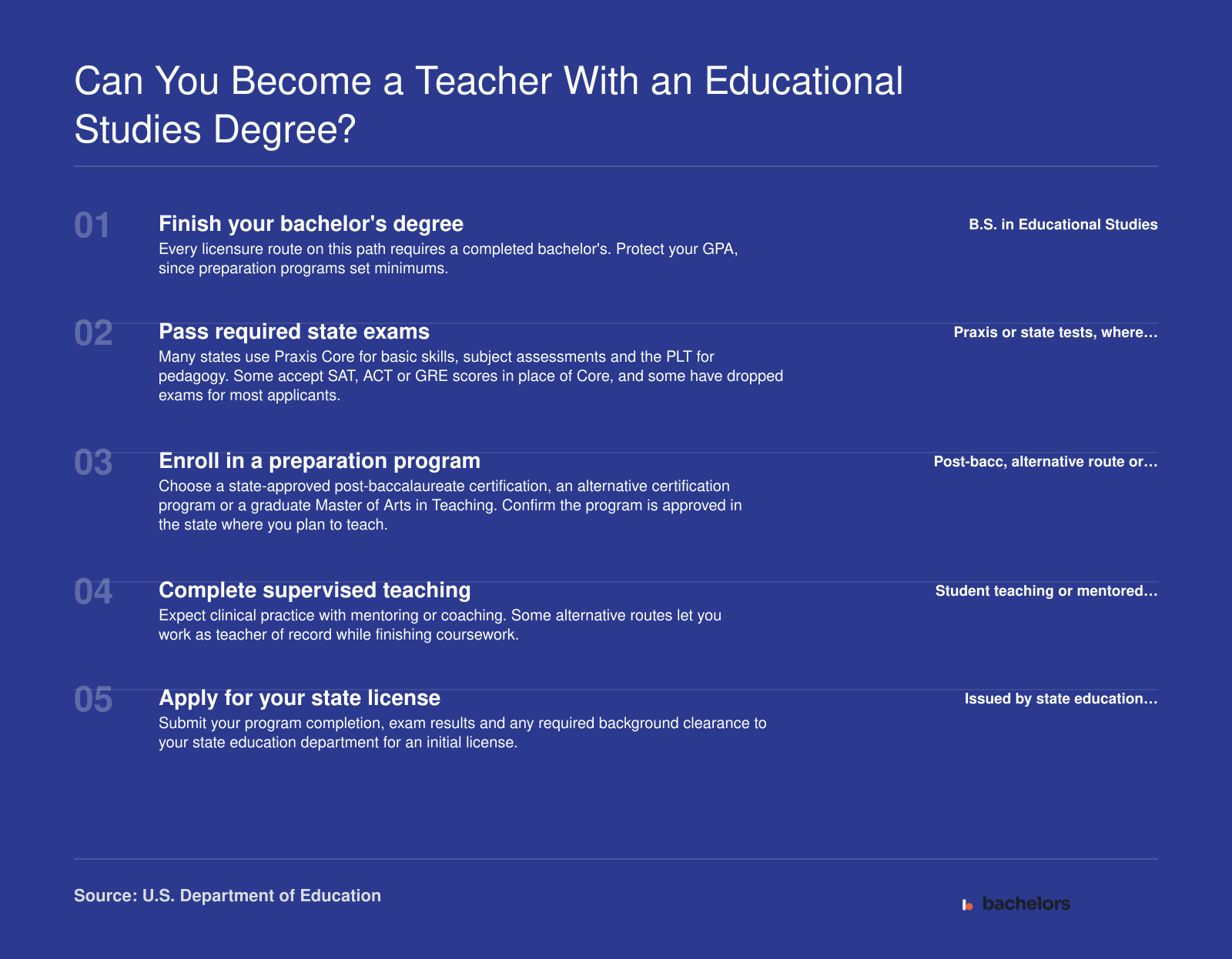
Can You Become a Teacher With an Educational Studies Degree?
Yes, but usually not with the bachelor's alone. Most educational studies programs are not state-approved teacher preparation programs, so graduates typically add a licensure route afterward. Routes and exam names vary by state. In Georgia, alternative certification asks for a 2.5 GPA, Praxis exams and a background check. In Texas, alternative certification can let you teach as teacher of record while you finish your requirements.
Related Articles
Online vs. Campus Educational Studies Programs
Campus study is still the default for this degree, and online options are the exception. Nearly every school ranked here teaches the major on campus. The University of Florida is the one listed as online, with a fully online Education Sciences option.
Degree-Completion Options for Working Adults
Adults who already hold college credit usually look past the top 10 to online schools built for them. Treat the figures below as ceilings, not guarantees, because limits vary by program and by year.
- Transfer credit: Online completion programs commonly accept 60 to 90 credits toward a 120-credit degree. Purdue Global, Columbia Southern and Franklin University cite up to 75 percent. UMGC and Charter Oak have reported 90, and UMass Amherst University Without Walls has reported 105.
- Prior learning: Portfolio assessment commonly earns 15 to 30 credits. Work-experience and prior-learning credit combined can reach 30 to 90 at adult-learner universities. Thomas Edison State University and Excelsior have reported figures as high as 113 when transfer and prior learning are combined, but sources conflict, so confirm the current cap.
- Residency: Most schools still require roughly 30 to 36 credits from the degree-granting institution. Some, such as UMass Amherst's program, require fewer.
- Pace: Many adult-focused programs run 7 to 8 week terms. Ask each school how its terms are structured.
Internships and Capstones Online
Online students typically complete fieldwork through a local placement, such as a school, nonprofit or training department near home, or through a project-based capstone. Florida's online program includes an internship or practicum experience. Ask early how placements are arranged and whether you must find your own site.
A Quick Rule of Thumb
Campus programs suit first-time students who want hands-on placements, faculty contact and a cohort. Online programs suit career changers who already hold substantial college credit and need to fit coursework around a job. Either way, check whether the major leads to teacher certification. Several programs here, including Florida's, do not.
Educational Studies Degree Cost: The Lowest Net Prices on Our List
The cost figures below are average net price after grants and scholarships, not sticker price, and the University of Florida's online Education Sciences program leads at $4,815 a year, well under the University of California-San Diego ($12,470) and the University of Washington-Seattle ($14,091). All of these are public universities, and their published tuition gaps matter for out-of-state applicants, ranging from $3,876 in-state versus $16,579 out-of-state at Florida to $16,758 versus $50,958 at UC San Diego. Of these programs, only Washington's Education Studies program publishes program-level federal debt, a median of $14,159, or about $150 a month on a 10-year plan. Pell Grant shares between 62.7% and 72.0% signal strong access for lower-income students, but net price is an average, so run each school's net price calculator before you compare offers.
| School | Location | Format | Average Net Price After Aid | In-State Tuition and Fees | Out-of-State Tuition and Fees | Pell Grant Share | Program Median Federal Debt |
|---|---|---|---|---|---|---|---|
| University of Florida | Gainesville, FL | Online | $4,815 | $3,876 | $16,579 | 66.7% | N/A |
| University of California-San Diego | La Jolla, CA | Campus | $12,470 | $16,758 | $50,958 | 72.0% | N/A |
| University of Washington-Seattle Campus | Seattle, WA | Campus | $14,091 | $12,973 | $43,209 | 62.7% | $14,159 (about $150/month over 10 years) |
Training and Development Specialist Pay at a Glance
Educational Studies programs by state
Educational Studies Degree FAQs
These answers cover the questions prospective students ask most about a bachelor's degree in educational studies. Requirements vary by state and by school, so confirm details with your target program and state education agency.
Can you become a teacher with an educational studies degree?
Are there online educational studies degree programs?
How long does a bachelor's degree in educational studies take if I already have college credits?
Is educational studies a good major if I might want a master's in teaching or school counseling later?
Compare Educational Studies programs on the data that matters
Explore more Education & Teaching majors or browse every field of study.
All Education & Teaching programs Browse every field of study