Best Respiratory Care Therapy Degree Programs
Compare 90+ accredited Respiratory Care Therapy programs, with net price after aid, graduation rates, earnings and debt from IPEDS and the U.S. College Scorecard.

A bachelor's degree in respiratory care therapy comes in two shapes, and choosing the wrong one costs a year. Entry-level programs take students with no credential through clinical rotations toward the NBRC exams. Degree-completion tracks, like those at Boise State and UNC Charlotte, admit only therapists who already hold the RRT.
Accreditation decides whether either path counts. Only a CoARC-accredited program qualifies graduates to sit for NBRC credentialing, which is what state licensure boards verify. Net price across the schools ranked here runs from roughly $9,400 at the University of West Florida to about $25,600 at the University of Cincinnati, a spread wide enough to reshape the decision on its own.
Key Points
- Baccalaureate RRT success averaged 77% versus 72% for associate programs (CoARC 2025).
- New graduates face a changed NBRC exam pathway starting January 1, 2027.
- Compare net price, not sticker price; professional-phase fees add hidden costs.
Best Respiratory Care Therapy Schools Ranked for 2027
These ten schools make up our national ranking of respiratory care therapy bachelor's programs, and the list spans every delivery format: fully online degree-completion routes, hybrid options and traditional campus degrees. Some are built for registered respiratory therapists who already hold an associate degree, while others are entry-level programs for students starting the field from scratch. What separates them is how quickly students can finish, what the degree costs after aid, and how well the curriculum maps to the credentials employers look for.
Pima Medical Institute-Tucson
#1Tucson, AZ
Best for: Working respiratory therapists seeking degree completion
Pima Medical Institute built its respiratory therapy bachelor's as a 16-month degree-completion path for registered respiratory therapists, and the entire program runs online and asynchronously. Students transfer roughly 71 credits of general education and respiratory coursework, finish 49 credits, choose a leadership or education track in the third semester, and close with a professional capstone. Admission depends on an active, unencumbered RRT credential and graduation from a CoARC-accredited entry-level program, so it suits therapists who want the credential upgrade without pausing their careers.
- 16-month degree-completion program for registered respiratory therapists
- 49 remaining credits after transferring about 71
- 100% online, asynchronous coursework
- Leadership or Education track chosen in the third semester
- Professional capstone in the final semester
- Admission requires an active RRT credential and a C or better in transfer courses
- CoARC provisional accreditation plus ABHES accreditation
- Available to residents of all U.S. states
University of Missouri
#2Columbia, MO · ~$20,000/yr (est.)
Best for: Therapists who want a research and management core
Missouri houses its respiratory therapy bachelor's inside the Bachelor of Health Science in Clinical and Diagnostic Sciences, a fully online advancement route for credentialed registered respiratory therapists. The 25-credit core covers management, education, research and adult, neonatal and pediatric critical care, with no clinical component required for this option. Students transfer prior respiratory therapy and general education credit and work from an individualized semester plan built with the program director.
- Fully online 25-credit major core for credentialed RRTs
- No clinical component required in the advancement option
- Transfer prior respiratory therapy and general education coursework
- Coursework spans management, education, research and critical care
- Capstone course in Current Issues in Respiratory Care
- CoARC #510020 provisional accreditation
- Individualized semester plan built with the program director
- Separate program application required
University of West Florida
#3Pensacola, FL · $5,000 – $10,000/yr (est.)
Best for: First-time students seeking an entry-level campus path
West Florida offers one of the few entry-level respiratory therapy bachelor's degrees in the country and the third such program in Florida, which makes it a real option for students starting in the field rather than advancing within it. Lecture and lab courses use a flipped classroom model with interactive labs, in-person discussion and clinical-based simulations. The curriculum leans on critical care, mechanical ventilation, advanced diagnostics, pharmacotherapy and neonatal-pediatric practice, and graduates move into hospitals, outpatient clinics, rehabilitation, home care, management and teaching.
- Entry-level bachelor's program, one of few nationwide and third in Florida
- Flipped classroom model with interactive labs and discussion
- Clinical-based simulations built into lecture and lab courses
- Curriculum covers mechanical ventilation and advanced patient monitoring
- Strong adult, neonatal and pediatric critical care content
- Prepares students for management, teaching and research roles
Cabarrus College of Health Sciences
#4Concord, NC · $15,000 – $20,000/yr (est.)
Cabarrus runs its respiratory therapy bachelor's as a hospital-based, four-year program: two years of general education followed by two years of professional coursework in small classes with a low student-to-faculty ratio. The college's affiliation with Atrium Health gives students preferred access to Atrium clinical sites, current technology and a pipeline into one of the country's largest health systems. Program goals cover the cognitive, psychomotor and affective domains of registered respiratory care, plus management, education, research and advanced clinical practice.
- Four-year, hospital-based format: two years general education, then two years RT
- Small classes with a low student-to-faculty ratio
- Online and hybrid classes available
- Preferred access to Atrium Health clinical sites and technology
- Curriculum includes management, education and research
- Adult, pediatric and neonatal respiratory care focus
University of North Carolina at Charlotte
#5Charlotte, NC · $15,000 – $20,000/yr (est.)
UNC Charlotte's respiratory therapy bachelor's is fully online and built for therapists who hold an associate degree from a CoARC-accredited program and the RRT credential. Full-time students can finish in as little as 12 months, with 26 credit-by-exam hours awarded for the RRT and 30 credits of major coursework inside a 120-credit degree. Three start dates a year and a part-time route make it one of the more flexible completion options on this list.
- Online completion degree for RRTs holding a CoARC-accredited associate degree
- Finish in as little as 12 months full time, or two years part time
- 26 credit-by-exam hours awarded for the RRT credential
- 30 credits of major coursework within a 120-credit degree
- Three start dates per year: spring, summer and fall
- Requires active RRT credential and a North Carolina license
- Resident tuition $199.54 per credit, $953.38 for non-residents
University of North Carolina Wilmington
#6Wilmington, NC · $7,000 – $24,000/yr (est.)
UNC Wilmington's online RRT-to-BSRT route admits students six times per academic year and runs courses in seven-week terms, so therapists can start almost immediately and move quickly. Core coursework covers leadership, management, education, research and advanced clinical practice, and the RRT credential converts into 34 elective credits after one bridge course. Up to 64 credits transfer in, and the core can be finished in as little as one year.
- Online RRT-to-BSRT route with six admission points per year
- Seven-week course terms; core can finish in as little as one year
- 36 credit hours of core respiratory therapy coursework
- RRT credential earns 34 elective credits after one bridge course
- Up to 64 credits transferable from prior institutions
- Core covers leadership, management, education and research
- NC resident tuition $185.13 per credit, $771.17 for non-residents
West Chester University of Pennsylvania
#7West Chester, PA · $20,000 – $25,000/yr (est.)
West Chester runs a cohort-based respiratory care concentration inside its health science bachelor's, taught on the campus of Bryn Mawr Hospital in partnership with the hospital. Cohorts are capped at 30 students with a single fall start, and clinical rotations draw on more than 15 sites, including Bryn Mawr, Lankenau, CHOP, Jefferson and Penn. Students need a 2.7 overall GPA and a C or better in professional courses, and the program prepares them for the NBRC therapist multiple-choice and clinical simulation exams.
- Cohort-based program capped at 30 students, one fall start
- Taught on the campus of Bryn Mawr Hospital in Pennsylvania
- Clinical rotations at more than 15 sites, including CHOP and Jefferson
- 2.7 overall GPA required, with a C or better in professional courses
- Prepares students for the NBRC board exams
- Accepts 0 to 10 internal transfers per cohort
- Nine weeks of summer floor care included
University of Kansas
#8Lawrence, KS · $12,000 – $30,000/yr (est.)
Kansas offers its respiratory care bachelor's fully online as a degree-advancement program for RRTs, awarding 45 upper-division credits by examination to students who hold an associate degree from a CoARC-accredited program. Most courses run in eight-week blocks, and students choose a clinical specialty such as neonatal critical care, adult critical care, asthma education, leadership or management. A capstone project closes the degree, and because coursework is entirely web-based, students anywhere in the country can enroll.
- Fully online degree advancement for RRTs with a CoARC associate degree
- 120 total credits, including at least 30 respiratory care credits
- 45 upper-division credits awarded through credit by examination
- Most courses run in eight-week blocks
- Specialty options include neonatal critical care and asthma education
- Capstone project required to finish the degree
- 2.5 GPA required on all transfer credits
- Track option: Degree Advancement concentration for RRT holders
University of Cincinnati
#9Cincinnati, OH · ~$26,000/yr (est.)
Cincinnati's online respiratory therapy bachelor's accepts both registered respiratory therapists and certified respiratory therapists who are eligible for the clinical simulation exam, which widens the pool of working therapists who can finish a bachelor's here. The curriculum pairs 28 credits of core coursework with 22 credits of advanced courses, and students can finish in as little as five semesters with no campus visits. A capstone course and 20 hours of specialty observation round out the degree, which holds continuing accreditation from CoARC.
- Online program open to RRTs and CRTs eligible for the simulation exam
- 28 credits of core courses plus 22 credits of advanced courses
- Finish in as little as five semesters, fully online
- Capstone course and 20 hours of specialty observation required
- Holds continuing accreditation from CoARC
- Multiple start dates, with the online application fee waived through spring 2027
- 2.5 cumulative GPA required, plus a CoARC-accredited associate degree
Boise State University
#10Boise, ID · $20,000 – $25,000/yr (est.)
Boise State's RRT-to-BS degree advancement program is one of the larger online completions in the country, with roughly 400 students enrolled in a given year and more than 1,100 alumni. It charges a flat $300 per credit with no out-of-state fees, which puts the approximate total near $10,000, and it admits three times a year with limited seats. An accelerated master's pathway lets students earn graduate credit while finishing the bachelor's, and partnerships with local healthcare facilities extend clinical and employment connections.
- $300 per credit with no out-of-state fees, roughly $10,000 total
- Three start dates per year: spring, summer and fall
- More than 1,100 alumni and about 400 students enrolled annually
- Accelerated master's pathway available to RRT-to-BS students
- Requires an active RRT credential verified through the NBRC
- 64 transferable credits for AS holders, or 35 plus general education for AAS
- Seats are limited each term
Cost & outcomes by school
Federal data for the highest-earning Respiratory Care Therapy programs, independent of the ranking above. Earnings are this field's bachelor's graduates four years after completing where the Scorecard reports them, else the school's undergraduate median.
| School | Net price / yr | Grad rate | Earnings | Debt | Grads/yr | Format |
|---|---|---|---|---|---|---|
| Long Island University NY | $33,062 | 57% | $107,539 | $25,000 | 37 | Campus |
| Thomas Jefferson University PA | $28,928 | 69% | $106,225 | $12,500 | 68 | Online |
| Georgia State University GA | $15,931 | 53% | $99,457 | $24,041 | 33 | Campus |
| Oregon Institute of Technology OR | $15,706 | 54% | $98,594 | $25,500 | 169 | Online |
| Pima Medical Institute-Tucson AZ | — | 72% | $96,688 | $24,959 | 193 | Online |
| Massachusetts College of Pharmacy and Health Sciences MA | $39,545 | 62% | $92,104 | $27,000 | 67 | Online |
| Gwynedd Mercy University PA | $27,483 | 57% | $90,618 | $26,820 | 22 | Campus |
| University of Cincinnati OH | $25,648 | 75% | $89,915 | $22,166 | 38 | Online |
| Boise State University ID | $21,610 | 60% | $89,863 | $16,551 | 271 | Online |
| Valencia College FL | $12,037 | 48% | $89,532 | $10,750 | 45 | Hybrid |
| University of North Carolina at Charlotte NC | $15,435 | 69% | $86,238 | $16,151 | 29 | Online |
| Midwestern State University TX | $11,656 | 43% | $83,622 | $17,064 | 203 | Online |
Sources: U.S. Department of Education. Net price, graduation rate, earnings and debt: College Scorecard (earnings and debt for this field's bachelor's graduates where reported, else school-wide); graduates: IPEDS. A dash means no figure is reported.
Cost, debt & payoff
Median earnings of this field's bachelor's graduates (4 yrs after completing, else the school's undergraduate median) vs. their median federal loan debt · U.S. College Scorecard
Across these programs the median graduate earns about $59,290 and finishes with roughly $23,327 in debt — a ratio that clears a common rule of thumb (keep debt below first-year salary). Net price and debt vary widely school to school, so check the per-school figures in the table above before you shortlist.
How We Ranked These Respiratory Care Schools
What Went Into the Evaluation
Each school was measured the same way: what graduates of its respiratory care therapy program earn a few years after finishing, how much debt they carry, the net price students pay after grant aid, graduation and retention rates, how many students finish the program each year, and how selective admissions are. Earnings and debt are the strongest signals of value, so they carried the most weight in placement.
Why Net Price, Not Sticker Tuition
Sticker tuition tells you very little. The figure used here is net price, the average a student pays after federal, state and institutional grant aid. It is an average across the school's students, so your own bill can land higher or lower depending on residency, grants and transfer credit.
Where the Limits Are
Graduation and retention figures cover the whole institution, not just the respiratory department, so read them as a broad health check rather than a verdict on the program. A small program sometimes has no published earnings data, in which case the remaining measures decide its position.
Verify the Credentials Yourself
Confirm that a program holds current accreditation from the Commission on Accreditation for Respiratory Care (CoARC), and ask the program directly for its National Board for Respiratory Care credentialing exam results. The accreditation section explains why that stamp matters for licensure.
Choosing a Bachelor's Degree in Respiratory Care Therapy: What Actually Matters
The 2025 CoARC report puts mean RRT credentialing success at 77% for entry-level baccalaureate programs, against 72% for associate programs. That is a program-level average, so individual schools land well above and below it. Four checks separate strong programs from weak ones.
The Four Non-Negotiables
- CoARC accreditation: Graduation from a CoARC-accredited program is what opens the door to the NBRC exams.
- RRT success rate: Look at what share of graduates earn the Registered Respiratory Therapist credential, not just the entry-level CRT.
- Clinical placement model: Ask whether the program arranges your hospital rotations or expects you to find them. West Chester's cohort model lists clinical partnerships with more than 15 sites, and Cabarrus College points to preferred access to Atrium Health sites.
- RRT eligibility at graduation: The degree should qualify you to sit for the RRT exam when you finish, with no extra coursework.
Where to Find Each Program's Outcomes
CoARC publishes RRT credentialing success, retention and job placement for every accredited program on its Programmatic Outcomes Data page. Many schools also post their own statistics. In 2025, 401 of 425 entry-into-practice programs reported RRT data, 14 reported 100% and one reported 0%1.
Know the thresholds. CoARC has no accreditation-action threshold for RRT success or job placement, though both are reported every year.2 Retention must average at least 70% over three years, and mean retention in 2025 was 92%2. A separate 60% three-year minimum applies to the TMC High Cut Score, a different exam measure that is often confused with RRT success.
Read the numbers with cohort size in mind. UAMS's BS in Respiratory Care reported an 83.3% first-time pass rate in 2025 (5 of 6 graduates) and 66.7% in 2026 (2 of 3).3 One graduate moves a small program's percentage sharply, so favor multi-year trends over a single year.
Which Programs Lead Most Directly to the RRT
Entry-level, CoARC-accredited bachelor's programs do. They include supervised clinical rotations and prepare you to sit for the credentialing exams at graduation. University of West Florida's Entry-Level Respiratory Therapy program is one example on this list.
Degree-completion tracks work differently. Missouri, UNC Charlotte, Kansas and Boise State admit therapists who already hold the RRT, and Missouri's track has no clinical component. Those programs add a bachelor's degree for leadership, education or advancement, but they cannot get you licensed. If you are starting from scratch, choose an entry-level program.
Respiratory Therapy Program Cost, Net Price and Return on Investment
Sticker price no longer tells you what a respiratory therapy bachelor's degree costs, because the professional phase adds fees the tuition line never shows. Start with net price, what a student pays after grant aid: among the schools here that report one, it runs from about $1,700 at Skyline College to about $28,900 at Thomas Jefferson University, with Daytona State near $7,200, the University of West Florida near $9,400 and Valencia College near $12,000 in between.
Debt and the Ten-Year Payback
Median debt sets the monthly payment that follows graduation. Valencia graduates carry roughly $10,750, about $114 a month over ten years. Jefferson and Weber State sit near $12,500 and $133 a month, the University of Missouri near $21,500 and $228, and Pima Medical Institute-Tucson near $25,000 and $265.
Earnings One Year and Four Years Out
Jefferson reports about $82,900 one year after completion and $106,200 at four years; Pima, $81,600 and $96,700; Valencia, $68,600 and $89,500; Weber State, $67,300 and $78,700; Missouri, $65,700 and $73,900. Measured against the national median for respiratory therapists, the strongest of these programs clear the mark inside a year of finishing, while others need four.
What Net Price Leaves Out
- Exams: $190 for the NBRC TMC on a first attempt, $150 to retake it, and $200 for the Clinical Simulation Exam1.
- Program and course fees: Boise State charges a $500 professional fee each semester2; 15 respiratory courses at Metropolitan Community College in Kansas City total $7,500 in fees, and full program cost there runs $27,100 in-district versus $51,095 out-of-state3.
- Compliance: background checks from $13.80 to $155, drug screens, tracking systems, TB tests and immunizations, plus BLS certification near $115 and ACLS at $300 to $3504.
- Gear and books: uniforms $200 to $300, a stethoscope around $100, and books near $1,000 to $1,500.
- Travel and living: clinical placements can mean long drives or temporary housing, and programs seldom publish an estimate.
Before you commit, ask each program for a cost-to-completion sheet covering the professional phase alone, not annual tuition. It is the one document that puts every fee above on a single page.
Related Articles
Questions to Ask Yourself
Are you starting from scratch, or are you already an RRT looking for a degree-completion track?
Will the program guarantee your clinical placements, or will you have to find hospitals yourself?
Does the program publish an RRT credentialing success rate at or above the national average?
Do you want to move into critical care, neonatal and pediatrics, or department leadership?
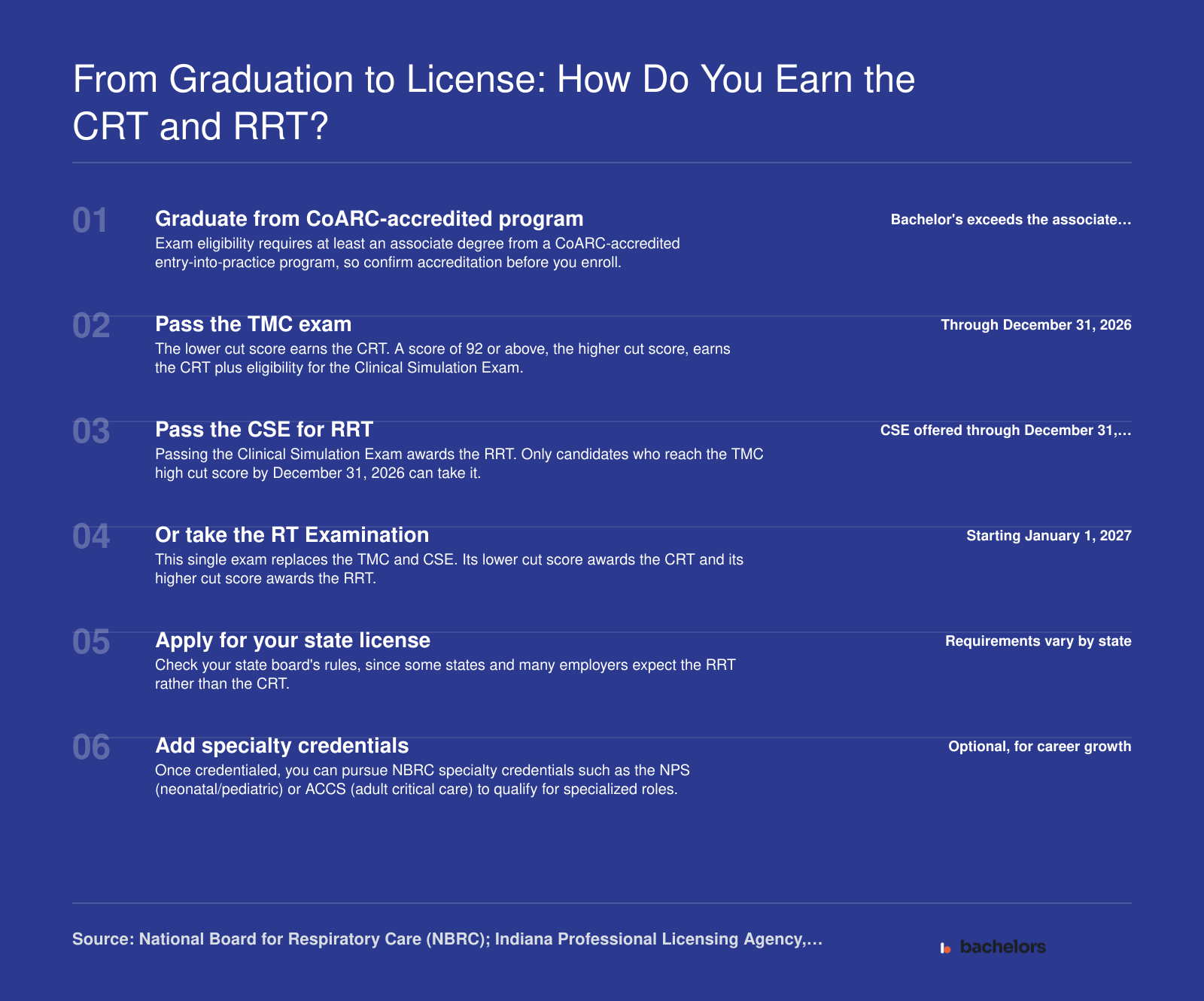
From Graduation to License: How Do You Earn the CRT and RRT?
Graduating from your bachelor's degree in respiratory care therapy is only the first step. You still need NBRC credentials and a state license, and the NBRC exam pathway changes on January 1, 2027. Licensure rules are set state by state, and as of August 2026, 10 states required the RRT or an equivalent registry-level credential for new licenses, so plan for the RRT rather than stopping at the CRT.
Admission Requirements for Top Respiratory Care Programs
Most entry-level bachelor's programs admit students to a professional phase only after prerequisites are complete. No national standard exists, so check each school's current-cycle requirements.
- Prerequisite courseworkAnatomy and physiology is the most common requirement. UAMS requires Anatomy and Physiology I and II (8 credits) for fall 2027. Other programs add English, statistics or college math, biology or chemistry. St. Louis Community College requires a C or higher across its 30-credit pathway.
- Minimum GPAPublished minimums range from 2.0 at Metropolitan Community College to 2.75 at City Colleges of Chicago. A 2.5 floor is common (UAMS, Texas State, KU Medical Center). Commonwealth University sets 2.7.
- Professional-phase applicationExpect a separate application with spring deadlines for fall entry. Examples include February 27, 2027 at City Colleges and May 1, 2027 at UAMS. Texas State uses a December 15 priority deadline and a May 15 general deadline.
- Health and compliance clearancePlan for a background check, a drug screen, immunizations and TB testing. Some schools also require a medical exam or current AHA Basic Life Support certification.
- Degree-completion prerequisitesMany online programs, such as those at Kansas and UNC Charlotte, admit only credentialed RRTs.
- Optional strengthenersSome programs list observation hours. Ask whether healthcare work experience or an interview factors into selection.
Top Early-Career Earnings Among Ranked Programs
Among the schools ranked here, one program stands out for first-year pay.
Respiratory Care Therapy programs by state
Respiratory Care Therapy Degree FAQs
These answers cover the questions prospective students ask most often about outcomes data, online formats, working while enrolled, and exam requirements for a bachelor's degree in respiratory care therapy.
Which respiratory therapy programs have the highest NBRC pass rates?
Are there accredited respiratory therapy programs online?
Can I keep working as an RRT while I finish a bachelor's degree in respiratory care?
If I already passed the NBRC exams with an associate degree, do I need to retest after earning a bachelor's?
Compare Respiratory Care Therapy programs on the data that matters
Explore more Healthcare majors or browse every field of study.
All Healthcare programs Browse every field of study