Best Nutrition Degree Programs
Compare 280+ accredited Nutrition programs at 190+ colleges, with net price after aid, graduation rates, earnings and debt from IPEDS and the U.S. College Scorecard.

A dietetics program accredited by ACEND and a general nutritional science major can look nearly alike on a course list, yet only one is built around the registered dietitian nutritionist (RDN) path. Most bachelor's degrees in nutrition are Bachelor of Science (B.S.) programs, and they can lead to clinical dietetics, community health, food industry, or wellness work.
Every school ranked here offers undergraduate programs only; graduate study is not part of this list.
Since 2024, first-time RDN candidates also need a graduate degree, so the undergraduate major you pick is the first step of a longer sequence, not the last.
Key Points
- Since January 1, 2024, RDN exam candidates need a graduate degree.
- ACEND-accredited dietetics programs offer the most direct path toward the RDN.
- For the lowest net price after aid, look to CUNY campuses.
Best Schools for a Bachelor's Degree in Nutrition
Every program on this list is campus-based at a public university, and average net price after aid across the ten runs from roughly $3,000 to $25,000 a year. What separates them is what happens inside the major: some carry ACEND accreditation for a dietetics pathway, while others are broader nutrition science degrees that feed graduate dietetics programs, medical school or public health work.
University of California-Davis
#1Davis, CA · $10,000 – $15,000/yr (est.)
Best for: Pre-health students wanting a lab science foundation
A large public research university with a science-first nutrition major and two options, nutritional biology and nutrition in public health. Expect heavy chemistry, biochemistry and physiology rather than counseling coursework. The major is not presented as an ACEND-accredited dietetics program, so students chasing the RDN credential should verify that pathway directly before enrolling.
- 137-unit major with nutritional biology and public health options
- 61 to 70 units of preparation in chemistry, biology and statistics
- Upper division covers biochemistry, food chemistry and clinical nutrition
- Nutritional biology option adds biochemistry, physiology and toxicology
- Public health option draws on social and health sciences
- Advising in 3202 Meyer Hall; department also offers M.S. and Ph.D.
University of North Carolina at Chapel Hill
#2Chapel Hill, NC · ~$12,000/yr (est.)
Best for: Policy-minded students drawn to public health
A flagship public university with an unusual setup: the nutrition bachelor's sits inside the Gillings School of Global Public Health. Majors apply in sophomore year and choose between a research track and a health and society track. The program is ACEND accredited, and a dual bachelor's to M.S. route supports research careers.
- 120 credit hours; two years in the major as a junior and senior
- Nutrition Science and Research track includes faculty-supervised research
- Health and Society track allows 18 customized credits
- 3.0 GPA and two letters of recommendation required to apply
- Assured enrollment for eligible Early Action first-years with 3.2 GPA
- Dual B.S.P.H. to M.S. option for research careers
University of Illinois Urbana-Champaign
#3Champaign, IL · ~$14,000/yr (est.)
Best for: Students torn between nutrition and food science
A large public research university where nutrition is taught within the Department of Food Science and Human Nutrition. The nutrition and health major builds on biochemistry, anatomy and microbiology, and the department publishes a sample four-year plan for planning ahead. It is ACEND accredited, so it can serve as a first step toward the RDN credential.
- 126 credit hours with a strong human nutrition science core
- Coursework in biochemistry, anatomy, microbiology and nutrition science
- Courses include Nutritional Aspects of Disease and Biochemical Nutrition
- One of the few human-nutrition-focused majors on campus
- Sample four-year plan and departmental advising
- Prepares students for medicine, dentistry and nursing study
Ohio State University
#4Columbus, OH · $17,000/yr (est. net price)
A very large public university with a Bachelor of Science in Nutrition and a revised curriculum for students entering from autumn 2026. The nutrition sciences track pairs a foundational science block with a nutrition core and an optional research or professional experience. ACEND status was not confirmed in the material reviewed for this program, so verify it before applying.
- Minimum 120 credit hours; curriculum effective autumn 2026
- Foundational science block of 24 to 28 hours
- Core nutrition sequence covers macro and micronutrients
- Choose professional experience, undergraduate research or individual study
- Supporting work includes general chemistry, biology and psychology
- Bachelor of Science in Nutrition awarded
Virginia Polytechnic Institute and State University
#5Blacksburg, VA · $25,000/yr (est. net price)
A public land-grant university whose nutrition and dietetics major is ACEND accredited and aimed squarely at the registered dietitian credential. The curriculum blends physical and social sciences with foods and nutrition, and majors take some coursework alongside exercise science peers. A 2.8 GPA minimum applies for a change of major.
- ACEND accredited and built around the RDN credential
- 2.8 GPA minimum for change of major
- Prerequisite courses required before upper-level work
- Interdisciplinary coursework shared with exercise science majors
- Graduates are also eligible for the DTR exam
- Accreditation listed through 2026
University of Connecticut
#6Storrs, CT · ~$25,000/yr (est.)
A public flagship where the nutritional sciences major offers three tracks, including a didactic program in dietetics and a pre-medical professions route. Coursework ties nutrient science at the cell, individual and community levels together, and undergraduates can join faculty research. The dietetics track is ACEND accredited.
- Three tracks including a Didactic Program in Dietetics
- Courses in basic sciences, core nutrition and specialized electives
- Research opportunities with department faculty
- Minors in Food Science and Nutrition for Exercise and Sport
- Some courses satisfy Common Curriculum requirements
University of Houston
#7Houston, TX · $10,000 – $23,000/yr (est.)
A large urban public university with a human nutrition and foods degree that splits into an ACEND-accredited dietetics track, a nutrition and fitness track and a nutritional sciences track. The dietetics route prepares students for a dietetic internship and the RDN credential, while the other two lead toward wellness work or graduate health study.
- Tracks: ACEND Accredited, Nutrition and Fitness, Nutritional Sciences
- ACEND track prepares students for a dietetic internship
- Nutrition and Fitness track blends nutrition with kinesiology
- Nutritional Sciences track builds prerequisites for health professions
- Only the ACEND track leads to the RDN pathway
CUNY Hunter College
#8New York, NY · ~$3,000/yr (est.)
A CUNY senior college in Manhattan with a compact 52-credit nutrition and food science major taught at the Silberman campus, usually one class day a week. This is a general nutrition degree, not the dietetics program, which Hunter offers at the graduate level. A small bachelor's to master's route is ACEND accredited and qualifies graduates for the RD exam.
- 52-credit major with fall and spring entry
- Classes at the Silberman campus, one day a week Monday to Thursday
- Covers food service management, epidemiology and community nutrition
- This bachelor's is not the Didactic Program in Dietetics
- Competitive bachelor's to master's route admits 1 to 5 students yearly
- Leads to roles with WIC, food companies and food service operations
Indiana University-Bloomington
#9Bloomington, IN · $12,000 – $42,000/yr (est.)
A large public university whose nutrition science degree is built on chemistry, biology and physiology, with five pre-professional tracks that include pre-medicine, pre-dentistry, pre-optometry and pre-physician assistant. Lab work and faculty-led research are available, and career services supports both immediate employment and graduate study. The program carries ACEND accreditation.
- Five tracks including pre-medicine, pre-dentistry and pre-physician assistant
- Science-based curriculum in chemistry, biology and physiology
- Hands-on lab work in biology and biochemistry
- Volunteer and faculty-led research opportunities
- Career paths in food, pharma, government and nonprofits
University of Nebraska-Lincoln
#10Lincoln, NE · $15,000 – $20,000/yr (est.)
A public land-grant university offering a nutrition and health sciences major with options in community health and wellness, nutrition science, and nutrition with exercise and health science. Students can join faculty research and global experiences in Japan and Greece, and the college awards more than $200,000 in scholarships each year. The program is ACEND accredited.
- Options in community health and wellness, nutrition science, exercise
- 120 credit hours with a science-heavy core
- 1-to-1 academic advising and career coaching
- Faculty research on topics such as obesity prevention
- Global experiences in Japan and Greece
- Internships with ConAgra, UNMC and other partners
- Prepares students for medical, dental or research science careers
- Prepares students for certification exams
- Career paths include athletic training, physical therapy and dietetics
- Interdisciplinary science curriculum with flexible elective hours
Cost & outcomes by school
Federal data for the highest-earning Nutrition programs, independent of the ranking above. Earnings are this field's bachelor's graduates four years after completing where the Scorecard reports them, else the school's undergraduate median.
| School | Net price / yr | Grad rate | Earnings | Debt | Grads/yr | Format |
|---|---|---|---|---|---|---|
| Cornell University NY | $28,690 | 95% | $104,043 | $14,000 | — | Campus |
| California Polytechnic State University-San Luis Obispo CA | $16,665 | 86% | $90,768 | $18,500 | — | Campus |
| Loma Linda University CA | — | — | $89,816 | $20,854 | — | Campus |
| Case Western Reserve University OH | $41,190 | 87% | $87,989 | $24,000 | 6 | Campus |
| Boston University MA | $24,402 | 89% | $83,238 | $23,250 | — | Campus |
| Illinois Institute of Technology IL | $18,425 | 75% | $82,592 | $25,000 | — | Campus |
| New York University NY | $37,050 | 88% | $82,509 | $20,500 | 7 | Campus |
| University of Illinois Urbana-Champaign IL | $14,355 | 85% | $81,054 | $19,500 | 6 | Campus |
| University of California-Davis CA | $14,741 | 86% | $80,838 | $13,000 | — | Campus |
| Brigham Young University UT | $15,564 | 81% | $75,790 | $11,069 | — | Campus |
| Virginia Polytechnic Institute and State University VA | $24,953 | 86% | $74,005 | $24,017 | 203 | Campus |
| University of Connecticut CT | $25,097 | 83% | $73,997 | $21,500 | — | Campus |
Sources: U.S. Department of Education. Net price, graduation rate, earnings and debt: College Scorecard (earnings and debt for this field's bachelor's graduates where reported, else school-wide); graduates: IPEDS. A dash means no figure is reported.
Cost, debt & payoff
Median earnings of this field's bachelor's graduates (4 yrs after completing, else the school's undergraduate median) vs. their median federal loan debt · U.S. College Scorecard
Across these programs the median graduate earns about $56,733 and finishes with roughly $21,522 in debt — a ratio that clears a common rule of thumb (keep debt below first-year salary). Net price and debt vary widely school to school, so check the per-school figures in the table above before you shortlist.
How We Ranked These Nutrition Schools
Since 2024, a bachelor's degree alone no longer qualifies a graduate for the registered dietitian exam, so choosing an undergraduate program is a longer-term decision than it once was.
What the federal data covers
We build this ranking from federal IPEDS and U.S. Department of Education College Scorecard data: net price, graduation and retention rates, admission rate, typical student debt, and program-level earnings for nutrition completers.
Each metric does one job, and each has limits. Graduation rate describes the whole institution, not the nutrition department, so treat it as a signal about institutional support rather than a verdict on the major. Net price reflects a sector-wide average, not a personal quote. Your aid package, residency, and transfer credits will move that number substantially. Admission rate tells you how selective a school is overall, not how competitive the nutrition major is.
Reading the earnings figures
Program-level earnings describe nutrition completers one to five years after finishing, which is the closest federal approximation of an early-career outcome. Institution-wide 10-year earnings cover every student at the school, including engineering and business graduates, so they serve as context only, never as a nutrition salary projection.
Accreditation checked separately
ACEND accreditation status was verified on its own, because federal datasets do not track it. That status matters more than any score on this page, since it determines whether a program can feed into the supervised practice pathway required for the credential.
Treat the list as a shortlist, not a finish line. Confirm accreditation, practicum placement, and how supervised hours are arranged directly with each school before you apply.
Nutrition vs. Dietetics vs. Nutritional Science: Which Bachelor's Track Fits You?
Dietetics, through an ACEND-accredited DPD or coordinated program, is the most direct track toward the RDN. Nutritional science is the stronger choice for pre-med, research, or food science, while wellness tracks are lower-barrier options that do not lead to clinical credentials. So what is the best degree for nutrition? It depends on whether you want to become a licensed dietitian: if you do, choose dietetics, and if you do not, match the degree to the field you want to work in.
| Factor | Dietetics | Nutritional Science | Public Health Nutrition | Nutrition and Wellness |
|---|---|---|---|---|
| Core focus | Medical nutrition therapy and clinical dietetic practice | Biochemistry and physiology of how food affects the body | Community and population nutrition, policy, and education | Healthy eating, lifestyle coaching, and general wellness |
| Typical coursework emphasis | Food science, clinical nutrition, foodservice management, and supervised practice requirements | Chemistry, biology, anatomy, physiology, and research methods | Epidemiology, program planning, community health, and nutrition education | Behavior change, fitness, health communication, and introductory nutrition |
| RDN pathway fit | Strongest. An ACEND DPD or coordinated program is the most direct route | Possible only if the program includes DPD coursework or you add it later. Confirm before enrolling | Varies. Works best when the program is paired with an ACEND-accredited component | Weak. Generally does not lead to RDN eligibility without additional coursework |
| Typical career directions | Hospitals, long-term care, outpatient clinics, and foodservice (dietitian and nutritionist occupation group) | Research, food science, pre-med or health professions preparation, and applied nutrition consulting | Public health agencies, community nutrition programs, and nonprofits | Wellness programs, sports organizations, community health initiatives, and nutrition coaching |
| Median pay for the occupation group (BLS, May 2025) | $76,400 for all dietitians and nutritionists | $76,400 for all dietitians and nutritionists | $76,400 for all dietitians and nutritionists | $76,400 for all dietitians and nutritionists |
| Best-fit student | Wants to practice clinically and become a licensed or registered dietitian | Plans medical school, lab research, or food industry work | Wants community-level impact and public service | Wants a lower-barrier path into wellness work without clinical credentials |
Which Nutrition Degrees Lead to RDN Eligibility?
The Short Answer
No bachelor's degree, on its own, makes you eligible for the Registered Dietitian Nutritionist (RDN) exam. For anyone seeking first-time eligibility on or after January 1, 2024, the Commission on Dietetic Registration (CDR) requires a graduate degree from an institution accredited by the U.S. Department of Education, or a foreign equivalent.1 You can finish that degree at any point before you apply.2 People who established eligibility by December 31, 2023, or who were already registered are not subject to the requirement.3 Graduate study comes later; what matters here is what your bachelor's must supply.
Why the Right Bachelor's Still Matters
The graduate-degree change did not remove the coursework or supervised practice requirements. An ACEND-accredited Didactic Program in Dietetics (DPD) delivers the required classroom foundation.4 A DPD alone does not confer eligibility, though.4 The traditional route combines the DPD, a graduate degree, an ACEND-accredited dietetic internship, and the internship's verification.
A coordinated program is the other bachelor's-level option.4 It folds coursework and supervised practice into one curriculum, and completing it establishes eligibility once the graduate degree requirement is also met, either through the program or separately.
Supervised Practice and the Future Education Model
Program materials from universities in the CDR and ACEND system cite at least 1,000 supervised practice hours for exam eligibility.5 Confirm the exact structure with any program you consider. The Future Education Model is an ACEND pathway that integrates coursework and practice in a graduate program, and completing it also establishes eligibility.6 If you want a single path from start to finish, ask each school which of these models it offers.
Licensure Is a Separate Step
The RDN credential comes from CDR.7 Most states license or certify dietitians separately, so passing the exam does not automatically let you practice. Check your state's requirements before you commit to a program.
How to Verify a Program
- Search the directory: Look up the school in the ACEND accredited-program directory and confirm the program type and its accreditation status.
- Ask about verification: Ask whether the school issues a DPD verification statement. That document proves you finished the DPD and supports your internship applications.5
- Check the timeline: CDR approves your eligibility only if the degree, coursework, and supervised practice were completed on or after the program completion date.8
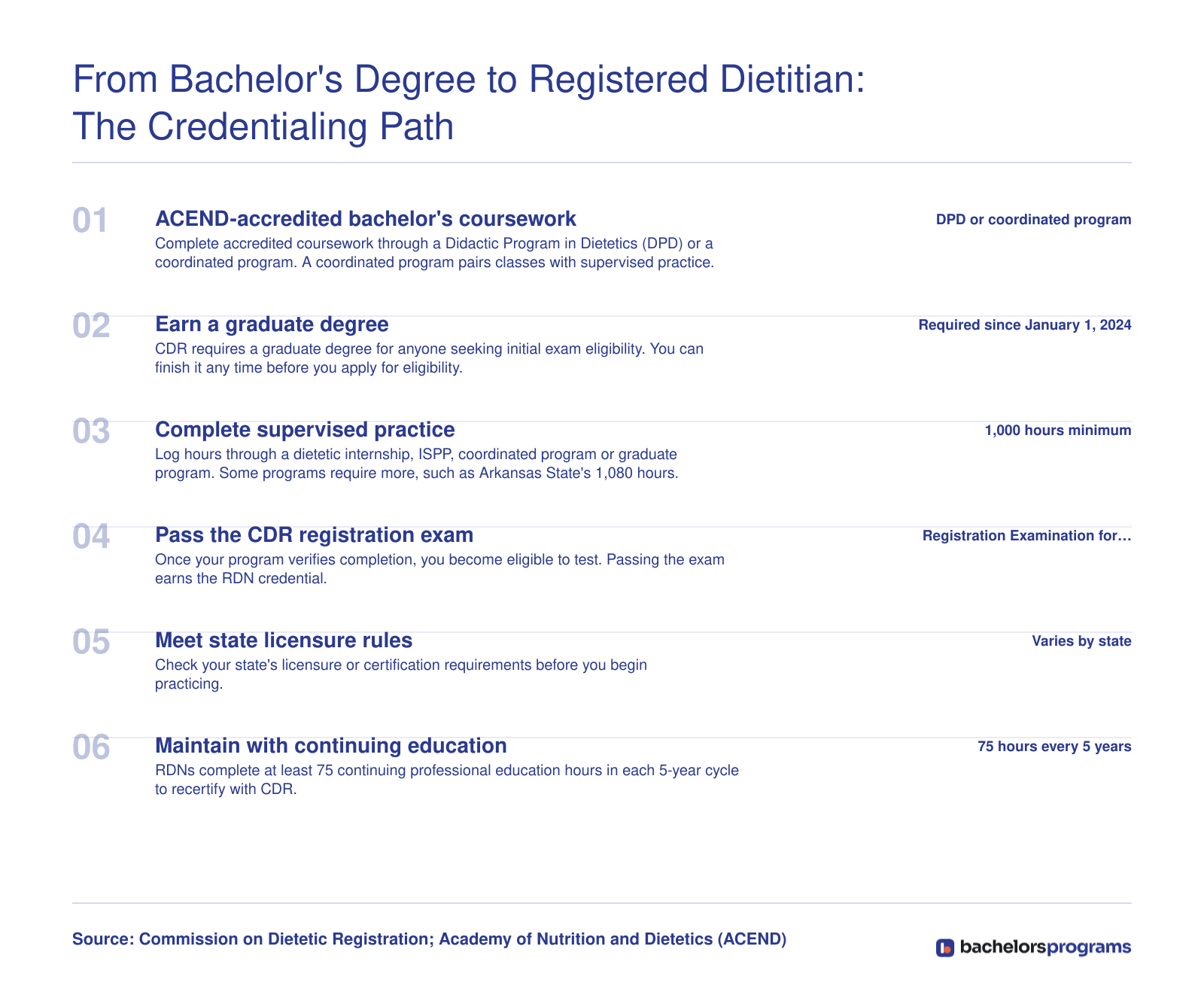
From Bachelor's Degree to Registered Dietitian: The Credentialing Path
Becoming a Registered Dietitian Nutritionist (RDN) starts with a bachelor's degree but no longer ends there. New candidates now need a graduate degree before they can sit for the exam. Coordinated and graduate programs can combine coursework and supervised practice, and combined graduate-level programs typically take about 2-3 years.
Related Articles
What Dietitians and Nutritionists Earn Nationally
Most graduates who earn a bachelor's degree in nutrition and go on to become credentialed work as dietitians or nutritionists.
Lowest Net Price Among Ranked Nutrition Schools
Among the schools ranked here, these CUNY campuses post the lowest average net price after aid, based on 2024 U.S. Department of Education data from IPEDS and the College Scorecard. Graduation rates are institution-wide, not specific to the nutrition major. Because the registered dietitian credential now requires a graduate degree, keeping bachelor's costs low leaves more room in your budget, and less debt, for the master's program and supervised practice that follow.
| School | Location | Program | Average Net Price After Aid | Graduation Rate (Institution-Wide) | Format | Dietetics Pathway |
|---|---|---|---|---|---|---|
| CUNY Hunter College | New York, NY | BS in Nutrition and Food Science | $2,984 | 56.9% | Campus | General nutrition B.S. (not a DPD); prepares for graduate DPD/RD study |
| CUNY Brooklyn College | Brooklyn, NY | Health and Nutrition Sciences (Foods and Nutrition) | $3,103 | 53.9% | Campus | ACEND-accredited Didactic Program in Dietetics |
| CUNY Lehman College | Bronx, NY | Dietetics, Foods, and Nutrition (Culinary and Community Nutrition) | $3,148 | 51.3% | Campus | Prepares for graduate study in nutrition |
Questions to Ask Yourself
If the RDN credential is your goal, can you absorb the cost of a master's degree on top of your bachelor's?
Are there supervised practice sites near where you plan to live?
Could you complete general education and science prerequisites at a community college first?
Does the lower sticker price still get you an accredited track?
How to Choose the Right Nutrition Program: A Checklist
Use this checklist to vet each nutrition program before you apply. No single national admission standard exists, so confirm every item directly with the schools on your list.
- ACEND accreditation and program typeIf you plan to become a registered dietitian nutritionist (RDN), confirm the program is ACEND-accredited and note its type: a Didactic Program in Dietetics (DPD), a coordinated program, or a Future Education Model program. Each one leads to the RDN credential by a different route.
- Science and math prerequisitesExpect general chemistry (often with lab), biology, statistics or math, and often anatomy and physiology, organic chemistry or biochemistry. Most programs require a C or better. Idaho State accepts a C-, while Nicholls State requires a B in an introductory dietetics course.
- Secondary admission and minimum GPAMany schools admit you to the university first and then require a separate application to the upper-division dietetics or DPD phase. Published minimum GPAs run from about 2.75 at Nicholls State (2026-2027) to 3.25, and Montclair State requires students to maintain a 3.2. Ask how the GPA is calculated and whether it is rounded.
- Transfer credit for community college sciencesAsk whether your chemistry, biology and anatomy courses transfer as direct equivalents. Many programs list their own course numbers rather than generic titles.
- Practicum support, concentrations and online labsFind out how the program helps students secure internship or practicum placements and which concentrations it offers. For online programs, ask how lab science requirements are completed.
- Compare your shortlistScore your top schools against each item above, then weigh the results alongside the cost and ranking data on this page.
Nutrition programs by state
Nutrition Degree FAQs
These answers cover the questions readers ask most about two-year options and the route to becoming a dietitian. Credential rules change, so confirm details with the Commission on Dietetic Registration and each program before you enroll.
Is there a 2-year nutrition degree?
What is the best nutrition degree to become a dietitian?
Can an associate degree lead to the Dietetic Technician, Registered (DTR) credential?
Will my associate degree in nutrition transfer into a bachelor's program?
Compare Nutrition programs on the data that matters
Explore more Healthcare majors or browse every field of study.
All Healthcare programs Browse every field of study