Best Kinesiology Degree Programs
Compare 800+ accredited Exercise & Sports Science programs at 760+ colleges, with net price after aid, graduation rates, earnings and debt from IPEDS and the U.S. College Scorecard.

Average net price across the ranked schools ranges from $6,555 a year at Cal State Fullerton to $16,665 at Cal Poly San Luis Obispo. Each program leads to a bachelor's degree in exercise and sports science, most often the Bachelor of Science (B.S.) in Kinesiology.
The ranked programs mix online, on-campus and hybrid delivery, so check the format listed for each school. The bigger tension comes after graduation. Many majors plan on physical therapy, occupational therapy or physician assistant school, which makes prerequisite coursework and clinical hours matter as much as price.
Without graduate training, a kinesiology bachelor's typically leads to roles such as coach, personal trainer or rehabilitation aide.
Key Points
- CAATE now accredits athletic training programs only at the master's level.
- Rankings weigh net price against early-career earnings using federal data.
- For future clinicians, accelerated 3+2 or 3+3 tracks can shorten training.
Best Kinesiology, Exercise & Sports Science Schools Ranked
Net price on each card is an average after financial aid, so your actual cost will depend on your aid package and residency. Below are 10 campus-based programs, each leading to a bachelor's degree in kinesiology or a closely related exercise and sports science field. Every card lists average net price, the school's graduation rate, the format, the location and any concentration the program names.
California Polytechnic State University-San Luis Obispo
#1San Luis Obispo, CA · ~$17,000/yr (est.)
Best for: Hands-on learners who prefer lab-based coursework
Cal Poly's kinesiology major is built for students who want lab and clinic exposure rather than a purely theoretical degree. The B.S. in Kinesiology carries a 120-unit load with an 18-unit Exercise Science concentration and a required senior project, and advisor-approved electives can qualify students for the ACSM Certified Exercise Physiologist exam. The university graduates 86% of its students, and the San Luis Obispo campus applies a learn-by-doing model across its programs.
- 120-unit degree with 40 upper-division units and a senior project
- 18-unit Exercise Science concentration
- Coursework includes clinical exercise physiology and motor control
- Advisor-approved electives can qualify students for the ACSM-EP exam
- Three concentration options within the major
- Up to 12 internship units can count toward the degree
- 2.0 GPA minimum for the major
University of Michigan
#2Ann Arbor, MI · $18,000 – $61,000/yr (est.)
Best for: Students combining exercise science with a business minor
Michigan's School of Kinesiology awards a B.S. in Applied Exercise Science that blends the biological, social, business and clinical sides of physical activity. Students take at least 15 credits of major electives and complete a for-credit learning experience during or after junior year, and they can add minors in business, nutrition or public health. Graduates move into rehabilitation aide, ECG technician, strength and conditioning and medical sales roles, or continue into athletic training, physical therapy and medical school.
- Bachelor of Science in Applied Exercise Science
- At least 15 credits of major electives
- For-credit learning experience required during or after junior year
- Customize with minors in business, nutrition or public health
- Business and research coursework built into the major
- Prepares for athletic training, physical therapy and occupational therapy
- Research and independent study options available
Rice University
#3Houston, TX · ~$13,000/yr (est.)
Best for: Pre-health majors targeting physical therapy school
Rice pairs a small, science-heavy kinesiology offering with unusually direct clinical pathways. The B.A. in Sports Medicine and Exercise Physiology runs 14 courses (43 credit hours) inside a 120-credit degree, and several electives double as medical school prerequisites. A Rice-UTMB agreement gives qualified majors preference in UTMB Doctor of Physical Therapy admissions, and a UTHealth Houston partnership shortens an MPH to one year after the bachelor's.
- Bachelor of Arts in Sports Medicine and Exercise Physiology
- 14 courses, or 43 credit hours, in the major
- Seven major courses must sit at the 300 level or above
- Core courses must be taken at Rice; no transfer credit accepted
- Electives can serve as medical school prerequisites
- Rice-UTMB agreement gives preference in UTMB physical therapy admissions
- UTHealth Houston path shortens an MPH to one year
- 2.00 major GPA required
University of North Carolina at Chapel Hill
#4Chapel Hill, NC · ~$12,000/yr (est.)
UNC-Chapel Hill's exercise and sport science major is one of the larger programs on this list, with a 60 to 62 credit major inside the bachelor's degree. Core work covers biomechanics, neuromuscular control, exercise physiology and the recognition and treatment of athletic injuries, backed by five electives with at least nine credits at the 400 level. A practicum with local fitness organizations and departmental research laboratories supply applied experience, and an honors track adds a two-semester research project.
- Major totals 60 to 62 credit hours
- Core includes biomechanics, neuromuscular control and exercise physiology
- Five electives with at least 9 credits at the 400 level
- Practicum with local fitness organizations
- Honors track requires a 3.3 GPA and a two-semester research project
- Prepares for physical therapy, occupational therapy and physician assistant study
- Summer study abroad programs available
- Merit scholarship awarded to an outstanding junior major
University of Central Florida
#5Orlando, FL · ~$10,000/yr (est.)
UCF's kinesiology degree is organized around a single applied track, Exercise and Sport Physiology, with 71 of the 120 credits sitting in the major. A final-semester capstone and internships with healthcare, fitness and sports organizations supply the applied side, and the program holds NSCA Education Recognition Program distinction. Students must show evidence of completing the ACSM Certified Exercise Physiologist exam, which makes that credential part of the plan rather than an afterthought.
- 120 credit hours, 71 of them in the major
- Exercise and Sport Physiology track
- Capstone in kinesiology during the final semester
- Students must show evidence of completing the ACSM-EP exam
- NSCA Education Recognition Program distinction
- Internships with healthcare, fitness and sports organizations
- Practicum elective open to juniors and seniors
- 2.5 overall GPA required
Indiana University-Bloomington
#6Bloomington, IN · $12,000 – $42,000/yr (est.)
At IU Bloomington, exercise science is a B.S. in Kinesiology delivered by the School of Public Health rather than a stand-alone kinesiology department. The curriculum leans on anatomy, biomechanics, exercise physiology, sport psychology and motor learning, and the same program is also offered at IU Indianapolis. Students heading straight into the workforce prepare for corporate and community fitness roles and for coaching outside public schools, while others continue to physical therapy, occupational therapy or medical school.
- Bachelor of Science in Kinesiology housed in the School of Public Health
- Science core in anatomy, biomechanics, exercise physiology and motor learning
- Same program also offered at IU Indianapolis
- Coaching path that does not require a teaching license
- Prepares for physical therapy, occupational therapy, medicine and dentistry
- Entry-level preparation for corporate and community fitness programs
University of Georgia
#7Athens, GA · ~$14,000/yr (est.)
Georgia's B.S. in Exercise and Sport Science sits in a kinesiology department that the National Academy of Kinesiology ranks No. 7 nationally. Students take 35 hours of core exercise science coursework plus eight hours of research, practicum or internship work, then choose from six concentrations including pre-physical therapy and strength and conditioning. Admission is selective at a 3.25 overall and Area VI GPA, with 50 to 70 students enrolled each fall and spring.
- 35 hours of core exercise science coursework
- Eight hours of research, practicum, internship or service learning
- 19 hours of major electives
- Six concentration options including pre-PT and strength and conditioning
- Admission requires a 3.25 overall and Area VI GPA
- Admits 50 to 70 students each fall and spring
- Most classes meet in the Ramsey Center
- Research available in the Non-Invasive Muscle Physiology Lab
Brigham Young University
#8Provo, UT · $15,000 – $20,000/yr (est.)
BYU keeps its exercise science major lean in required credits and heavy in supporting science. The B.S. requires 11.5 credits of major coursework, at least 2.0 credits of experiential learning through an internship or undergraduate research, and 28 credits of biology, chemistry, physics, statistics and nutrition. A physiology option adds four credits, and students aiming at a Master of Athletic Training take designated preparatory courses.
- 11.5 credits of required major coursework
- At least 2.0 credits of experiential learning through internship or research
- 12 major elective credits plus 28 credits of supporting science
- Physiology option adds 4 credits
- Designated courses for students targeting a Master of Athletic Training
- Premed students advised through the Preprofessional Advisement Center
- Advanced musculoskeletal anatomy and exercise physiology labs
California State University-Fullerton
#9Fullerton, CA · $7,000 – $20,000/yr (est.)
Cal State Fullerton's B.S. in Kinesiology with an Exercise Science concentration is a 120-unit degree that stacks a 22-unit concentration on a 30-unit kinesiology core. The concentration adds motor development, an exercise physiology laboratory, biomechanical analysis and nutrition for exercise and performance, plus 12 elective units that can include an internship. Graduates move into cardiac rehabilitation, clinical exercise programming and ergonomics, and some continue to exercise physiology or biomechanics graduate work.
- 120-unit degree with 30 units of kinesiology coursework
- 22-unit Exercise Science concentration
- 12 units of concentration electives including strength and conditioning
- Major courses require a C (2.0) or better
- Points to cardiac rehabilitation, ergonomics and clinical exercise programming
- Internship available among the concentration electives
- 9 or 10 units of major prerequisites
University of Illinois Urbana-Champaign
#10Champaign, IL · ~$14,000/yr (est.)
Illinois builds its kinesiology degree around an Applied Exercise Science concentration that emphasizes exercise testing, prescription and nutrition. The 120-hour program requires 40 upper-division hours and a third semester of a language other than English, and up to six hours of experiential learning can count toward the degree. A four-year sample sequence runs 15 to 16 hours a semester, and graduates go into personal training, strength and conditioning and clinical exercise physiology.
- 120 hours including 40 upper-division hours
- Third semester of a language other than English required
- Concentration covers exercise testing, prescription and nutrition
- Three concentration electives such as nutrition for performance
- Up to 6 hours of experiential learning count toward the degree
- Four-year sample sequence runs 15 to 16 hours per semester
- Coursework includes physiological basis of strength and conditioning
Cost & outcomes by school
Federal data for the highest-earning Exercise & Sports Science programs, independent of the ranking above. Earnings are this field's bachelor's graduates four years after completing where the Scorecard reports them, else the school's undergraduate median.
| School | Net price / yr | Grad rate | Earnings | Debt | Grads/yr | Format |
|---|---|---|---|---|---|---|
| University of Health Sciences and Pharmacy in St. Louis MO | $31,817 | 62% | $137,047 | $17,755 | — | Campus |
| George Washington University DC | $36,586 | 84% | $90,873 | $20,449 | — | Campus |
| Rice University TX | $13,370 | 95% | $87,404 | $10,000 | 48 | Campus |
| University of Portland OR | $28,210 | 80% | $82,804 | $21,370 | — | Campus |
| Virginia Polytechnic Institute and State University VA | $24,953 | 86% | $81,698 | $21,500 | — | Campus |
| University of California-Irvine CA | $14,251 | 87% | $80,735 | $15,000 | — | Campus |
| Wake Forest University NC | $28,719 | 89% | $79,599 | $22,777 | 109 | Campus |
| University of Michigan MI | $13,138 | 93% | $79,411 | $18,924 | 348 | Campus |
| Saint Louis University MO | $24,398 | 80% | $77,066 | $26,316 | 100 | Campus |
| Saint Johns University MN | $25,672 | 75% | $76,786 | $27,000 | — | Campus |
| University of Delaware DE | $17,799 | 81% | $76,478 | $25,000 | 233 | Campus |
| University of Mississippi MS | $13,314 | 72% | $73,870 | $21,516 | 124 | Campus |
Sources: U.S. Department of Education. Net price, graduation rate, earnings and debt: College Scorecard (earnings and debt for this field's bachelor's graduates where reported, else school-wide); graduates: IPEDS. A dash means no figure is reported.
Cost, debt & payoff
Median earnings of this field's bachelor's graduates (4 yrs after completing, else the school's undergraduate median) vs. their median federal loan debt · U.S. College Scorecard
Across these programs the median graduate earns about $53,145 and finishes with roughly $23,829 in debt — a ratio that clears a common rule of thumb (keep debt below first-year salary). Net price and debt vary widely school to school, so check the per-school figures in the table above before you shortlist.
What a Bachelor's Degree in Exercise and Sports Science Involves
What actually separates a kinesiology major from an exercise science major, and does the distinction change what you study?
Usually less than the titles suggest. Kinesiology is the broad study of human movement, spanning anatomy, physiology, biomechanics, motor behavior, and health promotion. Exercise science leans toward physiology and its clinical or fitness applications. Sport science leans toward performance, coaching, and sport management. Many schools use the labels interchangeably, so a bachelor's degree in exercise and sports science may sit under any of those three names.
The Core Courses You Will Take
Most programs build on a shared foundation: anatomy and physiology, biomechanics, exercise physiology (often with a lab), motor learning and development, nutrition, and a practicum or internship. Expect science prerequisites as well, typically biology, chemistry, physics, and psychology. Practicum requirements differ sharply: Eastern Washington asks for 8 practicum credits with a minimum grade of B1, while UW-La Crosse's sport management emphasis builds in a 12-credit internship2.
Common Concentrations
- Pre-physical therapy: keeps the kinesiology core and adds DPT prerequisites. The concentration itself does not license you as a physical therapist.
- Exercise physiology: the most physiology-intensive track, often including clinical and environmental exercise coursework.
- Strength and conditioning: programming, recovery, and athlete performance.
- Health promotion and sport management: fitness programming, leadership, ethics, and the business side of sport.
Compare Course Lists, Not Titles
Because the labels are not standardized, open the actual catalog for each program on your shortlist. Check the required core, the concentration rules, and how many credits stay open for electives. Two programs with nearly the same name can ask very different things of you.
How We Ranked These Kinesiology Schools
A strong kinesiology program has to balance two things that often pull in opposite directions: what it costs you now and what it is likely to return after graduation. This ranking weighs both, using public federal data rather than reputation or marketing claims.
What We Measured
- Affordability: The average price students pay after grants and scholarships, what families actually pay, not sticker tuition.
- Student success: Institution-wide graduation and retention rates, which show whether students stay enrolled and finish.
- Program outcomes: College Scorecard earnings and debt figures for kinesiology and exercise science graduates, where the U.S. Department of Education publishes them.
- Format: Delivery may be online, on campus, or hybrid.
All figures come from the most recent College Scorecard release available when the list was compiled. Earnings and debt data describe students who finished a few years before that release, not this year's graduating class.
Limits to Keep in Mind
Graduation and retention rates are school-wide. They describe all undergraduates at an institution, not kinesiology majors specifically. Program-level earnings are also unavailable for some schools, usually because too few graduates reported data for a figure to be published. Those schools are compared on cost, completion, and format.
The list includes bachelor's-level programs only, such as the B.S. in Kinesiology and related degrees in exercise and sports science. Graduate programs are excluded. Online, campus, and hybrid options are ranked together, so confirm each school's delivery format and any in-person lab or internship requirements before you apply.
Kinesiology Degree Cost and Return on Investment
Cost and return on investment come down to two plain questions: what you will actually pay for a kinesiology degree, and how fast your early paychecks can cover any loans. Sticker tuition rarely answers either one, so look at net price, residency rules and program-level debt together.
The Lowest-Cost Options
California State University-San Bernardino has the lowest average net price after aid among the schools ranked here, at about $4,564 a year. College of the Ozarks ($6,100) and Berea College ($6,106) follow closely. Berea shows how far aid can move the number: its published tuition is $51,658, yet students pay a fraction of that on average once grants are applied. Treat every net price figure as an approximation, since your own cost depends on family income and the aid you receive.
How Residency Changes the Sticker Price
At public universities, living in-state matters more than almost any other factor. The University of Central Florida lists $6,368 in-state against $22,467 out-of-state. Cal State Fullerton runs $7,470 versus $20,070, and the University of South Florida runs $6,410 versus $17,324. American Public University System, an online option, charges $8,400 regardless of where you live.
Debt Compared With Early Earnings
The 2022 federal figures for kinesiology graduates show median debt, the typical 10-year monthly payment and median earnings one year after graduation:
- Cal State San Bernardino: $15,000 in debt, about $159 a month, $29,143 in first-year earnings.
- Cal State Fullerton: $14,250, about $151 a month, $23,543.
- Cal State Northridge: $14,865, about $158 a month, $27,952.
- Cal Poly Pomona: $15,000, about $159 a month, $28,364.
- American Public University System: $25,250, about $268 a month, $51,381.
The quick read: at each of these schools, median debt lands at roughly half to two-thirds of one year's early pay. At the Cal State campuses, median earnings climb past $50,000 by year four, which makes a payment near $160 a month manageable for most graduates.
Top Early-Career Earnings Among Ranked Kinesiology Programs
Program-level earnings show what kinesiology graduates actually make once they enter the workforce.
Related Articles
Accreditation and Certifications to Look For
Accredited kinesiology degree programs start with institutional accreditation, but the professional credentials many graduates pursue increasingly depend on programmatic accreditation as well. CAATE now accredits professional athletic training programs only at the master's level, so a bachelor's program cannot by itself lead to the Board of Certification (BOC) athletic trainer credential. Our ranking data does not show accreditation status, so confirm any school you are considering in the CAAHEP and CAATE online directories, and verify any other accreditor a program cites, such as COAPRTE, on that accreditor's own website.
| Accreditor or Credential | What It Covers | Applies to Bachelor's Programs? | Why It Matters for Graduates |
|---|---|---|---|
| Institutional (regional) accreditation | Accreditation of the college or university itself by an agency recognized by the U.S. Department of Education or the Council for Higher Education Accreditation | Yes, it applies to the institution awarding the degree | Through December 31, 2029, ACSM-EP eligibility requires a bachelor's in exercise science or an equivalent field from a regionally accredited institution |
| CAAHEP, through CoAES | Programmatic accreditation for exercise science and related departments or tracks, including kinesiology, exercise physiology, and personal fitness training, that prepare students for health, fitness, and exercise-industry jobs | Yes, it can accredit bachelor's-level exercise science and related programs | Becomes the academic pathway for ACSM-EP and ACSM-CEP eligibility beginning August 15, 2027 |
| CAATE | Accreditation of professional athletic training education programs | No, professional programs must award a master's degree in athletic training | Future athletic trainers need a CAATE-accredited master's program; a bachelor's in kinesiology or exercise science is not the professional degree |
| NSCA CSCS (through December 31, 2029) | Eligibility for the Certified Strength and Conditioning Specialist exam | Yes, U.S. candidates need at least a bachelor's degree | Candidates also need current CPR/AED certification to sit for the exam |
| NSCA CSCS (from January 1, 2030) | Eligibility for the Certified Strength and Conditioning Specialist exam | Yes, but only from an accredited program | U.S. candidates must hold a bachelor's degree from a CASCE-accredited program |
| ACSM-EP (degrees before August 15, 2027) | Eligibility for the ACSM Certified Exercise Physiologist credential | Yes, a bachelor's in exercise science or an equivalent field from a regionally accredited institution | Specified exercise science coursework is also required |
| ACSM-EP (degrees on or after August 15, 2027) | Eligibility for the ACSM Certified Exercise Physiologist credential | Yes, from a CAAHEP-accredited program or one that has formally initiated CAAHEP/CoAES accreditation | Candidates must document at least 21 semester hours or 28 quarter hours of exercise science coursework |
| ACSM-CEP | Eligibility for the ACSM Certified Clinical Exercise Physiologist credential | Yes, a regionally accredited bachelor's before August 15, 2027; afterward, a CAAHEP-accredited exercise science or exercise physiology program, or one in formal inquiry or Request for Accreditation Services status | Existing coursework and practical experience requirements continue to apply |
Median Pay for Physical Therapists, the Most Popular Grad Path
Physical therapy is one of the most common destinations for kinesiology graduates, and it is among the better-paying clinical careers open to them.
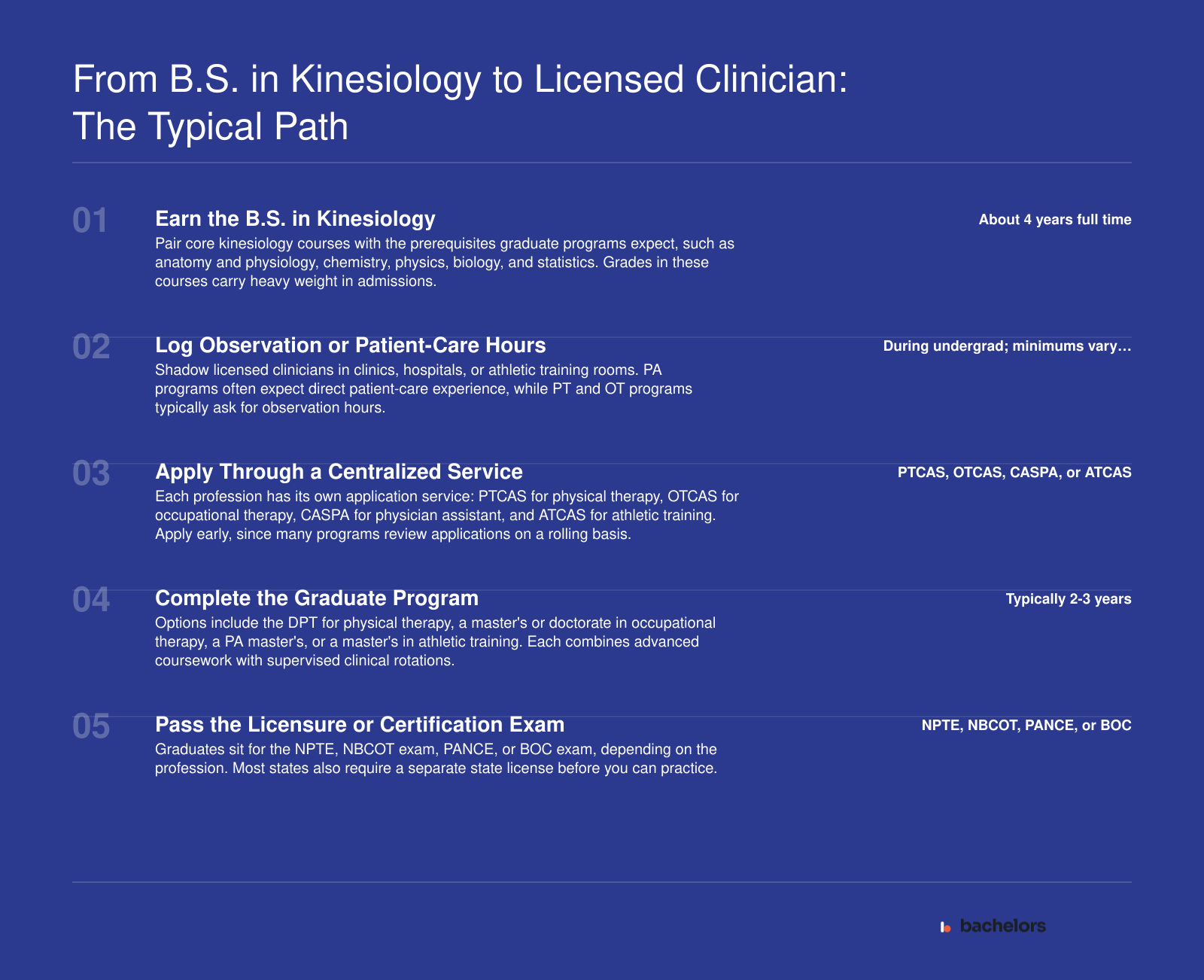
From B.S. in Kinesiology to Licensed Clinician: The Typical Path
Most kinesiology majors who go on to become physical therapists, occupational therapists, physician assistants, or athletic trainers follow the same general sequence. Timelines vary by profession, and accelerated 3+2 or 3+3 tracks at some universities can shorten the total path by a year or more.
Exercise & Sports Science programs by state
Kinesiology Degree FAQs
These answers cover the questions readers ask most about earning a bachelor's degree in kinesiology. Confirm details in each school's current catalog before you apply.
Are there accredited kinesiology degree programs online?
Can I become an athletic trainer with only a bachelor's in kinesiology?
Is kinesiology a better pre-PT major than biology?
How long does a B.S. in Kinesiology take, and will my community college credits transfer?
Compare Exercise & Sports Science programs on the data that matters
Explore more Healthcare majors or browse every field of study.
All Healthcare programs Browse every field of study