Best Gender & Sexuality Studies Degree Programs
Compare 310+ accredited Gender & Sexuality Studies programs, with net price after aid, graduation rates, earnings and debt from IPEDS and the U.S. College Scorecard.

For a bachelor's degree in gender and sexuality studies, whether you pick a public flagship or a private research university moves the bill more than anything else. Average net price across the ranked programs runs from $6,541 a year at the University of Florida to $25,184 at Brown University, and every one of them is an undergraduate major rather than a graduate track.
The curricula are closer than the prices. The University of Chicago requires 11 courses for the major and UC San Diego requires 14, which leaves room for a second major.
That room matters. One year after graduation, University of Florida majors earned a median $26,198, so the internship or second field a student adds often carries real weight with employers.
Key Points
- University of Florida posts the lowest net price here: $6,541 a year.
- Yale graduates earn the highest early-career pay among ranked programs.
- Need a fully online route? Oregon State Ecampus offers one.
Best Schools for a Bachelor's Degree in Gender and Sexuality Studies
Programs in gender and sexuality studies vary widely in size, cost, and structure, and the ten below range from small liberal arts colleges to large public research universities. Every program on this list is delivered on campus, and online options are covered later in this guide. Each card lists the average net price after aid, the school-wide graduation rate, and the kind of student the program tends to fit.
Stanford University
#1Stanford, CA · $10,000 – $15,000/yr (est.)
Best for: Students designing an individualized interdisciplinary subplan
Stanford pairs a small, research-driven undergraduate program with one of the broadest course catalogs in the country, and its Program in Feminist, Gender, and Sexuality Studies draws faculty from across the university. The major lets students choose a named subplan or build their own, and the chosen subplan appears on the diploma. Students at this school graduate at 92%, and the average net price after aid is about $13,807. Recent curriculum work added law-focused coursework and more experiential, problem-based learning.
- Five subplans, including queer and transgender studies
- 63 program units inside a 180-unit university minimum
- Senior capstone paper of at least 7,000 words
- Honors thesis of at least 15,000 words across 9 units
- Subplans print on the diploma
- Two electives required outside your subplan
- Option to design your own thematic focus
- Creative capstones include films, podcasts, and poetry
University of Chicago
#2Chicago, IL · ~$15,000/yr (est.)
Best for: Theory-minded students adding a second major
The University of Chicago is a private research university known for a rigorous core curriculum and small, discussion-heavy classes. Gender and Sexuality Studies sits inside that tradition, and its courses are cross-listed so majors can double-count work toward another degree. Students at this school graduate at 96%, and the average net price after aid is about $14,860.
- 11 courses required for students entering in 2026
- Optional BA thesis replaces two electives
- Honors needs a 3.25 overall and 3.5 major GPA
- One GNSE elective may be taken pass/fail
- Courses may double-count with another major
- Distribution requirement: one non-Western, one historical course
- Minor requires six courses
- BA seminar runs in autumn and winter quarters
University of Florida
#3Gainesville, FL · ~$7,000/yr (est.)
Best for: Cost-conscious students exploring health equity
The University of Florida is a large public research university in Gainesville and the state's flagship campus. Its Department of Gender, Sexuality, and Women's Studies offers a 30-credit major with four named concentrations plus a general track, and the department supports internships and undergraduate research. Students at this school graduate at 91%, and the average net price after aid is about $6,541.
- 30 credit hours, with 24 at the 3000 or 4000 level
- Four named concentrations plus a general specialization
- Concentrations include health equity and theories of sexuality
- Minimum grade of C in every course
- Up to 15 credits may count toward a double major
- Honors thesis for magna or summa cum laude
- 3.5 junior-senior GPA required for cum laude
- Internships and research projects available
University of California-San Diego
#4La Jolla, CA · $10,000 – $15,000/yr (est.)
UC San Diego is a public research university on the La Jolla coast, and its Critical Gender Studies program treats gender alongside race, class, sexuality, and nationalism. The major is deliberately interdisciplinary, pulling electives from social sciences and the arts and humanities. Students at this school graduate at 86%, and the average net price after aid is about $12,470. The program also markets itself as preparation for law, medicine, and public administration.
- 14 courses: a four-course intro sequence plus ten upper division
- Six upper-division courses must be in critical gender studies
- Honors thesis option with a 3.5 upper-division GPA
- Two courses may overlap with a double major
- Applicable electives drawn from social sciences and arts
- Minor requires the intro sequence plus three upper-division courses
- Prepares students for law, medicine, and public administration
University of California-Berkeley
#5Berkeley, CA · ~$13,000/yr (est.)
UC Berkeley's Gender and Women's Studies department sits in the College of Letters and Science, and undergraduates can tap university research programs, travel awards, and summer fellowships. The program is large enough to support an active honors track and small research grants for students working in the field. Students at this school graduate at 93%, and the average net price after aid is about $13,481.
- Honors program requires a 3.3 overall and 3.5 major GPA
- Honors thesis chaired by a faculty member or affiliate
- Research travel awards up to $500
- Center for Race and Gender grants of $100 to $1,000
- Undergraduate research through URAP and SURF
- Twenty Haas Scholars selected each year
- Study abroad support available
Bowdoin College
#6Brunswick, ME · ~$14,000/yr (est.)
Bowdoin is a small liberal arts college in Brunswick, Maine, with a curriculum built on small seminars and close faculty contact. Gender, Sexuality, and Women's Studies can be combined as a coordinate major with digital and computational studies, education, or environmental studies, which suits students who want a second field rather than a single focus. Students at this school graduate at 95%, and the average net price after aid is about $14,398.
- Coordinate major with digital and computational studies
- Coordinate major with education
- Coordinate major with environmental studies
- Minor open to non-majors
- Independent studies and honors projects
- First-year writing seminars count toward the major
- Coursework spans 1000-level intros to 4000-level seminars
Brown University
#7Providence, RI · $25,000 – $30,000/yr (est.)
Brown University's open curriculum lets students build their own course of study, and Gender and Sexuality Studies is housed in the Pembroke Center, a research center with a long history in feminist scholarship. Each concentrator designs a topic with an advisor rather than following a fixed sequence, so the degree reflects a student's own research question. Students at this school graduate at 96%, and the average net price after aid is about $25,184.
- Interdisciplinary concentration housed in the Pembroke Center
- Students design a topic or question with an advisor
- A.B. degree inside Brown's open curriculum
- Focus courses are paired with foundational theory and method
- Recent topics include trans memoir and queer archival practice
Florida State University
#8Tallahassee, FL · ~$11,000/yr (est.)
Florida State University is a large public university in Tallahassee, and its Women's Studies major is awarded as a Bachelor of Arts in Interdisciplinary Humanities. The program is campus-only and leans on cross-listed coursework plus foreign language proficiency, which keeps the degree broad. Students at this school graduate at 86%, and the average net price after aid is about $11,297. Graduates go into advocacy, government relations, and grant writing.
- BA in Interdisciplinary Humanities with a Women's Studies major
- 120 credit hours, including 33 in the major
- 12 hours of interdisciplinary WST coursework
- 12 hours of cross-listed core courses from four groups
- Foreign language proficiency through the intermediate level
- Campus only in Tallahassee, with no online option
- Upper-division admission needs 52 hours and a 2.00 GPA
- Exit interview and survey required to graduate
Harvard University
#9Cambridge, MA · $15,000 – $20,000/yr (est.)
Harvard College offers Studies of Women, Gender, and Sexuality as an undergraduate concentration that draws on the humanities, social sciences, and sciences. Advising and research access are strong, and the concentration treats gender and sexuality as categories of social power tied to race, ethnicity, class, and nationality. Students at this school graduate at 98%, and the average net price after aid is about $19,066.
- A.B. concentration through Harvard College
- Draws on the humanities, social sciences, and sciences
- Treats gender and sexuality as categories of social power
- Coursework centers on critical thinking and open inquiry
University of California-Los Angeles
#10Los Angeles, CA · $13,000/yr (est. net price)
UCLA's Department of Gender Studies is one of the largest in the country, and it awarded about 250 bachelor's degrees in the field in a recent year. The major is open to undergraduates across the university and keeps its requirements simple: three core theory courses, a capstone, and seven electives with no distribution rules. Students at this school graduate at 93%, and the average net price after aid is about $12,548.
- Three 4-unit core courses: Power, Knowledge, and Bodies
- Capstone seminar taken after the full core is complete
- Seven upper-division electives, 28 units total
- No concentration or distribution requirements
- Open to undergraduates in other UCLA schools by petition
- 2.0 GPA minimum, C or better in required courses
- Major and minor both offered
Cost & outcomes by school
Federal data for the highest-earning Gender & Sexuality Studies programs, independent of the ranking above. Earnings are this field's bachelor's graduates four years after completing where the Scorecard reports them, else the school's undergraduate median.
| School | Net price / yr | Grad rate | Earnings | Debt | Grads/yr | Format |
|---|---|---|---|---|---|---|
| University of Pennsylvania PA | $28,699 | 97% | $111,371 | $15,715 | 13 | Campus |
| Santa Clara University CA | $50,062 | 88% | $109,183 | $19,162 | 9 | Campus |
| Lehigh University PA | $36,931 | 88% | $105,584 | $21,960 | — | Campus |
| Cornell University NY | $28,690 | 95% | $104,043 | $14,000 | 14 | Campus |
| Georgetown University DC | $40,815 | 95% | $103,494 | $17,000 | 8 | Campus |
| Harvard University MA | $19,066 | 98% | $101,817 | $14,000 | 29 | Campus |
| Villanova University PA | $43,756 | 92% | $100,423 | $25,874 | 3 | Campus |
| Duke University NC | $29,612 | 97% | $97,800 | $13,000 | 2 | Campus |
| Dartmouth College NH | $29,519 | 96% | $97,434 | $15,157 | 26 | Campus |
| Brown University RI | $25,184 | 96% | $93,487 | $11,428 | 15 | Campus |
| University of Chicago IL | $14,860 | 96% | $91,885 | $15,000 | 22 | Campus |
| Vanderbilt University TN | $15,846 | 94% | $91,565 | $14,000 | 23 | Campus |
Sources: U.S. Department of Education. Net price, graduation rate, earnings and debt: College Scorecard (earnings and debt for this field's bachelor's graduates where reported, else school-wide); graduates: IPEDS. A dash means no figure is reported.
Cost, debt & payoff
Median earnings of this field's bachelor's graduates (4 yrs after completing, else the school's undergraduate median) vs. their median federal loan debt · U.S. College Scorecard
Across these programs the median graduate earns about $59,649 and finishes with roughly $21,500 in debt — a ratio that clears a common rule of thumb (keep debt below first-year salary). Net price and debt vary widely school to school, so check the per-school figures in the table above before you shortlist.
How We Ranked These Gender & Sexuality Studies Programs
Federal outcome data has made it easier to compare gender and sexuality studies programs, but the field's small size means the numbers are uneven from school to school.
Where the data comes from
The rankings draw on the U.S. Department of Education College Scorecard, which reports program and institution outcomes, and on IPEDS, which supplies cost and completions data.
What we weighed
- Earnings and debt: Program-level figures, used wherever they are published.
- Net price: The average price students pay once grant and scholarship aid is applied.
- Graduation and retention: How many students finish, and how many return after the first year.
- Completions: How many students earn the degree each year, a rough signal of how established a program is.
Limits to keep in mind
The completion and price figures cover the entire institution, not the gender and sexuality studies major alone. Treat them as context about the school rather than a verdict on the department. Where a small program publishes no earnings figure, we score that school on the remaining measures rather than penalize it or invent an estimate.
Who was eligible
Only bachelor's-level programs were considered. Online and campus programs were both eligible, so a strong fully online option can appear alongside a traditional on-campus department.
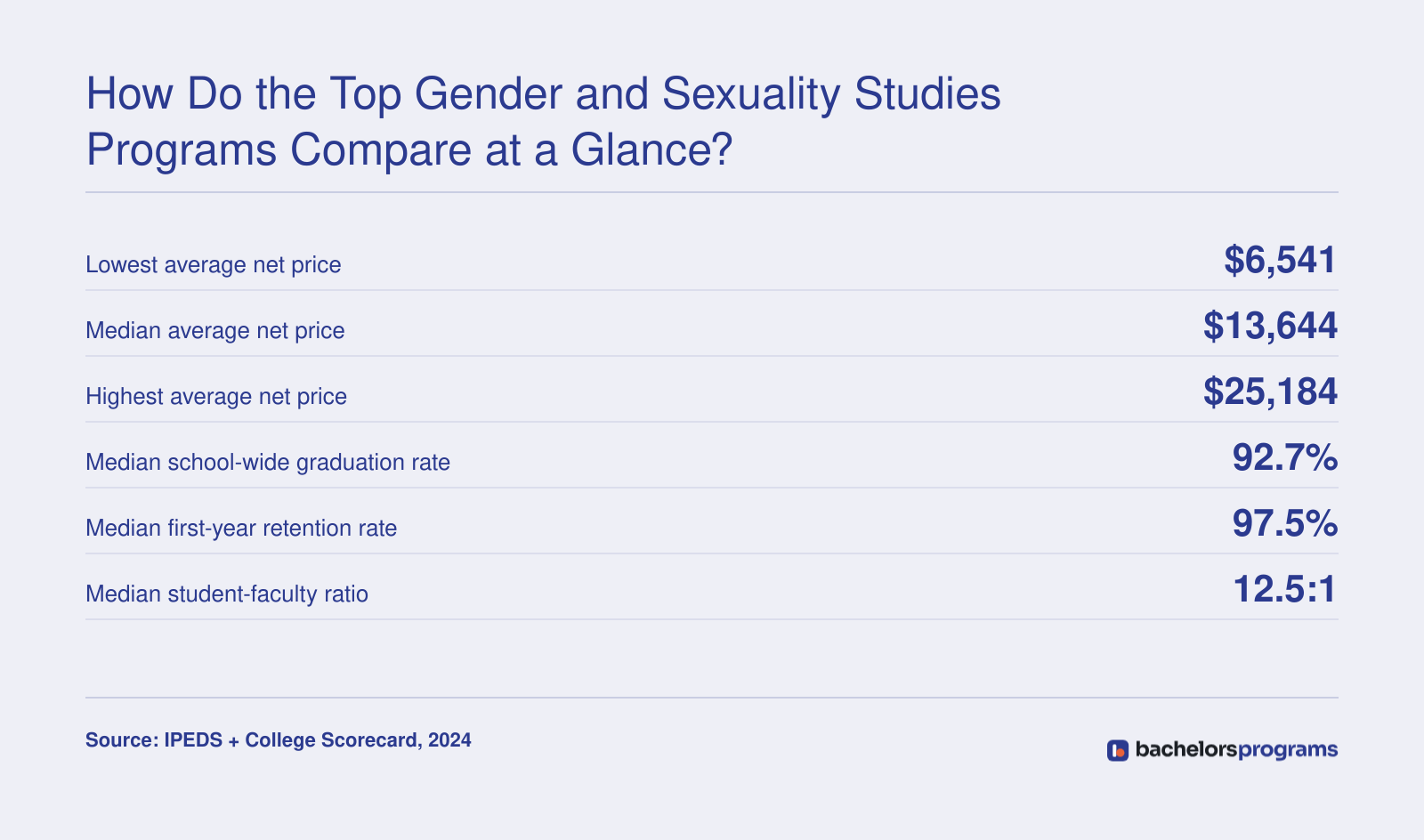
How Do the Top Gender and Sexuality Studies Programs Compare at a Glance?
These figures summarize the schools ranked here, using federal data from IPEDS and the College Scorecard. Net price is the average annual cost after grants and scholarships, not the sticker price. Graduation and retention rates are school-wide, so they reflect each university as a whole rather than its gender and sexuality studies major alone. Every program on this list is delivered on campus.
Online vs. Campus Gender and Sexuality Studies Degrees
Yes, you can earn this bachelor's fully online. Every school ranked here delivers its program on campus, including Stanford, the University of Chicago, Florida State and the UC campuses. If you need a fully online route, Oregon State University Ecampus offers a B.A. or B.S. in Women, Gender, & Sexuality Studies.
Credits and Tuition
A bachelor's degree typically runs about 120 semester credits. Florida State lists 120 total credit hours for its program. Oregon State uses quarter credits instead: the degree requires at least 180, including at least 60 upper-division credits, which works out to roughly 120 semester credits1.
Oregon State's 2026 online undergraduate tuition is $409 per quarter credit3. That rate includes a $15-per-credit distance-education fee and carries no extra nonresident charge. It excludes course materials and associated fees. At the 180-credit minimum, tuition comes to $73,620, and that is the floor for a student who transfers nothing3.
Transfer Credit Is the Big Cost Lever
For adult learners and community college transfers, transfer credit does more to lower the bill than any other factor. Oregon State reviews prior credits case by case at admission, and not every transferred credit necessarily applies to the degree2. You must still complete at least 45 of your last 75 credits at Oregon State, online or on campus2. Every credit that transfers and counts toward your degree is one you do not pay $409 for, so request a transcript evaluation before you commit.
The Honest Trade-Off
Campus programs offer what a screen cannot easily match: in-person activism, campus research centers, faculty-led research projects and local internships. Brown's program, for example, is housed in the Pembroke Center. Online programs give up some of that immersion in exchange for flexibility, which matters most if you are working, caring for family or finishing a degree you started years ago. Choose based on which of those two things you need more.
Gender and Sexuality Studies Degree Cost and Financial Aid
Among the schools ranked here, public universities post the lowest average net prices, led by the University of Florida at $6,541 a year, according to 2024 College Scorecard and IPEDS data from the U.S. Department of Education. Private colleges often list much higher sticker prices that can drop sharply once institutional grants are applied, and Pell Grant share signals access: UC San Diego's 72% share shows a campus that enrolls many lower-income students. Net price is an approximate average for aided students, so run each school's net price calculator for an estimate based on your own family's finances.
| School | Location | Average Net Price | In-State Tuition and Fees | Out-of-State Tuition and Fees | Pell Grant Share | Median Federal Debt at Completion |
|---|---|---|---|---|---|---|
| University of Florida | Gainesville, FL | $6,541 | $6,381 | $28,659 | 66.7% | $15,000 |
| Florida State University | Tallahassee, FL | $11,297 | $5,656 | $18,786 | 59.8% | $18,000 |
| University of California-San Diego | La Jolla, CA | $12,470 | $16,758 | $50,958 | 72.0% | $15,500 |
Related Articles
Concentrations and Curriculum: Women's, Queer, Transgender and Intersectional Studies
Transgender studies has moved from a subsection of queer theory to a named specialization at some programs, even as most curricula still fold it into broader LGBTQ coursework.
Three Tracks and How They Differ
Women's and gender studies tracks center feminist theory and treat gender as a system of power. Queer studies tracks focus on sexuality and identity, and often appear as required courses rather than formal concentrations: the University of Pennsylvania requires Introduction to Queer Theory,1 and Oregon State requires Introduction to Queer Studies.2 Transgender studies is the narrowest of the three. New Mexico State lists it as a specialization area,3 while UW-Eau Claire builds LGBTQ studies into its required core.4
What the Core Usually Requires
Credit loads commonly land between 30 and 48 semester credits, and the exact figure varies by institution. Grand Valley State and West Chester each require 30, UW-Eau Claire, New Mexico State, and UMass Amherst require 36, and Oregon State requires 48.2
The recurring core is an introductory course, feminist theory, a research or writing course, an upper-division theory requirement, and a senior synthesis. Grand Valley pairs WGS 101 with Foundations of Feminism and a capstone9; West Chester closes with a capstone in feminist research methods7; UMass Amherst requires a writing course and an integrative experience.8 Internships may be required or optional.
Named concentrations are common but not standardized. Santa Clara requires a three-course concentration,5 Ohio State requires 9 credit hours in one concentration area,6 and Penn lists 9 concentration elective courses.1
Pair the Major With a Second Skill
A minor or double major in psychology, public policy, social work, or pre-law gives employers and graduate committees a clearer signal. Check overlap rules first: Ohio State caps related coursework at 6 credits,6 and West Chester caps credits from any single department at 9.7
Accreditation and What to Verify Before You Apply
Gender and sexuality studies has no specialized programmatic accreditor. The accreditation that matters covers the whole institution. Check these points before you apply.
- No programmatic accreditor is neededA bachelor's degree in gender and sexuality studies falls under the school's institutional accreditation. Institutional accreditors review the college's full range of degrees rather than each major, so no separate program review is expected.
- A recognized institutional accreditorFor four-year schools, look for HLC, MSCHE, SACSCOC, WSCUC, NECHE or NWCCU, the bodies once called 'regional.' ACCJC mainly accredits community and junior colleges. The U.S. Department of Education does not accredit schools itself. It recognizes the agencies that do.
- Current accreditation statusSearch the school's exact name in the Department of Education's DAPIP database and in the CHEA directory. Confirm the record matches the campus or online entity granting your degree, and look for full accreditation. Candidacy and probation are not the same. DAPIP data is reported by agencies and not audited, so check the accreditor's own directory if records conflict.
- Credit transfer acceptanceAsk how your prior credits will be evaluated. Accreditation alone does not guarantee they will transfer.
- Total credits and residency requirementsOnline students should confirm the total credits required and how many must be earned at the school.
- Internship or practicum availabilityAsk whether placements are offered and whether online students can complete them locally.
- State authorization for online enrollmentConfirm the school is authorized to enroll online students in your state. This approval is separate from accreditation.
What Can You Do With a Gender Studies Degree?
A gender studies degree prepares you for work built around people, policy and communication: guiding clients through services, running community programs, analyzing laws and writing for public audiences. University career centers, including those at Grand Valley State and the University of Rhode Island, present these as common destinations for graduates, not guaranteed outcomes.1
Common Jobs and Employers
- Nonprofits and advocacy: anti-violence advocate, LGBTQ coordinator or nonprofit coordinator at advocacy groups and women's centers.
- Social services: case manager or community-health worker.
- HR and DEI: HR administrator or DEI professional at public and private corporations.
- Education: academic advisor, admissions professional or residence-life staff at colleges and universities.
- Policy and government: policy analyst, legislative aide or government-relations professional at federal, state and local agencies.
- Healthcare outreach: public-health roles at hospitals, clinics and public-health organizations.
Outcomes vary by school. The University of Mary Washington's 2018 to 2022 alumni report found 50% employed full time, 15% part time and 15% in graduate school.2 UW-Whitewater reports that recent graduates responding to its 2023-24 survey were all employed or pursuing an advanced degree one year out.3
Graduate Pathways
Many graduates use the bachelor's as a step toward further study. Frequent next steps include law school, a Master of Social Work, a master's in public policy or public administration, teaching or counseling programs, and public health. Roles such as lawyer, licensed social worker or clinical health professional require that added education and, often, a license.
Skills and Internships That Shape Your Path
The coursework builds the research, writing, policy analysis and community engagement abilities these job titles call on. Penn State highlights an alumna who practices law for lower-income clients in gender discrimination cases, pairing legal training with the major's analytical lens.4
An internship often settles the question. A semester at a women's center, a legislative office or an HR department gives you references, clarifies which sector fits and shows employers you can apply theory to real work. Aim to complete at least one before senior year.
Top Early-Career Earnings Among Ranked Programs
Yale posts the highest program-level earnings among the schools ranked here.
Gender & Sexuality Studies programs by state
Compare Gender & Sexuality Studies programs on the data that matters
Explore more Liberal Arts & Humanities majors or browse every field of study.
All Liberal Arts & Humanities programs Browse every field of study