Best Online History Degree Programs
Compare 130+ accredited online History programs, with net price after aid, graduation rates, earnings and debt from IPEDS and the U.S. College Scorecard.

Online history programs have become a standard offering at large public universities, and price now varies more than the credential does.
A bachelor's degree in history is typically a Bachelor of Arts (B.A.) in History of about 120 credits, earned with no hybrid or campus requirement. Every school on this page is 100% online. Among the top-ranked schools, what students actually pay after aid ranges from $9,288 to $17,447 a year, nearly double for the same degree.
Employers tend to read a history major as proof of research and writing ability rather than preparation for one job. That makes cost and finishing on schedule the variables you can control.
Key Points
- Every ranked program can be completed fully online, with no campus visits.
- Eastern New Mexico, Elizabeth City State and Marshall cost least after aid.
- University of Nebraska at Kearney's history B.A. posts the highest early-career earnings.
Best Fully Online Bachelor's Degree in History Programs, Ranked
These are the top 10 fully online bachelor's degree in history programs, ordered by a mixed quality composite that weighs cost, completion and program strength. Every program below can be finished entirely at a distance, and hybrids that require any in-person attendance were excluded from the list.
Florida International University
#1Miami, FL · ~$9,000/yr (est.)
Best for: Students drawn to international and public affairs
Florida International University is a large public research university in Miami with a strong footprint in international and public affairs. The history bachelor's degree is housed in the Steven J. Green School of International and Public Affairs, which shapes a curriculum built around how world cultures interact. The school's graduation rate is 74%.
- 120 total credit hours over four years of full-time study
- Offered through the Steven J. Green School of International and Public Affairs
- Coursework analyzes interactions between world cultures
- Builds analytical tools for interpreting the past and shaping change
University of Central Florida
#2Orlando, FL · ~$10,000/yr (est.)
Best for: Florida community college transfer students
The University of Central Florida is one of the largest public universities in the country and a major destination for Florida community college transfers. Its online division keeps transfer-support partnerships with colleges across the state, and fully online students often see campus-based fees reduced. History majors take 39 history credits and close with a portfolio capstone, and the school's graduation rate is 78%.
- 120 total credit hours, including 39 in history
- 33 upper-level history credit hours required
- 18 upper-level history hours must be taken in residency
- Capstone is a history portfolio of 8 to 12 graded written works
- Foreign language proficiency required for the degree
- Judaic Studies certificate and Honors in the Major available
- 2.0 GPA required in history courses
American Public University System
#3Charles Town, WV · $5,000 – $10,000/yr (est.)
Best for: Military-connected students with prior coursework
American Public University System is an online institution built around working adults, military members and veterans. History majors pick among general, American, European and global concentrations, and the university accepts up to 90 transfer credits toward the bachelor's degree, which can shorten time to graduation considerably. The school's graduation rate is 57%.
- 120 semester hours completed entirely online
- Major core of 9 semester hours, including Research Methods in History
- 36 semester hours of free electives for customization
- Final requirement pairs a research proposal with senior seminar
- Content spans ancient Greece and Rome through the Cold War
- 39 semester hours in American history, from early period to present
- Faculty who teach the concentration are published historians
- General education accounts for 30 semester hours
- Prepares graduates for curator, archivist and educator roles
- European history track runs from ancient Greece onward
- Research Methods in History is required
- Students analyze primary and secondary sources in a major research paper
- Independent study in history available
California State University-San Marcos
#4San Marcos, CA · $10,000/yr (est. net price)
California State University San Marcos is a public university in northern San Diego County that serves a large share of transfer and working adult students. Its history bachelor's is a degree-completion program delivered asynchronously, with a cohort structure and a guaranteed course sequence that keeps students moving. The school's graduation rate is 55%.
- Degree-completion program delivered fully online and asynchronously
- 60 units after 60 transferable semester or 90 quarter credits
- Cohort structure with a guaranteed course sequence
- Designed to finish in five consecutive semesters, summer included
- Coursework covers Africa, Asia, Europe, Latin America, the Middle East and the U.S.
- Digital and multimedia history tools built into the curriculum
- Credit for Prior Learning accepted
- Diploma does not state that the degree was earned online
University of West Florida
#5Pensacola, FL · $5,000 – $10,000/yr (est.)
The University of West Florida is a public university in Pensacola with a long record of serving nontraditional and military-connected students. History majors can focus on American, Latin American or European history and round out the degree with business or social science electives. The school's graduation rate is 59%.
- Concentrations in American, Latin American or European history
- Independent research and evaluation of historical claims
- Electives in literature, political science, anthropology and psychology
- Business electives in management, marketing, computer science and finance
- Accelerated B.A. to M.A. pathway for qualified students
- Internships and undergraduate scholarships available
- Classes offered face-to-face, hybrid and online
Arizona State University
#6Tempe, AZ · ~$15,000/yr (est.)
Arizona State University is a large public research university that runs one of the biggest online degree operations in the country. The history B.A. is available fully online, and the university layers on accelerated bachelor's-to-master's pathways and paid undergraduate research assistantships. The school's graduation rate is 68%.
- 120 credits in the College of Liberal Arts and Sciences
- Courses include The Historian's Craft and Methods of Historical Inquiry
- Accelerated bachelor's plus master's option in as little as five years
- Undergraduate research assistantships earn up to 9 elective credits
- Offered on campus, fully online, or through ASU Local
- Accredited by the Higher Learning Commission
- Western Undergraduate Exchange reduced tuition may apply
- Concurrent degrees earn two diplomas
Southern Utah University
#7Cedar City, UT · $7,000 – $21,000/yr (est.)
Southern Utah University is a public university in Cedar City whose history department leans on digital archives, research labs and study abroad. Students can earn either a B.A. or a B.S. in history, and online students pay the same tuition whether they live in Utah or elsewhere. The school's graduation rate is 61%.
- B.A. and B.S. options, on campus or online
- History Education emphasis leads to teaching licensure
- Licensure requires professional education coursework through Teacher Education
- Digital archives, specialized history databases and research labs
- Online students pay the same rate in state and out of state
- History honor society, study abroad and internships available
California State University-East Bay
#8Hayward, CA · $8,000 – $20,000/yr (est.)
California State University East Bay is a public university in the East Bay with close ties to California community college transfer pathways. Its history B.A. can be completed through an online degree completion format, and the curriculum adds an applied history course plus career-focused labs. The school's graduation rate is 48%.
- 120 units, with 51 to 56 units in history coursework
- 4-unit applied history course plus a 4-unit research capstone
- Thematic areas include Migration and Globalization and Social Justice and Citizenships
- Three one-unit Linked Labs cover skills, mentoring and career planning
- Online degree completion format available
- 2-year ADT roadmaps published for California transfers
University at Albany
#9Albany, NY · ~$17,000/yr (est.)
The University at Albany is a public research university in New York's capital region, a location that supports internships with museums and government agencies. Its history B.A. can be finished online, and a combined B.A. and M.A. lets strong students share up to 12 credits. The school's graduation rate is 61%.
- Four years for full-time students, longer for part-time students
- Three 100- or 200-level courses across U.S., European and World history
- The Historian's Craft: Methods plus a senior research seminar
- Internships earn up to six credits with junior or senior standing and faculty approval
- Combined B.A. and M.A. in five years with up to 12 shared credits
- Honors senior thesis seminar available
- Accredited by the Middle States Commission on Higher Education
Oklahoma State University
#10Stillwater, OK · ~$17,000/yr (est.)
Oklahoma State University is a public land-grant university in Stillwater with a broad history department and a published four-year degree plan. The B.A. in history spreads 30 major hours across American, European and world history and closes with a capstone seminar or honors thesis. The school's graduation rate is 68%.
- 120 credit hours, at least 40 at the 3000 level or above
- 48 major hours across American, European and World history
- Capstone is a senior seminar or senior honors thesis
- 12 upper-division hours from related fields such as anthropology or political science
- 9 hours of foreign language required
- 2.50 GPA in the major, with no grade below C in upper-division history
- At least 30 hours must be completed at OSU
- Finish in Four sample plan of study published
None of the ranked History programs match the online lens yet. The full ranking is at the link above.
Cost, debt & payoff
Median earnings of this field's bachelor's graduates (4 yrs after completing, else the school's undergraduate median) vs. their median federal loan debt · U.S. College Scorecard
Across these programs the median graduate earns about $52,248 and finishes with roughly $23,250 in debt — a ratio that clears a common rule of thumb (keep debt below first-year salary). Net price and debt vary widely school to school, so check the per-school figures in the table above before you shortlist.
How We Ranked These 100% Online History Schools
A hybrid history program and a fully online one can award the identical degree. Only one of them works if you cannot drive to campus for a seminar, a proctored exam, or a Tuesday afternoon office hour. That distinction decided who made this list.
The Filter Comes First
Every program here had to be a bachelor's degree in history delivered entirely online. Hybrid formats were excluded even when the on-campus commitment was a single weekend residency, and graduate study was never in scope. A university with a respected history department but a partly residential major does not qualify.
What Goes Into the Score
Programs were scored on a composite of four measures:
- Average net price: what students pay after federal, state, and institutional aid, not the sticker tuition.
- Graduation rate: the share of first-time, full-time students who finish at that institution.
- Earnings and debt: federal figures for history graduates, used where the data is published for that program.
- Concentrations: the tracks a major can choose, from American history to public history and European history.
Figures come from College Scorecard and IPEDS, drawn from the latest federal snapshot.
What the Ranking Cannot Tell You
Net price and graduation rate describe the whole institution rather than the history department alone, so a university's overall completion record can mask how a smaller program actually runs. Some history programs carry no published earnings data at all. And no composite score captures how well a professor teaches or how quickly an advisor answers an email. Use the ranking to narrow the field, then ask about teaching and advising directly.
Cheapest Online History Degree Programs: Net Price, Per-Credit Tuition, and Fees
Eastern New Mexico University, Elizabeth City State University and Marshall University have the lowest average net price after aid among the ranked schools, from $4,904 to $7,502 a year. The rows below them show published per-credit online rates from other fully online history programs. For part-time students and transfers, the per-credit rate matters more than the annual sticker price because you pay only for the credits you still need. A student who arrives with 60 credits and needs 60 more would pay about $21,180 at Louisiana State University of Alexandria's $353 flat rate, $24,600 to $28,500 at Liberty University's standard rates, or $15,000 at Liberty's $250 military rate. Those estimates are tuition only, before fees and financial aid.
| School | Program | Average net price after aid (per year) | Published tuition and fees or program cost | Per-credit online tuition | Fees and discounts | Source |
|---|---|---|---|---|---|---|
| Eastern New Mexico University | Bachelor of Arts or Science in History | $4,904 | $7,194 in-state, $9,174 out-of-state (per year) | N/A | N/A | IPEDS & College Scorecard (2024), U.S. Department of Education |
| Elizabeth City State University | B.A. in History | $6,364 | $6,536 in-state, $10,536 out-of-state (per year) | N/A | N/A | IPEDS & College Scorecard (2024), U.S. Department of Education |
| Marshall University | History, B.A. | $7,502 | $9,162 in-state, $20,342 out-of-state (per year) | N/A | N/A | IPEDS & College Scorecard (2024), U.S. Department of Education |
| Louisiana State University of Alexandria | B.A. in History | N/A | About $42,360 for 120 credits, before transfer credit and aid | $353 flat rate regardless of residency | No out-of-state fee; course fees for proctoring or books vary by program | LSU Online B.A. in History page |
| Eastern Oregon University | B.A./B.S. in History | N/A | About $60,840 for the 180-credit program, excluding fees | $338 | One-time $250 matriculation fee for fully online students; Active Duty Scholarship may cover remaining tuition for eligible National Guard and Reserve members | Eastern Oregon University online history tuition page |
| Liberty University | B.S. in History | N/A | N/A | $410 to $475 (2026-27; full-time and part-time rates differ) | $250 per credit for qualified military students and spouses after verification; no separate online fee identified | Liberty University B.S. in History and military tuition discount pages |
Related Articles
Online History Degree Transfer Credits and the Fastest Path to Finishing
How many credits can I transfer into an online history bachelor's degree? That number decides both what you pay and when you graduate, so pin it down before you apply.
What the Transfer Cap Looks Like
Every accredited online history program sets a maximum on transfer credit and a residency requirement, which is the number of credits you must earn at that institution. Caps vary by school and sometimes by college within a school. At ASU Online, the Bachelor of Arts in History requires 120 credits and publishes a 64-credit transfer maximum; applicants need at least 12 transferable credits to be reviewed as transfer students. ASU Online does not post a separate residency figure for this program, so ask an advisor which upper-division history courses must be completed in-house. Many online programs reserve the final year of coursework for their own faculty, and that reservation is what actually limits how fast you can finish.
Two Students, Two Timelines
A degree-completion student arriving with an associate degree or 60 or more credits is halfway through a 120-credit degree. Taking 15 credits per term, that is roughly two years; dropping to 6 credits per term stretches it to about three and a half. A first-time student starting from zero faces the full 120 credits, which is four years at 15 credits per term. Accelerated terms of seven or eight weeks let you stack more courses per calendar year, but the credit total does not change.
Where Transfer Credit Comes From
- Community college coursework: the cheapest per-credit source, and the most likely to satisfy general studies requirements.
- CLEP and DSST exams: ASU Online accepts both, and CLEP exams are free for eligible military members.
- Military training: evaluated through ACE recommendations and documented on the Joint Services Transcript. At ASU Online this credit can count toward total graduation credits but not toward general studies, and vocational ACE recommendations are not accepted.
Request an Unofficial Evaluation First
Send transcripts to an advisor for an informal review before you apply. It shows which credits land in the history major versus free electives, flags courses you would be retaking, and tells you how many terms you actually need, all before an application fee is due.
Online History Degree Accreditation: What to Verify Before You Apply
Before you apply to any online bachelor's in history program, confirm these points. Check them against official records, not a school's marketing copy.
- Institutional accreditation from a recognized accreditorLook for a regional accreditor such as HLC, SACSCOC, NWCCU or MSCHE. Arizona State University is accredited by the Higher Learning Commission (HLC), and Liberty University is accredited by SACSCOC.
- Confirmation through DAPIP or CHEASearch the school in the U.S. Department of Education's DAPIP database or the CHEA directory. These independent records confirm that the accrediting agency is recognized and the school's status is current.
- State authorization for your stateA school must be authorized to enroll online students where you live. ASU participates in SARA through the Arizona SARA Council and NC-SARA, which covers SARA member states only. Check each school's state authorization page.
- Teacher-certification portabilityMost online history degrees build content knowledge but do not lead to a teaching license. If you plan to teach, ask whether the program meets licensure requirements and whether your state's education department will accept it.
- Credit transfer into graduate schoolGraduate programs typically expect a bachelor's degree from an institutionally accredited school. Verifying accreditation now protects your options for a future master's degree.
What Do Fully Online History Degrees Cost, and How Do They Perform?
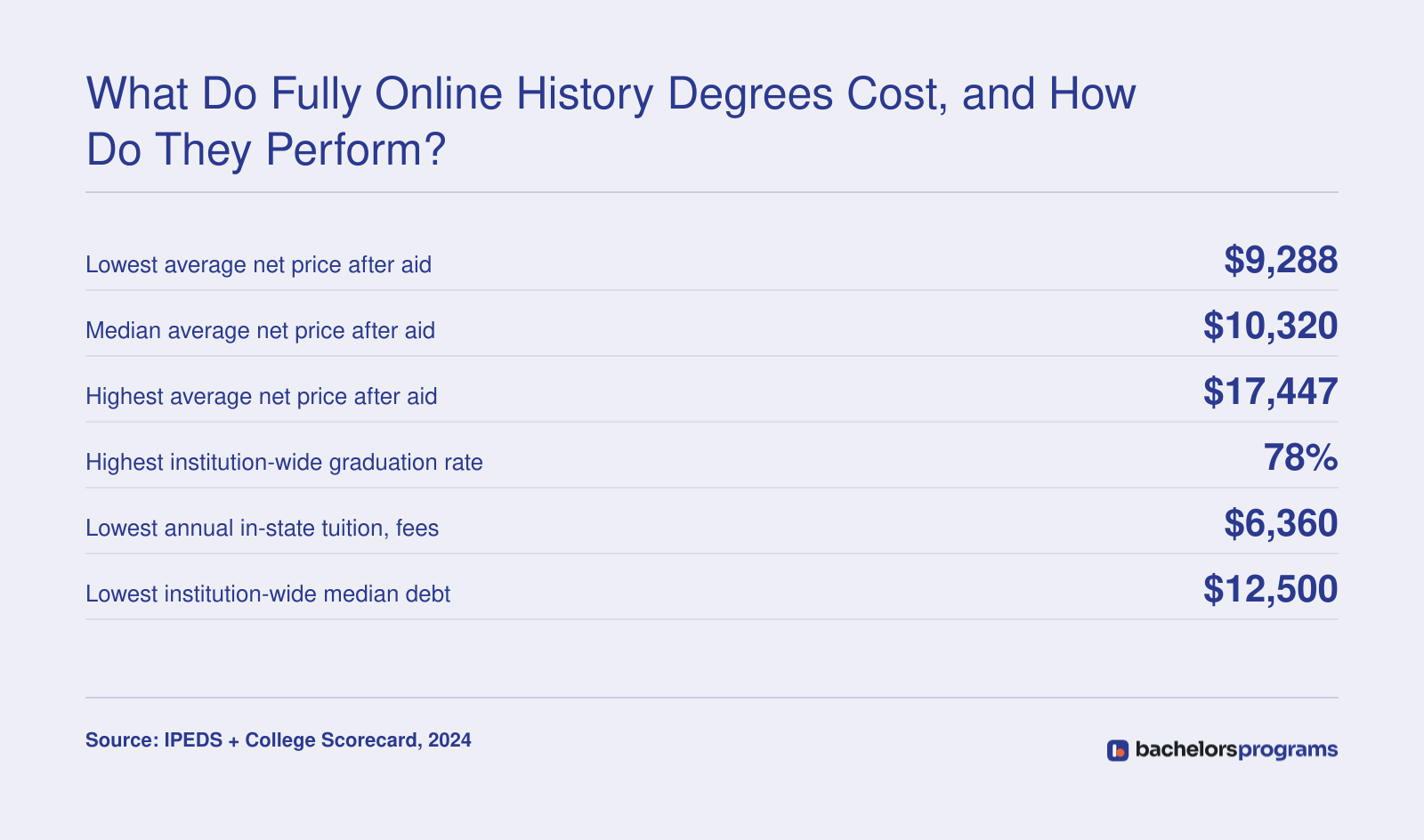
Average net price after aid at the ranked schools runs from $9,288 to $17,447 a year, and most cluster near the $10,320 median. For budget-conscious students, that means a strong program rarely requires paying top dollar. Florida International University has the lowest net price, and the University of Central Florida pairs a near-median price with the highest institution-wide graduation rate.
Top Early-Career Earnings Among Ranked History Programs
Among the ranked online programs here, the University of Nebraska at Kearney's History, Bachelor of Arts posts the highest early-career earnings.
Questions to Ask Yourself
Do you plan to teach history in a K-12 classroom?
Would a concentration like military or public history help you land the job you want?
Can you sustain the reading and writing load of 8-week terms?
History programs by state
Online History Degree FAQ
These are the questions prospective students ask most often about earning a bachelor's degree in history online. Answers reflect typical program structures, so confirm details with any school you are considering.
Can you get a bachelor's degree in history 100% online?
How long does it take to earn an online history degree?
Are online history degrees accredited and respected by employers?
Can I earn a second bachelor's in history online if I already have a degree in another field?
Does an online history degree prepare you for law school?
Compare History programs on the data that matters
Explore more Liberal Arts & Humanities majors or browse every field of study.
All Liberal Arts & Humanities programs Browse every field of study