Best Online Interdisciplinary Studies Degree Programs
Compare 130+ accredited online Interdisciplinary Studies programs, with net price after aid, graduation rates, earnings and debt from IPEDS and the U.S. College Scorecard.

A traditional major commits you to one department. A bachelor's degree in interdisciplinary studies, awarded as a Bachelor of Science (B.S.) or Bachelor of Arts (B.A.) in Interdisciplinary Studies, lets adult learners and transfer students combine two or three subject areas, often finishing sooner by applying credits already earned.
Every program ranked here is 100% online; hybrids were excluded. Average annual net price after aid runs from $8,221 to $22,383.
Employers rarely hire for the title, so the combination you build matters more than the label.
Key Points
- Elizabeth City State University has the lowest net price here, $6,364 yearly.
- Transfer students often finish the 120-credit degree in 18 to 24 months.
- Earnings track the two fields you combine, not the diploma's label.
Top 10 Fully Online Interdisciplinary Studies Programs for 2027
Every program below can be completed entirely online, with no hybrid or in-person component required, so you can study from wherever you live. What separates them is how the degree is built: self-designed concentrations, generous transfer credit, a structured subject pairing, or a track built for adult completers. The cards let you compare cost, completion and outcomes side by side.
University of Central Florida
#1Orlando, FL · ~$10,000/yr (est.)
UCF is a large public research university in Orlando that awards both a Bachelor of Arts and a Bachelor of Science in Interdisciplinary Studies, so students pick the credential that fits their concentration pairing. The degree requires 120 credits, two subject-area concentrations, a minor from UCF's catalog and a capstone, and it can be completed fully online. It suits students who want a flexible major inside a big institution with broad course choice.
- Bachelor of Arts or Bachelor of Science; 120 credit hours
- Two subject-area concentrations plus 30 restricted elective credits
- 3-credit Cornerstone Experience and 3-credit Capstone required
- UCF minor also required; declare the major two semesters before graduation
- 13 concentration options; Academic Success Coach consultation required
- Fully online option available through UCF Online
Florida International University
#2Miami, FL · ~$9,000/yr (est.)
Best for: Transfers wanting scheduled online start dates
Florida International University runs its interdisciplinary studies degree through the College of Arts, Sciences and Education and draws elective coursework from several other colleges, which gives students room to build a path across fields. It admits first-year, transfer and non-traditional students, and the degree can be finished online or on campus. FIU positions the major for job categories that reward combined skill sets, including entrepreneurial roles.
- 120 credit hours; four years of full-time study
- Coursework drawn from multiple FIU colleges and schools
- Customized academic path tied to interests and career goals
- Open to first-year, transfer and non-traditional students
- Can be completed fully online or on campus
- Builds critical thinking and entrepreneurial skills
Florida Atlantic University
#3Boca Raton, FL · $4,900 – $17,000/yr (est.)
Best for: Humanities-focused learners building an individualized plan
Florida Atlantic University's version sits in the Dorothy F. Schmidt College of Arts and Letters and splits into four tracks, with Arts and Humanities as one of them. Students work closely with faculty to assemble a plan of study spanning literature, visual arts, music, philosophy or a combination, and advising runs through the college's student academic services office. It is a good match for readers who want a humanities-heavy interdisciplinary degree rather than a broad self-design.
- Four tracks, including Arts and Humanities, Social Science and WGSS
- Faculty-guided plan of study across literature, arts, music, philosophy
- Research and internship opportunities available
- Advising through the Office of Student Academic Services
- Prepares for education, the arts, public service, business or graduate study
University of Oklahoma
#4Norman, OK · $15,000 – $20,000/yr (est.)
The University of Oklahoma delivers this degree through its College of Liberal Studies, a unit built around adult and nontraditional students. The interdisciplinary studies major carries a Learning and Education Studies focus, with a shared core in communication, data analysis and critical inquiry plus education coursework on instruction and learner development. Admission is restricted to applicants 25 and older who arrive with at least 60 letter-graded credits, so it fits working adults finishing a degree rather than first-year students.
- 120 credit hours, delivered online by the College of Liberal Studies
- 30 credit hours in the major, including a 15-credit shared core
- 40 hours of general education plus 15 credits of education coursework
- Admission requires 60 letter-graded credits and a 2.0 GPA
- Applicants must be 25 or older with work experience
- Portfolio course required; pass 70% of courses each year
- Implemented in Fall 2024 for adult degree completion
Brigham Young University-Idaho
#5Rexburg, ID · ~$8,000/yr (est.)
BYU-Idaho offers a Bachelor of Interdisciplinary Studies, a distinct credential from the B.A. and B.S. versions elsewhere on this list. Students draw coursework from three broad categories, science and technology, arts and humanities, and social sciences and business, and take a two-course sequence that introduces interdisciplinary thinking and innovation. A published four-year class plan gives the degree a structure that open-ended self-design programs often lack.
- Bachelor of Interdisciplinary Studies rather than a single-subject major
- Coursework pulled from STEM, arts and humanities, and social sciences
- Opens with IDS101 and IDS301; an example four-year plan is published
- Builds problem solving for complex questions and applied AI tools
- Customized degree path; three concentration options
- Example class plan published for four-year completion
American Public University System
#6Charles Town, WV · $5,000 – $10,000/yr (est.)
American Public University System is based in Charles Town, West Virginia, and serves a largely military and adult audience through recurring eight-week online sessions. Its interdisciplinary studies bachelor's lets students combine two or more disciplines chosen partly for employment trends in business, the sciences and social services, and a senior seminar caps the degree. Prospective students should know the program is not eligible for federal student aid, so financing has to come from other sources.
- 120 semester hours, with 39 in the major and 48 electives
- Students combine two or more disciplines in one degree
- Discipline choices tied to employment trends in business and social services
- 30 semester hours of general education; 3-hour senior seminar required
- Not eligible for federal student aid
- Eight-week online sessions with multiple start windows
University of Massachusetts-Amherst
#7Amherst, MA · $20,000 – $25,000/yr (est.)
UMass Amherst delivers this degree through University Without Walls, its long-running individualized-study unit. Students can transfer up to 75 credits, earn additional credit through a prior learning portfolio, and then build a 45-credit concentration with faculty guidance. The unit accepts students from all 50 states under the State Authorization Reciprocity Agreement, which matters if you live outside Massachusetts.
- 120 credits; up to 75 may be transferred in
- At least 45 credits must be earned through UMass Amherst
- 45-credit individualized concentration, 15 credits at upper level
- Prior learning portfolio can award up to 30 credits; average award is 15
- Four core courses include two experiential reflections courses
- Starts in fall, spring, summer and winter; 6-week accelerated terms
- Member of the State Authorization Reciprocity Agreement
Arizona State University
#8Tempe, AZ · ~$15,000/yr (est.)
Arizona State University's interdisciplinary studies B.A. is run by the College of Integrative Sciences and Arts and lets students combine two concentration areas from a very large catalog of options. The program includes an internship and can be completed online or at several Phoenix-area sites. It carries Higher Learning Commission accreditation but is not STEM-OPT eligible, a detail that matters to international students.
- Bachelor of Arts; 120 credit hours
- Two concentration areas chosen from nearly 200 options
- Internship adds career-ready practical experience
- Online version available alongside Downtown Phoenix, Polytechnic and Tempe sites
- Higher Learning Commission accreditation
- Not eligible for STEM-OPT extension
- Accelerated bachelor's plus master's option offered
University of Missouri
#9Columbia, MO · ~$20,000/yr (est.)
The University of Missouri offers its interdisciplinary studies B.A. entirely online, with no campus visits at all. Students take general education and College of Arts and Sciences foundation courses, then design a 39-credit major from two or three component areas at the 2000 level or above. Courses run in eight- or 16-week formats with full-time or part-time enrollment, and the university is accredited by the Higher Learning Commission.
- 100% online, with no campus visits required
- 120 credits across general education, foundations and the major
- 39-credit major built from two or three component areas
- Capstone of an internship, readings course or service-learning
- Eight- or 16-week course formats; full-time or part-time loads
- Foreign language requirement of 12 to 13 credits
- Higher Learning Commission accredited
University of Arizona
#10Tucson, AZ · ~$17,000/yr (est.)
The University of Arizona offers an interdisciplinary studies degree through its College of Humanities with an emphasis in Social Behavior and Human Understanding. Students can earn either a Bachelor of Arts or a Bachelor of Interdisciplinary Studies and transfer in up to 75 credits. The program appears in U.S. News and World Report's 2026 online bachelor's rankings and points graduates toward human services, public relations, policy and health care roles.
- $525 per credit; 120 credit hours
- Emphasis in Social Behavior and Human Understanding
- Transfer up to 75 credits into the degree
- Bachelor of Arts or Bachelor of Interdisciplinary Studies options
- Coursework in human behavior, history, culture, ethics and communication
- Housed in the College of Humanities
- Listed in U.S. News 2026 top 5% of online bachelor's programs
Cost & outcomes by school
Federal data for the highest-earning Interdisciplinary Studies programs, independent of the ranking above. Earnings are this field's bachelor's graduates four years after completing where the Scorecard reports them, else the school's undergraduate median.
| School | Net price / yr | Grad rate | Earnings | Debt | Grads/yr | Format |
|---|---|---|---|---|---|---|
| Villanova University PA | $43,756 | 92% | $100,423 | $25,874 | — | Online or campus |
| Rutgers University-Camden NJ | $18,745 | 67% | $74,479 | $21,500 | — | Online or campus |
| University of Massachusetts-Amherst MA | $22,383 | 83% | $71,631 | $22,763 | — | Online |
| Pennsylvania State University PA | $32,875 | 86% | $63,435 | $25,000 | — | Online or campus |
| Florida International University FL | $9,288 | 74% | $60,249 | $20,147 | 482 | Online or campus |
| University of Michigan-Dearborn MI | $9,492 | 58% | $59,649 | $22,500 | — | Online |
| University of Oklahoma OK | $15,300 | 75% | $59,001 | $19,100 | 190 | Online |
| Brigham Young University-Idaho ID | $8,221 | 56% | $55,978 | $13,074 | 659 | Online or campus |
| University of Central Florida FL | $10,411 | 78% | $51,959 | $19,408 | 838 | Online or campus |
Sources: U.S. Department of Education. Net price, graduation rate, earnings and debt: College Scorecard (earnings and debt for this field's bachelor's graduates where reported, else school-wide); graduates: IPEDS. A dash means no figure is reported.
Cost, debt & payoff
Median earnings of this field's bachelor's graduates (4 yrs after completing, else the school's undergraduate median) vs. their median federal loan debt · U.S. College Scorecard
Across these programs the median graduate earns about $53,459 and finishes with roughly $22,899 in debt — a ratio that clears a common rule of thumb (keep debt below first-year salary). Net price and debt vary widely school to school, so check the per-school figures in the table above before you shortlist.
What a Bachelor's Degree in Interdisciplinary Studies Covers
The degree is no longer a catch-all. Many programs now ask students to justify the combination they build rather than simply accumulate credits.
How the Coursework Is Built
Students typically combine two or three disciplines, or anchor one major area with two minors, then add a core of interdisciplinary research and writing courses. Many programs close with a capstone in which students tie the strands together in a single project or paper.
B.A. Versus B.S.
The Bachelor of Arts usually leans toward humanities, communication, and social science combinations, while the Bachelor of Science tends toward business, health, technology, or science pairings. Both are the same bachelor's degree in interdisciplinary studies; the difference is the mix of courses behind it.
Not the Same as General Studies
General studies is a broad liberal arts completion degree built for adults finishing a credential. Interdisciplinary studies asks you to design a coherent focus around a career or academic goal, which is why it reads differently on a resume. If cost is the deciding factor, compare the two side by side before you choose.
Common pairings include psychology with business, communication with health sciences, and data analytics with public policy.
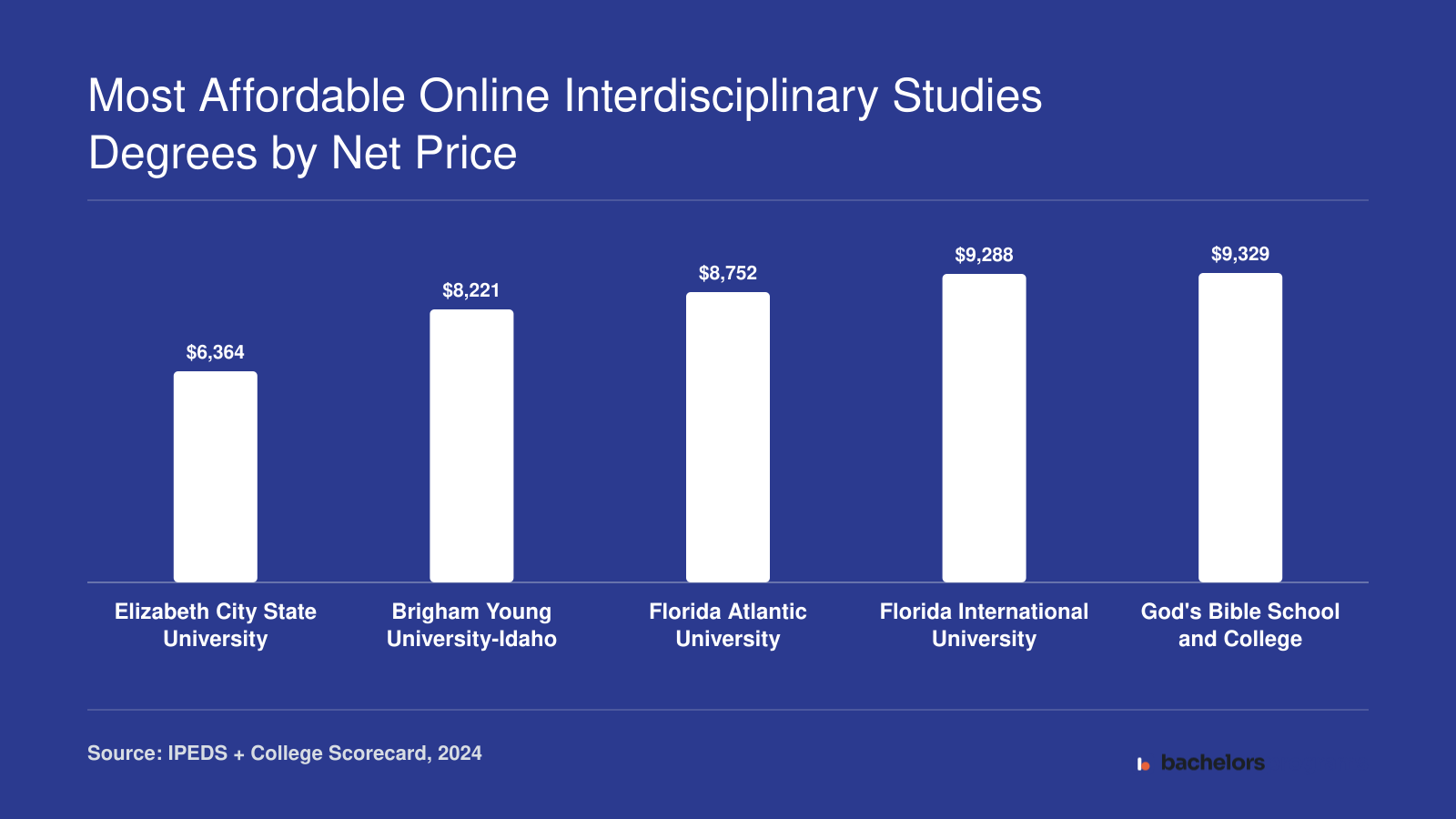
Most Affordable Online Interdisciplinary Studies Degrees by Net Price
Elizabeth City State University has the lowest average annual net price after aid in this comparison, at $6,364. These are institution-wide averages for undergraduates after grants and scholarships, so treat them as an approximation and not as tuition for the interdisciplinary studies program itself. To estimate the cost of the credits you still need, multiply them by each school's per-credit online rate (God's Bible School and College lists $295 per credit), then add technology or distance-learning fees, which schools often bill per credit or per term, such as the $34.50 per-term technology fee at Colorado State University Online.
Transfer Credits and How Long an Online Interdisciplinary Studies Degree Takes
A bachelor's degree in interdisciplinary studies typically requires about 120 credits. Full-time students starting from zero finish in roughly four years, while transfer students often complete the remaining coursework in 18 to 24 months.
Transfer Credit Caps and Credit for Prior Learning
Caps vary by institution. The University of Massachusetts Amherst and the University of Arizona each accept up to 75 transfer credits, and Campbellsville University takes up to 901. Eastern Oregon University publishes the most generous cap at 135 credits, though 20 credits must still be earned there2.
Associate degree holders get the smoothest path. UNH College of Professional Studies accepts an earned associate degree in full for its bachelor's-completion programs3, and American Public University System may apply up to 30 general education credits from an associate or bachelor's block. Prior learning assessment is another route: City University of Seattle and Eastern Oregon University evaluate portfolios and other demonstrated learning4, while Franklin University and National University accept CLEP and DSST exams, generally for lower-division credit.
Accelerated Formats and Time to Finish
Term length is where working adults make up ground. The University of Missouri runs eight- or 16-week courses, and UMass Amherst offers six-week accelerated winter and summer sessions. Shorter terms with frequent start dates let you carry two courses at once and finish sooner than a standard semester calendar allows.
Related Articles
Is an Interdisciplinary Studies Degree Worth It? Earnings and Jobs
A bachelor's degree in interdisciplinary studies pays off when you can name the two fields you combined and the job they map to. The earnings follow the combination, not the label on the diploma.
What the Programs Report
Among the schools ranked here, the highest median earnings five years after graduation belong to University of Oklahoma graduates at $63,126, against median program debt of $20,654 and a $202 monthly payment on a 10-year plan. University of Arizona follows at $59,979 (debt $19,620, $238 per month), then University of Central Florida at $58,308 (debt $18,190, $206 per month).
What the Combinations Pay
May 2025 BLS medians show where common pairings lead. Project management specialists earn $102,320 and human resources specialists $75,940, both with a bachelor's as the typical entry credential1; training and development specialists earn $69,280.5 A business and communication pairing points toward project coordination and HR roles. On the health and human services side, community health workers earn $51,850, while social and human service assistants earn $45,930 with a high school diploma as typical entry.4 A psychology and health pairing is better aimed at roles that expect a degree.
The Perception Question
No published U.S. survey establishes an employer premium or penalty for this degree, so treat confident claims in either direction with suspicion. Employers and graduate committees respond to a clear explanation of your two concentrations.
Questions to Ask Yourself
How many of my existing credits will this program actually accept toward the 120 required?
Do I need fully asynchronous courses, or can I log in at set times?
Which two or three disciplines map to the job or graduate program I want?
Is the school regionally accredited?
Interdisciplinary Studies programs by state
Compare Interdisciplinary Studies programs on the data that matters
Explore more Liberal Arts & Humanities majors or browse every field of study.
All Liberal Arts & Humanities programs Browse every field of study