Best Geography Degree Programs
Compare 320+ accredited Geography programs at 220+ colleges, with net price after aid, graduation rates, earnings and debt from IPEDS and the U.S. College Scorecard.

Geography graduates of the University of Florida earned a median of $43,856 in their first year after finishing the degree, while University of Georgia graduates in the same major reported $26,801. Geography majors land in GIS analysis, urban and regional planning, environmental consulting, and federal agencies, and the school you choose shapes both what you pay and what you earn.
Net price after aid across the ranked schools ranges from $6,541 at the University of Florida to $18,809 at Johns Hopkins University.
Price and payoff do not move in lockstep. Employers hiring GIS analysts tend to screen for remote sensing, spatial statistics, and a portfolio of applied projects, not the name on the diploma.
Key Points
- CUNY Hunter College's average net price after aid is just $2,984.
- Texas A&M tops first-year earnings, ahead of Ohio State ($44,789).
- GIS employers tend to prize portfolios over B.A. versus B.S. distinctions.
Best Geography Degree Programs for 2027: Top 10 Ranked
The strongest geography programs pair a manageable net price with high completion rates and published earnings for graduates of the major itself. Every school below clears those bars, and each entry shows what the geography degree actually contains: the concentrations, the GIS and field training, and the median earnings graduates report one year after finishing.
University of Florida
#1Gainesville, FL · ~$7,000/yr (est.)
Best for: Students drawn to medical geography
Florida's flagship runs one of the largest geography departments in the country, and the B.A. carries four specializations, including a medical geography track the department describes as the biggest in the nation. About 24% of applicants are admitted and roughly 91% of students finish a degree. Geography graduates report median earnings of $43,856 one year after finishing, and the curriculum builds in GeoAI, statistics and a senior capstone portfolio.
- Four specializations, including medical geography in global health
- Environmental geosciences option co-offered with geological sciences
- 120 total credit hours, including 39 to 45 in geography
- At least 18 geography credits must be earned at the university
- One GeoAI course, two technique courses and one regional course
- Senior seminar includes a capstone exam and portfolio
- Minimum grade of C required in all major coursework
- Statistics course required alongside the major
University of California-Los Angeles
#2Los Angeles, CA · $13,000/yr (est. net price)
Best for: High-achieving applicants seeking research access
UCLA's geography major is a Bachelor of Arts housed in one of the most selective public universities in the country, admitting about 9% of applicants. Roughly 93% of students complete a degree, the highest completion mark in this group, and the department sits inside a large research campus in Los Angeles. Geography graduates report median earnings of $36,776 one year after finishing.
- Bachelor of Arts major listed in the 2026 UCLA General Catalog
- Catalog is published annually in PDF and HTML formats
- 83 geography bachelor's degrees awarded in the latest reporting year
University of North Carolina at Chapel Hill
#3Chapel Hill, NC · ~$12,000/yr (est.)
Best for: Fieldwork and study-abroad enthusiasts
UNC's geography and environment B.A. blends human and physical geography with GIS, remote sensing and spatial analysis, and adds eight specialized pathways plus a study abroad program in the Galapagos Islands. About 15% of applicants are admitted and 91% of students graduate. Geography graduates report median earnings of $42,454 one year after finishing.
- Eight specialized pathways within the major
- 120 total credit hours; 2.0 GPA minimum
- Capstone seminar required for graduation
- Competitive honors thesis option available
- Study abroad program in the Galapagos Islands
- Internships available for academic credit
- Undergraduate research with faculty and weekly departmental seminars
- Coursework in GIS, remote sensing and spatial analysis
University of Maryland-College Park
#4College Park, MD · $16,000/yr (est. net price)
Maryland's geographical sciences B.S. is built around geospatial data science, with a second track in computational earth observation that adds machine learning and satellite image analysis. The university admits about 45% of applicants and graduates 89% of students. Geography graduates report median earnings of $40,913 one year after finishing, climbing to $63,835 four years out.
- Tracks: Geospatial Data Science, Computational Earth Observation Science
- 50 total credit hours; 2.0 GPA minimum
- Python programming and geocomputing coursework
- Remote sensing and digital image processing
- Machine and deep learning for satellite data
- 15 credits of advisor-approved supporting coursework
- Career planning course included
- Geographic visualization and digital mapping
Brigham Young University
#5Provo, UT · $15,000 – $20,000/yr (est.)
BYU's geography B.S. carries a geospatial intelligence emphasis that trains students in the structured analytic methods used by U.S. intelligence agencies. The university admits about 68% of applicants, the most accessible in this top tier, and graduates 81% of students. Geography graduates report median earnings of $40,051 one year after finishing, with an internship or mentored research project built into the degree.
- Geospatial Intelligence emphasis
- 50 total credit hours
- Structured analytic methods used by U.S. intelligence agencies
- Experiential learning through internships, field methods or mentored research
- Study abroad may count toward the experiential requirement
- Exit assessment required in the final semester
- Prepares for roles in the intelligence community and government agencies
University of California-Santa Barbara
#6Santa Barbara, CA · $15,000 – $20,000/yr (est.)
UCSB graduates about 100 geography majors a year, spread across general geography, a GIScience track and a physical geography track, making it one of the largest programs on this list. About 33% of applicants are admitted and 83% of students graduate. Geography graduates report median earnings of $37,398 one year after finishing.
- Combines human, physical and information-science geography
- Coursework in data analysis, cartography and remote sensing
- Multiple emphasis options, including GIS
- Hands-on labs and field-based projects
- Careers in cartography, GIS analysis, urban planning and consulting
University of California-Santa Barbara
#7Santa Barbara, CA · $15,000 – $20,000/yr (est.)
UCSB graduates about 100 geography majors a year, spread across general geography, a GIScience track and a physical geography track, making it one of the largest programs on this list. About 33% of applicants are admitted and 83% of students graduate. Geography graduates report median earnings of $37,398 one year after finishing.
- GIScience track within the geography major
- Skills in remote sensing and spatial analysis
- Graduates often become data analysts
- Esri named as a top employer of graduates
- Focus on sustainability and climate change
- Urban planning career path
University of California-Santa Barbara
#8Santa Barbara, CA · $15,000 – $20,000/yr (est.)
UCSB graduates about 100 geography majors a year, spread across general geography, a GIScience track and a physical geography track, making it one of the largest programs on this list. About 33% of applicants are admitted and 83% of students graduate. Geography graduates report median earnings of $37,398 one year after finishing.
- Hands-on field and lab experience
- Training in GIS and remote sensing
- Prepares students for environmental consulting roles
- Career paths as atmospheric scientists and climate analysts
Florida State University
#9Tallahassee, FL · ~$11,000/yr (est.)
FSU's geography program offers both B.S. and B.A. paths across three tracks, covering human and nature-society geography, physical geography, and GIS and technology. The university admits about 24% of applicants and graduates 86% of students. Geography graduates report median earnings of $35,608 one year after finishing, and a minor is required alongside the major.
- Three tracks: human and nature-society, physical, GIS and technology
- 120 total credit hours; 2.0 GPA minimum
- Capstone required
- Minor required for graduation
- In-person instruction on the Tallahassee campus
- B.A. path adds intermediate foreign language study
- No specialized admission required beyond the university
- Prerequisite courses required
University of Washington-Seattle Campus
#10Seattle, WA · ~$14,000/yr (est.)
Washington's geography B.A. organizes the major into four tracks, from cities and migration to GIS and society, plus an optional data science option that appears on the transcript. About 39% of applicants are admitted and 85% of students graduate. Geography graduates report median earnings of $42,489 one year after finishing.
- Four tracks spanning cities, environment, GIS and global health
- 60 credits in the major within 180 total
- No application needed to declare the major
- Up to 5 internship or independent study credits count toward the degree
- Service learning and public scholarship focus
- 2.0 GPA minimum; prerequisite courses required
University of Washington-Seattle Campus
#11Seattle, WA · ~$14,000/yr (est.)
Washington's geography B.A. organizes the major into four tracks, from cities and migration to GIS and society, plus an optional data science option that appears on the transcript. About 39% of applicants are admitted and 85% of students graduate. Geography graduates report median earnings of $42,489 one year after finishing.
- Data science option noted on the transcript
- Programming and machine learning courses
- Data management and visualization focus
- Sample course plan published for students
- No application needed to declare the major
University of Georgia
#12Athens, GA · ~$14,000/yr (est.)
Georgia's geography B.S. is aimed squarely at applied work, with career paths that run from cartography and satellite image analysis to market research and weather forecasting. About 38% of applicants are admitted and 90% of students graduate. Geography graduates report median earnings of $26,801 one year after finishing.
- Career path in cartography and satellite image analysis
- Environmental specialist and community planning tracks
- Market research and business location analysis careers
- Weather forecaster and geography teacher pathways
Johns Hopkins University
#13Baltimore, MD · $19,000/yr (est. net price)
Johns Hopkins runs a small geography department where undergraduates join faculty labs and field projects, often by the end of freshman year. Faculty expertise spans hydrology, public health, economics, political science and law, and the major splits between physical and human geography. Admission is the most selective here at about 6% of applicants, and 94% of students complete a degree.
- Splits between physical geography and human geography
- Small department with faculty expertise from hydrology to law
- Undergraduates join labs and field work, many by end of freshman year
- Research alongside faculty and graduate students
- Career paths in education, business, government policy and nonprofits
Cost & outcomes by school
Federal data for the highest-earning Geography programs, independent of the ranking above. Earnings are this field's bachelor's graduates four years after completing where the Scorecard reports them, else the school's undergraduate median.
| School | Net price / yr | Grad rate | Earnings | Debt | Grads/yr | Format |
|---|---|---|---|---|---|---|
| Villanova University PA | $43,756 | 92% | $100,423 | $25,874 | 26 | Campus |
| Bucknell University PA | $40,766 | 86% | $93,807 | $27,000 | 6 | Campus |
| University of California-Berkeley CA | $13,481 | 93% | $92,446 | $13,000 | — | Campus |
| University of Chicago IL | $14,860 | 96% | $91,885 | $15,000 | — | Campus |
| Johns Hopkins University MD | $18,809 | 94% | $87,555 | $10,250 | — | Campus |
| Colgate University NY | $28,786 | 91% | $85,139 | $15,000 | 11 | Campus |
| San Jose State University CA | $13,760 | 69% | $78,988 | $15,000 | 5 | Campus |
| University of Connecticut CT | $25,097 | 83% | $76,851 | $21,500 | 23 | Campus |
| Middlebury College VT | $31,483 | 91% | $76,310 | $13,857 | 18 | Campus |
| University of Richmond VA | $31,309 | 85% | $76,178 | $21,000 | — | Campus |
| University of Miami FL | $37,244 | 84% | $75,328 | $17,500 | — | Campus |
| California State University-Sacramento CA | $9,338 | 56% | $75,234 | $15,974 | 31 | Campus |
Sources: U.S. Department of Education. Net price, graduation rate, earnings and debt: College Scorecard (earnings and debt for this field's bachelor's graduates where reported, else school-wide); graduates: IPEDS. A dash means no figure is reported.
Cost, debt & payoff
Median earnings of this field's bachelor's graduates (4 yrs after completing, else the school's undergraduate median) vs. their median federal loan debt · U.S. College Scorecard
Across these programs the median graduate earns about $57,419 and finishes with roughly $21,030 in debt — a ratio that clears a common rule of thumb (keep debt below first-year salary). Net price and debt vary widely school to school, so check the per-school figures in the table above before you shortlist.
How We Ranked These Geography Programs
How do you compare a geography program at a $50,000 private college with one at a regional public university that costs a third as much?
The Four Inputs
- Cost: Average net price after federal, state, and institutional aid, so the figure reflects what a typical student actually pays rather than the sticker price.
- Outcomes: Program-level median earnings and typical debt for geography graduates, drawn from College Scorecard.
- Completions: How many students actually finish the geography program, which signals a department with real depth, course variety, and advising capacity.
- Graduation and retention rates: Whether students return for a second year and leave with a degree.
Where the Numbers Come From
Every figure traces to the U.S. Department of Education: College Scorecard for earnings, debt, and net price, and IPEDS for completions, graduation, and retention. We use the most recent snapshot available, which in most cases reflects the graduating classes a few years back.
What the Numbers Cannot Tell You
Graduation rates and net price are institution-wide averages, not quotes for the geography department itself. A large university's overall rate may say little about a small geography major inside it. Some smaller programs publish no earnings data at all, so those entries rest on cost, completions, and graduation rates instead.
Online, hybrid, and on-campus programs are scored side by side. A well-run online GIS track can outrank a campus program, so you compare formats on equal footing instead of guessing how they stack up.
Most Affordable Geography Degree Programs
Every school in this table is a public university, and their average net prices after aid, from $2,984 at CUNY Hunter College to $6,555 at Cal State Fullerton, show why in-state public options usually beat private colleges on value: state funding keeps the starting price low before aid is even applied. Residency is the biggest lever. Published in-state tuition and fees run $6,381 to $7,470 at these schools, while out-of-state rates climb to $15,332 to $28,659, according to U.S. Department of Education data. At the University of Florida, geography graduates carry a median program debt of $16,407, which works out to about $174 a month on a 10-year repayment plan. Net price is an average across aided students, so your actual cost will depend on your financial aid package and whether you qualify for in-state rates.
| School | State | Format | Average Net Price (After Aid) | Graduation Rate | Median Geography Program Debt | Median Monthly Loan Payment (10-Year) | Median Debt (All Graduates, School-Wide) |
|---|---|---|---|---|---|---|---|
| CUNY Hunter College | NY | Campus | $2,984 | 56.9% | N/A | N/A | $11,000 |
| University of Florida | FL | Campus | $6,541 | 91.1% | $16,407 | $174 | $15,000 |
| California State University-Fullerton | CA | Campus | $6,555 | 70.2% | N/A | N/A | $13,750 |
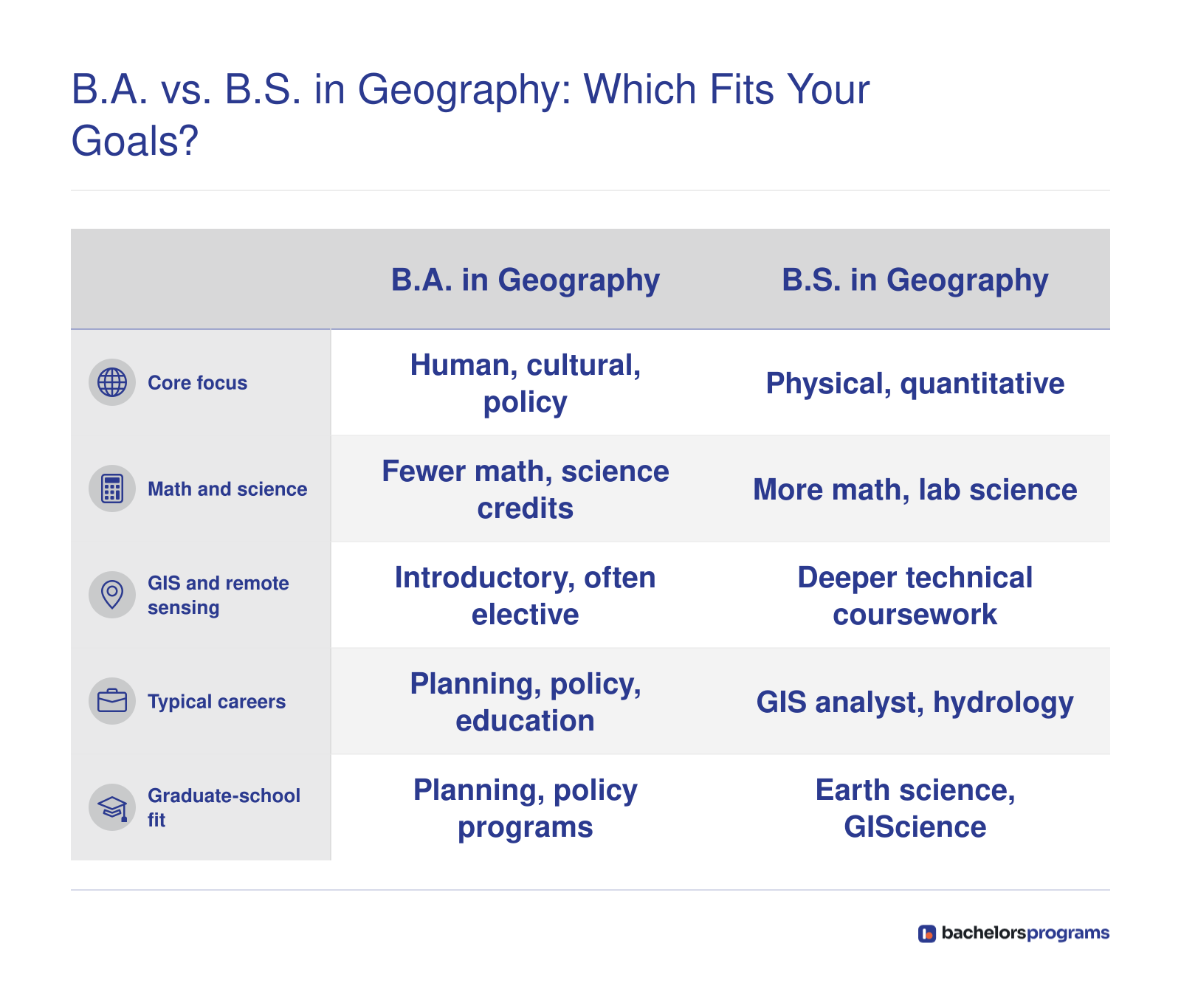
B.A. vs. B.S. in Geography: Which Fits Your Goals?
Neither degree is better; they lean toward different strengths, and employers hiring GIS analysts tend to weigh demonstrated technical skills and portfolio work more than the letters on your diploma. The comparison below shows how the two paths typically differ on focus, coursework, technical depth, careers, and graduate-school fit. Because B.A. and B.S. distinctions vary by institution, check each school's course catalog to see what its version of each degree actually requires.
Geography Specializations: GIS, Environmental, Human, and Physical
Some geography tracks center on software and data; others on places, people, and landscapes. Knowing which you want shapes the jobs you can pursue.
The Four Main Concentrations
- GIS and geospatial: Mapping, remote sensing, and spatial analysis. These feed analyst, cartographer, and geospatial data roles.
- Environmental: Land use, hydrology, and climate topics. Typical paths are environmental consulting, monitoring, and resource management.
- Human: Population, migration, cities, and health. Graduates often go into urban planning, community development, and market research.
- Physical: Climate, landforms, and weather systems. Common outcomes include forecasting, field science, and teaching.
Where the Ranked Schools Fit
The University of Florida and the University of Washington each list four concentration or track options, and UNC Chapel Hill lists eight. Florida State offers three. The University of Maryland focuses on two specializations, Geospatial Data Science and Computational Earth Observation Science. BYU offers a Geospatial Intelligence emphasis aimed at government and intelligence careers. UCSB blends human and physical geography with GIS and data science techniques.
GIS Credentials Worth Knowing
The GISP from the GIS Certification Institute is the main professional credential. It requires a 150-point portfolio, with at least 30 education points, 60 experience points, and 8 contribution points.1 The remaining points can come from any category. Applicants also need four years of professional experience and a passing score on the Core Technical Exam, and they have up to six years to finish the portfolio.1 The next exam window runs December 5 to 13, 2026, with registration due November 20.1 GISP-E, an optional track, shortens the experience requirement to three years for recent graduates.3
Coursework helps only if it is GIS-specific and documented. One point equals 40 student activity hours, so a three-credit GIS course earns three education points.2 A general geography course does not clearly qualify. Keep your transcripts and syllabi. GISCI's rules on whether an internship counts as experience are worth confirming directly.
Esri's technical certifications are a separate, experience-based track: Foundation (0 to 2 years), Associate (2 to 4), and Professional (4 or more).4 The GIS Fundamentals Foundation exam costs $275.4 Esri certification does not replace GISP requirements.
What to Look For in a Program
- A GIS certificate or clearly defined GIS course sequence
- A required capstone or applied project, as at Florida, UNC, and Florida State
- Hands-on ArcGIS and QGIS training, not just lectures
- Internship or experiential credit that builds a documented portfolio
Related Articles
Questions to Ask Yourself
Can you complete a required field course or summer field camp in person?
Does your computer meet the specs for ArcGIS Pro, or does the program provide virtual lab access?
Will you be able to land a local internship without on-campus career fairs?
Top First-Year Earnings for Geography Graduates
Among the schools ranked here, Texas A&M University leads on early earnings for geography graduates, ahead of Ohio State University ($44,789) and the University of Florida ($43,856).
How to Choose the Right Geography Program: A Checklist
Use this checklist to narrow your shortlist before you apply. Each item can be confirmed through a school's website, its admissions office, or a public database.
- Confirm institutional accreditationLook up the school's exact legal name and campus in the Department of Education's DAPIP database and in the CHEA directory. Note the accreditor, status, dates, and any adverse actions. Accreditation shapes federal aid eligibility, and receiving colleges and graduate programs often screen for it. It does not guarantee transfer or admission.
- Check concentration fitMake sure the school offers the track you want, whether GIS, environmental, human, or physical geography.
- Ask about GIS trainingFind out whether a GIS certificate and mapping software coursework are built into the major or available as an add-on.
- Get the transfer policy in writingCommunity college transfers should request a preliminary credit evaluation. Each college sets its own rules on grades, course equivalency, and credit limits.
- Look for applied experiencePrioritize programs that offer internships, field camp, and a capstone project.
- Compare real costsWeigh net price after aid and median program debt, not the sticker tuition.
- Map your graduate pathIf you plan to pursue a master's degree in planning, GIS, or environmental science, confirm that the coursework meets typical prerequisites.
- Take the next stepRequest information from each program on your shortlist and compare their answers side by side.
Geography programs by state
Geography Degree FAQs
These answers draw on federal occupational data and the program details covered above. Occupational figures describe specific job titles, not every geography graduate.
Is geography a good major?
How much do geography majors make?
Do you need a master's degree to work as a geographer or urban planner?
Is a GIS certificate enough, or do you need a full geography degree?
Compare Geography programs on the data that matters
Explore more Science & Engineering majors or browse every field of study.
All Science & Engineering programs Browse every field of study