Best Physics Degree Programs
Compare 790+ accredited Physics programs at 720+ colleges, with net price after aid, graduation rates, earnings and debt from IPEDS and the U.S. College Scorecard.

Prestige and price do not move together in physics. Among the top-ranked schools here, the average net price for a bachelor's degree in physics runs from $6,128 a year at Princeton University to $20,111 at MIT, and the highest sticker prices are not always the highest bills after aid. Schools award the degree as a Bachelor of Science (B.S.) or a Bachelor of Arts (B.A.) in Physics.
That choice matters as much as the school. The B.S. generally carries more required lab and theory coursework, while the B.A. leaves room for electives, a second major, or pre-med requirements.
Most departments expect calculus-based sequences and in-person labs from the first year, so fit with a program's structure often counts for more than its name.
Key Points
- Every ranked physics program here builds in-person lab sequences on campus.
- Compare net price after aid, not sticker tuition, when judging affordability.
- Stanford University offers a named 19-unit Astrophysics concentration within physics.
Best Schools for a Bachelor's Degree in Physics
The ten schools below pair a bachelor's degree in physics with strong completion rates, a net price that reflects real aid, and outcomes that justify the cost. All ten deliver their physics coursework on campus, which matters here: laboratory sequences, machine-shop access, and faculty research groups are hard to replicate at a distance. Each entry lists location, format, average net price, graduation rate, and admission rate so you can compare them side by side.
Princeton University
#1Princeton, NJ · ~$6,000/yr (est.)
Best for: Research-minded students wanting a senior thesis
Princeton treats physics as a concentration inside its Department of Physics, and the department's culture is built around written work: two junior papers and a senior thesis. Students may declare early, in the spring of sophomore year or sooner, which opens advanced coursework ahead of schedule. Financial aid meets full demonstrated need with grants rather than loans, and the department encourages summer physics coursework elsewhere when a student needs a course Princeton is not running that term. Alumni land in academic and industrial research, consulting, medicine, law, and teaching.
- Concentration housed in the Department of Physics
- Junior papers and a senior thesis required
- Early declaration opens advanced courses in sophomore year
- Study abroad in sophomore or junior year, including Oxford and St. Andrews
- Only one of the two junior papers may be written abroad
- Student groups include PSPS, PUPC and TiCuP
University of California-Berkeley
#2Berkeley, CA · ~$13,000/yr (est.)
Best for: Students declaring physics after prerequisites
Berkeley awards a Bachelor of Arts in Physics through the College of Letters & Science, with a curriculum built on broad fundamentals plus specialized elective options. Declaration is flexible: students apply once they finish, or are finishing, the prerequisite courses with at least a 2.0 GPA, and applications are accepted throughout the year. The honors program admits students with a 3.3 GPA and requires Physics H190 plus a senior thesis. Graduates move into graduate study or into academic, industrial, and government laboratories.
- Bachelor of Arts in Physics through the College of Letters & Science
- Declare after prerequisites, or while enrolled in final prerequisites
- Minimum 2.0 GPA in prerequisite courses
- Declaration applications accepted throughout the academic year
- Honors track requires 3.3 GPA, Physics H190 and a senior thesis
- Graduates enter graduate study or laboratory research careers
Massachusetts Institute of Technology
#3Cambridge, MA · ~$20,000/yr (est.)
Best for: Double majors pairing physics with math
MIT awards a Bachelor of Science in Physics through two routes, Flexible and Focus, so students can tune the degree toward breadth or toward a thesis-driven research sequence. The Focus track adds three terms of quantum mechanics, 36 units of laboratory work, and a faculty-supervised thesis; the Flexible track uses a three-subject focus area instead, which is why double majors are so common here. Two communications-intensive subjects are required within the major, and physics pairs frequently with mathematics, computer science, or planetary science.
- Two tracks: Flexible and Focus
- Flex track builds a three-subject focus area (astronomy, biophysics, CS)
- Focus track adds three terms of quantum mechanics
- 36 units of laboratory experience in the Focus track
- Focus students write a faculty-supervised thesis
- Two communications-intensive subjects required in the major
- Popular second majors include math, computer science and planetary science
University of California-Los Angeles
#4Los Angeles, CA · $13,000/yr (est. net price)
UCLA's Department of Physics and Astronomy runs four undergraduate majors: the B.S. in Physics, the B.A. in Physics, the B.S. in Biophysics, and the B.S. in Astronomy and Astrophysics. The B.S. pairs classroom work with laboratory training, while the B.A. leaves room for a double major or for students heading into science teaching. Department research spans condensed matter, elementary particle, plasma, nuclear, atomic-molecular-optical, accelerator, and biophysics work, plus astrophysics. Admission to the Biophysics B.S. is suspended for continuing students from Fall 2026 and for new admits from Fall 2027, though current biophysics majors can still finish.
- Four majors: Physics BS, Physics BA, Biophysics BS, Astronomy and Astrophysics BS
- BS includes classroom and laboratory training
- BA leaves room for a double major or science teaching
- Specialties include condensed matter, plasma, nuclear and biophysics
- In-person undergraduate advising Monday through Friday
- Biophysics BS admission suspended for new admits from Fall 2027
Harvard University
#5Cambridge, MA · $15,000 – $20,000/yr (est.)
Harvard College awards the A.B. in Physics through its Department of Physics, and students may also apply for a combined A.B./A.M. degree. The concentration builds a foundation for professional work in physics and for adjacent fields such as astronomy, biophysics, engineering and applied physics, and the history and philosophy of science. It also serves students heading to medical, law, business, or education programs. Department research covers atomic and molecular physics, quantum optics, condensed matter, biophysics, astrophysics, and high-energy particle physics.
- Awards a Bachelor of Arts (A.B.) in Physics
- Students may apply for a combined A.B./A.M. degree
- Foundation for astronomy, biophysics, engineering and applied physics
- Also prepares students for medical, law and business school
- Department research includes quantum optics and condensed matter
California Institute of Technology
#6Pasadena, CA · ~$16,000/yr (est.)
Caltech's B.S. in Physics starts in the second year, layering physics and mathematical foundations, advanced theory, computational work, and laboratory electives on top of the core curriculum. Students take graduate-level material such as quantum mechanics and electrodynamics in their second and third years and can join the paid Summer Undergraduate Research Fellowships program. More than 50 physics faculty teach and supervise research, with work extending to NASA labs and the Jet Propulsion Laboratory. Caltech accepts no AP or transfer credit, though placement exams can waive introductory physics.
- Thesis required for the Bachelor of Science in Physics
- Quantum mechanics and electrodynamics taken in second and third years
- Paid Summer Undergraduate Research Fellowships (SURF) available
- More than 50 physics faculty teach and supervise research
- Research extends to NASA labs and the Jet Propulsion Laboratory
- No AP or transfer credit accepted; placement exams can waive intro physics
- Computational physics and programming coursework included
University of Florida
#7Gainesville, FL · ~$7,000/yr (est.)
The University of Florida offers both a Bachelor of Science and a Bachelor of Arts in physics, along with a combined bachelor's and master's option and a 17-credit minor. The B.S. covers every major area of undergraduate physics and is built for students heading to graduate school or straight into technical work, while the B.A. carries fewer required courses and more electives. Several core courses come in enriched versions that add advanced topics to the standard material, and advisors help students pick the right level. Specialized tracks run through medical physics and nanoscience.
- Both a Bachelor of Science and a Bachelor of Arts in physics offered
- Combined bachelor's and master's option plus a 17-credit minor
- B.S. covers all areas of undergraduate physics
- B.A. requires fewer courses and allows more electives
- Enriched core courses add advanced topics to standard material
- Advisors help students choose the right course level
- 120 total credit hours, 41 of them in physics
- 79 total credits for the specialization
- Minimum grade of C in major courses
- 15 credits must be completed in UF coursework
- Five-part UF physics field test required
- Solid-state electronic devices course required
- Microelectronic fabrication technologies course required
- Python for physical sciences course included
- Critical-tracking GPA of 2.5
- 2.0 GPA minimum with prerequisite coursework
University of Chicago
#8Chicago, IL · ~$15,000/yr (est.)
The University of Chicago awards both a BA and a BS in physics, and the difference is mostly course load: 15 courses in the major after general education for the BA, 18 for the BS, which adds electricity and magnetism, quantum mechanics, and experimental physics. Both routes include the Mathematical Methods in the Physical Sciences sequence and a year-long experimental laboratory covering atomic, molecular, solid-state, nuclear, and particle work. A 3.3 major GPA plus a bachelor's thesis earns Special Honors, and the program can be finished in three years. Undergraduates join faculty research groups.
- Both a BA and a BS in physics offered
- BA: 15 courses in the major after general education
- BS: 18 courses, adding electricity and magnetism and quantum mechanics
- Year-long experimental physics laboratory sequence
- 3.3 major GPA plus a bachelor's thesis earns Special Honors
- Can be completed in three years
- Undergraduates join faculty research groups
Stanford University
#9Stanford, CA · $10,000 – $15,000/yr (est.)
Stanford awards a Bachelor of Science in Physics built on a shared core plus one of eight pathways, including Astrophysics, Biophysics, Computational Physics and Data Science, Geophysics, Mathematical Physics, Physics Education, and Quantum Science and Information. The core alone runs 23 units of introductory physics and roughly 18 to 19 units of introductory math before intermediate coursework. Students satisfy the capstone with a senior thesis, a research project plus paper, or an approved course option, and Writing in the Major is covered by Physics 191. Honors requires a senior thesis, a 3.30 overall GPA, and a 3.50 major GPA.
- Bachelor of Science in Physics with eight pathways
- Pathways include Astrophysics, Biophysics and Mathematical Physics
- Also Computational Physics and Data Science, Geophysics, Physics Education
- Core: 23 units of introductory physics, 18-19 units of math
- Capstone: senior thesis, research project plus paper, or course option
- Honors requires a senior thesis and a 3.50 major GPA
- Writing in the Major satisfied by Physics 191
University of Washington-Seattle Campus
#10Seattle, WA · ~$14,000/yr (est.)
The University of Washington awards about 100 Bachelor of Science in Physics degrees a year, making it one of the largest undergraduate physics programs in the country. Students choose among three tracks when they declare: Comprehensive Physics for graduate-school preparation, Applied Physics for students who want room for a second STEM major, and Teaching Physics for future pre-college teachers. The teaching track runs the Physics by Inquiry sequence and skips college-level math, while the applied track adds a statistics-focused lab and a programming class. Tracks can be changed at any point before applying to graduate school.
- About 100 physics bachelor's degrees awarded each year
- Three tracks: Comprehensive Physics, Applied Physics, Teaching Physics
- Comprehensive track adds in-depth mathematical work
- Applied Physics leaves room for a double major in a STEM field
- Teaching Physics uses the Physics by Inquiry sequence, no college math
- Applied track adds a statistics-focused lab and a programming class
- Tracks can be changed before applying to graduate school
Cost & outcomes by school
Federal data for the highest-earning Physics programs, independent of the ranking above. Earnings are this field's bachelor's graduates four years after completing where the Scorecard reports them, else the school's undergraduate median.
| School | Net price / yr | Grad rate | Earnings | Debt | Grads/yr | Format |
|---|---|---|---|---|---|---|
| Harvey Mudd College CA | $35,924 | 92% | $138,687 | $25,000 | 18 | Campus |
| Massachusetts Institute of Technology MA | $20,111 | 96% | $131,025 | $18,500 | 77 | Campus |
| California Institute of Technology CA | $16,075 | 94% | $128,566 | — | 22 | Campus |
| Stanford University CA | $13,807 | 92% | $124,080 | $12,000 | 31 | Campus |
| Cornell University NY | $28,690 | 95% | $118,649 | $15,961 | 49 | Campus |
| Carnegie Mellon University PA | $31,944 | 94% | $114,862 | $21,750 | 16 | Campus |
| University of Pennsylvania PA | $28,699 | 97% | $111,371 | $15,715 | 34 | Campus |
| Princeton University NJ | $6,128 | 98% | $110,066 | $10,320 | 36 | Campus |
| University of Notre Dame IN | $26,780 | 95% | $110,029 | $21,500 | 20 | Campus |
| Georgetown University DC | $40,815 | 95% | $103,494 | $15,500 | 14 | Campus |
| University of North Carolina at Chapel Hill NC | $11,655 | 91% | $103,477 | $17,150 | 50 | Campus |
| Columbia University in the City of New York NY | $21,590 | 96% | $102,491 | $21,500 | 25 | Campus |
Sources: U.S. Department of Education. Net price, graduation rate, earnings and debt: College Scorecard (earnings and debt for this field's bachelor's graduates where reported, else school-wide); graduates: IPEDS. A dash means no figure is reported.
Cost, debt & payoff
Median earnings of this field's bachelor's graduates (4 yrs after completing, else the school's undergraduate median) vs. their median federal loan debt · U.S. College Scorecard
Across these programs the median graduate earns about $61,307 and finishes with roughly $22,500 in debt — a ratio that clears a common rule of thumb (keep debt below first-year salary). Net price and debt vary widely school to school, so check the per-school figures in the table above before you shortlist.
How We Ranked Undergraduate Physics Programs
What the Ranking Measures
The ranking draws on outcome and cost data from the federal College Scorecard and IPEDS. For each school we weighed net price after aid, graduation and retention rates, selectivity, program-level earnings and debt where published, and delivery format: on campus, online, or hybrid.
How This Differs From Reputation Rankings
Reputation-based lists, such as the U.S. News physics rankings, depend heavily on surveys of academics. Those scores mostly reflect doctoral research strength: faculty publications, grant funding, and graduate training. That matters if you are choosing a PhD program, but it says little about a bachelor's student's experience. Our approach asks plainer questions. What does a family actually pay? Do students stay and finish? What do graduates earn, and what do they owe?
Limits Worth Knowing
Keep three caveats in mind as you read the numbers:
- Institution-wide averages: Graduation rate and net price cover the whole school, not just physics majors.
- Missing earnings: Some physics programs have no published program-level earnings, so those schools are judged on the remaining measures.
- Timing: Federal figures trail the current year, so recent changes in aid or tuition may not appear yet.
Why This Matters
A famous research department does not guarantee small classes, undergraduate lab access, or a good price for a physics major. Use the rankings to build a shortlist, then confirm class sizes, advising, and research opportunities with each department directly.
Most Affordable Physics Degree Programs: Cost, Debt, and Earnings
Published tuition is the sticker price a school lists, while average net price is what students actually pay per year after grants and scholarships, which makes net price the fairer way to compare affordable physics degree programs: Princeton University lists $62,688 in tuition and fees, yet its average net price is $6,128, according to 2024 IPEDS and College Scorecard data from the U.S. Department of Education. Median debt shows what physics bachelor's graduates owed at completion, and the 10-year monthly payment translates that debt into a monthly cost of about $146 at the University of Florida and $182 at the University of North Carolina at Chapel Hill. Earnings are median annual earnings for physics bachelor's graduates four years after completing the degree.
| School | Location | Published Tuition and Fees (In-State / Out-of-State) | Average Net Price per Year | Median Debt at Completion (Physics) | 10-Year Monthly Payment | Median Earnings 4 Years After Graduation (Physics) |
|---|---|---|---|---|---|---|
| Princeton University | Princeton, NJ | $62,688 / $62,688 | $6,128 | |||
| University of Florida | Gainesville, FL | $6,381 / $28,659 | $6,541 | $13,750 | $146 | $68,682 |
| University of North Carolina at Chapel Hill | Chapel Hill, NC | $8,994 / $41,203 | $11,655 | $17,150 | $182 | $103,477 |
B.S. vs. B.A. in Physics: Which Should You Choose?
Traditional and applied physics majors have blurred together, which is why one department often offers several versions of the degree. A rankings list cannot settle that choice for you. Your own catalog research can.
Step 1: Pull the Requirements
Open the current catalog page for the Physics B.S., the Physics B.A., and any Engineering Physics major at each school you are considering. Department websites and degree-audit pages usually show the same requirements in more detail. For each program, record:
- Total credit hours: Note the overall degree load and how many credits sit inside the physics major.
- Upper-level physics courses: List which are required, such as quantum mechanics or electromagnetism, and which are electives.
- Math sequence: Check how far it runs past calculus, for example into differential equations or linear algebra.
- Language and breadth requirements: See whether foreign language study is required and how many free electives remain.
Step 2: Compare Against Your Goals
A B.S. typically carries more math and science depth, which suits students who expect to pursue research or technical roles. A B.A. usually leaves more room for electives, a second major, or language study, which can fit teaching, policy, or law-adjacent paths. Engineering physics leans toward applied coursework and design, often with engineering classes built into the major. Compare what you recorded and see which structure matches the work you want to do.
Step 3: Check Outside Sources
Use the BLS.gov Occupational Outlook Handbook for career outlook, pay, and typical entry requirements for physics-related occupations. Professional associations such as the American Physical Society (APS), the American Institute of Physics (AIP), and the Institute of Electrical and Electronics Engineers (IEEE) publish discipline context and career resources.
Step 4: Confirm With People
Before you enroll, email an academic advisor or the department's undergraduate director. Ask whether you can switch between the B.S. and B.A. tracks later, which courses transfer, and how often required upper-level classes are offered. Catalogs change from year to year, so confirm that you are reading the version that applies to your entry term.
Related Articles
Physics Concentrations and Specializations to Consider
Stanford University's physics bachelor's program lists Astrophysics as a named concentration, with a 19-unit pathway that pairs stellar and galactic coursework with the standard physics core. It is one of the few schools in the rankings data that names a specialization alongside the general major.
Tracks You Will Actually See Listed
Most of the programs ranked here award a general physics degree and let you build a specialty through upper-division electives, research groups, and a senior thesis. A handful go further:
- Astrophysics: Stanford is the clearest example. This track suits students aiming at research, observatories, or a PhD in astronomy or physics.
- Applied and engineering physics: The best fit for students headed into industry, semiconductor work, lasers, or defense and aerospace labs, where a physics background plus hands-on instrumentation matters more than pure theory.
- Physics education: Designed for future high school physics teachers, usually pairing physics coursework with education courses and classroom field experience.
- Optics and quantum: Increasingly common as a research emphasis rather than a formal major, often available through lab work in quantum optics or photonics.
When the Major Is Just "Physics"
Several strong departments, including Princeton, Harvard, and Caltech, list no formal concentration at all. At those schools, specialization happens through junior papers, senior theses, and paid summer research, which is exactly how graduate committees and employers read the degree anyway. At MIT, students choose between a focus track that requires a thesis and a flexible track that leaves room for a second major such as mathematics or computer science.
Before you apply, check whether the specialization you want appears as a named track, as an elective cluster, or only as faculty research. That distinction shapes how many courses you can take outside the department and how early you need to declare.
Questions to Ask Yourself
Do you plan to apply to physics or astronomy graduate programs?
Would you rather design hardware in industry than run experiments?
Do you want room for a second major or teaching certification?
Are you drawn to a specific area, like astrophysics or optics?
Can You Earn a Physics Degree Online? Hybrid Options and Lab Requirements
In physics, online study is the exception rather than the rule. Every school ranked here delivers its bachelor's degree in physics on campus, with in-person lab sequences built into the major. Fully online options are rare. A 2025 American Institute of Physics publication described Arizona State University's online B.S. in Physics as the first and only fully online physics B.S. at that time.3 Other schools offered only partial curricula.
How ASU Handles Labs Online
ASU's online B.S. is accredited by the Higher Learning Commission, requires 120 credits and is also offered in person.1 ASU says it includes a complete lab curriculum.2 The upper-division Advanced Lab runs asynchronously in 7.5-week Canvas sessions.4 Custom simulator modules reproduce real experiments, including measurement imperfections such as noise, background, backlash, resolution and bandwidth limits.4
ASU also offers a B.A. in Physics (120 credits, 41 classes, 7.5-week sessions) online, in Tempe and through ASU Local.5 It includes lab experiences, but ASU does not spell out their format.6 Across its online science degrees, ASU says programs may use at-home kits, virtual labs or short in-person labs. Ask the department which format applies to each physics course. ASU's physics-focused secondary education degrees are no longer accepting new students.7
The Hybrid Path
For many students, a more practical route is to complete lower-division coursework online, such as general education and introductory math. They then transfer to a campus program for upper-level physics and labs. Confirm transfer agreements before you start so those credits count toward the major.
What to Verify Before Enrolling
- Accreditation: Confirm regional accreditation, such as the Higher Learning Commission.
- Upper-level labs: Ask whether advanced labs are simulated, kit-based or in person, and where any in-person sessions take place.
- Proctored exams: Find out whether exams require a proctor or testing center.
- Graduate school fit: Ask how graduate programs have treated the degree and its lab credits.
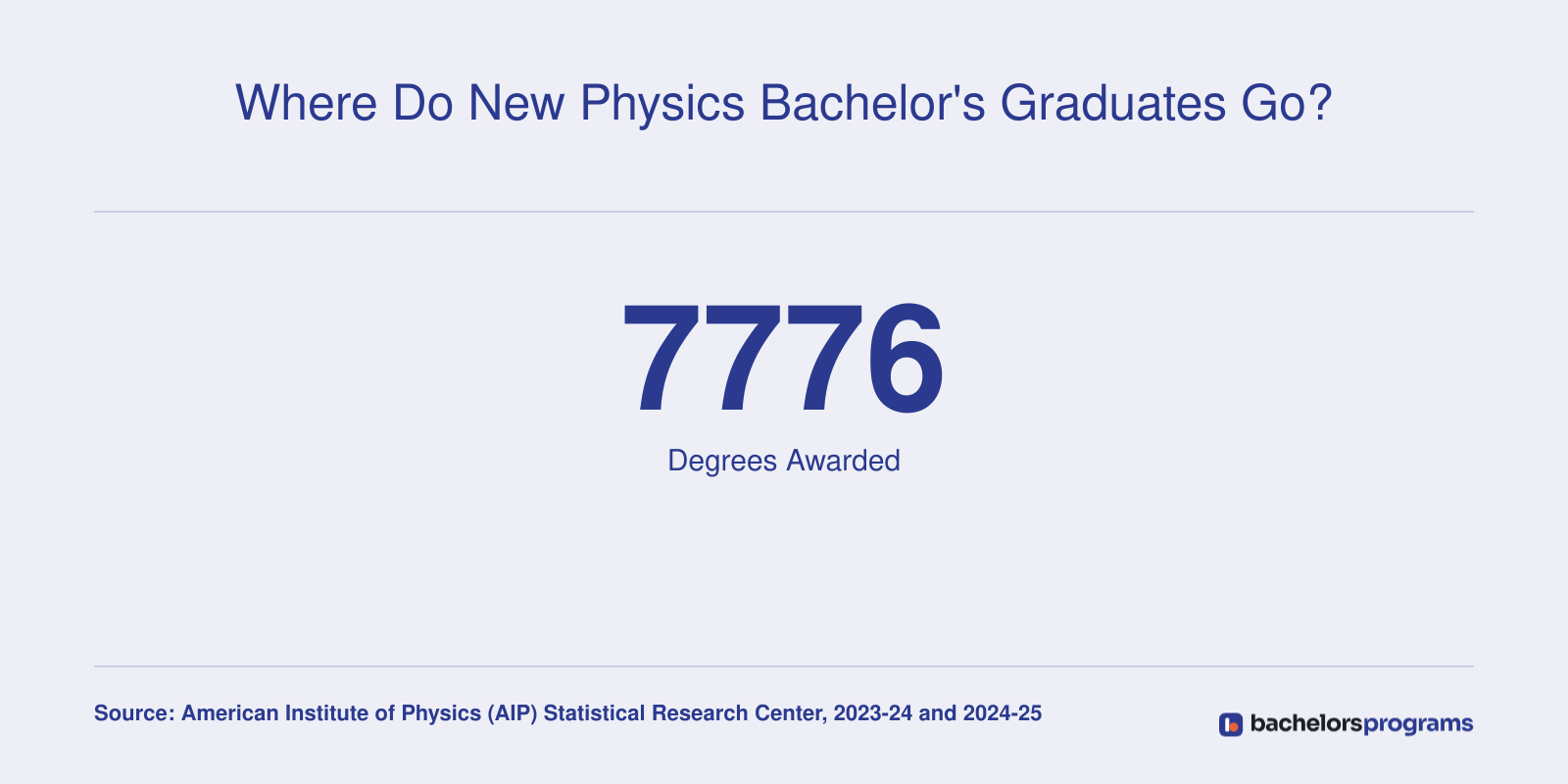
Where Do New Physics Bachelor's Graduates Go?
Questions to Ask Yourself
Can first- or second-year physics majors join faculty research here, or is it limited to seniors?
How many students graduate with a physics degree each year, and will you get to know the faculty in a department that size?
After aid, is this school's net price realistic for four years, or would a lower-cost program on the list give you the same preparation?
Physics programs by state
Compare Physics programs on the data that matters
Explore more Science & Engineering majors or browse every field of study.
All Science & Engineering programs Browse every field of study