Best Environmental Science Degree Programs
Compare 660+ accredited Environmental Science programs at 610+ colleges, with net price after aid, graduation rates, earnings and debt from IPEDS and the U.S. College Scorecard.

After grants and scholarships, what does a bachelor's degree in environmental science actually cost? Across the schools ranked here, net price after aid runs from $6,541 at the University of Florida to $29,612 at Duke University, a spread wide enough to change the answer. Most programs award the Bachelor of Science (B.S.) in Environmental Science, built on chemistry, calculus and field methods, and access to fieldwork varies as sharply as price. Every program ranked is campus-based; online and hybrid routes exist, but their lab requirements decide whether the degree is workable at all.
Key Points
- University of Florida's net price after aid is just $6,541 per year.
- Duke graduates borrow a median $11,875; UC San Diego's borrow $18,000.
- Online environmental science degrees still often require in-person lab or field work.
Top 10 Bachelor's Degree in Environmental Science Programs Ranked
These ten bachelor's degree in environmental science programs run from private research universities to large public flagships, and each is offered in a campus format. Every card lists net price after aid, in-state and out-of-state tuition, the school's graduation rate, and any concentration so the comparison stays concrete. Where program-level earnings are published, the card names the time window, such as four years after finishing.
Harvard University
#1Cambridge, MA · $15,000 – $20,000/yr (est.)
Best for: Future researchers wanting lab and field work
Harvard's undergraduate environmental work sits between Harvard College and the School of Engineering and Applied Sciences, where students choose an A.B. in Environmental Science and Engineering or an S.B. on the Engineering Sciences track. The curriculum stacks physics, chemistry, engineering, ecology and mathematical modeling before opening into energy systems, climate science, hydrology and pollutant coursework. Laboratory, modeling and big data projects are built in, and field trips have run to the Charles River, Joint Base Cape Cod and Marcellus Shale sites. The school's graduation rate is about 98%, reflecting a student body that finishes on time at unusually high rates.
- A.B. in Environmental Science and Engineering or S.B. in Engineering Sciences track
- Coursework in physics, chemistry, engineering, ecology and mathematical modeling
- Advanced classes in energy systems, climate science, hydrology, pollutants
- Field trips to the Charles River, Joint Base Cape Cod and Marcellus Shale
- Summer internships plus fellowships such as HUCE and PRISE
- Faculty lab research in climate change, water justice and environmental health
University of Chicago
#2Chicago, IL · ~$15,000/yr (est.)
Best for: Quantitatively minded geoscience students
Chicago's BS in Environmental Science is awarded by the Department of the Geophysical Sciences, and the major leans quantitative from the first year. Students complete a year each of chemistry, mathematics through Calculus I-II and biology, then required disciplinary courses such as The Atmosphere and Global Biogeochemical Cycles. An optional semester at the Marine Biological Laboratory and field trips that range from a single day to several weeks add hands-on work. Honors requires a 3.25 major GPA, an original research paper and an oral presentation.
- BS awarded by the Department of the Geophysical Sciences
- A year each of chemistry, math through Calculus I-II and biology
- Core courses include The Atmosphere and Global Biogeochemical Cycles
- Optional semester at the Marine Biological Laboratory
- Field trips range from a single day to several weeks
- Honors: 3.25 major GPA, 3.0 overall, original research paper
University of California-San Diego
#3La Jolla, CA · $10,000 – $15,000/yr (est.)
Best for: Students comparing four concentration tracks
UC San Diego's Environmental Systems major is deliberately interdisciplinary, drawing faculty from the sciences, engineering and medicine. Students finish a three-course integrating sequence and two social science courses, then pick one of four tracks, three of which award a BS and one a BA. Every major completes a three-quarter Senior Internship Project and Seminar before graduating. The school's graduation rate is about 86%.
- Electives in geochemistry, geophysics, hydrogeology, mineralogy and tectonics
- Three-course upper-division integrating sequence (ESYS 101, 102, 103)
- Two required social science courses, ECON 131 and POLI 160AA
- Three-quarter Senior Internship Project and Seminar capstone
- BS awarded on the Earth Sciences track
- 2.0 major GPA with C-minus or better in every major course
- BS awarded on the Ecology, Behavior and Evolution track
- Genetics core course plus at least one laboratory course
- Five upper-division electives chosen within the track
- Off-campus or laboratory internship for the senior project
- Capstone senior internship project and seminar required
- BS awarded on the Environmental Chemistry track
- Five upper-division courses selected within the track
- Off-campus or laboratory internship option
- Senior Internship Project and Seminar capstone
- All major courses taken for a letter grade
- Course selection planned with a faculty adviser
- BA awarded on the Environmental Policy track
- Senior project can include an off-campus internship
- Pairs natural science with economics and policy coursework
- Faculty drawn from sciences, humanities and medicine
University of California-Los Angeles
#4Los Angeles, CA · $13,000/yr (est. net price)
UCLA grants a Bachelor of Science in Environmental Science, listed as a major in the UCLA General Catalog with requirements published annually. It is a large, well-established program, with roughly 107 degrees awarded in the reporting year. Graduates who received federal aid reported median earnings of about $75,900 four years after finishing.
- Bachelor of Science in Environmental Science
- Requirements published in the annual UCLA General Catalog
- About 107 degrees awarded in the program in the reporting year
University of California-Berkeley
#5Berkeley, CA · ~$13,000/yr (est.)
Berkeley's Environmental Sciences major lives in the Rausser College of Natural Resources and lets students specialize in one of 12 concentration areas, from ecology and toxicology to hydrology, environmental justice and education. Every student completes a year-long senior research project with a faculty mentor, and the honors track adds an individual project under a faculty sponsor. Program graduates who received federal aid reported median earnings of about $78,600 four years after finishing, the highest published figure among the programs on this list. The school's graduation rate is about 93%.
- 12 concentration options, from ecology to environmental justice
- Year-long senior research project with a faculty mentor
- Honors requires a 3.6 GPA plus an individual research project
- Strong foundation in math, biology and physical sciences
- Declare the major by the end of the fourth semester
- Paths to law school, medical school and environmental engineering
University of Florida
#6Gainesville, FL · ~$7,000/yr (est.)
The University of Florida runs its environmental science degrees through the School of Natural Resources and Environment, a campus-wide program taught by faculty from several colleges. Both the BA and the BS require 120 credits; the BS leans on the natural sciences while the BA adds economics, policy and management. A capstone course, environmental ethics and environmental policy and law sit in the core, and BS students can add a Pre-Health track with coordinator approval. About half of graduates continue to graduate or professional school.
- BA and BS options, 120 credits each
- BS emphasizes natural sciences; BA focuses on policy and management
- Core includes ecology, earth and soil science, environmental ethics
- Fourth-year capstone course required
- Pre-Health track available to BS students with coordinator approval
- Combination degree pairs the bachelor's with an MS in interdisciplinary ecology
- Students choose 28 to 31 elective credits from an approved list
University of North Carolina at Chapel Hill
#7Chapel Hill, NC · ~$12,000/yr (est.)
UNC-Chapel Hill awards its BS in Environmental Science through the Environment, Ecology, and Energy Program, built on a short core sequence plus a capstone or honors project. Students choose an analytical skills option in applied math, GIS and remote sensing, statistics or informatics, then take five courses in one of three concentrations. Field sites, internships and a summer program in the Galapagos add experience outside the classroom, and a dual bachelor's-master's path can finish a master's in as few as five years.
- Concentrations: Ecology and Natural Resources, Environment and Health, Water and Climate
- Analytical skills option in applied math, GIS, statistics or informatics
- Capstone (ENEC 698) or honors thesis project required
- 120 credit hours plus a minor in an allied science
- Quantitative Energy Systems track adds four quantitative courses
- Dual bachelor's-master's path can finish in as few as five years
- Five experiential field sites and summer study in the Galapagos
University of Pennsylvania
#8Philadelphia, PA · $29,000/yr (est. net price)
Penn's Earth and Environmental Science BA covers physical, chemical and biological processes across the atmosphere, hydrosphere, biosphere and lithosphere, plus human-ecosystem interaction. The major requires 35 course units, a gateway course in Earth Systems Science, quantitative work and breadth in two of physics, chemistry or biology. Students add six electives and an experiential course, and the honors thesis option requires a 3.25 GPA plus two semesters of thesis research.
- Minimum of 35 course units for the major
- Gateway course in Earth Systems Science
- Breadth in two of physics, chemistry or biology
- Core areas in deep time, climate science and spatial analysis
- Experiential course required alongside six electives
- Honors thesis option: 3.25 GPA and two semesters of EESC 4997
Duke University
#9Durham, NC · ~$30,000/yr (est.)
Duke's BS in Environmental Sciences is housed in the Nicholas School of Environment and pairs a broad natural science core with a chosen focus area. Students take a gateway course built on local to global case studies and five core courses spanning health, ecology, physical science, social science and tools, then three focus-area courses with at least one at the 500 level. A capstone and a field experience or internship are required, and a semester at the Duke Marine Lab or the Stanback Internship Program can satisfy the latter.
- At least 16 courses in the major; 34 units for the degree
- Gateway course ENVIRON 201 uses local to global case studies
- Five core areas plus three focus courses, one at the 500 level
- Capstone through ENVIRON 495 or ENVIRON 545 and 546
- Field experience or internship required; study abroad can count
- Semester at the Duke Marine Lab or Stanback Internship Program
- Graduation with Distinction adds a thesis and symposium poster
Rice University
#10Houston, TX · ~$13,000/yr (est.)
Rice offers both a BA and a BS with a major in Environmental Science, jointly administered by the Department of BioSciences and the Department of Earth, Environmental and Planetary Sciences. Students pick a concentration in Earth Science or in Ecology and Evolutionary Biology, and many courses are team-taught by faculty from different areas of study. Undergraduate advisors are named for each concentration, which keeps the two paths distinct from the start.
- BA and BS degrees with a major in Environmental Science
- Two concentrations: Earth Science or Ecology and Evolutionary Biology
- Jointly run by BioSciences and Earth, Environmental and Planetary Sciences
- Many courses team-taught by faculty across departments
- Advisors named for each concentration
Cost & outcomes by school
Federal data for the highest-earning Environmental Science programs, independent of the ranking above. Earnings are this field's bachelor's graduates four years after completing where the Scorecard reports them, else the school's undergraduate median.
| School | Net price / yr | Grad rate | Earnings | Debt | Grads/yr | Format |
|---|---|---|---|---|---|---|
| University of Pennsylvania PA | $28,699 | 97% | $111,371 | $15,715 | 23 | Campus |
| Lehigh University PA | $36,931 | 88% | $105,584 | $21,960 | 12 | Campus |
| Georgetown University DC | $40,815 | 95% | $103,494 | $15,500 | — | Campus |
| Georgia Institute of Technology GA | $12,116 | 94% | $102,772 | $21,672 | 11 | Campus |
| Columbia University in the City of New York NY | $21,590 | 96% | $102,491 | $21,500 | 9 | Campus |
| Rensselaer Polytechnic Institute NY | $36,228 | 84% | $102,051 | $23,750 | 10 | Campus |
| Harvard University MA | $19,066 | 98% | $101,817 | $14,000 | 26 | Campus |
| Yale University CT | $23,777 | 96% | $100,533 | $12,975 | 50 | Campus |
| University of Notre Dame IN | $26,780 | 95% | $99,980 | $17,250 | 20 | Campus |
| Brown University RI | $25,184 | 96% | $93,487 | $11,428 | 60 | Campus |
| University of Chicago IL | $14,860 | 96% | $91,885 | $15,000 | 71 | Campus |
| Lafayette College PA | $34,433 | 88% | $91,410 | $16,000 | 16 | Campus |
Sources: U.S. Department of Education. Net price, graduation rate, earnings and debt: College Scorecard (earnings and debt for this field's bachelor's graduates where reported, else school-wide); graduates: IPEDS. A dash means no figure is reported.
Cost, debt & payoff
Median earnings of this field's bachelor's graduates (4 yrs after completing, else the school's undergraduate median) vs. their median federal loan debt · U.S. College Scorecard
Across these programs the median graduate earns about $55,465 and finishes with roughly $22,902 in debt — a ratio that clears a common rule of thumb (keep debt below first-year salary). Net price and debt vary widely school to school, so check the per-school figures in the table above before you shortlist.
How We Ranked These Environmental Science Schools
The U.S. Department of Education's College Scorecard anchors this ranking. It reports what graduates of a specific bachelor's degree in environmental science earn and borrow, not just what a school charges.
The Four Factors Behind the Ranking
- Affordability: What a typical student actually pays after grants and scholarships, not the sticker price.
- Completion: Each school's graduation and retention rates, which show whether students who start there tend to finish.
- Program earnings: Median earnings for environmental science graduates at that school, drawn from College Scorecard program-level reporting.
- Debt load: How much graduates of the program typically borrow, set against what they go on to earn.
Where the Numbers Come From
Earnings, debt, graduation and net price figures come from College Scorecard program and institution data, using the latest snapshot available. Tuition comes from IPEDS, the federal database that colleges report to each year.
What the Data Can't Tell You
Graduation rate and net price are school-wide averages. They describe the whole campus, not the environmental science department alone. Some smaller programs graduate too few students for federal earnings figures to be published, so keep that gap in mind when you compare schools side by side.
Why This Beats Prestige-Only Lists
Reputation surveys ask administrators what they think of other colleges. This approach measures what students pay, whether they graduate and what they earn afterward. Those questions sit much closer to the decision you're actually making.
Environmental Science Degree Cost: Where Net Price Runs Lowest
Sticker tuition is only the starting point. Net price is what students actually pay for a year of attendance (tuition, housing, books and other costs) after grants and scholarships. That is why the University of Florida's net price of $6,541 sits slightly above its $6,381 in-state tuition, yet far below its $28,659 out-of-state rate. The lowest net prices among the environmental science programs here all belong to Florida public universities. Private colleges typically list much higher sticker prices, but aid can narrow that gap, so compare each school's net price rather than its published tuition. To estimate a four-year total, multiply the annual net price by four. Treat that figure as a rough approximation, not a quote, since aid, fees and housing change from year to year. Debt and payment figures reflect the environmental science program specifically, based on U.S. Department of Education data. Starting at a community college can lower the total further. SUNY's transfer framework guarantees AA or AS completers admission to a SUNY four-year campus with junior standing in a parallel program. SUNY Delhi's AS in Environmental Studies, for example, articulates into SUNY Oneonta's BS in Environmental Sustainability. In California, the 60-unit environmental science Associate Degree for Transfer prepares students for CSU and UC. ADTs generally guarantee CSU admission, though not necessarily at a specific campus. Separately, six UC campuses offer Transfer Admission Guarantees to students who complete at least 30 semester or 45 quarter UC-transferable units and meet each campus's major requirements. Florida's 2+2 model pairs a state college associate degree with a university bachelor's degree, as in FSCJ's roadmap into UF's BS in Environmental Science. Credits do not always match, though: FSCJ's general physics course carries 4 credits, while UF awards 5 for the equivalent. Introductory biology, chemistry and calculus are common lower-division requirements, but confirm each course with the receiving school's catalog and an adviser before you enroll.
| School | Annual Net Price | In-State Tuition | Out-of-State Tuition | Median Program Debt | 10-Year Monthly Payment | Approx. Four-Year Net Cost (Net Price x 4) |
|---|---|---|---|---|---|---|
| University of Florida (Gainesville, FL) | $6,541 | $6,381 | $28,659 | $20,200 | $214 | About $26,164 |
| University of South Florida (Tampa, FL) | $9,812 | $6,410 | $17,324 | $17,500 | $186 | About $39,248 |
| University of Central Florida (Orlando, FL) | $10,411 | $6,368 | $22,467 | $14,875 | $158 | About $41,644 |
Which Environmental Science Programs Pay Off Fastest
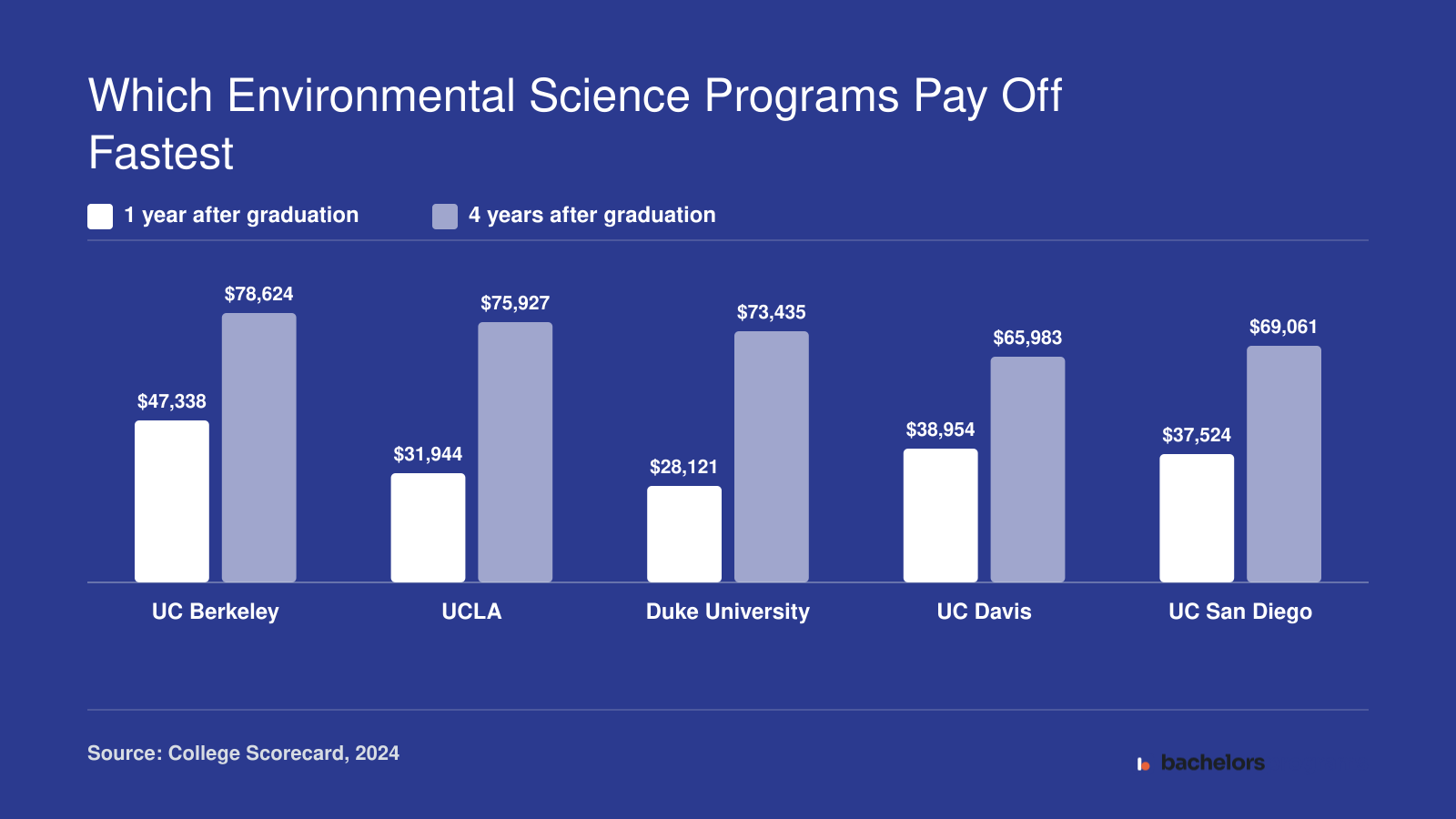
At each school shown, graduates' median first-year pay already tops their median federal loan debt, which runs from $11,875 at Duke University to $18,000 at UC San Diego. Year four is where the gains show: median pay at UC Berkeley climbs from $47,338 to $78,624, and Duke graduates more than double their early earnings, from $28,121 to $73,435. These are program-level results for environmental science bachelor's graduates, not campus-wide averages.
Accredited Environmental Science Degree Programs: What to Check
Accreditation in environmental science works on two levels, and most bachelor's programs in the field are covered by only the first. The first layer covers the college or university as a whole. Institutional accreditation from an accreditor recognized by the U.S. Department of Education or the Council for Higher Education Accreditation (CHEA) is the baseline every applicant should confirm, since it governs access to federal student aid, the odds that credits transfer between schools, and whether graduate programs will accept your transcript.
Programmatic Accreditation: Where It Applies
Most environmental science B.S. programs have no dedicated programmatic accreditor. Where program-level review exists, it usually sits with an adjacent field. ABET reviews environmental science programs through its Applied and Natural Science Accreditation Commission (ANSAC), not its Engineering Accreditation Commission (EAC).1 The EAC covers environmental engineering and similarly named engineering programs, and the two categories are not interchangeable when you read a school's accreditation page. The Society of American Foresters accredits forestry programs, which matters at a school like SUNY College of Environmental Science and Forestry, where the forest resources management, forest ecosystem science, and natural resources management bachelor's degrees hold SAF accreditation.2
A Four-Point Vetting Checklist
- Fieldwork: a required field course, access to a field station, or a supervised field semester.
- Lab sequence: chemistry, biology, and GIS, each as its own course rather than a single survey class.
- Capstone or internship: a senior research project, a practicum, or a placement with an agency or consultancy.
- Transfer policy: how community college coursework counts, in writing, before you enroll.
Verify It Yourself
Confirm the institution's accreditor directly in the Department of Education's Database of Accredited Postsecondary Institutions and Programs (DAPIP) or in CHEA's directory. Then check ABET's or SAF's own listings for any program-level accreditation a school advertises in its marketing.
Related Articles
Environmental Science vs. Environmental Studies vs. Sustainability
These three majors share a focus on the environment but train you for different work. A bachelor's degree in environmental science is a technical, lab-and-field Bachelor of Science (B.S.), while environmental studies and sustainability programs are typically built as Bachelor of Arts (B.A.) degrees with broader social, economic, and policy content. Use the table to see where each one puts its weight.
| Factor | Environmental Science | Environmental Studies | Sustainability |
|---|---|---|---|
| Typical credential | Bachelor of Science (B.S.) | Bachelor of Arts (B.A.) | Often a B.A. in Sustainability Studies; some schools offer a B.S. or a sustainability sciences option |
| Core coursework | Biological, physical, and chemical sciences, plus mathematics, statistics, and geospatial techniques | Social sciences and humanities, with a good foundation in the natural sciences | Social science, earth science, economics, communications, and policy, with focused study of sustainability methods |
| Math and lab intensity | High: chemistry, calculus, and statistics, with regular lab work | Moderate: natural science foundation without the full lab and math sequence | Moderate: environmental science grounding combined with applied learning experiences |
| Typical electives and topics | Ecology, environmental engineering, wildlife management, plant biology, GIS | Policy, ethics, and society-focused courses | Climate change, land and water management, environmental justice, environment and economics |
| Field and applied work | Field-based coursework, ecology expeditions, and hands-on research experience | Varies by program, usually less lab-based | Applied learning experiences built into the curriculum |
| Common career outcomes | Environmental consulting, GIS and mapping, remote sensing, pollution control and remediation, ecological restoration, regulatory enforcement | Policy, advocacy, and nonprofit-oriented roles | Corporate sustainability, resource management, nonprofit work, consulting, planning-oriented roles |
| Graduate study paths | Professional environmental work and related advanced study | Often leads to policy, law, or related graduate fields | Sustainability leadership, sustainable energy and food systems, environmental journalism, environmental law |
Can You Get an Environmental Science Degree Online?
Online study is the most flexible route to a bachelor's degree in environmental science, but it is also where lab requirements are hardest to avoid. This is a field discipline: chemistry, biology, soil and water courses carry lab credit, and most degree plans add field experience plus an internship. Distance programs handle that with a mix of formats rather than one delivery model, so the practical question is not whether an online environmental science degree exists, but which pieces you will still have to complete on site.
Online, Hybrid, or In Person
- Fully online: Coursework is delivered remotely. Labs run through at-home kits, virtual simulations, or virtual 3D microscopes, the approach Oregon State Ecampus describes for its science courses.1
- Hybrid: Online classes paired with one or a few required site-based classes. Oregon State notes that some online science degrees work this way, so read each degree plan course by course.1
- In person: The programs ranked on this page are campus-based.
Arizona State Online lists at-home lab kits, virtual labs and Dreamscape Learn across its science degrees, and notes that some science programs include a short in-person lab.4
Fieldwork and Internships
Oregon State Ecampus carries ENSC 221 Environmental Field Studies at 4 credits2, and a Cascadia field trip course that visits the Cascade volcanic arc, the Coast Range and the Oregon coast.3 Its internships are supervised placements with agencies, laboratories or companies: ENSC 410 runs 1 to 12 credits and OEAS 498 runs 1 to 16. Placements are arranged locally or abroad, but no program guarantees one.
What to Ask Admissions
- Is a field course or campus residency required, and in which term?
- Can the internship be completed near home, and who approves the site?
- Will the lab credits count toward the graduate programs you may want later?
- How many transfer credits are accepted, and does an associate degree satisfy general education requirements?
What Environmental Scientists Earn Nationally
A bachelor's degree in environmental science is the typical entry point into this occupation. National pay sits well above the median for all workers.
Environmental Science programs by state
Environmental Science Degree FAQs
These answers cover the questions prospective students ask most often about a bachelor's degree in environmental science, from cost and career fit to transfer options.
Is a bachelor's degree in environmental science worth it?
What is the best degree for environmental science?
Do you need a master's degree to work as an environmental scientist?
Can you switch into environmental science after starting at a community college?
Compare Environmental Science programs on the data that matters
Explore more Science & Engineering majors or browse every field of study.
All Science & Engineering programs Browse every field of study