Accelerated Psychology Degree Programs
Compare 1,300+ accredited accelerated General Psychology programs at 1,200+ colleges, with net price after aid, graduation rates, earnings and debt from IPEDS and the U.S. College Scorecard.

A psychology bachelor's runs about 120 semester credits, which is four years at 15 credits a term. Any time shaved off that schedule has to come from somewhere: shorter terms, credit for work already done, or a master's year overlapping the final undergraduate year.
Admissions pages use "accelerated" for all three, and the word alone does not tell you which one you are buying. The distinction matters beyond speed: a compressed-term bachelor's and a 4+1 track leave graduates with different bills and different eligibility for graduate study.
Key Points
- 7- or 8-week terms and transfer credit shorten the 120-credit timeline.
- Accelerated formats keep the same credits, so weekly workloads get heavier.
- Licensed psychologist roles require a graduate degree, usually a doctorate.
None of the ranked General Psychology programs match the accelerated lens yet. The full ranking is at the link above.
How we rank. Each program is scored on undergraduate figures: the field's earnings and debt, net price after aid, graduation and retention rates, the number of bachelor's graduates, Pell share and the student-faculty ratio, normalized across all programs in this field. Data comes from the U.S. Department of Education's IPEDS and College Scorecard; no school pays for placement.
Cost, debt & payoff
Median earnings of this field's bachelor's graduates (4 yrs after completing, else the school's undergraduate median) vs. their median federal loan debt · U.S. College Scorecard
Across these programs the median graduate earns about $49,763 and finishes with roughly $23,625 in debt — a ratio that clears a common rule of thumb (keep debt below first-year salary). Net price and debt vary widely school to school, so sort the ranking by "Lowest net price" or "Lowest debt" to weigh cost against outcomes.
Compressed Terms, Degree Completion or 4+1: Which Pathway Fits You
"Accelerated" can mean four different things, and they save time in different ways. Some programs shorten each course term, some let you bring in more existing credit, some let you move at your own pace, and some overlap your bachelor's with a master's. The table below sets the four pathways side by side so you can match the format to your situation.
| Pathway | How it saves time | Best suited to | Main tradeoff |
|---|---|---|---|
| Compressed-term online bachelor's | Shorter terms let you complete more courses per year, so the same credit total fits into fewer calendar months. | Working adults who can study steadily and want a fixed schedule with online coursework. | Heavier weekly workload, since each course covers a full semester of material in fewer weeks. |
| Degree-completion for transfer students | Prior college credit counts toward the degree, so you only take the remaining upper-level courses. | Students with an associate degree or earlier college credits who want to finish a bachelor's. | Transfer caps and course-match rules can leave some credits uncounted. |
| Competency-based or self-paced bachelor's | You move on as soon as you show mastery, so existing knowledge shortens the path. | Self-directed students with relevant work or study experience. | Requires strong self-discipline, with no instructor-set deadlines to keep you on track. |
| 4+1 combined bachelor's/master's | Students usually apply in junior year, and graduate courses taken as seniors count toward both degrees, which typically means a master's about a year sooner. Examples include Rowan University (12 shared graduate credits) and Cleveland State University (up to 9 shared credits). | Strong undergraduates already sure they want a master's in psychology or a related field. | A GPA cutoff applies. Miami University asks for a 3.25, Rutgers University for a 3.0 or 3.5 depending on the track, and Florida Atlantic University for a 3.6 in upper-division work. |
How Long Does an Accelerated Psychology Degree Take?
Most U.S. bachelor's degrees require about 120 semester credits. At the traditional pace of 15 credits per term, that is eight terms, or four years.
What Shortens the Timeline
Five options shorten the timeline: 7- or 8-week terms, year-round enrollment, a heavier credit load, transfer credits, and credit for prior learning such as CLEP, AP, DSST, or military training reviewed through ACE1.
Realistic Ranges
A student starting with no credit who studies year-round can often finish in about three years, though the exact pace depends on the school and course availability. A student transferring an associate degree (about 60 credits) has roughly 60 left, which can mean about two years of study, or less with a heavier load.
Check the caps first. Transfer limits commonly run 60 to 90 credits, and many schools require 30 to 36 credits, or the last 30 to 45, earned in residence2. UMGC, for example, accepts up to 70 credits from two-year colleges and 90 from four-year sources. Major courses and capstones often cannot be transferred.
The Weekly Workload
An 8-week term fits a full course into half the usual weeks, so each week carries about double the reading and assignments. Two courses at once can feel like a full-time job. Weigh the pace against your work and family hours before you commit.
Checklist: How to Confirm a Program Is Actually Accelerated
Before you apply, use the program's own pages to confirm each item below. If a school won't put these details in writing, treat the speed claim with caution.
- Stated formatThe page names an accelerated, degree-completion or 4+1 format. "Flexible" or "self-paced" alone does not mean faster.
- Term length and start datesCourse length is published, such as 7- or 8-week terms, along with how many start dates run each year.
- Credits and transfer capThe page lists total credits for the degree and the maximum transfer credits accepted.
- Residency requirementThe school states the minimum credits you must earn at that institution.
- Sample timelineA degree map or sample completion plan shows how the credits fit into the advertised timeframe.
- Institutional accreditationThe accreditor is named, and you can verify it in the Department of Education or CHEA databases.
Related Articles
Transfer Credit, Prior Learning and Competency-Based Options
Transfer credit is the fastest route through a psychology bachelor's, and it costs nothing to find out where you stand. Request an unofficial credit evaluation before you apply. Send transcripts from every regionally accredited college you have attended, and ask specifically which psychology major requirements the credits satisfy, not just how many credits transfer.
Banking Credit Before You Enroll
- Exams: CLEP and AP scores can clear general education and introductory psychology requirements.
- Military training: A Joint Services Transcript translates service schools and occupations into evaluated credit.
- Prior learning portfolios: Some programs assess work-based learning, licenses, or training for credit.
Competency-Based or Compressed?
Competency-based education advances you by demonstrated mastery1, and tuition may run per credit, flat rate, or as a subscription for a calendar period2. Western Governors University uses six-month terms3; Winthrop University's 2026 competency-based rate is $1,750 per 14-week period under 12 credits, $3,500 at 12 or more4. Compressed terms keep fixed courses on a shorter calendar.
Federal aid is not automatic for competency-based formats; eligibility is program and institution specific5, and regular substantive interaction with faculty is required1. Prior-learning credit generally cannot count toward Title IV enrollment status2. The trade-off for psychology majors is real: less structure, and fewer research or lab experiences that graduate schools look for.
Cost and Accreditation: What to Check Before You Enroll
Price the credits, not the brochure
Advertised program totals assume a path you may not take. Compare the per-credit rate, then add technology, course and term fees. Accelerated formats often pack more terms into a year, and fees can be charged per term rather than per credit. Finishing early rarely cuts the cost of each credit; what it saves is living expenses and the income you would have forgone during a fourth year. A 4+1 track works differently: it reduces total credits by letting approved graduate courses count toward both degrees.
Don't trust a tuition figure you find on a third-party page. Run the school's net price calculator and read its published tuition schedule, then ask admissions in writing what an accelerated student pays per term.
Verify accreditation yourself
The U.S. Department of Education does not accredit schools.1 Independent agencies do that, and the Department recognizes those agencies and maintains a searchable database of accredited institutions. Check three things there: the school's accreditation status, whether its accreditor is recognized, and whether the institution is certified for federal aid, since accreditation alone does not make aid automatic.2
Accreditation also shapes whether credits transfer (the receiving college still decides), how graduate programs view your degree, and which employers and licensing boards accept it.3 One caveat: APA accreditation applies to doctoral programs, so no bachelor's page should claim it.
Where a Bachelor's in Psychology Leads, and Where It Stops
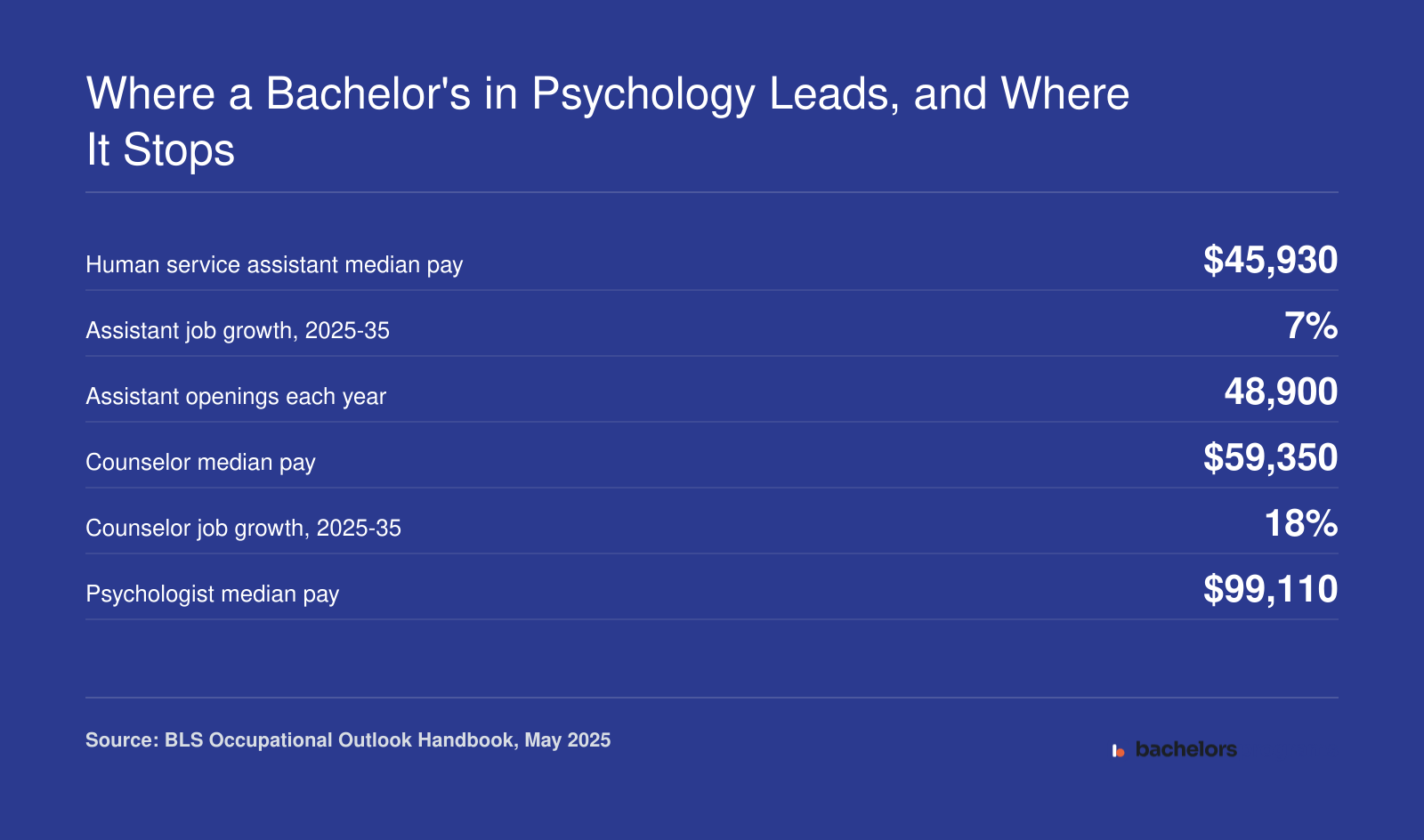
A psychology bachelor's can take you directly into roles like social and human service assistant, but licensed clinical practice requires more school. Licensed psychologist roles require a graduate degree, usually a doctorate for clinical and counseling work, and licensed mental health counselors need a master's plus supervised clinical hours and a national exam. If clinical work is your goal, a 4+1 track that counts master's credits toward your bachelor's can shorten that path. If you plan to stop at the bachelor's, the extra year may not be worth it.
General Psychology programs by state
Accelerated Psychology Degree FAQs
These answers cover the questions readers ask most about finishing a psychology bachelor's faster. Timelines, aid and admissions rules vary by school, so confirm details with the program itself.
Can you get a psychology degree online in less than four years?
Do graduate schools view accelerated psychology bachelor's degrees differently?
Can you use federal financial aid for 8-week accelerated terms?
Is a 4+1 psychology program worth it if you're unsure about grad school?
Compare General Psychology programs on the data that matters
Explore more Psychology majors or browse every field of study.
All Psychology programs Browse every field of study