Best Human Services Degree Programs in Washington
Compare 6 accredited Human Services programs in Washington, with net price after aid, graduation rates, earnings and debt from IPEDS and the U.S. College Scorecard.

A bachelor's degree in human services prepares you for case management, client advocacy and community support work, and in Washington it arrives as a Bachelor of Arts, a Bachelor of Science or a Bachelor of Applied Science, depending on the school. Most programs build in supervised field placement, so the degree is a hiring credential for agencies rather than a purely academic major.
The bigger question is which path. Universities such as Western Washington University and Washington State University offer a traditional major, while community colleges like Highline and Clark award applied degrees built for working adults.
Programs here run on campus in Washington and online at Washington-based schools. Whichever route you take, the degree alone does not confer state counselor credentials.
Key Points
- Western Washington graduates earned a $39,487 median one year after finishing.
- For flexible scheduling, start with Central Washington University or Clark College.
- Washington's social and human service assistants typically earn about $53,500 a year.
Best Bachelor's in Human Services Schools in Washington, Ranked
Washington's bachelor's programs in human services range from a traditional university major with a 240-hour field placement to applied degrees designed for people already working in behavioral health. The six schools below, listed in ranked order, cover campus, hybrid and fully online formats in Bellingham, Ellensburg, Des Moines, Vancouver and Pullman.
Western Washington University
#1Bellingham, WA · $10,000 – $29,000/yr (est.)
Best for: Campus students wanting deep field experience
Western Washington University is a public university in Bellingham with a human services program built around community partnerships. Undergraduates complete two quarters of supervised fieldwork, about 240 hours, with agencies such as Big Brothers Big Sisters and the Bellingham Food Bank. Coursework covers advocacy, grant writing, case management and outreach, and the curriculum aligns with national human service education standards.
- Two quarters of community internship work totaling 240 hours
- Curriculum aligns with national human service education standards
- More than 45 years of community engagement in Bellingham
- Placements include Big Brothers Big Sisters and the Bellingham Food Bank
- Coursework in advocacy, grant writing, case management and outreach
- Serves veterans, children and families in field placements
- Prepares graduates for MSW, law or counseling graduate study
Central Washington University
#2Ellensburg, WA · ~$18,000/yr (est.)
Best for: Working adults seeking online flexibility
Central Washington University in Ellensburg offers an applied sociology degree aimed squarely at human services delivery systems. Students take a required experiential learning course and complete an internship with a community agency. The program is available fully online as well as in person or hybrid, which makes it workable for students who cannot relocate to Kittitas County.
- 33 credits of required sociology coursework
- 15 credits of upper-division sociology electives
- Required 4-credit experiential learning course (SOC 490)
- Internship with a community agency of at least 160 hours
- Designated online-only option plus in-person and hybrid formats
- Must hold a 2.25 GPA in the major to graduate
- Minor in sociology allowed, but no double major with sociology
Highline College
#3Des Moines, WA · ~$10,000/yr (est.)
Best for: Associate-degree holders building on prior credits
Highline College in Des Moines offers an applied bachelor's degree built for people who already hold a related associate degree. The cohort model blends theory with practice, and coursework covers policy development, culturally responsive practice, legal and ethical standards, assessment and program evaluation. Graduates typically move into schools, nonprofit agencies and community organizations, often into supervisory or program management roles.
- Designed for students who already hold a related associate degree
- Prerequisite courses in human services required before entry
- 180 total credit hours including a senior capstone
- Core courses in positive youth development, leadership and supervision
- Coursework in culturally responsive practice and program evaluation
- Advanced field experience in schools and community organizations
- Cohort model with a 2.0 GPA minimum
Clark College
#4Vancouver, WA · ~$11,000/yr (est.)
Clark College in Vancouver runs a hybrid applied bachelor's degree designed around working professionals in behavioral health. Classes meet one evening a week, with roughly half the coursework online and asynchronous, and field placements supply supervised experience. The curriculum prepares students to advance as clinicians, managers or specialists in substance use and behavioral health settings.
- 90-credit program for working professionals with an associate degree
- Full-time students can finish in two years; part-time options available
- Classes meet one evening per week, about half online and asynchronous
- Coursework in multicultural counseling, trauma, grief and loss
- Field placements provide supervised real-world experience
- Meets educational requirements for the Washington CDP exam
- Built for holders of an Addiction Counselor Education associate degree
Northwest Indian College
#5Bellingham, WA · $3,100/yr (est. net price)
Northwest Indian College in Bellingham is a tribal college whose human services degree is grounded in relational accountability to community and place. The program pairs traditional Indigenous values with national human services standards and prepares students for tribal human services, advocacy and community health roles. Small cohorts and an anti-oppressive practice framework distinguish it from larger state universities.
- Blends traditional Indigenous values with national human services standards
- Focus on tribal human services, advocacy and community health
- Coursework in case management, documentation and grant writing
- Budget development and program funding skills built into the major
- Indigenous theories and methods for community-based research
- Anti-oppressive practice, cultural competency and self-reflection
- An additional TVR concentration is also offered
- Financial aid and scholarships available to students
Washington State University
#6Pullman, WA · ~$15,000/yr (est.)
Washington State University in Pullman houses human services inside its human development department, pairing a broad study of lifespan development with an applied services option. Students examine family dynamics and service delivery systems and prepare for advocacy, nonprofit and counseling support work. It is also a common route into graduate study in social work, counseling or family law.
- 120-credit degree in human development with a human services option
- Study of conditions that support or limit optimal functioning
- Coursework on family dynamics and service delivery systems
- Strategies for working effectively with diverse populations
- Prepares for family social service, advocacy and nonprofit roles
- Foundation for graduate study in social work, counseling or family law
Cost & outcomes by school
Federal data for the highest-earning Human Services programs, independent of the ranking above. Earnings are this field's bachelor's graduates four years after completing where the Scorecard reports them, else the school's undergraduate median.
| School | Net price / yr | Grad rate | Earnings | Debt | Grads/yr | Format |
|---|---|---|---|---|---|---|
| Washington State University WA | $14,971 | 61% | $68,905 | $19,500 | — | Campus |
| Central Washington University WA | $18,476 | 54% | $54,318 | $17,523 | 35 | Hybrid |
| Western Washington University WA | $21,193 | 65% | $53,788 | $19,500 | 65 | Campus |
| Highline College WA | $9,879 | 36% | $47,869 | $9,500 | 7 | Campus |
| Clark College WA | $11,465 | 39% | $42,356 | $10,881 | 9 | Hybrid |
| Northwest Indian College WA | $3,136 | 18% | $35,447 | — | 18 | Campus |
Sources: U.S. Department of Education. Net price, graduation rate, earnings and debt: College Scorecard (earnings and debt for this field's bachelor's graduates where reported, else school-wide); graduates: IPEDS. A dash means no figure is reported.
Cost, debt & payoff
Median earnings of this field's bachelor's graduates (4 yrs after completing, else the school's undergraduate median) vs. their median federal loan debt · U.S. College Scorecard
Across these programs the median graduate earns about $50,829 and finishes with roughly $17,523 in debt — a ratio that clears a common rule of thumb (keep debt below first-year salary). Net price and debt vary widely school to school, so check the per-school figures in the table above before you shortlist.
How We Ranked Washington Human Services Schools (And Why Accreditation Matters)
Accreditation is the filter that matters most here, because a human services degree rests on two separate approvals answering two different questions: whether the school can disburse federal aid and accept your credits, and whether the program itself meets a national standard for the field.
What the Outcome Data Measures
The comparisons here lean on public College Scorecard figures: net price after aid, graduation rate and earnings for graduates. Those numbers describe an institution as a whole, not its human services department, so read them as a profile of the schools offering this program rather than a verdict on the major. Format and structure carry weight too, including which schools run fully online, which hold classes on campus, and how each program organizes its upper-division coursework and field placements.
Regional Accreditation: NWCCU
In Washington the regional accreditor is the Northwest Commission on Colleges and Universities. All of them are regionally accredited, and that status is what makes federal student aid, credit transfer between colleges and admission to graduate school possible. Because accreditation is reviewed on a cycle, confirm a school's current standing in the NWCCU directory before you apply.
Program-Level Accreditation: CSHSE
The Council for Standards in Human Service Education accredits human services programs at the associate, baccalaureate and master's levels, measured against 21 baccalaureate standards.2 It is voluntary, and membership is not accreditation: a department can join CSHSE without ever applying, and accredited programs must renew.2
Western Washington University's Department of Human Services appears on CSHSE's membership list.1 The published list of accredited programs, updated through the February 2026 board meeting, does not confirm CSHSE accreditation for the bachelor's programs ranked here3, so treat that as a question to ask each department directly. CSHSE accreditation eases transfer and signals field readiness, but its absence is not a red flag on a regionally accredited degree.
What a Bachelor's Degree in Human Services Covers in Washington
Human services training in Washington is shifting from generalist social science toward supervised practice, and agencies now expect documented field hours from the people they hire as case managers. A bachelor's degree in human services is the credential that carries that expectation, and it sits a level above the associate degree and certificate in both scope and responsibility. Bachelor's-level graduates typically move into case management, advocacy, program coordination and family support work; associate and certificate holders more often enter as paraprofessionals or direct-support staff. Human services is also not the same as a Health and Human Services major, which leans toward health administration and clinical support, or a human development major, which centers on lifespan psychology.
What the Coursework Looks Like
Coursework in Washington programs clusters around a few themes: applied sociology and family dynamics, case management and documentation, grant writing and budget development, community advocacy, and culturally responsive or anti-oppressive practice. Northwest Indian College builds its community advocates degree around tribal human services and Indigenous research methods, while Western Washington University pairs coursework with 240 clinical hours and internships such as Big Brothers Big Sisters, folding grant writing and outreach into the placement. Central Washington University requires 160 clinical hours plus a four-credit experiential learning component and expects students to take a minor outside sociology.
Emphases Across Washington Programs
The programs tilt toward particular practice areas rather than offering long lists of formal concentrations. Highline College's applied bachelor's emphasizes youth development; Clark College frames its degree as a holistic approach to behavioral health; Washington State University's Human Services Option focuses on family social service programs across the lifespan.
The Transfer Route From a Community College
Highline College and Clark College both build their applied bachelor's degrees around transfer. Highline requires a related Associate of Applied Science plus three prerequisite courses before admission, and Clark's program is a two-year, 90-credit completion track designed for working professionals who already hold a technical degree, with one evening class a week and half the coursework online. GPA floors, test policy and credit-by-credit rules vary by school.
Related Articles
Online and Hybrid Bachelor's in Human Services at Washington Schools
Which formats each school uses
If you want flexibility, start with Central Washington University and Clark College. CWU's Social Services BS runs in a hybrid format from Ellensburg and its program materials point to a fully online option, which makes it the most straightforward distance route among the schools here. Clark College's Bachelor of Applied Science in Human Services in Vancouver is also hybrid: roughly half the coursework is asynchronous online, with one evening class per week on campus, a schedule built deliberately around people already working.
Western Washington University and Northwest Indian College run their human services programs primarily on campus in Bellingham, Highline College in Des Moines and Washington State University in Pullman. WWU's program page also describes an online option serving learners across Washington, but it does not spell out whether that path is fully online or how much on-campus time is expected, so ask the department directly before assuming you can finish from a distance.
Residency, tuition rates and fieldwork
None of these schools publish a flat national online tuition rate in the information we reviewed, so plan on the published resident or nonresident rate for the campus. The gap matters: at WWU and CWU, nonresident tuition runs roughly three times the in-state figure, while Highline's resident and nonresident rates sit much closer together. WWU's online option is described as serving Washington learners, and out-of-state eligibility is not stated anywhere we could verify. Confirm it in writing.
Fieldwork is the part no format removes. WWU requires about 240 clinical hours across two quarters, CWU builds in 160 clinical hours plus a community agency internship, and Highline and Clark both include field placements. Those hours happen in person, near you, which means even a mostly online student needs a local agency willing to host them.
Picking a format
- Working adults: Clark's evening-plus-asynchronous model, or CWU's online pathway.
- Transfer students: Highline and Clark, which are built on top of a related applied associate degree.
- Traditional students: WWU, WSU and Northwest Indian College, where the campus experience and advising are the point.
Admissions: GPA, Test Policy and Transfer Credit at Washington Schools
The usual route into a bachelor's degree in human services in Washington starts at a community college, and the Direct Transfer Agreement (DTA) associate degree is what makes that handoff work. Read each school's admissions rules through that pathway.
Western Washington University
WWU publishes the most detail, and the human services program sets a higher bar than the university's general transfer standard.
- University transfer GPA: 2.00 cumulative transferable GPA, plus 2.00 in the quarters before application review and enrollment.
- Human Services GPA: A cumulative college-level GPA of 2.75 or higher, for both the program page and the online page.
- Test policy: No published policy.
- Transfer credit: The program is a 2+2 distance-learning degree built for students who hold a DTA associate degree. Transfer students with a Washington community college DTA generally have their general education requirements (GURs) satisfied.
How the Credit Handoff Works
For the human services major, applicants must finish the GURs by attending WWU or by earning a Washington community college DTA-AA by the first day of the application quarter. The online program page asks applicants to be within 5 credits of a DTA, or an equivalent. It recommends up to 105 transferable credits before entering WWU. Those are recommendations tied to the DTA, so a student without a DTA should ask an advisor how remaining courses will be counted.
Other Schools Here
The admissions pages reviewed for the remaining schools did not list a minimum GPA, test requirement or transfer credit cap for human services.
- Central Washington University: No published policy.
- Highline College: No published policy.
- Clark College: No published policy.
- Northwest Indian College: No published policy.
- Washington State University: No published policy.
That does not mean these schools have no standards. It means the information was not available in a form we can report. Ask the admissions office for GPA expectations, whether test scores are considered, and how many credits transfer.
Before You Apply
GPA minimums, credit limits and application deadlines change, and program-level rules often differ from the university's general policy, as WWU's two GPA thresholds show. Confirm current requirements with each school's admissions office before you plan your coursework. If you are still at a community college, ask your advisor now which courses fit a DTA so no credits are wasted.
Cost of a Bachelor's in Human Services in Washington
Tuition in Washington splits sharply between the community colleges that award applied bachelor's degrees and the public universities, and the gap is wide enough to change which route makes sense for you.
Sticker Price Versus What Families Actually Pay
Annual in-state tuition and fees at the schools ranked here run from $4,365 at Northwest Indian College to $13,391 at Washington State University. Highline College ($4,772), Clark College ($5,233), Central Washington University ($9,417) and Western Washington University ($9,582) fill in the middle.
Published rates are not what students actually pay. Average net price, the figure left after grants and scholarships, runs $3,136 at Northwest Indian College, $9,879 at Highline, $11,465 at Clark, $14,971 at Washington State, $18,476 at Central Washington and $21,193 at Western Washington. Net price is an institution-wide average across all undergraduates, not a quote for a human services major, so treat it as a starting point rather than a promise.
Washington Aid That Changes the Math
- Washington College Grant: In 2026-27 a family of four earning $83,500 or less qualifies for a full award.1 Maximum awards at the schools ranked here reach $12,700 at Washington State, $8,804 at Western Washington and $8,615 at Central Washington.1 Eligibility requires Washington residency, a diploma or equivalent, income within the scale, no prior bachelor's degree, and enrollment at an eligible college.1
- College Bound Scholarship: For students who were income-eligible for free or reduced-price meals in seventh or eighth grade. Household income must stay below 65% of median family income at award time.2 Maximum combined awards reach $13,200 at Washington State, $9,304 at Western Washington, $9,115 at Central Washington and $8,634 for applied bachelor's programs at community colleges.2 It covers tuition, allowable fees and a small book allowance, not housing or food.
- Passport to Careers: Serves students who were in foster care or were unaccompanied homeless youth, and requires Washington residency plus a Washington diploma or GED. The 2026-27 scholarship tops out at $2,000 and can be reduced depending on legislative funding.3
Median Debt and the Practical Route
Median federal debt among graduates who borrowed comes to $9,500 at Highline, $10,881 at Clark, $18,500 at Western Washington, and $19,500 at both Central Washington and Washington State.
For most students the cheapest route is two years at a community college and then a finish at a public university, or an applied bachelor's at Highline or Clark. Filing the FAFSA or WASFA matters more than any sticker price on this page.
What Do Washington Human Services Graduates Earn After Finishing?
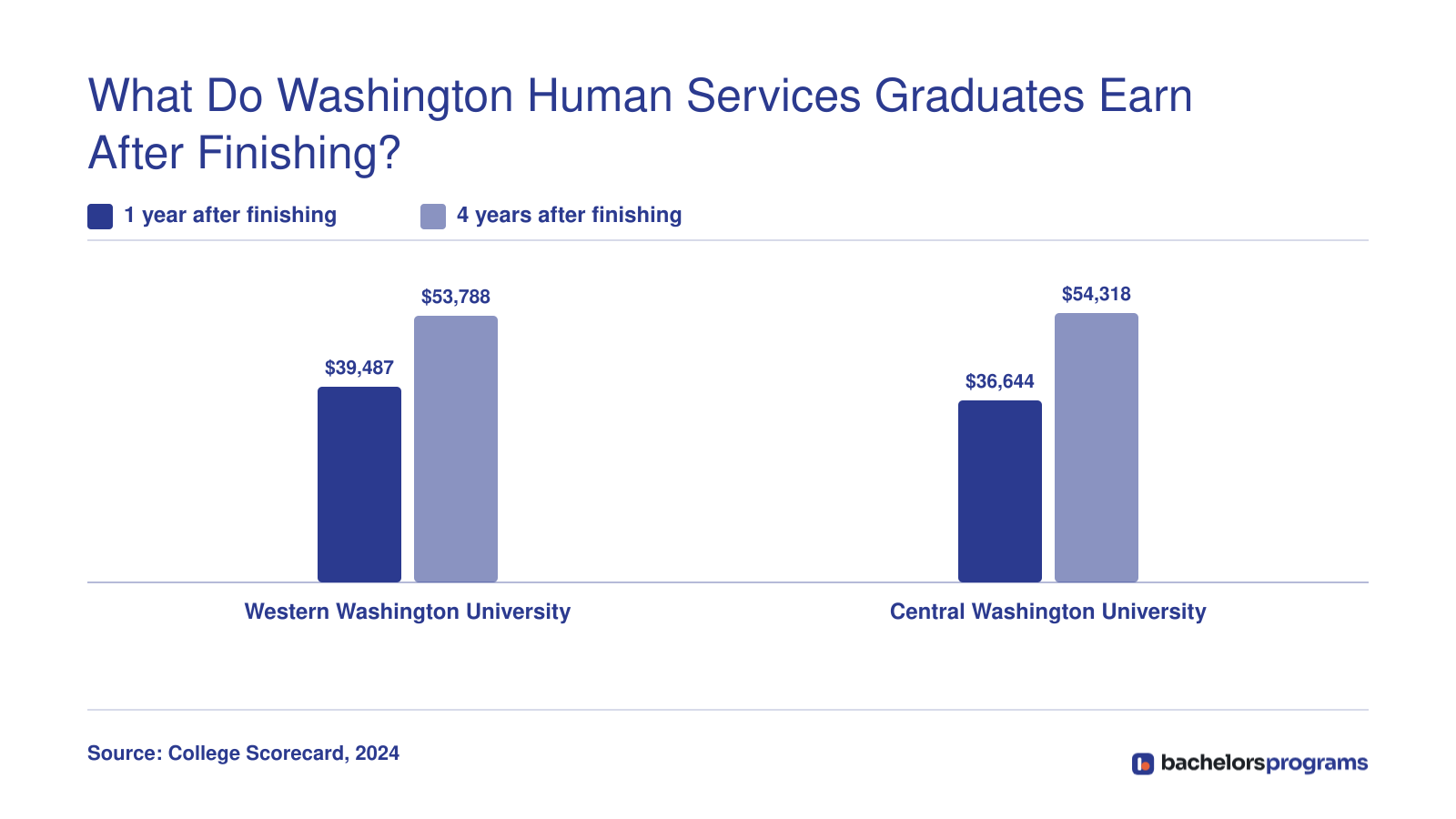
Federal outcomes data tracks median earnings for bachelor's in human services graduates at Western Washington University and Central Washington University. One year after finishing, Western Washington graduates earned a median of $39,487 and Central Washington graduates $36,644. Four years out, those medians rose to $53,788 and $54,318. Schools without earnings figures for this specific program are left out of the chart rather than shown with campuswide earnings.
Jobs You Can Get With a Bachelor's in Human Services in Washington
Washington's social and human service assistants earn a typical wage of about $28 per hour, or $53,500 a year, according to the state Employment Security Department's Career Bridge tool. The middle half of workers in that role earn between $23 and $31 per hour. That is the most direct entry point for a bachelor's degree in human services, and the state counted 9,281 people in the occupation with roughly 1,478 openings a year.
Common roles and what they pay
- Social and human service assistant: The broadest entry role, often titled case manager or case aide in county offices, nonprofit agencies and behavioral health clinics. Typical pay is the $28-per-hour figure above.
- Community health worker: Connects clients to care, insurance and social services. Nationally, the Bureau of Labor Statistics put the median at $51,850 a year in May 2025.1
- Substance use and mental health counselor: A role that usually requires the state credential described further down this page. The national median was $59,350 a year ($28.53 per hour) in May 2025, and BLS projects 18% growth nationally from 2025 to 2035, about 50,500 openings a year.2 One 2026 report citing federal data lists a Washington annual wage of $75,020 for this occupation.3
Occupational wages are not graduate earnings
The earnings figures elsewhere on this page describe what graduates of specific programs reported, not what any single occupation pays. A new graduate may start below the typical wage for an occupation, and an experienced counselor may earn well above it. Read the two sets of numbers as different questions: what alumni earn, and what the job pays.
The social work link
A bachelor's in human services is not a social work license and does not make you a licensed social worker in Washington. It can, however, shorten the path: some MSW programs grant advanced standing to applicants with a related bachelor's degree, letting them finish the master's in less time. If licensure as a social worker is the goal, plan on the MSW.
Job growth in Washington's care and behavioral health sectors is steady, and the state's long-term services workforce reports continue to flag hiring demand across these roles.3
Washington Substance Use Disorder Professional and Counselor Credentials at a Glance
Questions to Ask Yourself
Do you need a fully online format, or can you attend campus and complete an in-person practicum?
Are you starting from a community college associate degree and need a transfer-friendly bachelor's?
Does your target job, such as SUDP counseling or a later MSW, depend on a particular concentration or accreditation?
Compare Human Services programs on the data that matters
Explore more Social Work & Social Sciences majors or browse every field of study.
All Social Work & Social Sciences programs Browse every field of study