Best Information Technology Schools in Utah
Compare 4 accredited Information Technology programs in Utah, with net price after aid, graduation rates, earnings and debt from IPEDS and the U.S. College Scorecard.

Information technology is a field where the degree matters less for what it teaches than for what it proves: that a graduate can administer systems, secure networks, and document the work. The common credential is the Bachelor of Science (B.S.) in Information Technology, and in Utah it is offered in sharply different formats, from a traditional campus major in Provo to a competency-based online program based in Salt Lake City.
The tension applicants face is not admission difficulty. It is fit: a campus program with lab work and internships, a public university with stackable certificates, or a self-paced online degree priced by the term. Cost and earnings spread widely across those models.
Every program here is a bachelor's degree, offered on campus in Utah or online through a Utah school.
Key Points
- BYU IT graduates earn $123,638 median five years out, owing $13,500.
- Western Governors University offers a fully online, competency-based IT bachelor's.
- BYU and Utah Valley University both appear in ABET's accredited-program search.
Best Information Technology Schools in Utah: Our Ranked List
Four Utah institutions appear in this year's list of bachelor's degree programs in information technology: a private university in Provo, a competency-based online school based in Salt Lake City, and two public universities in Orem and St. George. They differ sharply in format, price and admission requirements, so the right pick depends on whether you need scheduled campus classes or a self-paced online term.
Western Governors University
#1Salt Lake City, UT · ~$13,000/yr (est.)
Best for: Working adults needing self-paced online study
Western Governors University is a competency-based online institution headquartered in Salt Lake City, and its B.S. in Information Technology folds CompTIA and AWS certification preparation directly into the coursework at no extra cost. Students work through 35 courses at their own pace, complete at least 12 competency units per six-month term, and most finish within 39 months. With 12 start dates a year and a flat per-term tuition, it is built for people who are working while they study.
- 35 courses; competency-based with no set class times
- At least 12 competency units per six-month term
- CompTIA A+, Network+, Security+, Cloud+ and Project+ built in
- AWS Certified Cloud Practitioner and ITIL 4 Foundation included
- Admission needs a high school diploma plus one readiness option
- No ACT or SAT required; test optional
- 12 start dates a year with rolling admission
- Associate degree transfer credits accepted
Utah Valley University
#2Orem, UT · $5,000 – $10,000/yr (est.)
Best for: Certificate holders stacking credentials toward a degree
Utah Valley University in Orem offers a public-university route into IT that lets students stack certificates and associate degrees into the bachelor's rather than starting over. The 120-credit degree covers cloud computing, networking, system administration and information security, with elective tracks in cybersecurity, database, enterprise IT, business intelligence and web and mobile development. Internship and lab work is part of the program, and the campus sits in a dense technology corridor along the Wasatch Front.
- 120 total credit hours
- Accredited by the Computing Accreditation Commission of ABET
- Five concentration options, including cybersecurity and database
- Certificates and associate degrees stack toward the BSIT
- Coursework in cloud computing, networking and system administration
- Elective tracks in business intelligence, enterprise IT and web/mobile development
- Internship and lab projects; an alum now works as a state information security analyst
- Minors and certificates available alongside the degree
Utah Tech University
#3Saint George, UT · $16,000/yr (est. net price)
Best for: Hands-on learners drawn to networking and security
Utah Tech University in St. George delivers its B.S. in Information Technology as a completion pathway, with students moving from the Associate of Science in IT into the bachelor's after meeting with a computing advisor. The 120-credit curriculum adds Windows server administration, database design, information security and intermediate networking on top of the associate foundation, plus electives in ethical hacking, digital forensics and big data analytics. A senior capstone closes the degree, and graduates typically target systems analyst, network administrator and IT administrator roles.
- 120 total credit hours; 2.0 cumulative GPA to graduate
- Core covers Unix/Linux, A+ hardware, Windows servers and information security
- 18 credits of IT core electives, from DevOps to ethical hacking
- 9 additional elective credits, including big data and digital forensics
- Senior capstone required
- Entry through the Associate of Science in IT with a C or better
- 40 upper-division credits, 30 of them taken at Utah Tech
- Maximum 12 upper-division transfer credits
Brigham Young University
#4Provo, UT · $15,000 – $20,000/yr (est.)
Brigham Young University in Provo houses information technology inside its Electrical and Computer Engineering department, giving the major an engineering-adjacent core in programming, data structures, computer architecture, networking and defensive cybersecurity. The 77-credit degree ends in a two-course senior project and capstone and requires 200 hours of pre-approved IT work before graduation. The university has stopped admitting new students to this major, so anyone considering BYU should confirm current program status with the department before applying.
- 77 total credit hours, fixed minimum and maximum
- Housed in the Electrical and Computer Engineering department
- Core spans programming, data structures, calculus and discrete structures
- Upper-level work in operating systems, networks and defensive cybersecurity
- Two-course senior project and capstone
- 200 hours of pre-approved IT-related work required
- Grade of C or higher in gateway courses before 300-level IT classes
- Electives need program pre-approval; department packet and exit interview
Cost & outcomes by school
Federal data for the highest-earning Information Technology programs, independent of the ranking above. Earnings are this field's bachelor's graduates four years after completing where the Scorecard reports them, else the school's undergraduate median.
| School | Net price / yr | Grad rate | Earnings | Debt | Grads/yr | Format |
|---|---|---|---|---|---|---|
| Brigham Young University UT | $15,564 | 81% | $113,338 | $13,500 | 69 | Campus |
| Western Governors University UT | $12,548 | 46% | $108,836 | $16,625 | 1,341 | Online |
| Utah Valley University UT | $6,376 | 45% | $55,486 | $14,750 | 59 | Campus |
| Utah Tech University UT | $16,039 | 38% | $44,570 | $20,722 | 12 | Campus |
Sources: U.S. Department of Education. Net price, graduation rate, earnings and debt: College Scorecard (earnings and debt for this field's bachelor's graduates where reported, else school-wide); graduates: IPEDS. A dash means no figure is reported.
Cost, debt & payoff
Median earnings of this field's bachelor's graduates (4 yrs after completing, else the school's undergraduate median) vs. their median federal loan debt · U.S. College Scorecard
Across these programs the median graduate earns about $82,161 and finishes with roughly $15,688 in debt — a ratio that clears a common rule of thumb (keep debt below first-year salary). Net price and debt vary widely school to school, so check the per-school figures in the table above before you shortlist.
How We Ranked Utah's Bachelor's in IT Programs
Some of the numbers behind this list describe a single program, and others describe the whole university. Knowing which is which matters before you compare schools.
Scope
Every program here is a bachelor's, taught on campus or online, at a school located in Utah or at a Utah-based online school. Western Governors University, Utah Valley University, Utah Tech University, and Brigham Young University all fit that scope. Graduate study is not part of the comparison.
What We Weighed
- Program-level earnings: what graduates of the information technology program earn after they finish.
- Median debt: the typical federal loan balance for students who complete that program.
- Graduation rate: the share of students who finish their degree.
- Net price: what students pay after grants and scholarships are subtracted.
- Accreditation: each school's institutional accreditation, plus programmatic accreditation such as ABET where a program holds it.
What the Numbers Can and Can't Tell You
Two of these measures, graduation rate and net price, describe the entire institution. They describe everyone enrolled at the school, not only IT majors, so your own experience in an IT program may differ. Earnings and debt are tied to the specific program, which makes them the better figures for comparing one IT degree against another.
Program data from the federal College Scorecard also lags. The outcomes it reports belong to graduates who finished several years ago, so they may not reflect today's pay or tuition. Completions, meaning the number of degrees a program awards, show how large each program is. That matters because earnings figures from a small program can swing more than those from a large one. Treat every figure as a starting point, and confirm current costs and requirements on each school's own pages before you apply.
Bachelor's Degree in Information Technology Compared: B.S. vs. Bachelor of Applied Studies
The Bachelor of Science (B.S.) in Information Technology is the conventional named major, while a Bachelor of Applied Studies (BAP/BAS) is a shorter completion degree built on technical or associate-level credit. The BAP/BAS figures below come from one Utah public university's published graduation standards and are not a statewide rule. Before you apply to Brigham Young University, Utah Tech University, Utah Valley University, or Western Governors University, check each school's catalog for the exact degree title, credit total, upper-division and residency rules.
| Feature | B.S. in Information Technology | Bachelor of Applied Studies (BAP/BAS) |
|---|---|---|
| Typical total credits | About 120 credits, with a defined IT major | At least 90 and fewer than 120 credits under the published framework reviewed |
| Upper-division credits | Set by each school's major requirements | At least 40 credits |
| Residency credits | Set by each school's catalog | At least 30 credits earned at the institution; military, examination, experiential, and department-awarded credit does not count toward residency |
| Starting point | Full IT course sequence, usually from the first year | Builds on an associate degree or a technical or academic certificate |
| Typical student | Traditional students who want a named IT major | Working adults, technical college graduates, and military or occupational learners who already hold substantial credit |
| Role of an associate degree | An AA or AS can cover general education and some lower-division work, but major, upper-division, and graduation requirements remain | An associate degree can supply the foundation, but a 60-credit associate degree does not automatically equal 90 bachelor's credits |
| General education transfer | An AA or AS can satisfy general education if completed before transfer; an AAS is evaluated individually | Same rules apply; an AAS is recognized but does not automatically meet general education |
| Role of certificates | Credits may count as electives or prerequisites, or be rejected, depending on level, grade, and accreditation | Certificates can serve as an entry pathway, but their credits do not always count as bachelor's credit |
| Is it an IT degree? | Yes, the title and major are IT | Not automatically; the value depends on the emphasis and approved technical coursework |
ABET-Accredited IT Programs and Specializations at Utah Schools
Brigham Young University and Utah Valley University both appear in ABET's accredited-program search. Utah Valley's listing is filed under its former name, Utah Valley State College, and neither result we reviewed named the accredited program, so confirm the IT degree itself in ABET's search before relying on it. For IT and information systems degrees, the ABET body that usually applies is the Computing Accreditation Commission rather than the Applied and Natural Science Accreditation Commission. Utah Tech University and Western Governors University could not be verified as ABET-accredited in the results available. Our sources did not list concentrations such as cybersecurity, databases, web and mobile development, enterprise IT or cloud, so check each school's current program page for its emphases.
| School | Program | ABET Accreditation Status | Concentrations / Emphases |
|---|---|---|---|
| Brigham Young University (Provo) | Information Technology | ABET-accredited program listed for BYU in Provo; the result viewed did not name the program, so verify that the IT degree is the one covered | Not listed in sources reviewed; see the program page |
| Utah Valley University (Orem) | Information Technology, B.S. | ABET-accredited program listed under the former name Utah Valley State College (renamed Utah Valley University on Dec. 31, 2008); the result viewed did not name the program | Not listed in sources reviewed; see the program page |
| Utah Tech University (Saint George) | Information Technology | Not verified; no Utah Tech program was identifiable in the ABET results reviewed | Not listed in sources reviewed; see the program page |
| Western Governors University (Salt Lake City) | Information Technology | Not verified; no WGU program was identifiable in the ABET results reviewed | Not listed in sources reviewed; see the program page |
Online and Hybrid Bachelor's in IT Options at Utah Schools
A Utah information technology bachelor's can be completed without ever setting foot on campus. Only one school on this list offers that, and the gap between its format and a traditional campus program is wider than most applicants expect.
Fully Online and Competency-Based
Western Governors University delivers its B.S. in Information Technology entirely online and asynchronously, with 12 start dates a year and no set class times.1 The program runs 35 courses, and full-time status means 12 or more competency units per six-month term. Tuition is a flat $3,925 per term for terms beginning on or after January 1, 2026, plus a $200 E-Books and Resources Fee; students carrying fewer than 12 competency units pay a prorated rate.1 WGU also publishes a School of Technology undergraduate range of $3,925 to $4,425 per term and states that rates change for terms beginning October 1, 2026, so confirm the current per-term figure before you budget.2 Because billing is per term rather than per credit, finishing courses faster does not cost more, and WGU does not charge a different rate to in-state and out-of-state students.
Campus Programs and Hybrid Flexibility
Our program data lists the IT bachelor's at Brigham Young University, Utah Valley University, and Utah Tech University as campus-based. That does not mean every class meets in person. UVU's degree stacks certificates and associate credits into the bachelor's, and Utah Tech requires a capstone plus 30 residency credits, so some components are tied to the campus. Ask each department whether hybrid or online sections exist for general education and upper-division IT courses, and whether online sections carry a separate distance-education fee.
Who Each Format Suits
Working adults, career changers, and transfer students with existing credits tend to benefit most from WGU's rolling starts and self-paced terms. Students who want labs, internships, in-person recruiting, and structured semester deadlines usually get more from a campus program.
Questions to Ask Yourself
Do you need to keep working full time while you study?
Do you already hold an associate degree or a block of college credits?
Will your target employers screen on accreditation or on a specific focus?
Related Articles
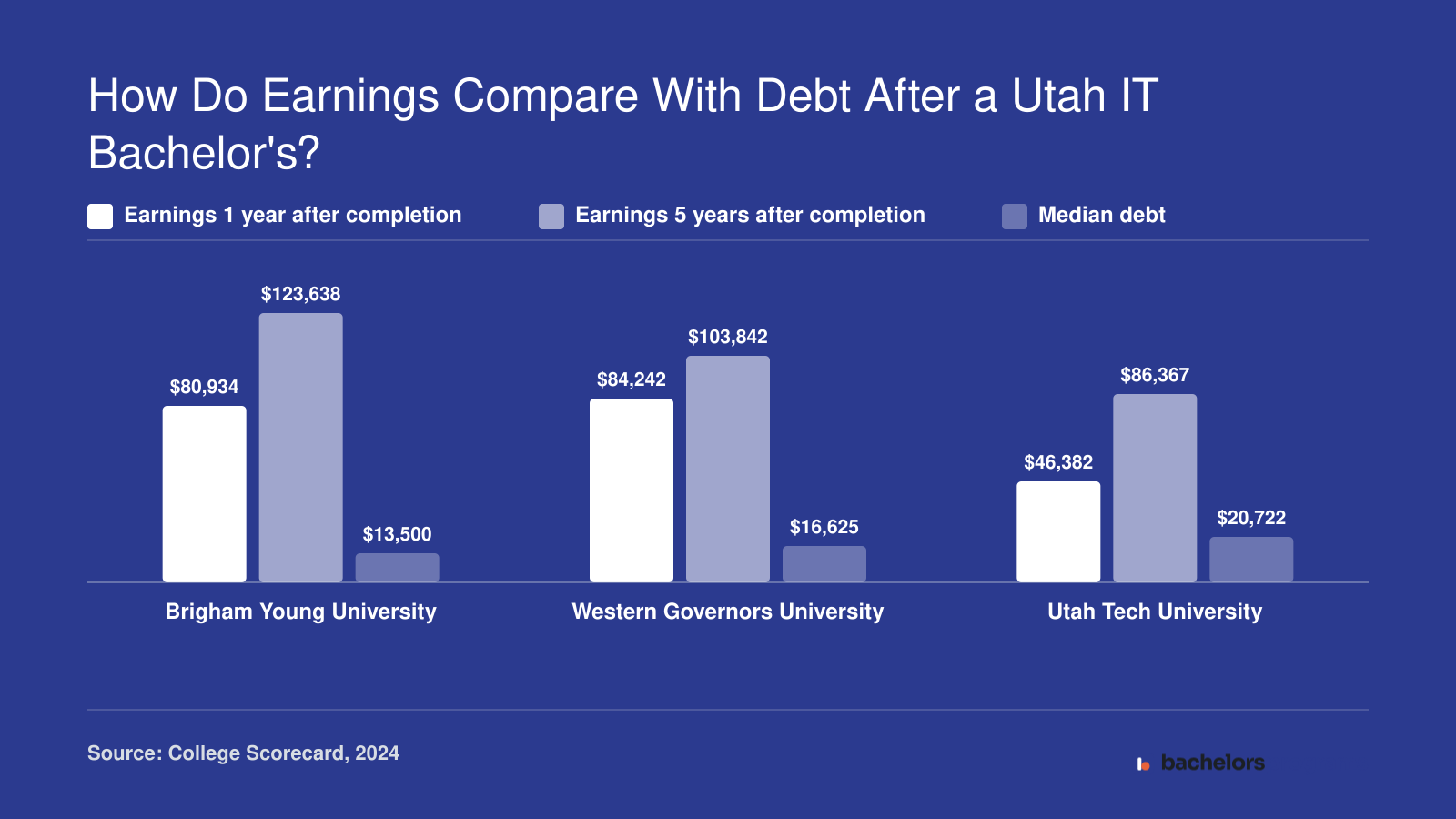
How Do Earnings Compare With Debt After a Utah IT Bachelor's?
Brigham Young University's information technology graduates report median earnings of $80,934 one year after completion and $123,638 five years after, against median debt of $13,500. That is the strongest earnings-to-debt balance in the chart. Western Governors University graduates earn $84,242 at one year and $103,842 at five years, with $16,625 in median debt, while Utah Tech University graduates earn $46,382 at one year and $86,367 at five years, carrying $20,722. Program-level earnings and debt are not reported for Utah Valley University's B.S. in Information Technology, so it is left out of the chart.
Compare Information Technology programs on the data that matters
Explore more Computers & IT majors or browse every field of study.
All Computers & IT programs Browse every field of study