Best Psychology Schools in Utah
Compare 11 accredited General Psychology programs in Utah at 7 colleges, with net price after aid, graduation rates, earnings and debt from IPEDS and the U.S. College Scorecard.
Choosing a psychology program in Utah comes down to price versus reach: resident tuition and fees at Utah Valley University run $6,507 a year, while Westminster University lists $43,528 before aid. Schools award it as a Bachelor of Science (B.S.) or a Bachelor of Arts (B.A.) in Psychology, and the split usually tracks foreign language and research requirements.
The ranking below covers campus and online options at Utah schools. Beyond sticker price, the choice turns on research access and format, since a Utah counseling license requires graduate study either way.
Key Points
- Brigham Young University ranks first, with a 52-credit B.S. and required capstone.
- Utah Valley University charges residents $6,507 yearly; average net price is $6,376.
- Online students can earn psychology bachelor's degrees from Utah State or University of Utah.
Best Schools for a Bachelor's Degree in Psychology in Utah
Brigham Young University takes the top spot for a bachelor's degree in psychology in Utah, pairing a 52-credit science track with mentored research and a required capstone. The seven schools below range from large public research universities to regional state colleges and a private liberal arts campus in Salt Lake City, and several offer a fully online route. Each entry shows what the program asks of you and what its graduates report earning after finishing.
Brigham Young University
#1Provo, UT · $15,000 – $20,000/yr (est.)
Best for: Research-minded undergrads wanting mentored lab work
Brigham Young University grounds its psychology offering in psychological science, with a 52-credit Bachelor of Science that runs from biological and cognitive psychology through a required capstone seminar. Students can earn credit through mentored research, internships or teaching assistantships, and electives reach into multicultural, health and sports psychology. Psychology graduates report a median $62,106 four years after finishing, with median borrowed debt near $11,000.
- 52 credit hours, with a capstone seminar required
- Mentored research, internship or teaching options for credit
- Coursework spans social, cognitive, developmental and biological psychology
- Research methods and statistics form a core part of the major
- Electives include multicultural, health and sports psychology
- 500-level courses open to advanced undergraduates
Southern Utah University
#2Cedar City, UT · $7,000 – $21,000/yr (est.)
Best for: Future human services workers wanting applied training
Southern Utah University awards psychology as both a Bachelor of Arts and a Bachelor of Science, and either version can be completed with a Human Services Emphasis built around an internship capstone. Faculty advisors help students tailor course selection to career goals, and transfer credit is reviewed case by case. Psychology graduates report a median $42,393 four years after finishing, with median borrowed debt around $9,250.
- Course blocks run from prerequisites through foundation and electives
- Faculty advisors help tailor course selection to career goals
- Transfer credit reviewed by faculty case by case
- Minimum C- required in major courses
- Prepares for human services, education or graduate study
- Bachelor of Science route through the same psychology core
- Faculty assist with career development and graduate school planning
- Capstone courses consolidate learning before graduation
- 120 credit hours, including an internship capstone
- Methods courses paired with labs
- Prepares for helping professions and counseling field work
- Sample degree plan published for four-year sequencing
- Counseling field courses built into the emphasis
- Aimed at students entering helping careers directly after the degree
- Same 120-credit structure with a science designation
- C- minimum in major courses
Utah State University
#3Logan, UT · $9,000 – $25,000/yr (est.)
Best for: Working adults needing a fully online option
Utah State University offers psychology as a Bachelor of Science or Bachelor of Arts, with a capstone or apprenticeship and a required minor that lets students build a second field into the degree. The program runs at multiple Utah State campuses and 100% online, which suits working adults, and students can join the Psi Chi honor society. Psychology graduates report a median $51,111 four years after finishing, with median borrowed debt near $18,000.
- Capstone or apprenticeship required before graduation
- A minor is required, adding a second field to the degree
- Available 100% online and at multiple Utah State campuses
- Research opportunities with faculty in active labs
- Psi Chi psychology honor society on campus
- Prepares students for competitive graduate programs
Utah Valley University
#4Orem, UT · $5,000 – $10,000/yr (est.)
Utah Valley University organizes its Bachelor of Science in Psychology around the American Psychological Association's five pillars, with 120 credit hours, a capstone and required service-learning or internship work. Written communication and critical thinking are built into the curriculum, and a 2.5 program GPA is needed to graduate. Psychology graduates report a median $47,596 four years after finishing, with median borrowed debt near $16,000.
- 120 credit hours built on the APA five pillars of psychology
- Minimum 2.5 program GPA to graduate
- Service-learning, internship or capstone engaged learning required
- 30 credits must be completed in residence at UVU
- Online course options available
- Global and intercultural course requirement
Utah Tech University
#5Saint George, UT · $16,000/yr (est. net price)
Utah Tech University requires 120 credits for its Bachelor of Science in Psychology, including a capstone research course and coursework drawn from at least three depth areas such as developmental, cognitive, clinical, social and neuroscience. Nine writing-intensive upper-division credits and a 40-credit upper-division requirement give the degree a research and writing cast. Psychology graduates report a median $49,965 four years after finishing, with median borrowed debt near $20,000.
- 120 credit hours, 40 of them upper-division
- Capstone research course required
- Choose coursework from at least three depth areas
- 9 writing-intensive upper-division credits in the major
- 12 credits of psychology electives, 9 at upper-division
- 2.0 cumulative GPA and C or higher in major courses
- Course fee applies to some psychology classes
University of Utah
#6Salt Lake City, UT · $10,000 – $31,000/yr (est.)
The University of Utah's general psychology major runs 41 credits and, with careful planning, can be completed entirely online. Research assistant positions in faculty labs and internships for credit give students applied experience, and an honors track adds a thesis and an Honors College partnership. Psychology graduates report a median $52,440 four years after finishing, with median borrowed debt near $17,800.
- 41 credit hours in the major
- Can be completed entirely online with careful planning
- Research assistant positions in faculty labs
- Internships available for academic credit
- Honors track adds a thesis and Honors College partnership
- Open major with no additional admission requirements
Westminster University
#7Salt Lake City, UT · ~$27,000/yr (est.)
Westminster University is a private liberal arts campus in Salt Lake City, and its Bachelor of Science in Psychology requires 124 credit hours, a capstone and eight credits of world language. Students can take a field experience in psychology, undergraduate research is strongly encouraged, and the program asks for a 2.5 cumulative GPA. Psychology graduates report a median $49,564 five years after finishing.
- 124 credit hours, including a capstone course
- 2.5 cumulative GPA required
- Eight credits of world language required
- Field experience option in community settings
- Undergraduate research strongly recommended
- Themed 300-level courses in counseling, health and neuroscience
Cost & outcomes by school
Federal data for the highest-earning General Psychology programs, independent of the ranking above. Earnings are this field's bachelor's graduates four years after completing where the Scorecard reports them, else the school's undergraduate median.
| School | Net price / yr | Grad rate | Earnings | Debt | Grads/yr | Format |
|---|---|---|---|---|---|---|
| Westminster University UT | $27,094 | 64% | $66,215 | $22,250 | — | Campus |
| Brigham Young University UT | $15,564 | 81% | $62,106 | $11,000 | 26 | Campus |
| University of Utah UT | $16,200 | 65% | $52,440 | $17,766 | — | Online |
| Utah State University UT | $14,936 | 59% | $51,111 | $17,976 | 191 | Online |
| Utah Tech University UT | $16,039 | 38% | $49,965 | $20,000 | 62 | Campus |
| Utah Valley University UT | $6,376 | 45% | $47,596 | $16,000 | 485 | Campus |
| Southern Utah University UT | $10,462 | 61% | $42,393 | $9,250 | 100 | Campus |
Sources: U.S. Department of Education. Net price, graduation rate, earnings and debt: College Scorecard (earnings and debt for this field's bachelor's graduates where reported, else school-wide); graduates: IPEDS. A dash means no figure is reported.
Cost, debt & payoff
Median earnings of this field's bachelor's graduates (4 yrs after completing, else the school's undergraduate median) vs. their median federal loan debt · U.S. College Scorecard
Across these programs the median graduate earns about $49,965 and finishes with roughly $16,000 in debt — a ratio that clears a common rule of thumb (keep debt below first-year salary). Net price and debt vary widely school to school, so check the per-school figures in the table above before you shortlist.
How We Ranked Utah Psychology Schools
Every school on this list offers a bachelor's degree in psychology through a program based in Utah, whether you study on campus or online. To put them in order, we used federal data.
What the Ranking Looks At
- Outcomes: How graduates do after they finish, including typical earnings and how manageable their student debt is.
- Cost and net price: What students actually pay after grants and scholarships, not just the published tuition rate.
- Graduation and retention: How many students return after their first year and go on to finish a degree.
Schools that do well in all three areas rise toward the top. A school that is strong in one area but weaker in another usually lands in the middle.
Limits to Keep in Mind
Graduation rates and net price figures cover the whole institution, not the psychology department alone. A university's overall completion rate may not show how psychology majors in particular progress. Net price also depends on family income, so your own cost could be higher or lower than the average.
The list includes only schools with a Utah-based bachelor's program. Online providers based in other states are left out, even if they enroll Utah residents.
Adjusting the List to Fit Your Priorities
No ranking can account for your situation. If cost comes first, compare net price figures side by side and review the state aid programs in the cost section. If you need to fit classes around work or family, start with the online and hybrid section and narrow from there. If you are set on a particular credential, check each school's degree title. For example, Southern Utah University offers both a B.A. and a B.S. in Psychology.
Cost of a Bachelor's Degree in Psychology in Utah
Utah Valley University charges resident undergraduates $6,507 a year in tuition and fees, against $18,489 for nonresidents,3 and its students pay an average net price of $6,376 after aid, the lowest among the Utah schools ranked here.
Sticker Price Versus Net Price
- Utah Valley University: $6,507 resident, $18,489 nonresident; net price $6,376
- Southern Utah University: $6,962 resident, $21,192 nonresident; net price $10,462
- Utah State University: $9,228 resident, $24,802 nonresident; net price $14,936
- Brigham Young University: $6,688 for every student; net price $15,564
- Utah Tech University: $6,306 resident, $18,246 nonresident; net price $16,039
- University of Utah: $9,620 resident, $30,860 nonresident; net price $16,200
- Westminster University: $43,528 for every student; net price $27,094
Net price is the average cost of tuition, fees, books, housing and food for full-time aided undergraduates after grants and scholarships, so it can land above a school's tuition line. Treat it as an approximate average, never a quote. For 2026-27, the systemwide weighted average tuition increase across Utah's degree-granting institutions is 2.82 percent.4
State Aid for Utah Residents
The Opportunity Scholarship is merit-based for Utah high school graduates who apply as seniors: a 3.3 cumulative GPA, three advanced courses in grades 9 through 12 (including an AP, IB or concurrent-enrollment course in math, science and language arts), a FAFSA, and at least 12 credits in the fall after graduation.1 The class of 2026 award is up to $800 per semester for four semesters, applied to tuition and fees after other state aid, and it expires five years after high school graduation.1
The Utah Promise Grant is need-based for recent Utah high school graduates and adult residents who qualify for resident tuition, and it requires a FAFSA. It can cover up to full cost of attendance and continues until a first bachelor's degree or 120 attempted credits.2 Apply through the financial aid office, since the state publishes no single fixed dollar award.
Debt and Ways to Lower the Bill
Median debt among federal borrowers who completed the degree runs from $11,069 at Brigham Young and $12,500 at Southern Utah to $19,000 at the University of Utah and $22,250 at Westminster.
- File the FAFSA early. Both state programs require it.
- Bank college credit in high school. AP, IB and concurrent enrollment cut the credits you pay for.
- Apply for institutional scholarships. The University of Utah reports more than $74 million a year in scholarships for Utah residents and $58.3 million in merit awards across 9,109 offers.5
Admission Requirements for Utah Bachelor's Degree in Psychology Programs
For Utah psychology admissions, the general major is open; the Honors track carries the actual entry requirements. Honors students must also maintain a 3.5 overall GPA and a B in every psychology course.
University of Utah: The Published Rules
- Minimum GPA: No minimum for admission. For context, 75% of recent transfer admits had an unweighted high school GPA of 3.1 or higher.1
- ACT/SAT: Conditionally required. Transfer applicants who must submit a high school transcript and were homeschooled, attended an unaccredited high school, or earned a GED must submit scores.
- Transfer credit: Regionally accredited coursework only.1 Remedial courses, credit from non-regionally accredited institutions, and examination-based credit are excluded. Applicants with at least 30 completed transferable academic credits after high school must apply as transfers and meet the cumulative transferable GPA standard.2
- Declaring the major: Open. Students declare after acceptance; transfer students should meet a psychology advisor so prior coursework can be evaluated.
- Course grades: Psychology and allied courses require a C or better.
The Other Schools on This List
Brigham Young University, Southern Utah University, Utah State University, Utah Valley University, Utah Tech University and Westminster University publish general undergraduate admission and transfer standards, but the pages reviewed here post no psychology-specific rule for minimum GPA, test scores, transfer credit or declaring the major. For those items, the accurate answer is "No published policy" at the psychology level. Confirm with each department, because general university admission rules still apply and transfer equivalency is decided by the receiving school.
Three Takeaways
- Open versus selective: The University of Utah's general psychology major is open once you are admitted; Honors Psychology is the selective route. The other psychology departments do not publish a separate gateway in the pages reviewed.
- Tests: Do not assume a blanket test requirement or a blanket waiver. At Utah, the rule depends on the transfer applicant's high school record.
- Transfer timing: The 30-credit line matters. Below it, Utah evaluates your high school record; above it, your college work and cumulative transferable GPA carry more weight.
Related Articles
Online and Hybrid Bachelor's in Psychology Options at Utah Schools
Yes, you can earn a psychology degree online in Utah: Utah State University and the University of Utah both list the psychology bachelor's degree as available online. Utah State describes its psychology degree as available 100% online, and the University of Utah says its 41-credit General Psychology Major can be completed entirely online.
Delivery Details by School
- Utah State University: Online or on one of its multiple campus locations, with a capstone and a minor required.
- University of Utah: The online route covers the same major, including internships for academic credit and research assistant positions.
- Utah Valley University: Primarily campus-based, with online course options available. Its program carries a residency requirement of 30 credits at UVU, so a degree cannot be earned entirely through transfer work.
- BYU, Southern Utah, Utah Tech and Westminster: Listed as campus programs.
The program pages we reviewed do not say whether the online versions include any on-campus visits, and none describes a hybrid format. Ask each school's psychology department before you apply.
Cost and Out-of-State Rates
Published tuition is the safest starting point, but confirm whether online students pay the same rate. Utah State lists in-state tuition and fees of $9,228 against $24,802 for out-of-state students. The University of Utah lists $9,620 in-state and $30,860 out-of-state. Online students who live outside Utah may be charged differently from on-campus students, so confirm the exact rate and any distance-learning fees with the school.
Flexibility Versus Support
Online study suits working adults, parents and anyone who cannot relocate to Logan or Salt Lake City, because coursework fits around a job. The trade-off is less daily contact with faculty and peers. Traditional students on campus get easier access to research labs, in-person advising and honor society activity such as Utah State's Psi Chi chapter. Online students should check how internships and research placements are arranged remotely, since those experiences matter for graduate school applications and early career roles. Cost differences may be small, so weigh schedule and support before price.
B.A. vs. B.S. in Psychology at Utah Schools
What Actually Separates the Two
At most Utah schools, the difference between a Bachelor of Arts and a Bachelor of Science in Psychology is smaller than the names suggest. The clearest dividing line is foreign language. The University of Utah requires language study for the B.A. and does not for the B.S. Utah State University also requires foreign-language proficiency for its B.A.
On math and research depth, the University of Utah's published requirements do not split the two degrees. Both use the same psychology foundation, the same four required courses (PSY 1010, PSY 2010, PSY 3000 and PSY 3010) and the same statistics options. Students who want more lab or quantitative work get it through elective choices and research experience, not through the degree label.
University of Utah Requirements
The major takes roughly 41 psychology credits. The department and the catalog differ by one credit on the exact total, so confirm it with an advisor. Other requirements include:
- Core areas: one course from four of the five core areas, with each course counting toward only one area.
- Statistics: PSY 3000, or an approved alternative such as FCS 3210, SOC 3112 or SW 3000.
- Grades and residency: a C or better in counted courses, and at least 9 psychology credits taken at the University of Utah.
- Experiential learning: up to 6 credits may count.
- AP and IB: a 3 on AP Psychology or a 4 on IB Psychology can satisfy PSY 1010.
The B.S. is available fully online, while the B.A. requires on-campus language courses.
Who Offers Which
Southern Utah University offers both degrees, plus versions of each with a Human Services emphasis. Utah State offers both. Brigham Young University, Utah Tech University and Westminster University list a B.S. in Psychology. Utah Valley University's program information points to a B.A. The University of Utah has no separate psychology concentrations, but students can choose its Neuroscience path instead of the general major.
A Simple Rule of Thumb
Choose the B.A. if you want language study alongside your psychology courses, and the B.S. if you would rather skip the language requirement or want the online route.
What You Can Do With a Bachelor's Degree in Psychology in Utah
Psychology is a broad degree, not a single-career track. Most graduates move into jobs that use research, communication and people skills, and many of those jobs do not carry "psychologist" in the title. Realistic bachelor's-level paths in Utah include:
- Human services and case management: Assistant and caseworker roles at social service agencies and nonprofits.
- Behavioral health support: Entry roles on treatment teams, often paired with on-the-job training.
- Human resources: Recruiting, onboarding and employee relations.
- Marketing and market research: Survey work, consumer insight and analytics.
- Research assistant: Lab and program-evaluation roles at universities and health organizations.
Utah Wages for These Occupations
Bureau of Labor Statistics data for Utah (May 2023) show how pay varies by field:
- Social and human service assistants: Median annual wage of $38,020 ($18.28 an hour), with about 6,090 workers employed.
- Market research analysts and marketing specialists: Median annual wage of $65,440 ($31.46 an hour), with about 14,020 workers employed.
- Substance abuse, behavioral disorder and mental health counselors: Median annual wage of $70,310 ($33.80 an hour), with about 3,850 workers employed.
These are the most recent Utah figures for all three occupations. For current openings and local demand, check the Utah Department of Workforce Services alongside the BLS Occupational Outlook Handbook.
Reading the Numbers Correctly
The earnings shown in the visual below describe graduates of each school generally, across every job they took. The BLS figures above describe everyone working in an occupation, including people with more experience and more education. Neither one predicts what a new psychology graduate will earn in a specific job.
Paths That Need More Study
Some roles need study beyond a bachelor's degree. Nationally, BLS lists a master's degree as the typical entry requirement for substance abuse, behavioral disorder and mental health counselors, and the national median for that occupation was $59,190 in 2024.1 Clinical counseling and practicing as a psychologist also require graduate training. The Utah licensure section below explains how a bachelor's degree fits into that route.
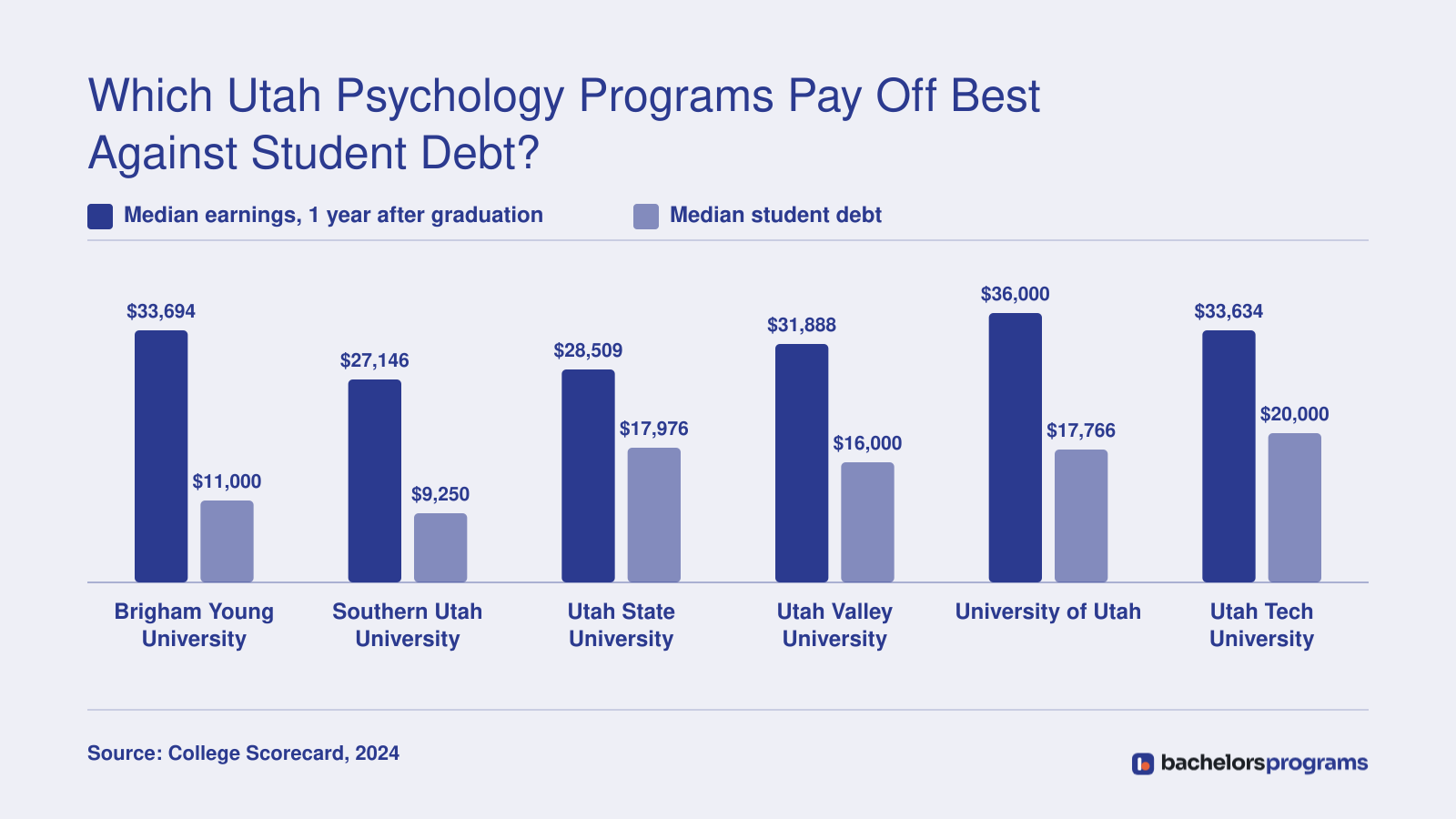
Which Utah Psychology Programs Pay Off Best Against Student Debt?
This chart compares median earnings one year after graduation with median student loan debt for bachelor's degree in psychology graduates at each ranked Utah school that reports both figures. Brigham Young University ($33,694 earned vs. $11,000 owed) and Southern Utah University ($27,146 vs. $9,250) show the strongest balance, with first-year earnings roughly three times typical debt. Westminster University is left out because its program-level debt and first-year earnings are not reported.
Utah Licensure: How a Bachelor's Degree in Psychology Fits
Utah's counseling license depends on documented graduate coursework and supervised hours, which makes the undergraduate years a planning stage rather than a finish line. The Utah Division of Professional Licensing (DOPL) issues both the psychologist and clinical mental health counselor (CMHC) credentials, and a bachelor's degree in psychology meets the education requirement for neither. DOPL treats the bachelor's as the foundation that precedes the qualifying graduate program.
The Psychologist Pathway
Applications go through DOPL with fingerprint cards and, when applicable, the EPPP and the Utah Psychologist Law and Ethics Exam.1 Psychologists already licensed in another U.S. state, territory, or district may qualify by endorsement. A bachelor's degree in psychology does not qualify anyone for this license; DOPL points to further education and supervised preparation, so confirm the current requirements in the application packet and the statutes and rules before you build a timeline.
Counselor Pathways
For initial CMHC licensure, an applicant without a Utah associate license must document a CACREP master's or doctorate in mental health counseling, or a CHEA-recognized equivalent-field graduate degree with prescribed coursework.2 Non-CACREP programs can qualify at 60 semester or 90 quarter credit hours, and the graduate program needs 700 supervised clinical training hours, 240 of them direct client therapy.4 Full licensure then requires 3,000 post-graduate supervised hours plus the NCMHCE and NCE.2 Associate CMHC candidates complete at least 4,000 supervised hours over no less than two years, two hours of postgraduate suicide-prevention training, and the same exams.4 The extern license covers applicants short no more than 12 quarter credit hours, with practicum, ethics, and DSM coursework finished; DOPL does not count school counseling or educational psychology as related fields.3
Work Before the License
Bachelor's-level roles that need no Utah license include human services and case-management support, research assistance, behavioral support under supervision, and entry positions in human resources or social services administration.
Choosing the Right Utah Psychology School for Your Goals
The best Utah psychology school is the one that fits your goal, your format and your budget, not simply the one ranked highest. Use these three quick matches to narrow the field.
Three Quick Matches
- Research-minded students: The University of Utah, Utah State University and Brigham Young University are larger research universities, which makes them natural places to look for lab experience and faculty-led projects. Ask each department how undergraduates get involved.
- Online flexibility: Begin with the online and hybrid section above, then confirm that the psychology program itself, not just the university, is offered in the format you need.
- Budget: Public options such as Utah Tech University, Utah Valley University, Southern Utah University and Utah State University are the place to start for in-state pricing. Compare each against private Westminster University on net price, not sticker price.
Check Before You Apply
Policies change, so confirm three things on each school's own pages: current admissions requirements, estimated net price after aid, and whether the program runs on campus, online or both. Southern Utah University is worth a close look if you want a choice between a B.A. and a B.S., or a human services emphasis.
Put two or three schools side by side in a simple chart. List the admissions requirements, the estimated yearly cost, the degree type and the format. Gaps in a column usually show you what to ask next.
Your Next Step
Pick the two or three schools that match your format and budget, then request information from each psychology program. An admissions advisor can confirm deadlines, transfer credit and financial aid, so you can apply knowing what the degree will cost and how it will fit your life.
Compare General Psychology programs on the data that matters
Explore more Psychology majors or browse every field of study.
All Psychology programs Browse every field of study