Best Public Health Schools in Utah
Compare 7 accredited Public Health programs in Utah, with net price after aid, graduation rates, earnings and debt from IPEDS and the U.S. College Scorecard.
A bachelor's degree in public health is offered at several Utah schools, on campus and online, and most award the Bachelor of Science (B.S.) in Public Health as the common credential. The degree is broad by design: graduates leave prepared for health education, epidemiology support, community program work and health administration roles rather than a single licensed title, since Utah does not license public health generalists the way it licenses nurses or social workers.
That breadth is also the decision problem. Net price after aid and CEPH accreditation vary from campus to campus, and the earnings spread among Utah public health graduates is wide enough that the choice of school carries real weight.
Key Points
- Utah State University graduates earn a $76,451 median one year out.
- Weber State and Western Governors University offer bachelor's routes without relocating.
- FAFSA filers, including adult Utah residents, can qualify for the Utah Promise Grant.
Best Bachelor's in Public Health Schools in Utah, Ranked
Utah's public health bachelor's degrees cluster at a few campuses: a large private university in Provo, the state's land-grant campus in Logan, and several public universities along the Wasatch Front and in St. George. Every entry below awards a bachelor's degree in public health or a closely related population health field, and each one pairs core coursework in epidemiology and biostatistics with an internship, capstone, or applied project. Prices, delivery modes, and program links appear with each entry so you can compare them side by side.
Brigham Young University
#1Provo, UT · $15,000 – $20,000/yr (est.)
Best for: Pre-med students drawn to health equity
Brigham Young University is a large private university in Provo, and its public health bachelor's degree carries CEPH accreditation, the outside review standard the field recognizes. The Health Science emphasis pairs core public health coursework with a deliberate tilt toward vulnerable and marginalized populations, and every student completes an applied learning experience such as mentored research, global health work, or a community placement. It suits students aiming at public health practice, primary care, or graduate study in medicine and allied health.
- CEPH accredited public health program
- Health Science emphasis built on an upstream, population-level approach
- Applied learning experience required: research, global health, or community work
- Coursework in biostatistics, epidemiology, health systems, social determinants
- Skills in statistical software, cultural competency, motivational interviewing
- Prepares students for public health practice, primary care, or medical school
Utah State University
#2Logan, UT · $9,000 – $25,000/yr (est.)
Best for: Future environmental health inspectors and sanitarians
Utah State University is the state's land-grant campus in Logan, and its public health bachelor's degree belongs to one of the oldest public health programs in the country. The Environmental Health emphasis is the standout track: air and water pollution control, hazardous waste management, food safety inspection, wastewater treatment, and outbreak response, plus a required internship or field experience. Graduates leave eligible for the Utah Environmental Health Scientist-In-Training license and can work toward the Registered Environmental Health Specialist credential.
- Environmental Health emphasis with a required internship or field experience
- Three concentration options inside the public health major
- Coursework in air and water pollution, hazardous waste, food safety inspection
- Prepares graduates for the Utah Environmental Health Scientist-In-Training license
- Pathway to the Registered Environmental Health Specialist credential
- 2.3 GPA minimum for the major
- Faculty mentors, research labs, and strong medical school acceptance rates
Utah Valley University
#3Orem, UT · $5,000 – $10,000/yr (est.)
Best for: Working professionals seeking health education credentials
Utah Valley University in Orem runs one of the larger public health bachelor's programs in the state, a 120-credit degree built around health behavior theory, biostatistics, epidemiology, and policy and advocacy. A senior capstone and an optional health internship tie the coursework to practice, and online course options plus structured graduation plans make the degree workable for students who are also holding a job. Graduates are positioned for government, hospital, school, nonprofit, and worksite wellness roles and for the Certified Health Education Specialist exam.
- 120 credit hours with a 2.5 overall GPA requirement
- Senior capstone required; health internship optional
- Coursework in epidemiology, biostatistics, social marketing, grant writing
- Prepares students to sit for the Certified Health Education Specialist exam
- Online course options and structured graduation plans available
- Career paths in health departments, hospitals, schools, nonprofits, worksite wellness
Weber State University
#4Ogden, UT · ~$10,000/yr (est.)
Weber State University in Ogden offers the most flexible delivery in the state: the public health bachelor's can be finished entirely online, or through face-to-face classes and independent study. The curriculum leans practical, stacking leadership, management, communication, and program planning on a foundation of epidemiology and population health. Graduates typically start in community health and healthcare organizations in roles such as public health administrator, human services worker, or biomedical research assistant.
- Complete 100% online or through face-to-face classes and independent study
- Coursework in leadership, management, communication, and program planning
- Epidemiology and population health foundation
- Independent study option available
- Entry-level roles include public health administrator and human services worker
- Groundwork for graduate study in public health or health administration
Western Governors University
#5Salt Lake City, UT · ~$13,000/yr (est.)
Western Governors University is based in Salt Lake City and delivers its public health bachelor's entirely online on a self-paced, competency-based model built for working adults and career changers. Tuition is charged as a flat rate per six-month term rather than per credit, so students who move quickly can finish for less, and there is no entrance exam with rolling start dates. The 33-course curriculum runs from epidemiology and environmental health through policy, grant writing, and a capstone.
- Fully online, self-paced, competency-based format
- Flat tuition per six-month term rather than per credit
- 33 courses including a required capstone project
- No entrance exam, rolling admissions, 2.0 GPA minimum
- Grant writing, evidence-based practice, and systems thinking built in
- Curriculum developed with public health industry experts
- Associate degree holders may clear roughly 14 courses by transfer
Westminster University
#6Salt Lake City, UT · ~$27,000/yr (est.)
Westminster University is a private institution in Salt Lake City, and its public health major sits inside the School of Nursing and Health Sciences. The program requires a capstone that runs from project conceptualization to presentation of results, and students take community-engaged learning trips and intern at sites such as the International Rescue Committee. Classes are small, with a student-faculty ratio of 8 to 1, and students report strong job placement around graduation.
- Public health major and minor in the School of Nursing and Health Sciences
- Capstone runs from project conceptualization to presentation of results
- Community-engaged learning trips and internship placements
- Internship example: International Rescue Committee
- Student-faculty ratio of 8 to 1
- Coursework in infectious and chronic diseases, global health, environmental health
- Accelerated pathway to a public health master's in 10 months, no GRE required
Utah Tech University
#7Saint George, UT · $16,000/yr (est. net price)
Utah Tech University in St. George awards its bachelor's as a B.S. in Population Health with a Public Health emphasis, a 120-credit degree built around biostatistics, epidemiology, health policy, and environmental health. Interprofessional education and community engagement run through the curriculum, and students complete a population health internship and a capstone that connect coursework to local practice. Graduates move into public health agencies, healthcare organizations, and community nonprofits, or continue to graduate study.
- B.S. in Population Health with a Public Health emphasis
- 120 credit hours and a 2.0 GPA minimum
- Three concentration options within the program
- Coursework in biostatistics, epidemiology, health policy, environmental health
- Population health internship and capstone required
- Interprofessional education and active community engagement
- Builds cultural competence and ethical reasoning
Cost & outcomes by school
Federal data for the highest-earning Public Health programs, independent of the ranking above. Earnings are this field's bachelor's graduates four years after completing where the Scorecard reports them, else the school's undergraduate median.
| School | Net price / yr | Grad rate | Earnings | Debt | Grads/yr | Format |
|---|---|---|---|---|---|---|
| Utah State University UT | $14,936 | 59% | $93,161 | $14,340 | 14 | Campus |
| Western Governors University UT | $12,548 | 46% | $60,615 | $11,116 | 361 | Online |
| Westminster University UT | $27,094 | 64% | $58,974 | $23,250 | 8 | Campus |
| Brigham Young University UT | $15,564 | 81% | $51,996 | $10,317 | 154 | Campus |
| Weber State University UT | $10,258 | 46% | $50,046 | $13,950 | 12 | Hybrid |
| Utah Valley University UT | $6,376 | 45% | $49,432 | $14,415 | 34 | Campus |
| Utah Tech University UT | $16,039 | 38% | $44,570 | $15,000 | 11 | Campus |
Sources: U.S. Department of Education. Net price, graduation rate, earnings and debt: College Scorecard (earnings and debt for this field's bachelor's graduates where reported, else school-wide); graduates: IPEDS. A dash means no figure is reported.
Cost, debt & payoff
Median earnings of this field's bachelor's graduates (4 yrs after completing, else the school's undergraduate median) vs. their median federal loan debt · U.S. College Scorecard
Across these programs the median graduate earns about $51,996 and finishes with roughly $14,340 in debt — a ratio that clears a common rule of thumb (keep debt below first-year salary). Net price and debt vary widely school to school, so check the per-school figures in the table above before you shortlist.
How We Ranked Utah Public Health Schools
A school's overall record and a single program's record are not the same thing, and the ranking keeps that gap in view. The order rests on the measures below.
What We Looked At
- Net price after aid: What students typically pay once grants and scholarships are subtracted, which is usually lower than the sticker price.
- Program earnings and debt: What graduates of the public health program itself earn and owe, where that data exists.
- Completions: How many students finish the public health bachelor's degree each year, a rough signal of program size and activity.
- Graduation rate: The proportion of students at the school who complete a degree.
- Selectivity: How competitive admission is, which helps you gauge your odds.
What the Numbers Do and Don't Show
Graduation rate, net price, and 10-year earnings and debt describe the whole school, not the public health program. A university with strong overall outcomes can still have a small or young public health major, so treat those figures as context rather than a verdict on the degree.
Scope
The list covers bachelor's programs only, both campus and online, at Utah-based schools such as Brigham Young University, Utah State University, and Western Governors University. Graduate study is not part of it. Use the order as a starting point, then check each program's own page before you apply.
Bachelor's in Public Health Online and Hybrid Options at Utah Schools
Yes, you can complete a public health bachelor's degree at a Utah school without moving to campus. Western Governors University and Weber State University both offer routes that don't require regular classroom attendance, though they work very differently.
Fully Online: Western Governors University
WGU's public health bachelor's is fully online and self-paced, so there are no scheduled class sessions to attend. Students enroll on a rolling basis, progress through six-month terms and finish with a required capstone. The self-paced model gives you control over your schedule. It also means nobody keeps you on track but you.
Online or Face to Face: Weber State University
Weber State's B.S. in Public Health can be completed 100% online or in person, and independent study is available. The program's published materials don't say whether online courses meet live or run on your own schedule. Ask the department how class sessions and any field components are handled before you commit.
Campus-Based Programs
Brigham Young University, Utah State University, Westminster University and Utah Tech University list their public health bachelor's degrees as campus programs. Utah Valley University's B.S. in Public Health runs fully online at 120 credits, with no requirement to attend class in person. Hands-on requirements also tie several of these programs to a location:
- Utah State: An internship or field experience is required.
- Utah Tech: The curriculum includes a population health internship.
- BYU: An applied learning experience is required.
Who Benefits Most From Online Study
Online formats suit working adults who can't attend daytime classes and students in rural Utah who live far from Logan, Ogden, Orem, Provo or St. George. Before enrolling in any program, online or not, confirm whether internships or capstone projects require an in-person placement near you.
Admissions for Utah Public Health Bachelor's Programs
Applying from high school and transferring in college credit both lead to a Utah public health degree, but the two routes ask for different things. Because each school sets its own rules, the specifics matter more than any general guidance.
Freshman Applicants
Brigham Young University, Utah State University, Utah Valley University, Weber State University, Westminster University and Utah Tech University each run their own admissions process. Minimum GPA and ACT/SAT policies are usually set at the university level, and a program such as Utah Tech's Population Health degree with a public health emphasis may add its own steps for entering the major. Western Governors University is an online school and structures enrollment differently from the campus-based options, so read its requirements separately.
General public health guidance says undergraduate applicants often need test scores and a GPA near 2.5, but that varies widely and should not be taken as a Utah rule. Where a school's admissions page states no minimum GPA or test policy, treat it as no published policy and ask the admissions office directly rather than assuming a number.
Transfer Applicants
Transfer rules are set by each institution, and they decide how much of your work counts toward the major.1 Before you apply, get answers to these questions in writing:
- Credit threshold: Does the school treat you as a transfer student after a set number of completed credits, and what cumulative GPA does it expect?
- Public health coursework: Will your health, statistics and biology courses count toward the major, or only toward general education?
- Associate pathway: Is there a published agreement that carries an associate degree from a Utah community college into the bachelor's program? If a school publishes none, ask an advisor what the usual route looks like.
- Residency of credit: How many credits must you finish at the school itself to earn the degree?
Send official transcripts from every college you have attended, and contact an admissions advisor early so you can plan courses that transfer cleanly.
Related Articles
Utah Grants and Scholarships That Lower the Price
Which Utah scholarships actually lower the bill for a public health bachelor's degree?
Statewide programs
Three state awards matter most for Utah residents. The Utah Promise Grant serves recent Utah high school graduates and adult residents who file the FAFSA1, paying last-dollar: it covers remaining tuition and fees after other gift aid for up to four semesters or 60 credits.2 The New Century Scholarship rewards an associate degree earned at a 3.0 GPA (or the required math and science curriculum) alongside a 3.5 high school GPA, with 15 credits per semester.3 The Opportunity Scholarship replaced the older Regents' award structure and asks for a 3.3 GPA, three AP, IB or concurrent-enrollment courses, a senior-year application and the FAFSA3; it has paid $1,000 per semester for four semesters, dropping to $800 for 2026-27.4
Campus awards and deadlines
Each school here runs its own merit and need scholarships that stack with state aid, and the Western Undergraduate Exchange cuts tuition at participating Western campuses outside Utah. File the FAFSA early, then confirm every institutional deadline, because campus money often closes before state money does. The cost table above already flags the most affordable option on this list; these awards land on top of that figure rather than replacing it.
CEPH Accreditation for Utah Bachelor's in Public Health Programs
A public health degree can be convenient and affordable and still lack the credential some employers and graduate schools look for. That credential is accreditation from the Council on Education for Public Health (CEPH), and the schools here do not all stand in the same place on it.
Where the Utah Programs Stand
- Utah Valley University: The B.S. in Public Health is CEPH-accredited, first accredited in March 2019 and currently listed through 07/01/2027.2 That date means the program is approaching its next review cycle, so check the directory for updates.
- Utah State University and Utah Tech University: A current CEPH status for the undergraduate program is not established in the directory or applicant list.
- Brigham Young University, Weber State University, Western Governors University and Westminster University: No CEPH listing turned up for these bachelor's programs, so ask each school directly.
CEPH says its accredited categories carry the same full accreditation status1, and no Utah undergraduate program appears on its applicant list.2 Applicant status would not guarantee eventual accreditation anyway.
Why It Matters
Some public health employers, particularly in government and health systems, treat a CEPH-accredited degree as a sign of vetted training. Graduate public health programs may also view it favorably. It can also affect eligibility for the Certified in Public Health (CPH) exam, so confirm current requirements with the exam's administrator.
Don't Confuse It With Regional Accreditation
Every school here holds institution-wide regional accreditation, which covers the whole university and its financial aid eligibility. CEPH accreditation is separate and applies to the public health program itself.
How to Verify a Program
Open the CEPH accredited programs directory and search by school name. Confirm the listing covers the bachelor's level, not just a graduate program at the same school, and read the expiration date. Then check the applicant list if the school is missing.
Public Health Careers in Utah for Bachelor's Graduates
A public health bachelor's degree can lead to a wide range of work in Utah, but it rarely points to one obvious job title. Graduates of the schools here, from Weber State University to Utah Tech University, tend to start in entry-level health education, outreach or program coordination roles and specialize from there.
Where Graduates Work
- Government: The Utah Department of Health and Human Services and county or multi-county health departments, such as those serving Salt Lake, Utah, Weber-Morgan and southwest Utah, hire for health education, immunization outreach, and prevention programs.
- Nonprofits and community organizations: These groups often hire community health workers and program assistants for chronic disease, maternal health, and access-to-care efforts.
- Schools: Districts and school health programs use health educators for wellness curricula and student health initiatives.
- Hospitals and health systems: Systems such as Intermountain Health run community benefit, patient education and population health programs.
- Worksite wellness: Employers and insurers hire coordinators for employee wellness and screening programs.
Wages and Demand
The U.S. Bureau of Labor Statistics publishes Utah wages for health education specialists and community health workers in its Occupational Employment and Wage Statistics program. Pull the latest state and metro figures for those two occupations directly from BLS before you compare offers, because pay differs between the Wasatch Front and rural counties and between government, nonprofit, and hospital employers. Treat any single salary number you see elsewhere cautiously unless it names its data year.
Licensure and the CHES Credential
Public health is generally not a licensed field, so no Utah license is required to start working with a B.S. in Public Health. The optional CHES credential, issued by NCHEC, can still strengthen your résumé.
- Eligibility: It is based on academics alone. You need a bachelor's degree or higher with a health education major, or at least 25 semester credits (37 quarter hours) of coursework tied to the Nine Areas of Responsibility.
- Exam: The CHES exam has 175 multiple-choice questions, 150 scored and 25 pilot, and allows 3 hours.
- Upkeep: Recertification takes 75 continuing-education contact hours every five years.
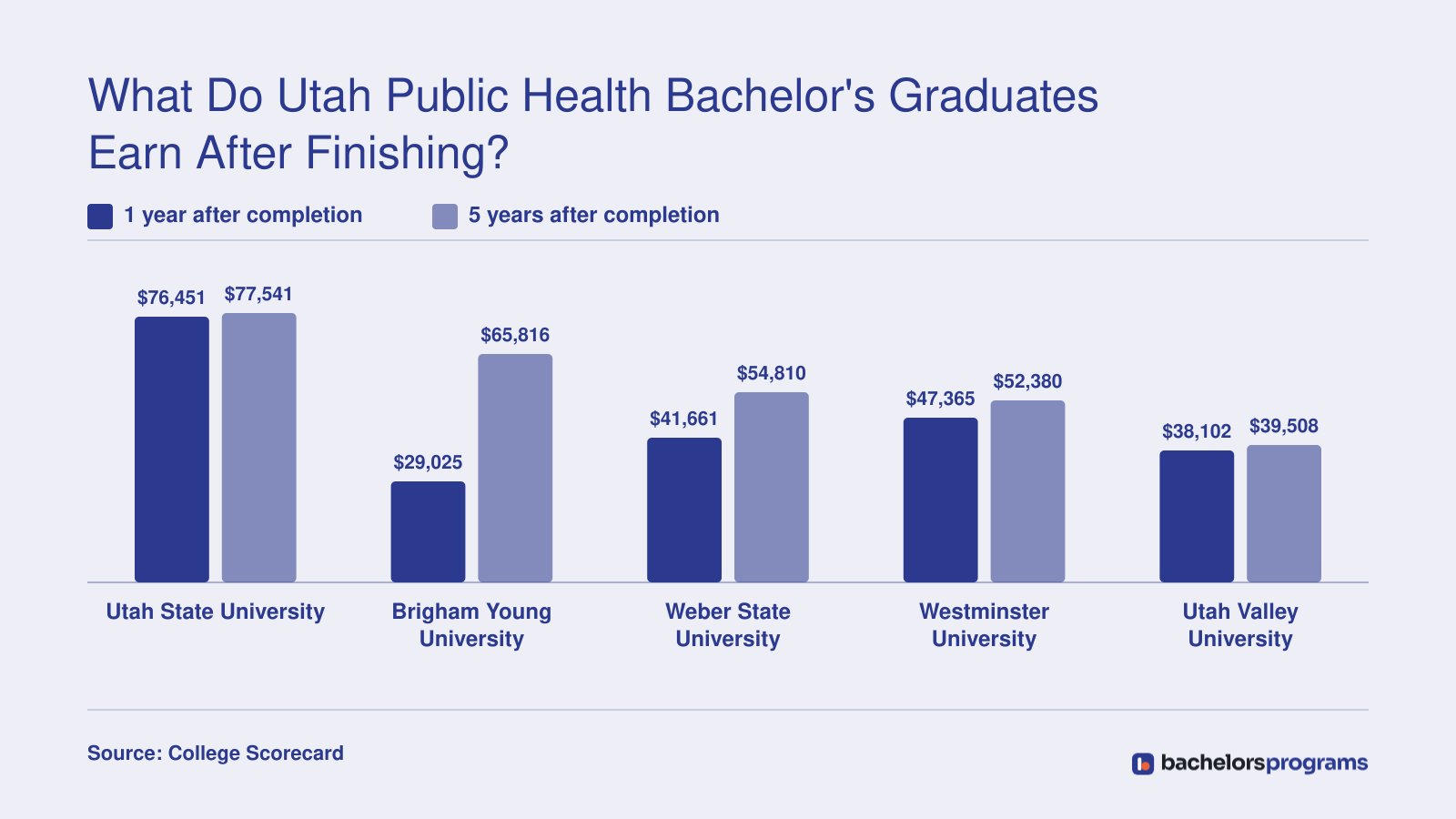
What Do Utah Public Health Bachelor's Graduates Earn After Finishing?
Program-level federal data shows Utah State University's public health graduates earning the most, with a median of $76,451 one year after completion and $77,541 five years out. Brigham Young University shows the steepest climb, rising from $29,025 at one year to $65,816 at five years. Weber State, Westminster and Utah Valley fall between $39,508 and $54,810 at the five-year mark. Program-level earnings are not reported for Western Governors University or Utah Tech University, so they are left out rather than replaced with school-wide figures.
Questions to Ask Yourself
Do you need an online or hybrid format, or can you attend classes on campus in Utah?
Do you plan to pursue graduate study or sit for the CPH exam?
Are you transferring an associate degree, and will the school accept your credits?
Utah Public Health Bachelor's Degree FAQ
Which Utah public health school is best overall?
Which public health school in Utah is the cheapest?
Can you get a bachelor's degree in public health online from a Utah school?
Which public health programs in Utah are CEPH-accredited?
Compare Public Health programs on the data that matters
Explore more Healthcare majors or browse every field of study.
All Healthcare programs Browse every field of study