Accelerated Biomedical Engineering Degree Programs
Compare 230+ accredited accelerated Biomedical Engineering programs, with net price after aid, graduation rates, earnings and debt from IPEDS and the U.S. College Scorecard.

An accelerated biomedical engineering program lets you finish a bachelor's, or a bachelor's plus a master's, in less time than earning the two degrees separately. Most do it by double-counting graduate credits, which usually trims a year from the standard six.
Most accelerated BME programs are five-year BS/MS tracks. Fully online options are rare, since lab-heavy ABET-accredited bachelor's curricula rarely transfer to remote delivery. BS/MD routes exist but are far more selective.
A shorter timeline pays off only if you clear the GPA cutoffs and credit rules that most schools enforce strictly.
Key Points
- Shared credits let five-year BS/MS students count graduate courses toward both degrees.
- Arizona State University offers a rare online biomedical engineering bachelor's.
- BLS projects 8% growth, about 1,200 yearly openings, from 2025 to 2035.
Shortest Accelerated BME Programs Compared
These pathways are ordered by total time to the master's, with shared or double-counted credits breaking ties. Each entry names the student it suits and the gate that matters most, and because GPA cutoffs and credit rules change between catalog years, confirm the current terms with the department before applying.
University of Massachusetts-Amherst
#1Amherst, MA · $20,000 – $25,000/yr (est.)
Best for: Engineering majors adding a master's in-house
UMass Amherst pairs its biomedical engineering BS with a 4+1 master's that typically takes one year beyond the bachelor's, and up to 12 undergraduate credits can carry into the graduate program. Six of those credits are double-counted, and a 3.5 GPA earns engineering students the fast track. A dual BS in biomedical engineering and nursing is also available.
- 4+1 accelerated MS takes about one year after the BS
- Up to 12 undergraduate credits transfer into the master's
- 6 credits double-counted toward the graduate degree
- 3.5 GPA required for the engineering fast track
- Non-engineering backgrounds may need extra time
- ABET-accredited BS in biomedical engineering
- Dual BS in biomedical engineering and nursing offered
- Research in prosthetics, regenerative tissue and optical imaging
University of Wisconsin-Madison
#2Madison, WI · ~$17,000/yr (est.)
Best for: Students wanting a non-thesis master's track
Wisconsin's College of Engineering awards a 128-credit biomedical engineering BS with four specializations and a design sequence that starts in the first year. The master's is a course-based, non-thesis option that can be finished in a year, and UW-Madison graduates skip the usual three recommendation letters and may transfer up to six approved credits.
- 128-credit, four-year ABET-accredited BS
- Four specializations, including bioinstrumentation and biomechanics
- Seven-semester design curriculum ending in capstone
- One-year MS option after the BS, up to six credits transfer
- Accelerated MS is course-based and non-thesis
- Applicants need a 3.0 GPA over the most recent 60 credits
- Current students need 24 graded credits and four core courses
- Graduates move into industry, medical school or the one-year MS
Fairfield University
#3Fairfield, CT · $48,000/yr (est. net price)
Best for: Medtech-bound students wanting industry ties
Fairfield runs a five-year dual BS/MS in biomedical engineering that cuts at least a year off a traditional master's, for 151 total credits including at least 30 graduate credits. Students spend year four finishing the BS while taking up to two graduate courses, then complete the master's in year five. Graduates land at Medtronic, Regeneron, Amgen and Abbott.
- Five-year accelerated BS/MS cuts at least a year off the master's
- 151 total credits, including at least 30 graduate credits
- Up to 6 graduate credits double-count toward both degrees
- 3.0 GPA plus advisor approval to enter
- Fourth year: BS plus up to two graduate courses; fifth year finishes the MS
- 127-credit BS in Biomedical Engineering
- Research with faculty mentors and internships before graduation
- Employers include Medtronic, Regeneron, Amgen and Abbott
University of Missouri
#4Columbia, MO · ~$20,000/yr (est.)
Missouri's 125-credit biomedical engineering BS offers four tracks and a capstone design sequence, and the accelerated route adds an MS in Biological Engineering in five years. Entry to the accelerated path requires at least 90 credits and a 3.0 GPA, and the combined program totals at least 141 credits.
- Accelerated BS to MS in Biological Engineering in five years
- Entry needs at least 90 credits and a 3.0 GPA
- Combined program totals at least 141 credits
- 125-credit BS with four tracks, including biomechanics and bioinformatics
- 21 credits of technical electives, 12 in a single track
- C- or better required in prerequisite and core BME courses
- Capstone design sequence with a faculty mentor
- Prepares seniors for the Fundamentals of Engineering exam
Stony Brook University
#5Stony Brook, NY · ~$19,000/yr (est.)
Stony Brook offers a four-year biomedical engineering BE with four focus areas and a two-semester senior design project, plus an accelerated five-year BE/MS for strong students. Undergraduates can earn credit for faculty-lab research or an industry internship, and the honors program adds an independent research thesis.
- Accelerated five-year BE/MS for strong students
- Four focus areas, including clinical instrumentation and devices
- Two-semester senior design project required
- Credit available for faculty-lab research or industry internship
- Honors program adds an independent research thesis
- ABET-accredited BE in biomedical engineering
- Technical electives chosen with a faculty advisor
- Coursework also suits students targeting MD, DO or PA programs
Tulane University of Louisiana
#6New Orleans, LA · ~$40,000/yr (est.)
Tulane's biomedical engineering major leads to a BS in Engineering with at least 129 credits, a full year of anatomy and physiology, and a required thesis. Students can apply to the 4+1 MS and finish the master's in one additional year, and every student completes both a group design project and an individual research project.
- 129-credit BS in Engineering, 2.000 GPA minimum
- 4+1 MS option finishes the master's in one additional year
- Full year of anatomy and physiology with a gross anatomy lab
- One-year group design project plus a one-year individual thesis
- ABET-accredited program
- Two domain courses chosen from biomaterials, biomechanics, biosignals or design
- Graduate-level follow-up course in the chosen domain
- Dedicated class advisors for undergraduates
Florida International University
#7Miami, FL · ~$9,000/yr (est.)
FIU's 128-credit biomedical engineering BS offers four concentrations and a two-semester Senior Design capstone, and it runs two accelerated tracks: a BS/MS in Biomedical Engineering and an MS in Engineering Management. The Miami campus prepares graduates for industry, medical school and roles at agencies such as the FDA and NIH.
- 128-credit BS with four concentrations
- Accelerated BS/MS in Biomedical Engineering available
- Accelerated MS in Engineering Management also offered
- Two-semester Senior Design capstone
- Concentrations include tissue engineering and pre-med
- Coursework in molecular engineering, immunology and genetics
- Prepares graduates for FDA, NIH and USPTO roles
- Career advising through Career and Talent Development
Vanderbilt University
#8Nashville, TN · ~$16,000/yr (est.)
Vanderbilt's biomedical engineering department lets undergraduates count up to six research credits as BME or technical electives, and it offers an accelerated bachelor's/master's route in engineering. Students can work in labs at Vanderbilt University Medical Center, and a dedicated BME career coach handles resumes and interview prep.
- Accelerated bachelor's/master's engineering option
- Up to six credit hours of undergraduate research count as electives
- Research placements in Vanderbilt University Medical Center labs
- Dedicated BME career coach for resumes and interviews
- BME Honors application available
- Study abroad options for BME students
- Coursework spans molecular through whole-body engineering problems
- Accredited biomedical engineering program
Stevens Institute of Technology
#9Hoboken, NJ · ~$41,000/yr (est.)
Stevens offers a BE in biomedical engineering with three concentrations, a design course every semester and a capstone that builds and tests a real medical device. An accelerated master's option is available, and nearly 30% of engineering students complete a co-op.
- Three concentrations, including biomaterials and neuroengineering
- Design Spine course every semester plus senior capstone
- Capstone teams design, build and test a medical device
- Accelerated master's program option
- Nearly 30% of engineering students complete a co-op
- ABET-accredited BE in biomedical engineering
- Research with Hoboken University Medical Center in emergency medicine
- Reported $82,900 average starting salary for 2025 engineering graduates
The College of New Jersey
#10Ewing, NJ · $20,000 – $26,000/yr (est.)
TCNJ's ABET-accredited BSBME pairs a senior design capstone in medical devices with a research track that can run two to four semesters. Accelerated routes include a five-year BSBME/MS with Rutgers and a seven-year BSBME/MD with direct admission to New Jersey Medical School.
- ABET-accredited BSBME with senior design capstone
- Capstone teams design, develop and test a medical device
- Research track runs two to four semesters, up to 2 course units as electives
- Five-year BSBME/MS completed with Rutgers
- Seven-year BSBME/MD with direct admission to New Jersey Medical School
- Small class sizes and core faculty
- Recent employers include Medtronic and Becton Dickinson
- Curriculum covers medical device design control regulations
None of the ranked Biomedical Engineering programs match the accelerated lens yet. The full ranking is at the link above.
Cost, debt & payoff
Median earnings of this field's bachelor's graduates (4 yrs after completing, else the school's undergraduate median) vs. their median federal loan debt · U.S. College Scorecard
Across these programs the median graduate earns about $80,933 and finishes with roughly $22,725 in debt — a ratio that clears a common rule of thumb (keep debt below first-year salary). Net price and debt vary widely school to school, so check the per-school figures in the table above before you shortlist.
Four Main Types of Accelerated BME Pathways
Some pathways shorten the bachelor's degree itself, while others add a graduate degree without adding much time. Knowing which is which keeps you from applying to the wrong one.
Five-Year BS/MS
This suits students headed to industry or a PhD. Shared credits typically let you finish both degrees in about five years, saving roughly a year. Johns Hopkins goes further with a 3+1 BS/MSE, where both degrees are done by the end of year four.
Three-Year BS
It rewards disciplined students who want to start work or graduate study early. It can save a year, but it is uncommon in biomedical engineering and usually means heavy course loads.
BS/MD or BS/DO
These suit future physicians, and they are rare and highly selective. Unlike a BS/MS, they reserve a medical school seat. Rowan pairs an accelerated three-year BME degree with its MD and DO partners, though BME admission does not guarantee a combined spot. Drexel's four-year BS+MD admitted 66 of 2,406 applicants for Fall 2026.1
Accelerated Standalone MS
This suits graduates who already hold a bachelor's degree, including career changers. Many run about 12 to 18 months, but check prerequisites first.
Match the path to the goal: BS/MS for industry or research, a three-year BS for an early start, BS/MD or BS/DO for medicine, and an accelerated MS for a pivot.
How Shared Credits and Admission Work
Accelerated biomedical engineering pathways promote shared credits as their headline benefit. The admissions rules behind that overlap are where applicants most often stumble.
How Double-Counted Credits Work
The mechanism is unglamorous but powerful. Graduate-level courses taken during the senior year are counted twice: they satisfy requirements for the bachelor's and the master's at once, which is why the graduate phase can be compressed into a handful of semesters rather than a full standalone program.
Thresholds and Timing
Minimum GPA cutoffs cluster between 3.0 and 3.5. Saint Louis University asks for a 3.25 and an application in fall of junior year, after 75 credits. Drexel wants 3.4 and an application filed between 90 and 120 credits.1 East Carolina requires 3.5 at admission and again at entry.2 Wichita State sets 3.000 plus a letter from a BME faculty adviser3, while Northwestern expects two quarters of supervised BME research and director approval.4
Transfers and the Fallback
Most programs admit only their own majors; Drexel is the clearest exception, taking transfer students who can finish both degrees on the bachelor's timeline.1 Miss the threshold and the B.S. still finishes on schedule. Wichita State keeps admission tentative until master's requirements are met when the bachelor's is awarded3, and East Carolina puts graduate-phase students below a 3.0 on probation, with dismissal possible after 9 attempted graduate credits below 3.0.2
Questions to Ask Yourself
Are you aiming for industry work, a PhD, or medical school?
Can you handle graduate-level coursework during your senior year?
Is your current school or major eligible, or would you need to transfer?
Online and Hybrid Options, and Why ABET Status Matters
Online delivery is rare at the bachelor's level
If you want an accelerated BME bachelor's you can finish from home, your options narrow fast. Arizona State University stands out: it offers its BSE in Biomedical Engineering, plus the biological devices and biomedical devices variants, both on campus and through ASU Online. Students can pair the BSE with a master's in as little as five years. ASU describes its BSE as the only online ABET-accredited biomedical engineering program in the country.
The accelerated programs at schools such as the University of North Dakota, the University of Miami, Purdue, and Saint Louis University are campus-based as far as their published materials establish.1 ASU's accelerated students share undergraduate and graduate coursework, with approval usually sought in the junior year, but whether that shared-credit arrangement works identically for online students is worth confirming directly with an advisor. Most fully online biomedical engineering coursework sits at the master's level, not the bachelor's.
What ABET actually covers
ABET's Engineering Accreditation Commission accredits the undergraduate engineering degree, not the master's attached to it. That matters because ABET accreditation at the bachelor's level is what licensure boards and many employers look for. Before you apply, search the program by name and campus on ABET's accredited program directory and confirm the listing covers the bachelor's degree you plan to earn.
Related Articles
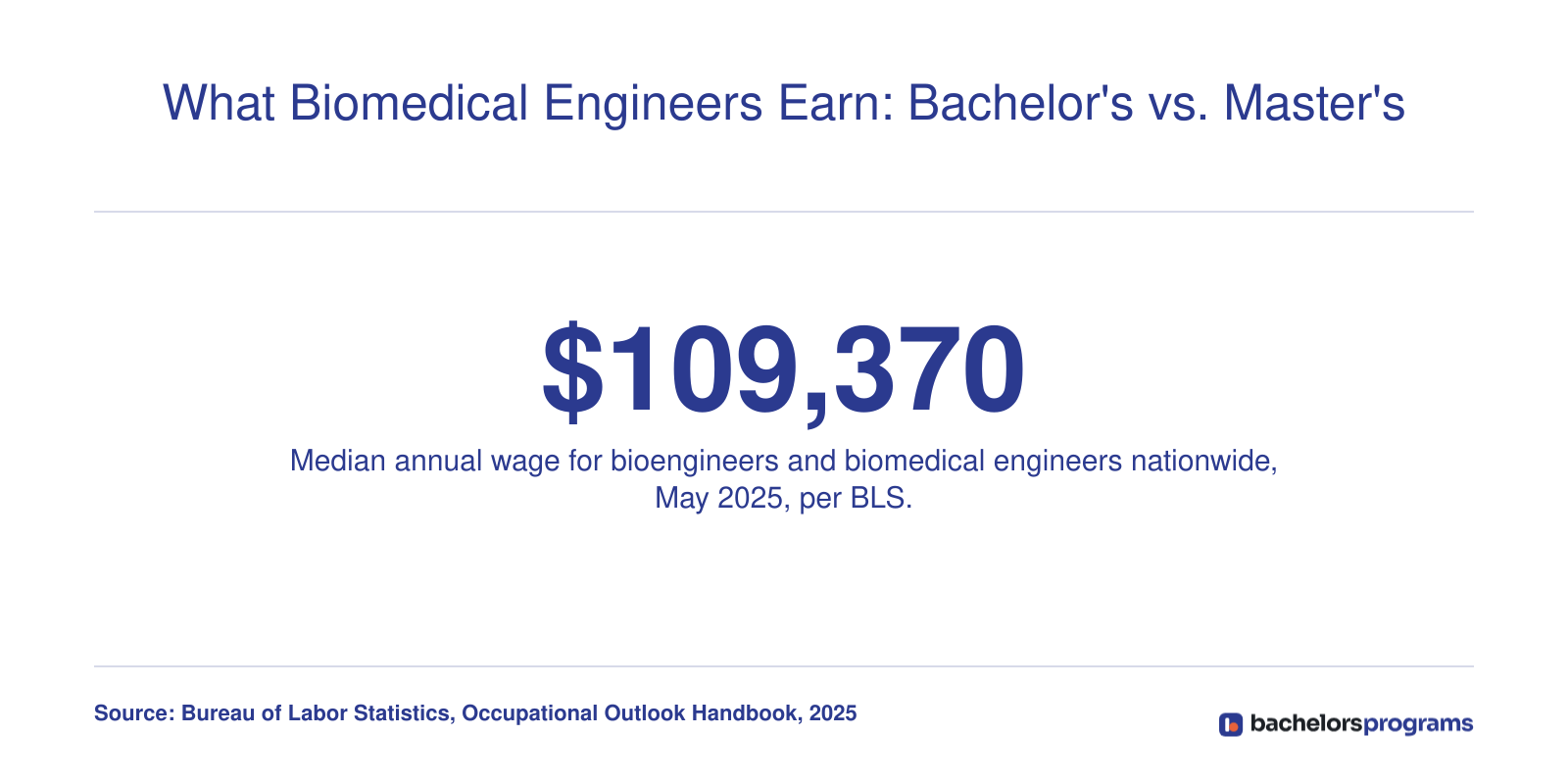
What Biomedical Engineers Earn: Bachelor's vs. Master's
The Bureau of Labor Statistics projects 8% job growth for bioengineers and biomedical engineers from 2025 to 2035, much faster than average, with about 1,200 openings a year. A bachelor's degree is the typical entry-level credential, and no prior work experience or on-the-job training is usually required. BLS reports one median wage for the whole occupation rather than separate figures for bachelor's and master's holders, so weigh a master's on the specialization it opens up rather than on a guaranteed raise.
Cost, Time Savings, and Whether the Payoff Is Worth It
Five-year BS/MS pathways promise a master's credential without a full second degree's price tag, yet few schools publish a dollar figure for the savings.
Where the Savings Come From
The math has two parts. First, shared credits cut tuition: Tennessee lets up to 9 graduate hours count toward both degrees, and Saint Louis University allows up to 15. Second, finishing a year sooner means an extra year of engineering pay instead of another year of tuition. Programs like UNT's, which bill graduate courses at undergraduate rates, widen the gap further.3 At Georgia Tech, for example, Fall 2026 undergraduate tuition for a full load is $758 per credit, while graduate rates run $1,341 or $1,379 per credit.1
A Worked Illustration
This is a hypothetical, not a quoted program price. Boston University lists its 2026-2027 engineering master's at $2,282 per credit, or $73,024 for 32 credits.2 If a student shared 9 of those credits with the bachelor's degree, the avoided graduate tuition would be about $20,538 (9 x $2,282). Actual savings depend on each school's rates and billing rules, so confirm them with the program.
The Verdict
The accelerated route pays off most for students who already know they want a master's, hold strong grades early, and attend a school with generous credit sharing. Skip it if you are unsure about graduate study, want a gap for industry experience first, or plan to attend a different school for your master's. The savings vanish if you drop out of the combined track.
Biomedical Engineering programs by state
Compare Biomedical Engineering programs on the data that matters
Explore more Science & Engineering majors or browse every field of study.
All Science & Engineering programs Browse every field of study