Accelerated Public Health Degree Programs
Compare 590+ accredited accelerated Public Health programs, with net price after aid, graduation rates, earnings and debt from IPEDS and the U.S. College Scorecard.

Public health employers increasingly screen on the master's degree, and a growing share of applicants reach it without adding a fifth or sixth year of tuition. Compressed BS/MPH, 4+1 and one-year MPH tracks can cut a year or more from the standard sequence.
The programs ranked here are ordered by how quickly they can be completed. Speed alone rarely decides whether the shortcut pays: what the graduate year is billed at, and whether the public health unit holds CEPH accreditation, matter just as much.
Key Points
- BS/MPH and 4+1 tracks double-count graduate courses, cutting a full year.
- Federal aid follows your enrollment level, not the "4+1" program label.
- CEPH accredits schools and units, so verify the fast-track pathway itself.
10 Accelerated Public Health Programs That Get You to the Finish Line Fastest
These ten programs are listed in the order that puts the shortest, most direct accelerated route first, so the 4+1 and dual-degree pathways that begin graduate coursework before the bachelor's is finished sit at the top. Each entry pairs the school's public health strengths with the specifics of its fast track, so you can compare structure, concentration, and length side by side.
Tufts University
#1Medford, MA · ~$40,000/yr (est.)
Best for: Any-major students wanting a combined MPH
Tufts runs its public health training through the School of Medicine, and the undergraduate route feeds directly into that graduate program. The 4+1 Bachelor's to MPH pathway takes students from any major, lets six credits count toward both degrees, and starts MPH coursework in senior year. Admission requires no entrance exam and uses rolling review, with a priority deadline of July 15.
- Accelerated 4+1 pathway: bachelor's and MPH in five years
- Six graduate credits count toward both degrees
- 42-credit MPH curriculum with 160-hour applied practice experience
- MPH coursework begins senior year; open to students from any major
- No entrance exam required; test optional with rolling admissions
- Six MPH concentrations to choose from
- Two letters of recommendation; priority deadline July 15
Rutgers University
#2New Brunswick, NJ · $24,000/yr (est. net price)
Best for: Transfer and nontraditional students seeking an MPH
Rutgers pairs a large public research university setting in New Brunswick with a Bloustein School public health program accredited by CEPH. Undergraduates work through epidemiology, public health law and ethics, research methods, and a professional practice internship, with an accelerated BA/MPH or BS/MPH route for those who continue. The program is deliberately built to absorb transfer, adult, and nontraditional students.
- CEPH accredited public health program
- Accelerated BA/MPH or BS/MPH option for continuing students
- Includes a professional practice internship
- 2.5 GPA minimum with prerequisite courses required
- Minor requirement waived for SAS/SEBS students
- Open to transfer, adult, and nontraditional students
- Scholarships and financial aid available
Boston College
#3Chestnut Hill, MA · ~$42,000/yr (est.)
Best for: Liberal arts students drawn to health equity
Boston College teaches public health as a liberal arts discipline, run jointly with the Connell School of Nursing and framed around ethics and social justice. Majors take epidemiology, biostatistics, and global health law, then finish with a required two-semester capstone. A Tufts arrangement lets students bank up to 12 graduate credits while still undergraduates, then complete the MPH in about one more year.
- Accelerated pathway to the Tufts MPH with up to 12 credits
- 36 credit hours across 12 courses
- Two-semester senior capstone required
- Joint program with the Connell School of Nursing
- 11 student-run public health organizations
- Ethics and social justice emphasis within the BC liberal arts core
- Prepares for graduate study in medicine, nursing, law, and health policy
Virginia Polytechnic Institute and State University
#4Blacksburg, VA · $25,000/yr (est. net price)
Virginia Tech's public health department builds its curriculum around rural and Appalachian communities and a One Health view linking human, animal, and environmental health. The BSPH pairs a liberal arts base with an 80-hour practicum, pre-veterinary and pre-medical options, and an accelerated MPH route for strong public health majors. The program is CEPH accredited and supported by dedicated advising.
- CEPH accredited program
- 80-hour practicum required for the degree
- Accelerated BSPH/MPH pathway for public health majors
- Two concentration options
- Focus on rural and Appalachian communities and One Health
- Pre-veterinary and pre-medical options available
- Elective room for a double major, minor, or study abroad
Saint Anselm College
#5Manchester, NH · ~$35,000/yr (est.)
Saint Anselm is a small New Hampshire Catholic college where public health sits alongside health policy, social work, and pre-health advising. The Community and Public Health major runs 16 courses, pairs a research capstone with an internship at hospitals, nonprofits, or policy centers, and places students with local organizations during the year. A Tufts pathway lets graduates reach the MPH in as little as one additional year.
- 16 courses with a required capstone
- Senior capstone pairs a research project with a practical internship
- MPH in as few as one year through the Tufts pathway
- Offered as a B.S. and as a minor
- Volunteer placements with Girls, Inc. and Easter Seals
- Prepares for health policy, law, social work, medicine, and allied health
Saint Louis University
#6Saint Louis, MO · $24,000/yr (est. net price)
Saint Louis University houses public health in a college devoted to public health and social justice, with CEPH accreditation and a strong pre-medical following. Undergraduates cover epidemiology, biostatistics, and advocacy and policy, then complete a senior capstone and field placements with agencies such as the CDC and local health departments. A four-year B.S. plus one-year M.P.H. option shortens the graduate leg considerably.
- CEPH accredited program
- 120 credit hours across four years
- Four-year B.S. plus one-year M.P.H. option
- Senior capstone project and portfolio
- 2.0 GPA minimum with prerequisite courses required
- Internships and service with the CDC, hospitals, and health departments
- Fellowship pathways including Peace Corps and WHO
University of Vermont
#7Burlington, VT · $19,000 – $46,000/yr (est.)
The University of Vermont anchors its public health degree in Burlington, with connections to the UVM Medical Center and community partners such as Rise VT and Planned Parenthood. Students complete a 40-credit public health core, coursework in biology and statistics, and a senior capstone field experience. Faculty routinely bring undergraduates into research, and a 3+3 occupational therapy track offers a separate accelerated route.
- CEPH accredited program
- 120 credit hours with a 40-credit public health core
- Senior capstone field experience with community partners
- On-campus format in Burlington
- Accelerated 3+3 Doctor of Occupational Therapy pathway
- Faculty research collaboration opportunities for undergraduates
- Prerequisite courses required
The University of Alabama
#8Tuscaloosa, AL · ~$22,000/yr (est.)
The University of Alabama's public health major centers on health education and promotion, training students in needs assessment, program planning and evaluation, and social marketing. Graduates are eligible to sit for the Certified Health Education Specialist exam, and an Accelerated Master's Program turns the degree into a five-year bachelor's plus MPH. The program is CEPH accredited and requires 120 credit hours.
- CEPH accredited program
- Health Education and Promotion concentration
- 120 credit hours with a 2.5 GPA minimum
- Prepares students to sit for the CHES exam
- Accelerated Master's Program: bachelor's and MPH in five years
- Two concentration options
- Coursework in health disparities, social marketing, and environmental health
The University of Tennessee-Knoxville
#9Knoxville, TN · ~$19,000/yr (est.)
Tennessee's BSPH uses a Population Health Sciences framework that ties the health care system to the social, economic, and political forces shaping outcomes. Students cover 11 foundational public health domains and complete a 120-hour applied practice internship chosen around their own career interests. A five-year bachelor's to MPH pathway is available, and a 2.8 GPA is required to stay in the program.
- CEPH accredited program
- Population Health Sciences concentration
- 120-hour applied practice internship chosen by career interest
- 5-year accelerated bachelor's to MPH pathway
- 2.8 GPA minimum to progress and remain in the program
- Covers 11 foundational public health knowledge domains
- 21 credit hours of foundational public health coursework
University of Mississippi
#10University, MS · $10,000 – $15,000/yr (est.)
Ole Miss splits its public health major into Community Health and Health Science emphases, one aimed at outreach and patient advocacy, the other at hospitals, clinics, and pre-professional study. The 120-credit degree includes hands-on work designing programs that address disparities and environmental threats. An accelerated master's option lets undergraduates begin graduate coursework early.
- Community Health and Health Science emphasis areas
- 120 credit hours across four years
- Accelerated master's option lets undergraduates start graduate work early
- Coursework in research methods, personal and community health, and public health policy
- Prepares students for medical, dental, nursing, and public health graduate study
- Scholarships and financial aid available
Cost & outcomes by school
Federal data for the highest-earning Public Health programs, independent of the ranking above. Earnings are this field's bachelor's graduates four years after completing where the Scorecard reports them, else the school's undergraduate median.
| School | Net price / yr | Grad rate | Earnings | Debt | Grads/yr | Format |
|---|---|---|---|---|---|---|
| San Jose State University CA | $13,760 | 69% | $78,988 | $15,000 | 162 | Online |
Sources: U.S. Department of Education. Net price, graduation rate, earnings and debt: College Scorecard (earnings and debt for this field's bachelor's graduates where reported, else school-wide); graduates: IPEDS. A dash means no figure is reported.
Cost, debt & payoff
Median earnings of this field's bachelor's graduates (4 yrs after completing, else the school's undergraduate median) vs. their median federal loan debt · U.S. College Scorecard
Across these programs the median graduate earns about $56,469 and finishes with roughly $23,275 in debt — a ratio that clears a common rule of thumb (keep debt below first-year salary). Net price and debt vary widely school to school, so check the per-school figures in the table above before you shortlist.
Which Accelerated Public Health Pathway Fits Your Background?
A three-year bachelor's track and a five-year combined bachelor's-to-graduate plan both cut time, but they work differently: the first compresses your undergraduate credits, the second lets you start graduate coursework before you finish the bachelor's.2
Formats, eligibility rules and timelines vary by school, so check the specifics with each institution instead of relying on any general comparison. Start with each school's website and admissions page, and put CEPH-accredited public health programs first. Then ask an advisor to confirm the accelerated bachelor's pathway, credit requirements and expected completion term in writing. For career context, use BLS.gov to check entry-level public health roles and pay, and consult APHA, SOPHE, and your state public health association for program features and career paths.
- Confirm that the public health program holds CEPH accreditation.
- Ask how AP, CLEP, dual-enrollment, and transfer credits affect the timeline.
- Request the total cost, including per-term fees, since a faster schedule does not always mean a lower price.
- Verify every claim with the school before you apply.
What You Need to Qualify for an Accelerated BS/MPH
Most accelerated BS/MPH tracks admit students already enrolled at the university, and the bar varies sharply by school. Check each program page before planning your course load.
- Minimum GPAThresholds range from a 2.75 overall GPA at Sam Houston State (with a 3.00 in the major) to a 3.5 at BYU. UMass Amherst says applicants should have a 3.2 or higher, Wingate asks for 3.25 in public health coursework, and Miami recommends 3.50.
- Eligible majors and creditsMaryland lists Family Health, Global Health, Kinesiology, Public Health Practice and Public Health. Stockton requires 96 credits, including 20 in the public health major.
- Application timingMost schools expect you to apply in junior year. Deadlines include February 1 at BYU, February 15 at Miami and March 1 at UMass Amherst, which also requires 75 credits to apply.
- Shared creditsBYU allows up to 12 graduate-level credits to count toward both degrees, and Sam Houston State shares 12 graduate hours.
- Transfer studentsStockton accepts transfer students after admission. UMass Amherst's Epidemiology track is open to students in the Five College Consortium.
What an Accelerated Public Health Degree Costs and How Much You Can Save
Finishing sooner saves money only if the credits you move into the graduate year are billed at a lower rate. Check that before you compare sticker prices.
What the published tuition shows
The published figures for these schools are annual undergraduate tuition and fees, not per-credit rates. Public schools split by residency: Rutgers lists $17,929 in-state and $37,441 out-of-state, Virginia Tech $15,948 and $37,764, Alabama $12,180 and $34,172, and Ole Miss $9,772 and $28,600. Private schools charge one rate: Tufts $70,704, Boston College $70,702, Saint Louis University $55,760, and Saint Anselm $48,920. Graduate per-credit rates for the MPH year were not established, so confirm them with each school.
A simple example
The University of Arizona's accelerated route takes five years instead of six.4 Using Rutgers as a rough stand-in, one skipped year is about $17,929 in tuition and fees in-state, or $37,441 out-of-state. Treat that as an illustration only, since the graduate year carries its own rate.
Where the savings come from
- Shorter timeline: one fewer year of tuition.
- Shared credits: Maryland and Arizona allow up to 12 MPH credits at undergraduate rates1, West Chester up to 18, and Georgia State shares up to 16 credits toward the MPH and charges no graduate fees for 4+1 courses.2 Pace cites up to 29 percent off MPH tuition.3
- Living costs and lost income: you start earning a year earlier.
Average net price is an approximation, not a quote. Ask each school for an individual estimate.
Related Articles
Will Financial Aid Still Cover Your Graduate Year?
Federal aid follows your official enrollment level, not the "accelerated" or "4+1" label, so the key question is when your school classifies you as a graduate student. Until then, undergraduate rules and loan limits apply.1 After the switch, graduate Direct Loan limits generally take over, and Pell Grants typically stop.1 Rules also changed on July 1, 2026, so Grad PLUS and annual caps depend on your situation and whether an interim exception covers you.
Keeping the undergraduate tuition rate for graduate credits is a school pricing choice, not a federal rule. Policies vary widely, and graduate-level courses alone don't guarantee graduate loan status.
Before you enroll, get the school's aid and tuition policy for the graduate year in writing from the financial aid office.
Why CEPH Accreditation and Practicum Hours Matter in a Compressed Program
An accredited school and an accredited fast-track pathway are not the same thing, and the gap matters more in a compressed program. CEPH, the Council on Education for Public Health, accredits schools and public health units. It does not list accelerated BS/MPH or one-year MPH tracks as separate categories. Many public health employers, including some federal and state agencies, prefer or require a degree from a CEPH-accredited program. Eligibility for the Certified in Public Health exam is generally tied to it as well.
Status varies among schools offering fast tracks. Tennessee State University (accredited through July 2028) and Charles R. Drew University (through July 2032) appear in the CEPH directory. Lehigh University and the University of Wisconsin, Eau Claire are listed as applicants as of 2028. The University of New Haven applied in February 2026. Confirm that the MPH itself is covered, not just the school.
Each school sets its own practicum hours, and no central source publishes them. CEPH-accredited MPH degrees require at least 42 semester credits, so compressed formats often move applied practice into summer terms or run it alongside coursework. Ask each program how many hours it requires and when they fall.
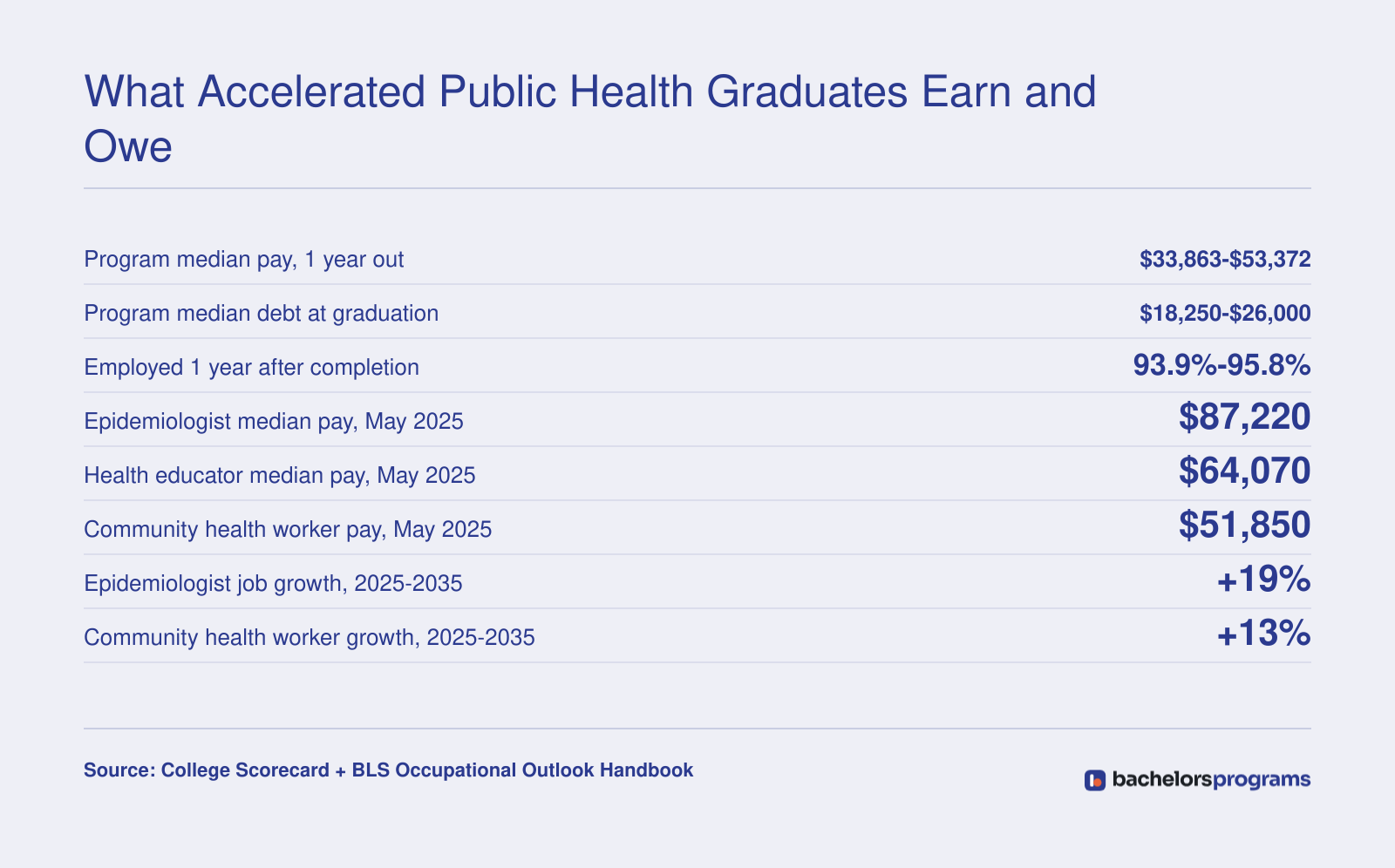
What Accelerated Public Health Graduates Earn and Owe
The first three figures are program-level outcomes for bachelor's public health graduates at Tufts, Rutgers, The University of Alabama and Saint Louis University, not campus-wide averages. The remaining figures are national pay and outlook data for common public health roles. Health education specialists, for example, earned a median of $64,070 in May 2025, and their jobs are projected to grow 6% from 2025 to 2035.
How to Shortlist Programs and Take the Next Step
How do you narrow a long list of accelerated public health programs down to two or three worth applying to? Start with a three-part filter: your starting point (still finishing an undergraduate degree, already holding a bachelor's and eyeing a one-year MPH, or switching careers), your format need (fully online, hybrid, or campus), and your budget ceiling before aid.
Then confirm the details that decide whether a fast track actually works for you:
- Shared credits: exactly how many undergraduate credits count toward the master's, and the minimum grade required.
- CEPH status: whether the public health program holds Council on Education for Public Health accreditation.
- Deadlines: application windows, prerequisite course cutoffs, and any early-decision dates for the graduate year.
Compare the ranked schools, then request information from two or three.
Public Health programs by state
Compare Public Health programs on the data that matters
Explore more Healthcare majors or browse every field of study.
All Healthcare programs Browse every field of study