Accelerated Criminal Justice Degree Programs
Compare 930+ accredited accelerated Criminal Justice programs at 870+ colleges, with net price after aid, graduation rates, earnings and debt from IPEDS and the U.S. College Scorecard.

A standard criminal justice bachelor's runs 120 credits across four years. Accelerated versions trim electives, stack terms, or fold a master's into the senior year, so graduates reach police academy eligibility or analyst desks sooner.
The fastest options fall into three groups: three-year bachelor's, bachelor's-to-master's, and 3+3 law routes.
Accreditation and per-credit cost still decide whether finishing early saves money. A compressed schedule that loses transfer credit costs more than a traditional four-year path.
Key Points
- Accelerated paths compress the standard 120-credit, four-year bachelor's into less time.
- University of Mississippi's average net price is $13,314 per year after aid.
- Some schools offer 3+3 law routes or five-year bachelor's-to-master's tracks.
Top 10 Accelerated Criminal Justice Schools Ranked by Speed
Schools below are ordered by how much of the degree can be finished on a shortened path, whether that means a three-year bachelor's, an accelerated bachelor's-to-master's track, or a 3+3 route into law school. Each card shows the average net price after aid, the institution-wide graduation rate, and whether the program runs online, on campus, or both.
Saint Louis University
#1Saint Louis, MO · $24,000/yr (est. net price)
Best for: Pre-law students planning an early start
Saint Louis University pairs a 42-credit criminology and criminal justice major with an accelerated B.A. to M.A. track that lets qualified juniors begin graduate work during senior year. Students aiming at law school can use the 3+3 route, which applies first-year law credits toward the bachelor's degree. Internships reach more than 250 social service agencies across the St. Louis region, and criminal justice graduates earned a median of about $61,100 four years after finishing.
- 42 credit hours in the major, 120 for the degree
- 11 required courses plus three electives
- Capstone seminar required for graduation
- Accelerated B.A. to M.A.: apply junior year, 3.00 GPA
- Up to 12 graduate credits counted in senior year
- 3+3 B.A. to J.D. with SLU Law, 3.20 GPA
- Internships with 250+ social service agencies
- Police Academy option for interested students
University of Kentucky
#2Lexington, KY · $19,000/yr (est. net price)
Best for: Community college transfers needing a clear pathway
Kentucky's criminal justice degrees run through the College of Social Work, with B.A. and B.S. tracks and a fully online option for students who cannot relocate to Lexington. The curriculum closes with a capstone research project, and an Accelerated Master's Pathway lets strong students start graduate coursework early. A KCTCS transfer pathway smooths entry for community college graduates.
- 120 to 121 credit hours across four years
- Fully online option available
- Capstone research project required
- Accelerated Master's Pathway available
- KCTCS transfer pathway accepted
- ACT and SAT scores optional through 2028-29
- Early Action deadline of December 1, 2026
- $50 domestic application fee
Appalachian State University
#3Boone, NC · $8,000 – $25,000/yr (est.)
Best for: Students pairing justice with a second field
App State teaches criminal justice at its Boone and Hickory campuses and online, with a required minor that lets students pair justice studies with chemistry, geography, or anthropology. An accelerated bachelor's to master's option lets undergraduates begin graduate work and finish a master's degree in as little as one year. The university holds an R2 research designation.
- Offered in Boone, in Hickory, and online
- Minor required; chemistry, geography, anthropology popular
- Accelerated bachelor's to master's option
- Core courses in government, crime theory, criminal law
- International studies track available
- Scholarships and financial aid available
University of Northern Iowa
#4Cedar Falls, IA · $10,000 – $22,000/yr (est.)
Cedar Falls offers a 39-credit criminology and criminal justice major inside a 120-credit degree, with a three-year pathway for students who arrive with credit already in hand. The program was the first of its kind at an Iowa state school when it launched in 1985 and runs fully online and asynchronously for students who need flexibility. Internships and field experience are arranged through a dedicated program office.
- Three-year accelerated degree pathway
- 39 credit hours in the major, 120 total
- Fully online, asynchronous option
- Multiple start terms each year
- Online B.A. designed for AA transfer students
- Internships and field experience arranged
- Started in 1985, first at an Iowa state school
West Chester University of Pennsylvania
#5West Chester, PA · $20,000 – $25,000/yr (est.)
West Chester's B.S. in criminal justice sits in the College of Business and Public Management and lets students concentrate in areas ranging from law enforcement and investigation to juvenile treatment, corrections, and crime mapping. A full-time summer practicum with a criminal justice agency is built into the degree. The accelerated option awards both the bachelor's and the master's in five years.
- Accelerated B.S. and M.S. in five years
- Eight concentration options
- Full-time summer field practicum
- Study abroad options within the major
- Alpha Phi Sigma honor society chapter
- Criminal Justice Student Association
St. Joseph's University-New York
#6Brooklyn, NY · ~$19,000/yr (est.)
St. Joseph's runs its criminal justice B.S. at Brooklyn and Long Island campuses, pairing an 18-credit minor and a capstone seminar with an internship in the field. Students drawn to technology can add a dual B.S./M.S. in cyber security completed in five years. Coursework covers criminal procedure, courts, corrections, and policing, and graduates earned a median of about $60,500 four years after finishing.
- Dual B.S./M.S. in Cyber Security in five years
- 18-credit minor required
- Capstone seminar and internship required
- Classes at Brooklyn and Long Island campuses
- Cyber security minor recommended
Widener University
#7Chester, PA · ~$26,000/yr (est.)
Every criminal justice major at Widener completes a 200-hour internship at an agency of their choosing, and recent placements include the Chester Police Department and the U.S. Marshals Service. The accelerated B.A./M.A. track awards both degrees in as little as five years, while a pre-law pathway and structured double major fit inside the four-year plan. Applications are free and reviewed on a rolling basis.
- 200-hour internship at a criminal justice agency
- Accelerated B.A./M.A. in five years
- Pre-law professional pathway
- Double majors fit within four years
- Test optional with a $0 application fee
- Annual criminal justice career fair
- Alpha Phi Sigma honor society chapter
Robert Morris University
#8Moon Township, PA · ~$23,000/yr (est.)
Robert Morris asks for 66 credits in the major plus a minor, and adds hands-on training with a crime scene and use-of-force simulator. A required practicum or internship in the final year places students with an agency before graduation. Students can add an accelerated 4+1 into the M.S. in Cyber Investigations and Intelligence or apply to the 3+3 early law school admission program.
- 66 credits in the major, plus a minor
- Crime scene and use-of-force simulator
- Required practicum or internship in final year
- Accelerated 4+1 to M.S. in Cyber Investigations
- Early Law School Admission 3+3 program
- 2.75 GPA minimum; SAT and ACT optional
University of Mississippi
#9University, MS · $10,000 – $15,000/yr (est.)
Ole Miss offers the B.S.C.J. in Oxford, online, and at regional sites in Tupelo, Grenada, Booneville, and DeSoto, with emphases in corrections, homeland security, or law enforcement. Majors who reach 90 credits with a 3.0 GPA can apply to the accelerated master's program and count 12 graduate credits toward both degrees. An internship program and a community college transfer route are also available.
- 42 credit hours across an eight-semester program
- Emphases in corrections, homeland security, law enforcement
- Accelerated master's: 90 credits and 3.0 GPA
- Up to 12 graduate credits started as an undergraduate
- Internship program available
- Transfer-friendly for community college students
- Taught in Oxford, online, Tupelo, Grenada, Booneville, DeSoto
DeSales University
#10Center Valley, PA · $32,000/yr (est. net price)
DeSales combines a 120-credit criminal justice major with five tracks, including digital forensics, pre-law, and investigative forensics. Students practice evidence work in a crime scene simulation house and can earn Act 120 basic police training through the Allentown Police Academy at regular spring tuition. A five-year B.A./M.C.J. or B.A./M.A.H.S. is open to students holding a 3.0 GPA, and graduates earned a median of about $64,000 four years after finishing.
- Five tracks including digital forensics and pre-law
- Crime Scene Simulation House for evidence work
- Act 120 police training via Allentown Police Academy
- Accelerated 5-year B.A./M.C.J. or B.A./M.A.H.S. with 3.0 GPA
- 15 credits available through Pennsylvania State Police Academy
- Seniors may begin master's courses early
- Test optional with rolling admissions
Cost & outcomes by school
Federal data for the highest-earning Criminal Justice programs, independent of the ranking above. Earnings are this field's bachelor's graduates four years after completing where the Scorecard reports them, else the school's undergraduate median.
| School | Net price / yr | Grad rate | Earnings | Debt | Grads/yr | Format |
|---|---|---|---|---|---|---|
| Herzing University-Kenosha WI | $23,066 | 72% | $69,601 | $19,310 | 2 | Online |
| California State University-San Marcos CA | $10,229 | 55% | $62,908 | $17,350 | — | Online |
| Humphreys University CA | $5,524 | 62% | $60,478 | $35,500 | 1 | Online or campus |
| California State University-Long Beach CA | $10,440 | 69% | $58,513 | $15,000 | 273 | Online |
Sources: U.S. Department of Education. Net price, graduation rate, earnings and debt: College Scorecard (earnings and debt for this field's bachelor's graduates where reported, else school-wide); graduates: IPEDS. A dash means no figure is reported.
Cost, debt & payoff
Median earnings of this field's bachelor's graduates (4 yrs after completing, else the school's undergraduate median) vs. their median federal loan debt · U.S. College Scorecard
Across these programs the median graduate earns about $53,916 and finishes with roughly $24,212 in debt — a ratio that clears a common rule of thumb (keep debt below first-year salary). Net price and debt vary widely school to school, so check the per-school figures in the table above before you shortlist.
How Long Does an Accelerated Criminal Justice Degree Take?
An accelerated criminal justice degree is a bachelor's that compresses the standard 120 credits, normally four years of study, into a shorter window. No single timeline covers every program, so compare the main paths.
Typical Timelines
- Accelerated bachelor's: Often 2.5 to 3 years when you enroll year-round, though the schools here do not publish one universal figure.
- Degree completion: Shorter still if prior credits, military or academy training, or prior-learning assessments transfer in.
- Combined BS/MS: Usually about five years instead of six. North Dakota lists an estimated 5 years and 138 total credits, and Saint Joseph's 4+1 pathway follows the same five-year pattern.2
How the Speed Happens
Short terms create most of the time savings. Old Dominion uses 8-week courses1, and Arizona State runs 7.5-week sessions in fall and spring plus 6-week summer terms. Taking classes straight through the summer removes the long breaks built into a traditional calendar.
In BS/MS tracks, graduate credits count toward both degrees. Louisville, Florida Gulf Coast and East Carolina each allow up to 12. Students generally apply in junior year; Louisville asks for 60 to 75 completed credits.3
A Realistic Working-Adult Timeline
If you work full-time and take one or two 8-week courses at a time, expect four or more years from scratch, or two to three years with substantial transfer credit. "As fast as" claims assume full-time, year-round enrollment.
What Accelerated Criminal Justice Degrees Cost After Aid
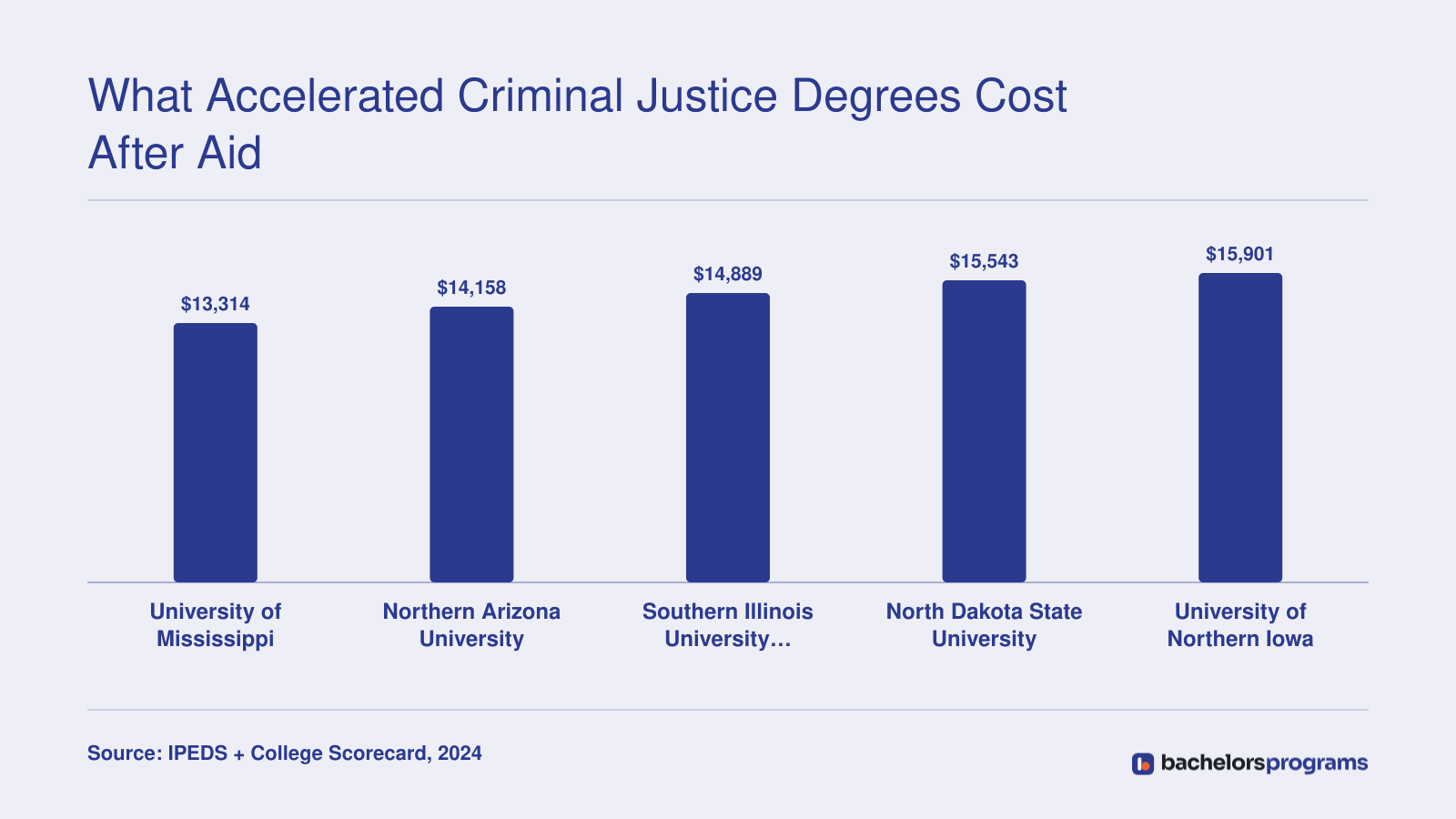
Among the lowest-cost schools offering accelerated criminal justice pathways, average annual net price after aid runs from $13,314 at the University of Mississippi to $15,901 at the University of Northern Iowa. Finishing faster lowers your total bill because you pay for fewer terms and fewer months of living expenses, and you start earning a paycheck sooner. Net price is an institution-wide average across undergraduates, not an exact quote for your situation, so use each school's net price calculator for a personal estimate.
Related Articles
Online Formats and Why Accreditation Matters
Flexibility only pays off if the credential holds up later. A fast online program from a school with weak standing can cost you more time later than a slower campus option would.
How Online Delivery Works
Several schools ranked here pair campus study with a fully online route, including the University of Kentucky, Appalachian State University and the University of Northern Iowa. Northern Iowa runs asynchronous online classes with multiple start terms each year, and its online B.A. is built for students transferring in with an associate degree. Asynchronous coursework lets working adults and officers on rotating shifts finish assignments on their own schedule.
Institutional vs. Programmatic Accreditation
Institutional accreditation covers the whole college or university.1 As of 2026, the U.S. Department of Education no longer treats "regional" accreditation as a separate category. Recognized institutional accreditors are held to the same standards.2 Programmatic (or specialized) accreditation reviews a single program against field-specific standards.1 For criminal justice, institutional accreditation is the baseline, confirming you attended a recognized institution.
What Accreditation Does and Doesn't Guarantee
No accreditation automatically guarantees credit transfer, graduate admission or a job offer.2 Under 2026 federal rules, undergraduate transfer decisions focus on whether your coursework is comparable.3 Graduate schools can't reject you solely because your school used a different recognized accreditor, but they still decide which credits to accept.3 Employers and agencies set their own rules, so check tuition reimbursement terms with HR.
Before enrolling, confirm a school's status in the Department of Education or CHEA accreditation database.2
Eligibility Checklist for Accelerated and BS/MS Tracks
Requirements differ by school, so check each program's current rules before you apply.
- Meet the GPA floorAccelerated bachelor's tracks can set a low bar. William Paterson's professional track asks for a 2.0. BS/MS pathways usually expect 3.0 to 3.3. Marshall also requires a 3.5 major GPA, and Stockton expects you to keep its GPA every semester.
- Check transfer limitsUMGC accepts up to 90 transfer credits. Stockton caps transfer at 64, and Salem State's BS/MS track allows 45. Webster's accelerated pathway accepts no outside transfer credit.
- Ask about academy or military creditUMGC may award up to 60 credits for eligible police-academy and law-enforcement experience. William Paterson allows up to 30 academy credits. Stockton accepts none. Confirm military training credit with each school.
- Time your BS/MS applicationYou can apply after 60 credits at Webster, 72 at Salem State, 75 at FIU and 90 at Marshall. FIU also requires a B in research methods.
- Prepare supporting documentsConfirm whether the program requires recommendation letters or a personal statement.
What Criminal Justice Careers Pay
Law enforcement is the most common destination for criminal justice graduates, and it pays solidly at the median.
Criminal Justice programs by state
Accelerated Criminal Justice Degree FAQs
Are accelerated criminal justice degree programs available fully online?
Can transfer students enter an accelerated criminal justice program?
Is an accelerated criminal justice degree worth it?
Do employers view accelerated degrees differently from traditional ones?
Compare Criminal Justice programs on the data that matters
Explore more Criminal Justice & Law majors or browse every field of study.
All Criminal Justice & Law programs Browse every field of study