Accelerated Environmental Engineering Degree Programs
Compare 250+ accredited accelerated Environmental Engineering programs at 190+ colleges, with net price after aid, graduation rates, earnings and debt from IPEDS and the U.S. College Scorecard.

A traditional bachelor's plus master's in environmental engineering runs about six years: four to finish the BS, then two more for the MS. Accelerated pathways trim that to roughly five by letting a set number of graduate credits count toward both degrees.
The tradeoff is early commitment. Most programs require a GPA floor, cap how many credits can be shared, and ask you to declare your intent early, often by junior year.
BLS counts a bachelor's degree as the typical entry credential for environmental engineers, so the master's has to earn its keep through a faster start and a sharper specialty.
Key Points
- 4+1 pathways finish a bachelor's and master's in five years, not six.
- Arizona State lets up to 6 credits count toward both degrees.
- Environmental engineers earned a $107,110 median wage in May 2025 (BLS).
Fastest Accelerated Environmental Engineering Programs, Ranked by Time to Degree
Accelerated environmental engineering pathways compress a bachelor's and a master's into roughly five years instead of six, and the schools below are ordered by how quickly students can move through both degrees. Most of the time savings come from graduate courses taken during the senior year and a handful of credits that count toward both credentials.
University of Michigan
#1Ann Arbor, MI · $18,000 – $61,000/yr (est.)
Best for: Research-minded students targeting water quality
The University of Michigan's environmental engineering program sits in one of the country's most established civil and environmental engineering departments, with research strength in water quality, atmospheric systems, and sustainable infrastructure. Undergraduates take a rigorous math and science core, then move into hands-on research with faculty. An accelerated master's option lets strong students begin graduate work while finishing the bachelor's.
- Accelerated master's option available to undergraduates
- Coursework in water quality, atmospheric systems and sustainable infrastructure
- Hands-on research opportunities with faculty
- Admissions require a 2.0 GPA plus calculus and physics prerequisites
- Prepares students for environmental engineering and consulting roles
Lehigh University
#2Bethlehem, PA · ~$37,000/yr (est.)
Best for: Students wanting pollution control specialization
Lehigh University pairs an ABET-accredited environmental engineering degree with a LEED-certified engineering building and a strong undergraduate research culture in Bethlehem, Pennsylvania. Students choose concentrations such as pollution control and waste management or geo-environmental engineering, and the curriculum blends chemistry, environmental science, and hydraulic engineering. Accelerated master's options are available to qualified undergraduates.
- Concentrations in pollution control and waste management, and in geo-environmental engineering
- ABET-accredited curriculum with rigorous chemistry and environmental science training
- Hands-on research and industry-sponsored projects
- Accelerated master's option available
North Carolina State University at Raleigh
#3Raleigh, NC · $9,000 – $33,000/yr (est.)
Best for: North Carolina students eyeing state agencies
NC State's environmental engineering program is ABET-accredited, requires 128 credit hours, and sits in a research university with deep ties to state environmental and water agencies in Raleigh. Undergraduates can pursue research, study abroad, and an accelerated bachelor's/master's option. First-year engineering students enter through the CODA admissions process.
- 128 credit hours, ABET-accredited
- Accelerated bachelor's/master's option
- Undergraduate research and study abroad opportunities
- Admissions through the CODA process for first-year engineering students
Stevens Institute of Technology
#4Hoboken, NJ · ~$41,000/yr (est.)
Stevens Institute of Technology offers an ABET-accredited environmental engineering bachelor's with a hands-on design spine, a senior capstone, and a cooperative education program, all on a Hoboken campus across the river from New York City. Undergraduates can join faculty research and compete in the Innovation Expo, and the accelerated master's pathway lets undergraduate credits count toward a graduate degree so the master's can be finished in five years.
- Accelerated master's pathway lets undergraduate credits count toward a graduate degree
- Master's completable in five years through the accelerated route
- ABET-accredited with a hands-on design spine and senior capstone
- Cooperative education program and Innovation Expo competition
- Small classes near New York City
Virginia Polytechnic Institute and State University
#5Blacksburg, VA · $25,000/yr (est. net price)
At Virginia Tech, environmental engineering is offered as a concentration within the civil engineering bachelor's, taught by the Via Department of Civil and Environmental Engineering in Blacksburg. First-year engineering students complete a common General Engineering year before joining a major, while transfer students enter directly. The department awards roughly $300,000 a year in scholarships and offers an accelerated undergraduate/graduate program.
- Environmental engineering concentration within the civil engineering bachelor's
- Accelerated undergraduate/graduate program available
- First-year students start in General Engineering; transfers enter the major directly
- Roughly $300,000 awarded annually in merit, need-based and industry scholarships
- Environmental track covers biological and chemical treatment and air pollution physics
University of Central Florida
#6Orlando, FL · ~$10,000/yr (est.)
UCF's environmental engineering bachelor's requires 122 credits and covers air pollution control, water and wastewater treatment, and hazardous waste management on a large Orlando campus with strong local employer ties. Qualified students can apply to the accelerated track after 64 credit hours and work toward the B.S. and M.S. at the same time. Seniors can also sit for the Fundamentals of Engineering exam.
- 122 total credit hours with capstone design
- Apply to the accelerated B.S. and M.S. track after 64 credit hours
- Accelerated acceptance does not guarantee graduate admission
- Seniors can sit for the Fundamentals of Engineering exam
- No admission requirements beyond admission to UCF
University of Delaware
#7Newark, DE · $15,000 – $20,000/yr (est.)
The University of Delaware offers a bachelor's in environmental engineering with a curriculum grounded in chemistry and engineering principles, covering water treatment, air pollution control, and sustainability. Many undergraduates work as research assistants, a co-op option provides 26 weeks of professional experience, and a 4+1 program allows a master's in five years.
- 4+1 program allows a master's degree in five years
- Co-op option with 26 weeks of professional experience
- Many undergraduates work as paid research assistants
- Coursework in water treatment, air pollution control and sustainability
University of Vermont
#8Burlington, VT · $19,000 – $46,000/yr (est.)
UVM's environmental engineering bachelor's emphasizes hands-on laboratory work, capstone design, and a sustainability designation in Burlington. Coursework spans water treatment, pollution control, waste disposal, and clean energy, with room for minors and study abroad. An accelerated master's degree is available for students who want to continue.
- Accelerated master's degree option
- Sustainability designation with project-based learning
- Hands-on laboratory courses and capstone design experience
- Opportunities for minors and study abroad
Drexel University
#9Philadelphia, PA · $39,000/yr (est. net price)
Drexel University's environmental engineering bachelor's requires at least 185.5 credits on a quarter calendar and is built around co-op options that place students in professional practice before graduation. The Philadelphia program is ABET-accredited, emphasizes lab and field work plus senior design, and offers an accelerated degree option.
- Co-op options available with ABET accreditation
- 185.5 minimum credits on a quarter calendar
- Lab and field work plus senior design projects
- Accelerated degree option available
- Placement exams in math and chemistry considered for admission
University of Oklahoma
#10Norman, OK · $15,000 – $20,000/yr (est.)
The University of Oklahoma's ABET-accredited environmental engineering bachelor's mirrors the civil engineering core, then turns to air pollution control, water and wastewater engineering, and solid and hazardous waste management in the final two years. A two-semester capstone runs like a consulting firm and is judged by practicing engineers, and an accelerated master's program lets up to nine graduate credits apply to both degrees.
- Accelerated BS/MS pathway allows up to nine graduate credits toward both degrees
- Up to seven additional graduate credits may be taken during the undergraduate program
- Applicants need a 3.20 major GPA and faculty endorsement
- Applications accepted only in the first two weeks of fall or spring semesters
- Two-semester capstone run like a consulting firm and judged by practicing engineers
None of the ranked Environmental Engineering programs match the accelerated lens yet. The full ranking is at the link above.
Cost, debt & payoff
Median earnings of this field's bachelor's graduates (4 yrs after completing, else the school's undergraduate median) vs. their median federal loan debt · U.S. College Scorecard
Across these programs the median graduate earns about $72,097 and finishes with roughly $21,250 in debt — a ratio that clears a common rule of thumb (keep debt below first-year salary). Net price and debt vary widely school to school, so check the per-school figures in the table above before you shortlist.
How Accelerated Environmental Engineering Programs Work
Accelerated environmental engineering programs let you earn a bachelor's and a master's in one continuous run instead of applying to graduate school after four years. The most common structure is the 4+1, where you finish the undergraduate degree in four years and continue straight into a one-year master's track. Combined BS/MS models work the same way in practice, with a single application near the end of sophomore or junior year and one coordinated plan of study.
Shared Credits
The time savings come from double-counted credits. With departmental approval, a few graduate-level courses taken during senior year satisfy requirements for both degrees at once, which shrinks the master's portion to roughly two semesters instead of four. Programs typically want a 3.0 to 3.5 undergraduate GPA to qualify and often expect those graduate courses to be completed with a B or better.
Who It Suits
It rewards students who are confident about environmental engineering early and can handle a heavier senior-year load. Either way, it typically takes five years from the start of the bachelor's to the master's, versus six on the standard route.
Shared Credits and GPA Requirements Compared
Shared-credit caps and GPA floors decide whether an accelerated environmental engineering pathway actually shortens your timeline. Arizona State University's BSE/MSE in environmental engineering sets a clear benchmark: a maximum of 6 credits may count toward both degrees, with up to 6 additional graduate credits counting only toward the master's.1 The minimum cumulative GPA is 3.20. A 6-credit overlap is modest, so the calendar savings depend on starting graduate coursework early rather than double counting many courses.
When You Can Apply
You need at least 75 bachelor's credits completed to apply for the accelerated pathway, and at least 90 completed before you begin shared credits. Deadlines are March 15 for fall entry and November 15 for spring, and students typically enter in junior year. That sequencing matters: the GPA and credit thresholds are checked before you start graduate coursework, so a weak sophomore year can disqualify you before the shared-credit benefit begins.
Questions to Ask Every Program
Ask each program for four numbers in writing: the shared-credit cap, the GPA floor, the credit threshold to apply, and the application deadline. Confirm the answer with the graduate coordinator, not a general admissions page, and verify which courses qualify for double counting before you register. Get those four numbers before you commit to a start term.
How Much Can You Save With an Accelerated Pathway?
The traditional route, a four-year bachelor's followed by a two-year master's, takes about six years. Accelerated pathways at schools like ASU and FIU compress that to five,1 and the savings come from three places:
- Graduate tuition: Credits shared between degrees are credits you don't buy a second time.
- Living costs: One less year of rent, food, and campus expenses while enrolled.
- Earnings: You start drawing an engineer's salary a year earlier.
A Sample Estimate
UCF lets students share up to 12 graduate credits. Its 2026 graduate tuition runs $369.65 per credit for Florida residents and $1,276.48 for nonresidents. If those 12 credits also satisfy bachelor's requirements, you avoid roughly $4,400 in separate graduate tuition as a resident, or about $15,300 as a nonresident. FIU's nine shared credits at its 2026 graduate rates work out to about $4,100 in-state and $9,500 out-of-state. Treat these as rough estimates. Neither school publishes a dollar savings figure for its pathway.
Shared credits aren't free. You still pay for them, and fees, residency status, and financial aid can shift the math considerably.
Is It Worth It?
For most students who qualify, yes. Tuition savings on their own are modest. The real value comes from skipping a year of living costs and earning a full year of engineering pay sooner.
What Environmental Engineers Earn: The Payoff of Finishing a Year Sooner
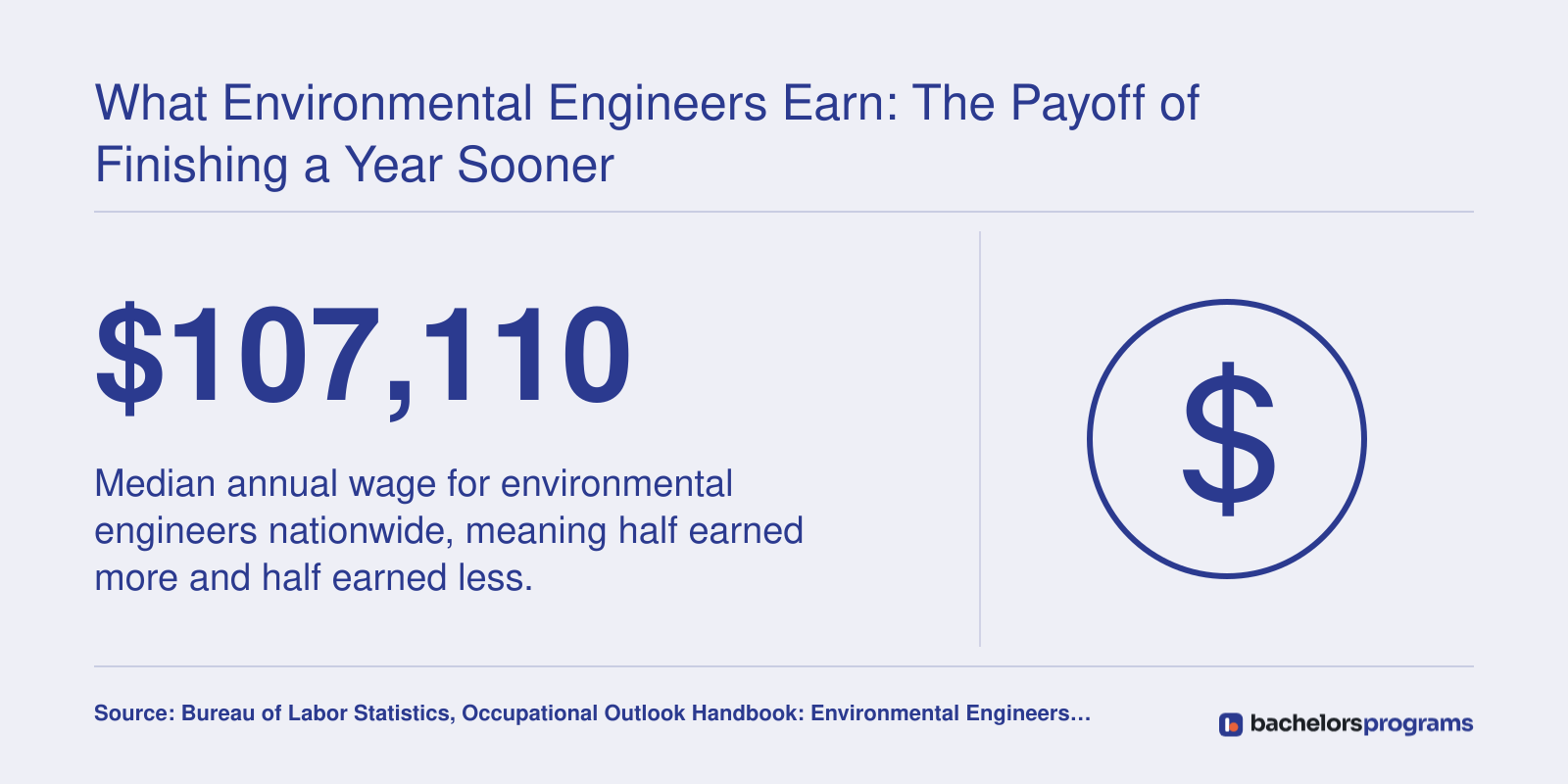
Environmental engineers earned a median annual wage of $107,110 in May 2025, according to the Bureau of Labor Statistics. BLS projects 6% employment growth from 2025 to 2035, faster than average, and lists a bachelor's degree as the typical entry-level education, so an accelerated pathway can put you in the job market with a graduate degree about a year earlier. BLS does not publish a separate wage for environmental engineers who hold a master's degree.
Online and Hybrid Accelerated Options
Accelerated BS-to-MS pathways in environmental engineering are rarely fully online. The undergraduate half usually includes lab courses, fieldwork, and design sequences that ABET-accredited programs expect in person, so the bachelor's portion stays largely on campus.
The more realistic route pairs an on-campus bachelor's with an online or hybrid master's:
- University of Kansas: A fully online, 30-credit Master's in Environmental and Water Resources Engineering.
- Washington State University: A 100% online MEng with an environmental specialization. It requires a civil engineering bachelor's and a 3.0 GPA.
- Old Dominion University: An online MS taught in eight-week asynchronous courses.1
- Northeastern University: A part-time MS that includes some asynchronous online classes.2
Before applying, confirm whether the online label covers the bachelor's, the master's, or both. UCF's accelerated pathway, for example, limits how many graduate credits can be taken fully online.
Transfer students should check eligibility early. Accelerated pathways such as FIU's are limited to students already enrolled in that school's own environmental or civil engineering bachelor's program.
Related Articles
Financial Aid, Licensure, and What Happens if You Leave the Pathway
When you shift from undergraduate to graduate status, your aid picture changes. Pell Grants stop at the bachelor's level1, graduate students are treated as independent on the FAFSA2, and federal Direct Unsubsidized Loans for graduate study cap at $20,500 a year3, with Direct PLUS available after a credit check2. Repayment begins at graduation, when you leave school, or when you drop below half-time enrollment4. Federal borrowing rules changed in mid-20263, so confirm your eligibility with the financial aid office before you count on a specific loan amount.
Accreditation and the PE path
ABET accreditation applies to your bachelor's program, and a master's does not substitute for it. The PE path still runs through an ABET-accredited degree, the FE exam, supervised experience, and the PE exam. Ask whether the accelerated track keeps your undergraduate record on the same accreditation footing.
Thesis, co-op, and exit options
A thesis track and a co-op term both add time, so ask how each one affects your finish date. If you leave the pathway, most programs let you complete the bachelor's and drop the master's; confirm the drop procedure, how completed graduate credits are treated, and the aid impact in writing with your advisor.
Environmental Engineering programs by state
Compare Environmental Engineering programs on the data that matters
Explore more Science & Engineering majors or browse every field of study.
All Science & Engineering programs Browse every field of study